This is the first alignment of independent legal publishers that I can recall.. As a consumer of  legal information, I appreciate the importance of small publishers in the legal information ecosphere. Past  publishing partnerships involved companies of wildly disproportionate size and market power. This partnership has delightful symmetry and counterpoint (Hein offers  deep archive of primary and secondary historical materials, Fastcase has a  primary law research system which offers futuristic visualization tools, search algorithms and the “bad law bot.”   I applaud this partnership of  two high quality niche publishers..

Ed Walters at New Fastcase HQ
c. Jean O’Grady
“Fastcase and HeinOnline are two of the largest independent legal publishers in America,” said Ed Walters, CEO of Fastcase. “Integrating these two libraries is a home run for our members. Both services create unique values based on citation analysis and the information architecture of the law. Beyond the fantastic new libraries our users can access, we’re also making our tools smarter as they learn from these new citation relationships.”

Customers Win Concurrently, Hein will provide HeinOnline materials to Fastcase, allowing Fastcase users to search across content available in the Law Journal Library, Session Laws Library, State Attorney General Reports and Opinions, and State Statutes: A Historical Archive. The new libraries will be fully integrated into Fastcase’s search system, and Fastcase users will see Hein results and abstracts for free, with subscription options for the full articles. The Hein collection will include more than 1,800 law reviews back to their first volumes, and represents the first secondary material to be integrated into the Fastcase legal research service.


New Topical Advance Sheets

Last year, Fastcase began releasing jurisdictional  digital “advance sheets” which report judicial opinions as they are released.. They will now be publishing  topical slices of newly released federal opinions in a new suite of  advance sheets which are released as eBooks.

The new titles include: Federal Personal Injury, Trademark, Securities, Patent and Antitrust.

The thing I really like about the Fastcase advance sheets are the “skeuomorphic” features. You experience traditional  book features including the shaded binding  between two pages and have the natural experience of page turning.

New Digs Too

Fastcase is also in the process of moving to new digs in the Penn Quarter section of DC.  . Welcome to the neighborhood!

Fastcase 50 2013 and they announced the Fastcase 50 today. Congrats to the Fastcase 50 Winners!
 

The July edition of Practice Innovations from Thomson Reuters was just released and it
includes an interesting array of articles of interest to law firm executives in
a wide ranges of areas including, procurement, business development, process improvement, knowledge and library management,. Below you can link directly to articles of interest.
ISO 2000 for Law Firms by Linda Will


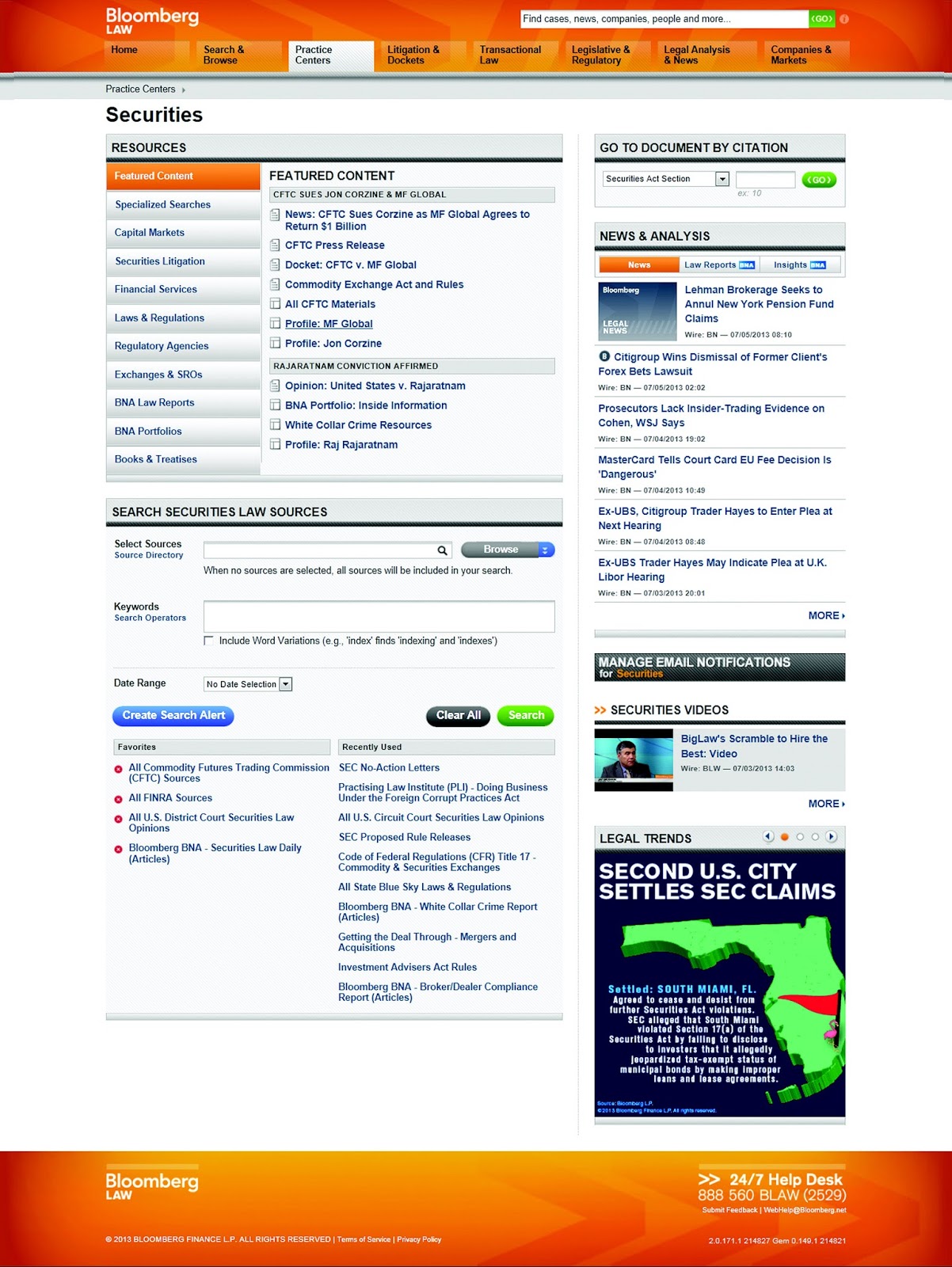
When Bloomberg Law acquired BNA in September 2011, they promised to develop sophisticated practitioner pages. Today they are announcing the release of the The Securities Practice Center  which integrates laws and regulations; opinions and dockets; SEC and SRO materials; books, treatises, Bloomberg BNA Law Reports and Portfolios, plus a broad range of transactional resources, including the DealMaker Document Search with over 300,000 real transaction documents. The “gold plated” Bloomberg Business company information, news and data which can drive custom alerts  is also woven throughout the platform. It is clear that Bloomberg is also responding in part  to Thomson Reuters acquisition of PLC and the LexisNexis development of Practice Advisor as well as the sophisitcated No Action Letter research offerings from Intelligize.

 
Bloomberg Law Securities Practice Center
All In For Subscribers Maintaining their “no exclusions” policy, the Securities Law Practice Center  will be available to all Bloomberg Law subscribers at no additional cost.

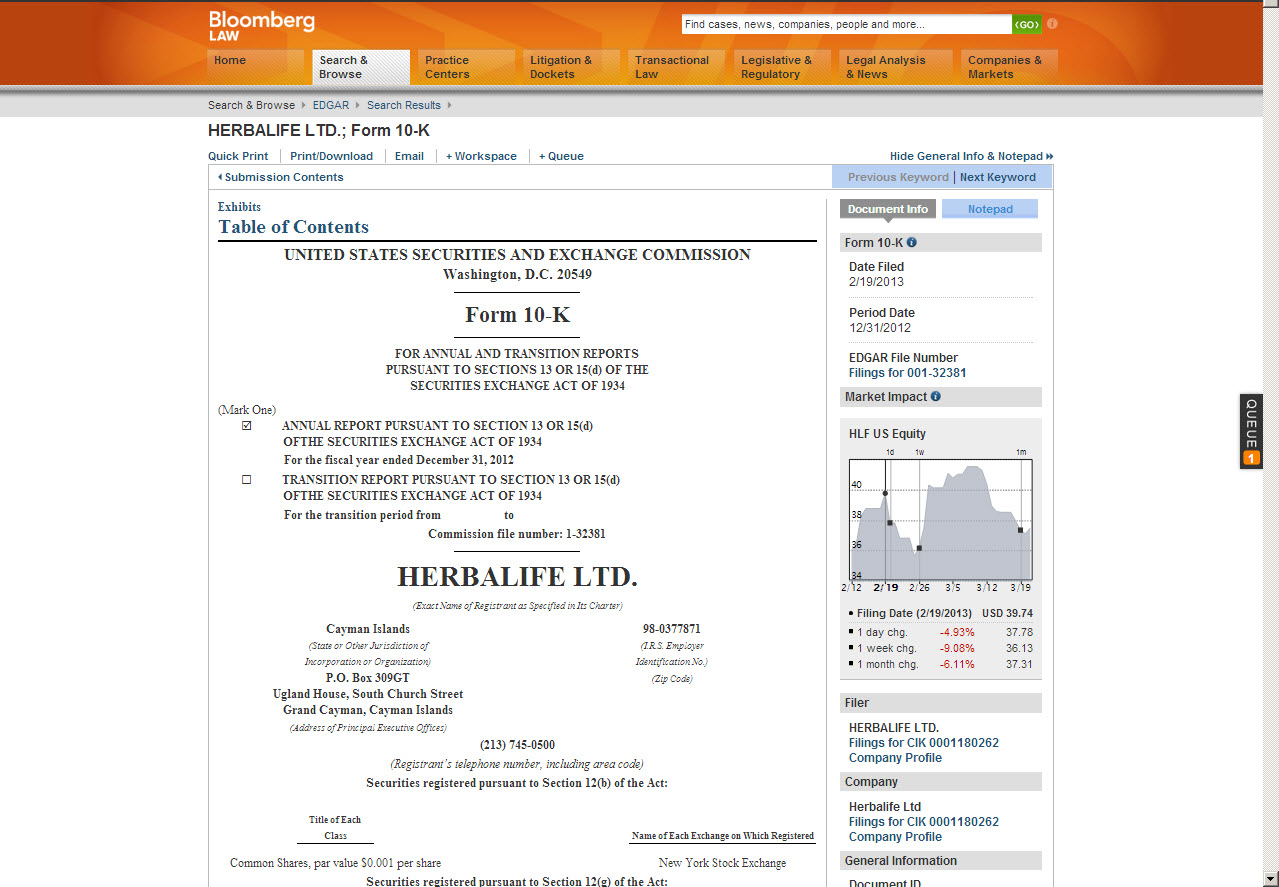
Something New in EDGAR filings, No Kidding! I have to be honest, every time someone offers new EDGAR content I groan at the thought of yet one more option in an over saturated market. But Bloomberg Law had done something interesting!


Bloomberg Law’s new EDGAR functionality includes market-based search filters, related document stock charts and side-by-side and redlined views of results produced in Item and Risk Factor searches, with the option to compare your own text with other filings.
 
This means you can read an EDGAR filing and look at what the stock was doing  before during and after disclosed events! I have worked with enough Securities Litigators to know that what used to be a complex research project can now be handled with one click! I can’t think of any competitor offering this kind of contextual data integration.


EDGAR filing with related stock price data

 Partners Using BLaw for Business Development

 
Is is also notable in the press release reprinted  below includes a quote from a partner regarding how he uses Blaw for Business Development:
 
“My need for research information comes at two major points in time—when I am reaching out to new clients and when I am addressing the often complex securities issues they face,” said Nicolas Morgan, DLA Piper Partner and West Coast Chair of the firm’s Securities Enforcement Practice. “Bloomberg Law’s smart, practical format allows me to find the securities information I need quickly and the alerts function helps me stay ahead of potential problems.”
 
New Features Include:

  •  Distinct Securities Law Practice Pages. Dedicated categories for financial services, capital markets and securities litigation feature tailored access to relevant primary and secondary resources designed to streamline workflow and provide a competitive edge.
  • Enhanced EDGAR Search. Bloomberg Law’s new EDGAR functionality includes market-based search filters, related document stock charts and side-by-side and redlined views of results produced in Item and Risk Factor searches, with the option to compare your own text with other filings.
  • Fielded No-Action Letter Search. Bloomberg Law’s new specialized No-Action Letter Search includes multiple fields that enable you to narrow your search, allowing for fast, efficient research of SEC guidance and interpretation and helping to ensure that relevant letters are at your fingertips.
  • “Go-To” Citation Search. Next-generation navigation provides quick access to securities laws and regulations, including major Acts, the Code of Federal Regulations, and SEC and CFTC materials–all in one place.

The Securities practice center goes live today (with the exception of the Edgar module which goes live on Thursday July 11th.) Previously released practice centers include Tax,
Antitrust, Banking & Finance, Employee Benefits, Intellectual Property,
Bankruptcy, Corporate/M&A, Health, and Labor & Employment. .

The Press Release:
__________________________________________________________________________________

Bloomberg Law Launches Enhanced Securities Practice
Center

Advanced Tools,
Features and Practice-Oriented Design Help Securities Lawyers Efficiently
Integrate

Critical
Content Into Their Workflow and Stay on Top of the Latest Developments


New York – Bloomberg Law, the legal and business
intelligence research system from the world leader in data and information
services, today launched a series of enhancements to its Securities Practice
Center designed to provide practitioners with the next generation of tools,
resources and analysis to best serve their clients.

 The Securities Practice Center seamlessly integrates laws
and regulations; opinions and dockets; SEC and SRO materials; books, treatises,
Bloomberg BNA Law Reports and Portfolios; and much more.  A broad range of
transactional resources, including the DealMaker Document Search with over
300,000 real transaction documents, and the renowned Bloomberg company
information and news, provide users with superior value. All Bloomberg Law
users have access to the enhanced Securities Law Practice Center as part of their
subscription.

“Bloomberg Law’s Practice Centers integrate primary
and secondary sources with advanced practice tools to provide a comprehensive
resource unique to a particular practice area and the Securities Practice
Center has long been a cornerstone,” said Joe Breda, Bloomberg Law’s head
of product. “We listened carefully to our clients as we built on that strength
to add a new level of content, analysis and tools oriented around the way
practitioners work.”

“My need for research information comes at two major
points in time—when I am reaching out to new clients and when I am addressing
the often complex securities issues they face,” said Nicolas Morgan, DLA
Piper Partner and West Coast Chair of the firm’s Securities Enforcement
Practice. “Bloomberg Law’s smart, practical format allows me to find the
securities information I need quickly and the alerts function helps me stay
ahead of potential problems.” 

 
The Securities Practice Center allows users to take
advantage of integrated resources across Bloomberg Law’s award-winning legal
research platform, including powerful new features:

·        
Distinct Securities Law Practice Pages.
Dedicated categories for financial services, capital markets and securities
litigation feature tailored access to relevant primary and secondary resources
designed to streamline workflow and provide a competitive edge.

·        
Enhanced EDGAR Search.  Bloomberg
Law’s new EDGAR functionality includes market-based search filters, related
document stock charts and side-by-side and redlined views of results produced
in Item and Risk Factor searches, with the option to compare your own text with
other filings.

·        
Fielded No-Action Letter Search.
Bloomberg Law’s new specialized No-Action Letter Search includes multiple
fields that enable you to narrow your search, allowing for fast, efficient
research of SEC guidance and interpretation and helping to ensure that relevant
letters are at your fingertips.

·        
“Go-To” Citation Search.
Next-generation navigation provides quick access to securities laws and regulations,
including major Acts, the Code of Federal Regulations, and SEC and CFTC
materials–all in one place.

In addition, Bloomberg Law’s Securities Practice Center
makes it easy to search securities opinions and dockets, stay on top of the
latest industry developments and provide clients with optimal solutions. 
All users have unlimited access to EDGAR Search, the SEC No-Action Letter
Search, example transactional documents and clauses, Bloomberg Law’s deep
library of regulatory materials and analysis, Bloomberg’s acclaimed securities
news coverage and company information, and trusted secondary sources, including
Bloomberg BNA’s Alternative Investment Law Report® and White Collar
Crime Report
™, and an extensive selection of Practising Law Institute securities
law treatises. 


Bloomberg Law developed its Practice Centers based
on practitioners’ feedback of what is most important to their areas of
specialty. Each Practice Center integrates
in-depth legal analysis, commentary and news with time-saving tools and key
primary sources to help give attorneys a comprehensive, nuanced understanding
of the issues unique to their particular practice areas.  In addition to
Securities, Bloomberg Law Practice Centers include Tax, Antitrust, Banking
& Finance, Employee Benefits, Intellectual Property, Bankruptcy,
Corporate/M&A, Health, and Labor & Employment.


About Bloomberg Law


Bloomberg Law is a legal and business intelligence, news and research
system designed for leading legal professionals who are focused on delivering
superior client service. By integrating Bloomberg’s renowned news, company and
financial data with primary and secondary legal research and business
development tools, Bloomberg Law delivers an advantage to legal professionals
who handle the most complex legal matters. Presented in a sophisticated yet
easy-to-use interface, Bloomberg Law allows subscribers unlimited desktop and
mobile access to the information in the system–as often as they want and
whenever they want. For more information, visit BloombergLaw.com.

About Bloomberg

Bloomberg, the global business
and financial information and news leader, gives influential decision makers a
critical edge by connecting them to a dynamic network of information, people
and ideas. The company’s strength–delivering data, news and analytics through
innovative technology, quickly and accurately–is at the core of the Bloomberg
Professional service, which provides real time financial information to more
than 315,000 subscribers globally. Headquartered in New York, Bloomberg employs
more than 15,000 people in 192 locations around the world.

 
American Lawyer Media Legal Intelligence released the 2013 Law Librarian Survey data earlier this week.

 Library Chiefs  Rule Contract Negotiations

Firms recognize the special expertise of Library Directors in high ticket and complex licencing negotiations. 87% of the firms have kept this responsibility in the hands of the Library Director.

In reviewing the data I am struck by the terrific challenge library chiefs face in the current environment. Law firm profits are reviving, lawyers continue to demand the best and most strategic information resources for their practices and yet  library chiefs have succeeded in containing costs. The survey give clues how they achieve this. Librarians are sharp negotiators who assess not only price but the comparative value and usability of the content. They also employ sophisticated tools for analysing the ROI for the resources they invest in. These talents are paying off big time for the firms which employ these experts.  

The Big Movers: Embedding, Complex Research  Competitive Intelligence and Social Media Monitoring

A few trends showed dramatic changes from the prior year or made a strong first appearance in the survey

  • 72% of are embedding librarian in practice groups up from 14% in 2012.
  • 75% report that librarians are performing legal research previously performed by lawyers up 16% from 59% in 2012.
  • Manzama a social media monitoring tool jumped to the top of the news aggregation tools and is used in 40% of the responding firms.

A Sampling of Key Trends From the 2013 Law Library Survey

  • 58% of Library Chiefs are responsible for overseeing Competitive Intelligences
  • 43 % of Library Chiefs are responsible for Knowledge management
  • The average budget was down $500,000
  • Fewer firms were purchasing eBooks.  Number dropped from 24% to 21% of libraries.

Librarians: AFA/Insourcing Trend in Practice Support

Firms appear to be recognizing the value and expertise of research staff in delivering lower cost/ high value results to clients. Librarians are increasingly their volume of legal research formerly handled by lawyers. 75% of respondents report that librarians are performing complex legal research. This could be the result of librarians having the expertise in specialized research platforms or a general decline in lawyers research skills. There was a decline in the value of work billed by clients which might also suggest that lawyers are shifting AFA work the research staff.

  
Outsourcing and Centralization

For  several years Library Chiefs has been spearheading initiatives to streamline library operations through centralization and outsourcing administrative operations.  I am uncomfortable with the results reported regarding centralization and outsourcing. The ALM data actually suggests both centralization and outsourcing are declining. Centralization was down in in all categories except Contract negotiations. This doesn’t seem likely. When I asked ALM to validate the data they responded that the wording of the question had changed in the past year. But they have not yet provided me with the wording of the 2012 question.

Low Cost Centers: The Trend That Was Not Tracked

An issue related to outsourcing was not even on the survey. The newer trend of migrating work to lower cost centers was not addressed in the survey. In the past year several ALM 100 firms began moving some work to low cost centers and this is a trend that should be measured in future reports. In one case the entire library was relocated, in most instances, selected functions were moved to the low cost center.

Research Support
A new question asked how much time the staff spending on research to support clients or business development (69%).  59% of respondents report the centralization of research. It is not clear how many are referring to a centralized staffing location or alternatively to a virtual centralization which creates a unified workflow across multiple locations. But one obvious benefit of centralized virtual research is expanding the hours of coverage by taking advantage of time zone differences.


The Long Slow Death of Cost Recovery

In just 4 year there has been a dramatic decline in the number of firms which recover more than 60% of their online costs. In 2009 51% of firms reported recovering more than 60% of their online costs. In 2013 it is down  a whopping firm22% to 29% of responding firms. This is no doubt due in part to the growth of AFAs and client demands for cost reduction.

  
Recommendations

  • Since this survey covers the Amlaw 200, I recommend that ALM add questions on cost per attorney and staffing of services per attorney. This would  provide valuable metrics for benchmarking.
  • Query dollar amount of print spending. Yes it will be a kind of deathwatch.
  • Query the amount spent for new specialized digital products
  • Ask  for the name of one new speciality resource which was acquired and why it was purchased.
  • Add question on low cost centers
There is a lot more detail and many other issues addressed in the full report. I look forward to the ALM Survey presentation at the upcoming AALL Annual conference in Seattle.
The web is awash with reaction to the dramatic news from Weil, Gotshal & Manges which includes not only staff and associate layoffs, but also dramatic cuts in partner compensation for selected partners. Is this a “one off” or the beginning of a trend? The pundits  and the partners disagree.Will More Firms Follow? YES (Adam Smith Esq.)

Bruce McEwen is not surprised, but practically apologetic that he is responding to “breaking news.”  In his blog post The Weil Layoffs. , he points to the fact that these law firm layoffs were so dramatic that they were reported above the fold in the Wall Street Journal Law Firm Slowdown Fuels Cuts at Weil Gotshal. and in the New York Times Dealbook, .Mass Layoffs at Top Flight Law Firm .  It was reported that 110 staff and 60 associates were laid off. MacEwen estimates that  7% of associates got pink slips and 10% of partners had their compensation cut. MacEwen estimates that there  may be cuts from $200,000-500,000 per affected partner.

Weil’s Executive Partner Barry Wolf  in his announcement  indicated that the decisions came in reaction to secular, not cyclical, developments in the market for high-end legal services. “We believe that this not just a cycle but that the supply-demand balance is out of whack across the industry. If we thought this was a cycle and our business was going to pick up meaningfully next year, we would not be doing this.”

MacEwen ‘s Taxonomy of Overcapacity

MacEwen definitely believes that other firms will follow suit,but perhaps not immediately. He pokes fun at the law firm management trope of managing with the “who else has done it?” strategy.

Law firms which have too many lawyers  fall into three rough categories:

•They could use some trimming but there’s been no sense of true urgency;

•They really need to do something like this but have been paralyzed by indecision and existential worries over what it would mean for their “culture;”

•They need someone to toss them a permissive lifeline and Mr. Wolf has just done them the favor.

But the bottom line for MacEwen is that there will be more firms following Weil’s lead.

Will More Firms Follow? NO ( Amlaw Daily)

AmLaw Daily is offering hope that Weil may be an isolated event. Weil Peers See Layoffs as an Isolated Event..  Julie Triedman reports that she contacted a number of Weil’s peer firms. Most partners who talked to ALM indicated that they were not planning any lawyer or staff layoffs. They also report that  “several firms tried to distance themselves from any potential layoffs in conversations with The Am Law Daily, pointing out that Weil’s situation may be firm specific.”

However the ALM story goes on to cite the Citibank Private Firm Survey and noted that law firms have on average excess lawyer capacity of 8-8.5 % over what they had in 2007. The math computes to lawyers at large firms working nearly 200 hours less per year than they were in 2007 across the elite firms.

One law firm leader who was interviewed indicated that Weil may be caught short if work picks up. But several partners indicated that Weil’s situation is unique because of their heavy focus on bankruptcy work. As large bankruptcies are winding down, and the economy is improving Weil’s major practice group has found itself  in a swoon. Some  firms suggested that they were weathering a slowdown in corporate and bankruptcy work better than Weil due to their greater geographic or practice diversity.Almost all firm leaders interviewed for the AmLaw story said they disagreed that the Weil move will trigger other such announcements.

Was Weil Insulated or Overconfident?

Was Weil riding  a bankruptcy bubble that insulated them from the worst of the recession that hammered most of the Amlaw 100 firms  5 years ago? Had their secure identity as an elite firm blinded them to the seismic changes in General Counsel attitudes toward procuring legal services?

There was an interesting quote from a Weil associate in the Wall Street Journal article. The associate suggested that Weil priced itself out of the Houston market because of its reputation for refusing to cut rates, with this colorful quote:  “This white-shoe insistence on not getting dirty has left us dinosaured out of the situation.” 

Weil Wasn’t the Only Layoff Story This Week   It was reported that 17 partners are leaving Patton Boggs and Jones Day announced layoffs of 60 IT staff members.  The thing that is clear is that law firms are continuing to recalibrate both attorney and staff levels. The  economic earthquake of 2008 may have passed but the aftershocks will live on…being ready for upheaval and displacement may just be part of “the new normal.”

 This week Wolters Kluwer Legal & Regulatory announced the appointment of Robert Lemmond as President & CEO of Wolters Kluwer Law & Business. Lemmond, joined Wolters Kluwer in 2011 as Vice President of the Law & Business Legal Markets Group. He previously held executive positions at several content and software companies including IHS, Primark, Disclosure, Northern Light. He replaces Mark Dorman.
Why this is good news for Wolters Kluwer
Robert Lemmond
Over the past decade I was slowly coming to the conclusion that WK  had seen its best days. They were destined to be bought or slowly fade away. They had good solid products but they seemed to be losing momentum. The Standard Federal Tax Reporter retained iconic status for tax lawyers. WKs suite of business titles were solid staples for securities, banking, trade and host of other practices. WK was one of the first major publishers to digitize their publications with the release of cd-roms in the early 1990s. They purchased Loislaw a low cost research alternative to Lexis and Westlaw in 2000. They owned a suite of esteemed treatises from Aspen Publishing. But the 2009 release of the Intelliconnect platform was a disappointment. Their biggest limitation was the absence of a full blown citator system to help lawyers verify that the cases they were citing had not been overturned. When Bloomberg Law was released in 2011, Greg Lambert in his 3 Geeks and a Law blog  pointed out that Blaw had stepped in and made the move everyone was waiting for Wolters Kluwer to make. WK owned lots of great pieces but couldn’t seem to weave then into a whole.

 The Problem Wasn’t Just the Products Over the years I had found WK pricing and contracts to be stubbornly out of touch with the law firm demands for efficiency and cost control. They tied online contracts to the retention of print. The pricing structure was opaque. A law firm couldn’t cancel a print subscription even when it was no longer needed. There seemed to be no way to cut the WK spending short of cancelling everything and returning as a new customer.  It really got ugly following the 2007 financial crisis. Law firm attorney counts were falling and budgets were being slashed. Many publishers agreed to suspend or modify existing contracts as an investment in future “good will.” Not Wolters Kluwer! They were spectacularly indifferent. An executive agreed to meet with me at  the annual AALL conference so I could plead my case in person. He reacted as if I was reading him a page from a phone directory. It was a brief, polite and yet pointless exercise. I walked away wondering if he had heard a word I had said.

Bob Likes to Listen Since Bob Lemmond arrived at WK in 2011 he has been on a mission to learn about customers. He likes to listen to customers! He created advisory councils of librarians and attorneys. He traveled around the country meeting with key customers. During a call this week, Lemmond said he is especially interested developing a close partnership with the librarian community because they have such deep research expertise and are focused on the quality of information.  In the past two years there has also been a steady stream of changes in the tone of client communications, the introduction of new products, innovative licensing schemes and new pricing models for products. Lemmond doesn’t take credit for all the changes but the timing is curiously aligned.
 Recent WK Law & Business Initiatives Include:
  • Establishing Insight Leaders Councils  
  • Expanding the new RB Source platform which is more intuitive than Intelliconnect 
  • Releasing a series of practice dailies which are clearly positioned to compete with the Law360. 
  • Offering pioneering licensing models for the newsletters which allows lawyers to share content with clients and post certain content on the law firm website. 
  • Entering  a relationship with Thomson Reuters to distribute WK newsletters on the Westlaw platform 
  • Offering new pricing options which anticipate the ongoing shift from print to digital and which allows customers to permanently migrate lawyers off of print resources.

The War Between the SuperSystems For the past 2 years everyone has been watching the 3 way tug-of -war for market share between Blaw, Westlaw and Lexis. I suspect that WK is not going to jump into that end of the pool. During this week’s call Lemmond indicated that there would be no major change in direction for WK. However, he was confident that the company had the right pieces in place to expand market share with practice focused workflow solutions which enhance productivity and provide expert guidance.

Budgets are still tight in law firms, so focusing on productivity enhancing expert systems instead of competing directly with the SuperSystems may provide the right lever for growth in the current market.

Keep the phoneline open. The next voice you hear may be Bob Lemmond calling.

___________________________
Related Posts:
News You Can Use: Wolters Kluwer Continues to Bring Sanity to Digital Licensing

Wolters Kluwer Launching Daily Reporting Suite Built for Collaboration and Copright Compliance

Nancy McKinstry, Wolters Kluwer CEO On Leadership Strategies and the Importance of Law Librarians In the New Information Environment.

Breaking News: Thomson Reuters and Wolters Kluwer Law & Business Joining Forces on Current Awareness

American Lawyer Media Just released a special report on “Pricing Professionals” in Law Firms: Here for Good — Pricing Professional in Law firms and This Impact on Clients and Firm Business.

In the five years since the collapse of Lehman Brothers, both law firms and clients have been whipsawed by the economy. Corporations have interposed Procurement Officers between General Counsels and even long time outside counsel. Law firms have sought the advice of a new breed of internal pricing professional to help the firms respond effectively to the Procurement driven demand for high quality legal work at the best price.  Lawyers went from a century of  using the reliable hourly billing rate to facing a complex array of alternative fee arrangements, involving, discounts, caps, project management and performance metrics.  ALM released a report on AFAs in May.
According to the Pricing  survey, most lawyers don’t have a strong interest in mastering the mechanics of pricing out an RFP. Enter the pricing professional!
Toby Brown a pioneer in the pricing arena, summarizes the problem in the Foreword to the report. He points to the lack of  information as the greatest challenge to pricing. “Too many decisions are made in a vacuum, with only intuition and anecdotal stories for guidance.”
It is rare that we get to trace the development of a new niche profession in law firm management from its inception.The report does not focus on how firms are actually setting the prices. It is an peek at a “work in progress.” There is no wide consensus on how to define the functions of the pricing professional  or where  the function should reside in the law firm. But we rarely see the emergence of a completely new role which is both so widespread and about which there is so little consensus.

Organization

67% of responding firms indicated that they had a pricing officer. 50% of the respondents report that this function is less than 2 years old. There is no template here.  31% of the pricing officers report to “other ” which means that pricing professionals appear all over the org chart. But 29% report to the CFO. 23% are part of the Knowledge Management department.

When pricing has its own department, it is relatively small . 44% have no direct reports. 22% have 1 report and 34% have 2-5 direct reports.

Pricing officers work most closely with lawyers and only 27% report working closely with clients. The report raises the question about whether this should be a more external client facing position.

 The Question of Authority. It is not clear how much authority the pricing officer has. Partners want to “own” their relationship with their clients. I imagine that the pricing officer may have an easier time influencing the pricing for a new client via an RFP process than intervening in between a partner and an existing client. But consider the challenge of intervening in the prized partner-client relationship either way! Partners need to believe that this new role will in the long run strengthen their client relationships, but that may take time.

Oddbits

  • 43% regard financial analysis as the most important skill of the pricing officer.
  • 55% the % of RFPs referred to the pricing officer
  • 68% the pricing officer doesn’t have defined performance metrics
  • 30% of Pricing Officers has been at their firms 10 years or more. Which means that they have evolved from another role into this recently created position.
  • 58% of Firms with pricing officers have project management function within the pricing department. But only 7%of pricing officers are responsible for project management. 
  • 11% of firms give the pricing officer final authority in pricing a matter.
Pricing “Officer?”

I recently reviewed “chief “titles In the AmLaw 200  and didn’t find one “Chief Pricing Officer” yet this report repeatedly refers to the “pricing officer.”

I like the word “officer” it lends an air of gravitas to any position. So I have to hope what when the ALM releases  it’s Annual library survey in July, librarians and information professionals will also be  granted the  “officer” honorific and be referred to as information and knowledge “officers,” regardless of their actual titles.

Matthew Bender Online was one of the earliest digital successors to legal treatises on cd-rom. When it was released in the early 1990s, MBOnline offered an elegantly  simple interface and eliminated the technical  idiosyncrasies ( I almost wrote atrocities) of managing networked cd-roms. It allowed lawyers to have digital access to multi-volume treatises. But it was on a separate platform from LexisNexis and could be accessed without having to put in a client number. It could provide lawyers and law firms with a custom library of treatises. But according to Lexis executives, the platform hasn’t really evolved in the past 2 decades.

The Letter is in the Mail. Over the coming weeks LexisNexis will begin notifying customers that Bender.com in person or by mail that the product will be phased out by the end of 2014. They stopped selling the product to large law firms 5 years ago. They are planning to help firms transition to the treatise platform on LexisAdvance or the LexisNexis eBooks platform.

According to Karin Lieber,  Vice President Large Law Segment at Lexis Nexis there are several reasons that Lexis Nexis has decided to phase out this product at this time. Bender Online is based on an old “flat file” technology and the product is no longer being enhanced. LexisNexis is focused on enhancing treatise research on Lexis Advance and on their Overdrive eBook platforms. Both platforms will offer enhanced functionality which is not available on the current MBOnline platform..Ebooks are navigable like a book but are also searchable, portable and can allow lawyers to highlight and annotate the book and link to primary sources with a login to LexisNexis.
Shabeer Khan, Director of Information Services at Kaye Scholer has had access to both the Bender.com and LexisNexis eBook library. When I asked him which platform was “better.” he responded that the question of “better” doesn’t apply. They are “different.” and each has it’s strength. Khan pointed out that there are advantages to interacting with a the eBook medium because it mimics the look and feel of an actual book. In addition, the Lexis eBook platform with uses the Overdrive system, offers more functionality and works on mobile devices. These features were never available on Bender.com.

What about eLibraries? Karin Lieber, assured me that LexisNexis will continue to support the eLibraries or Custom User Interface (CUI) Libraries which many large law firms have access to through their LexisNexis contract.. eLibraries are custom portal based libraries that allow anonymous authentication within the firm This means that lawyers have unlimited access without having the charge a client. The firms custom interface may provide access to treatises by jurisdiction, topic, or alphabetical list by title. A lawyer can search one title or all titles. Lexis Nexis is committed to supporting this platform for Lexis Nexis subscribers. But they are actively working to transition the elibraries from  Lexis.com to CUI libraries based in the Lexis Advance platform.

Matthew Bender print Not Impacted. Matthew Bender print titles will not be impacted by these developments. Well, that is what they said. I think the truth is that Matthew Bender treatises have already been impacted. Matthew Bender, founded in 1887 was a family owned company and one of the countries largest law book companies. It was sold to the Times Mirror Co. in 1963 and then sold to Lexis Nexis, a subsidiary of Reed Elsevier in 1998. In January 2013 it was reported that the company was laying off over 200 employees at their office in upstate New York. There is no question that law firm economics and advances in technology have in combination accelerated  an unprecedented decline in the demand for print treatises.
More to Come Lexis Nexis will be announcing a new set of eBook enhancements in July at the AALL conference.
Last  week I attended the 100 Year Anniversary of  my alma mater  the Fordham Law School Evening Division.  When Fordham was planning an earlier reunion, Assistant Dean Robert Reilly discovered that the school didn’t even keep a separate list of evening division grads. The school regarded the day and evening divisions as equivalent programs. Everyone got the same degree. A 2012  article in Fordham Lawyer highlighted the many notable evening division grads who include the late Congresswoman Geraldine Ferraro, the first woman ever nominated to run for Vice President. But  law firms often take a dimmer view of night programs. Evening Law students are generally not courted by large law firms, a fact which has always baffled me. Is it not obvious that night students have a very special capacity for endurance? …. but it baffles me even more in the current legal market. 

The Night Student Advantage. In fact, night students are probably better suited to work in the today’s efficiency driven law firm than most full time students. A recent article in Law Technology News  Big Law Whipped for Poor Tech Training underscores the advantages in hiring students with more sophisticated technical experience and attuned to the need for efficiency.

Here are just a few of the advantages of evening program law grads:

  • They have a high tolerance for pain
  • They are experts at multi-tasking 
  • They have demonstrated mastery of time management 
  • They know all about working 2,200 hours a year. 
  • Their mutual need to survive makes more collaborative and they are less likely to regard classmates as “the competition.”
  • Having worked in a business environment they will arrive with  a skill set and industry     knowledge that can be leveraged in both practice and client development.
  • They likely have spent more time using their computer for Excel than for Facebook.

A Word About Teamwork One of the key characteristics of  night school students is their willingness to help each other out rather than viewing each other as “the enemy.”  They tend to have empathy for each other’s unique “juggling act.” There are the famous stories of vicious competition among day students. That is not at all common among  night students who develop a very unique bond and special forms of team work  to help other “cross the finish line.” Night students excel at  collaboration which is a touted as a key strategy for law firm success.

The Night School Grind. In retrospect I do wonder how I spent 4 years leaving home at 6 am carrying 20 pounds of books to the train, worked a full day as the Director or Legal Information  Services at Shea & Gould,  attended class and returned home at about 11 pm.  Night school is not for the “faint of heart.”  People who attend night school are not about the glory. But too often in fact we simply “get no respect.”
 
At the reunion, one classmate recalled going on “white shoe” firm interview. The partner asked her why she had no extra curricula activities on her resume.  When she responded that her “extra curricula activity” was her day job, he quickly ended the interview. Now she is a General Counsel in a corporation and I couldn’t help but chuckle to myself  at the prospect of the tables being turned.


Are the Tables Turning? She like many other evening grads had ended up “in-house.”  The shoe is on the other foot now as partners compete to gain favor and business from GCs.  Let’s hope she is more open minded than the white shoe partner if he shows up to pitch work to her.

In light of the market upheavals, it may be time for law firms  to seriously consider the advantages of evening  law students as strategic assets in the “new normal.”

Last week Bloomberg acknowledged that Bloomberg reporters had used the infamous “Z”  and  “UUID” functions on the Bloomberg terminal to access “customer data.”  Reporters had access to the names of users at an organization, how long the account had existed, when the account was last used and what broad categories of data they had accessed, e.g. news, bond data, etc. My reaction was “huh?” Given the shrillness of the press reports I assumed that that reporters were seeing actual search queries or trades. That kind of knowledge could be a real “market mover” but that was not the case at all. According to a  story in the New York Times, reporters had used account inactivity to prompt a question to Goldman Sachs about whether a partner had been fired. A recent Washington Post story said that the Federal Reserve and Treasury Department are now examining whether their employee’s activities were also tracked by Bloomberg reporters.
The Ethical Wall in Newsroom. The real controversy is not the extensiveness or the granularity of the data – which as quite limited – but the very fact reporters were able to cross the ethical threshold into accessing any customer data at all. In fact, the same data should be accessible to Bloomberg customer support personnel. Bloomberg has now disabled the “z”  and “UUID” functions in their newsroom only.

The Bloomberg Response. Dan Doctoroff CEO of Bloomberg is quoted in the Times story: “To be clear, the limited customer relationship data previously available to our reporters never included access to our trading, portfolio, monitor, blotter or other related systems or our clients’ messages,”  The Times story, also notes that Bloomberg recently centralized its data security efforts, including the appointment of Steve Ross, a senior executive, to the newly created role of client data compliance officer.
 No Impact at Bloomberg Law. According to Greg McCaffery, CEO of Bloomberg Law, reporters have no access to the Bloomberg Law user data. Bloomberg Law resides on a separate cloud platform, not on the same platform as the Bloomberg terminal data. Bloomberg Law doesn’t even have the same “command” functions which the reporters used to access customer data. He also pointed out that the Bloomberg BNA reporters who write the Bloomberg BNA newsletters have no access to the customer data. McCaffery stated that “Bloomberg Law takes the privacy of its customer data very seriously. To be clear: no journalists at Bloomberg News or BNA have ever had access to customer research activity on Bloomberg Law.

There are Bloomberg Business Terminals in Law Firms. The fact is that there are law firms which subscribe to Bloomberg business terminals under separate contracts from Bloomberg Law, so presumably reporters were also able to view the limited account activity described above. The Bloomberg business terminals are generally used by researchers and not law firm partners, but we now have assurance that reporters can no longer access any law firm Bloomberg terminal customer information or usage. However, Bloomberg does need to do some outreach and provide assurances to law firms with “the terminal.”

Bloomberg Thumb Scanner
Bloomberg is No Stranger to Privacy and Confidentiality. Bloomberg is the last information provider I would have expected to be accused of violating privacy. Bloomberg is all about closed systems and  being locked down and buttoned up. They are unapologetically restrictive in how their subscribers use their products. When you subscribe to the Bloomberg business terminal they retain the right to come to your office and inspect the installation. The earliest version of Bloomberg Law used the Bloomberg terminal platform, but required a lawyer use a biometric card which validated their thumbprint in order to logon to the terminal. I repeatedly warned them that biometric card was “thumbprint too far” for most lawyers and they now use a more traditional username and password approach.

The Big Data Question  The recent  Bloomberg privacy issue is really a journalistic ethics issue about the wall which has always existed between news reporting and the  newspaper or news service subscriber data. I believe there is a bigger issue lurking out there for all the large legal research providers. What really scares me is the prospect of a rogue internal or external hacker who could analyse all of the search queries of a law firm and draw some conclusions about things like M&A activity, litigation research or government investigations.  Law firm research queries are a treasure trove of leads… pretty innocuous standing alone – but probably an interesting “data map”  of law firm client support activity if  viewed in the aggregate. In 30 years I have never ever heard of a breach  or misuse of this kind of data at LexisNexis Westlaw, Wolters Kluwer or Bloomberg but I think it is time that these companies provide more information to customers about how they protect law firms and their clients from the threats of a “big data” hack.