So a man sporting Fendi shades, Gucci shoes and carrying a box of Cuban cigars walks into the Folger Shakespeare Library in DC and pulls a Shakespeare First Folio from a plastic bag and demands to see the librarian.

This is a remarkable “truth is stranger than fiction” tale. The characters and facts are dazzling, amusing and appalling.
But the point of this post is not simply to recount a “ripping yarn.” The story illustrates how the specialized skills of librarians led to the recovery of a  stolen First Folio which had been missing for 10 years.  The Folger Library Staff demonstrated extraordinary results from utilizing the professional expertise, judgment and sleuthing that are the hallmarks of a successful research librarian. The ability of the members of the Folger staff to think on their feet, to meet the unexpected inquiry with dispassion and objectivity, to communicate so effectively with a charlatan that he turned over a stolen treasure, and to develop strategies to delay returning the volume until its true provenance could be established saved a cultural treasure. They applied  their extraordinary knowledge of bibliographic research and “CSI -like” forensic skills to solving an international mystery involving the FBI, Scotland Yard and the Constabulary of Durham, England.

Last week the Folger Shakespeare Library hosted a lecture To Catch a Thief: Recovering the Durham First Folio . Steven Galbraith, Curator of Books and Renate Mesmer, Head of Conservation, recounted the remarkable story with brilliant humor using the documentation they had prepared for the FBI and the Durham Constabulary to successfully prosecute Raymond Scott.

First Folios were printed in 1623, 8 years after Shakespeare’s death and contained the first collection of Shakespeare’s plays. Since no original Shakespeare manuscripts survive, the First Folios were the only source for 18 plays.   It that likely that Macbeth and As You Like It would have been unknown today without the printing of the First Folio. Although all the Folios were produced on a printing press, no two copies were identical, due to variations in spelling, misprints, and variations in page trimming. Over the years each acquired additional unique features as they were bound and rebound, gilded or damaged.  A specilialized reference work, The Shakespeare First Folio by Anthony James West was consulted by the librarians as the most current census of First Folios which are located around the globe and it  identified some of the unique characteristics of the Durham Folio which could be compared with the book that had landed at the Folger.

Prolog

In December 1998  the Durham First Folio disappeared from a glass case in the Durham University Library in Northeastern UK. The estimated value at the time was $3 million pounds.

Act One – The Con Man at the Folger

On June 16th, 2008, Raymond Scott, walked into the Folger Library in Washington DC and asked to see the Librarian because he needed assistance valuing an old book which had come into his possession. Librarian Richard Kuhta was stunned when Scott pulled a book resembling a First Folio from a plastic bag.  The volume was missing it’s binding, title and final pages. He explained that he had gotten the book from a friend in Cuba who became known through the course of the investigation as the “Cuban Cutie.” He claimed to be an wealthy bibliophile, with homes across Europe. He bolstered the Cuba story by handing Kuhta a box of Cuban cigars, the first in a series of increasingly expensive “gifts” to be left on Kuhta’s desk. Scott pressed Kuhta to confirm the book’s value.He even suggested that it was a First Folio although the book was missing it’s title page. Kuhta, who was growing ever more suspicious, convinced Scott  to leave the book at the Folger so the staff could study the volume more closely. The Folger’s Head of Reference, Georgianna Ziegler moved the book to the vault and staff started investigating the book’s  provenance

Several days later Scott returned and was told that the preliminary assessment indicated that the book was a First Folio, but Kuhta bought more time by saying they needed additional confirmation and didn’t return the book to Scott. Scott returned on repeated visits bringing expensive ties, cigars and at one point put $2,500 on Kuhta’s desk. Kuhta took the money and immediately enrolled Scott as a member in the “Renaissance Circle” of Folger supporters.

On his last visit to the Library, Scott brought a cake for afternoon tea which he had ordered from the chef at the Mayflower Hotel. The cake bore an inscription “Shakespeare First Folio?” with Shakespeare misspelled!

Stephen Massey a well known, rare book appraiser based in New York was brought in and  he identified the volume as the stolen Durham First Folio. Renate Mesmer, the Curator set to work on forensic tests to provide additional evidence that could be used in court to support the identification of the Folio. Her tests included studying the remnants of the book binding which was determined to be of goatskin, like the cover of the stolen folio. Through bibliographic research, she located photocopies of pages of the Durham Folio in England which showed that the stitches in the binding matched the stitching in the damaged folio.Durham Folio Evidence

Kuhta then notified the FBI, the Head of Durham University and Scotland Yard.

Act Two – The Investigation

 The Durham Constabulary determined that Raymond Scott was not a a wealthy, international, bon vivant, but an unemployed 51 year old bachelor who lived with his mother in public housing. on Widgon Close. He lived on public assistance and had piled up massive credit card debt. The constables went to the home and found 1,000 books (many later determined to be stolen) and interrogated Scott. The tabloids descended on the sleepy town  of Washington Tyne and Ware. Neighbors revealed that Scott drove a series of expensive cars, a Ferrari, a Rolls-Royce, a Lamborghini… Scott revelled in the tabloid attention brought on by the investigation and posed swilling Dom Perignon from jeweled, champagne flutes that he routinely carried around in his briefcase.

He had a criminal history including 17 convictions and had used a variety of exotic aliases.

The Cuban Cutie, Heidi Rios was a 21 year old chorus girl from Havana to whom Scott was engaged. Scott claimed that Rios had introduced him to a former Castro bodyguard turned bibliophile who had “inherited” the mutilated First Folio. Scott had agreed to bring the book to the US for valuation for a share of the expected profits.

Act Three – The Trial

In 2010 Scott went on trial. Librarian, Richrd Kuhta was flown to England and testified for four hours. Scott continued to profess his innocence and demonstrate his talent for the outrageous by, arriving at court in various costumes, or in stretch limos or horse drawn carriages. In the end he was convicted of handling stolen property and removing it from the country but there was insufficient evidence to prove he had been involved in the original theft. He was convicted of the two lesser charges but not theft. The prosecutor had argued that Scott had in fact mutilated the Folio in an attempt to remove the characteristics that would identify it as the Durham First Folio. He was way out of his depth on that one! He clearly underestimated the awesome research skills and expert knowledge of bibliography demonstrated by the Folger librarians. The Judge in sentencing him to 8 years in Her Majesty’s Prison in Castington, described Scott’s crimes as “cultural vandalism” inflicted on a “quintessentially English treasure.”

The Terminal Jig

Scholars tell us that many of Shakespeare’s plays ended with a bawdy dance or a “terminal jig” performed by a jester or a comic actor. And so ends this tale…

Scott, apparently never one to pass up an opportunity for self-promotion, decided to write a confessional while in jail and has now inflicted his own version: “Shakespeare & Love” on the reading public. (Amazon link omitted intentionally!).The BBC Produced a documentary Stealing Shakespeare which recounts the story of theft and recovery of the Durham First Folio.

Sadly, the missing pages and binding have not been found, but the Durham First Folio is back home at the University of Durham where security has been dramatically improved since 1998.
 

I interviewed Lou Andreozzi to learn about the strategy behind the July 5th re-launch of the Bloomberg Law platform. Andreozzi makes the case that Bloomberg’s unique approach to content and pricing will allow it to peel off a significant market share from Lexis and Westlaw who have a 30 year lead on upstart Bloomberg.

Bloomberg Law includes a standard federal and state caselaw archive back to 1789 and 1755, respectively. They developed their own editorial topics and case summaries, as well as, a citator to compete with Keycite and Shepards. They have added dockets, law reviews, news, financial data, regulatory and legislative sources. It offers sophisticated Boolean, natural language and faceted field searching.

Andreozzi claims that Bloomberg has taken a fundamentally different approach than its main competitors. According to Andreozzi Lexis and Westlaw built vast mega-libraries, trying to be “all things to all lawyers.” Andreozzi believes that Bloomberg’s more focused approach will help lawyers avoid information overload and enhance lawyer productivity. Bloomberg has built it’s platform to target a core of business focused practice areas including, Corporate M & A, Securities, Intellectual Property, Bankruptcy and Litigation.(More in development).

Because Bloomberg owns both their legal and their business information they can integrate it in ways that is not possible for competitors who rely on third party data which is only available for as long as it is licensed. Bloomberg doesn’t need to compete for business content, because they already own it!

Andreozzi admitted that the original launch of Bloomberg in 2009 “coincided with the ‘perfect storm’ of upheaval in the legal marketplace.” The year 2009 was most notable for massive layoffs in law firms, shrinking “profits per partner”, the implosion of several Amlaw 100 firms and unprecedented pushback on billing rates and disbursements from clients. According to Andreozzi this was simultaneously “the best and the worst of times for Bloomberg Law to launch”

Bloomberg has taken advantage of two significant trends impacting the law firm market, 1) cost containment and  2) increased competition among law firms to not only develop new business, but to keep even their existing client base.

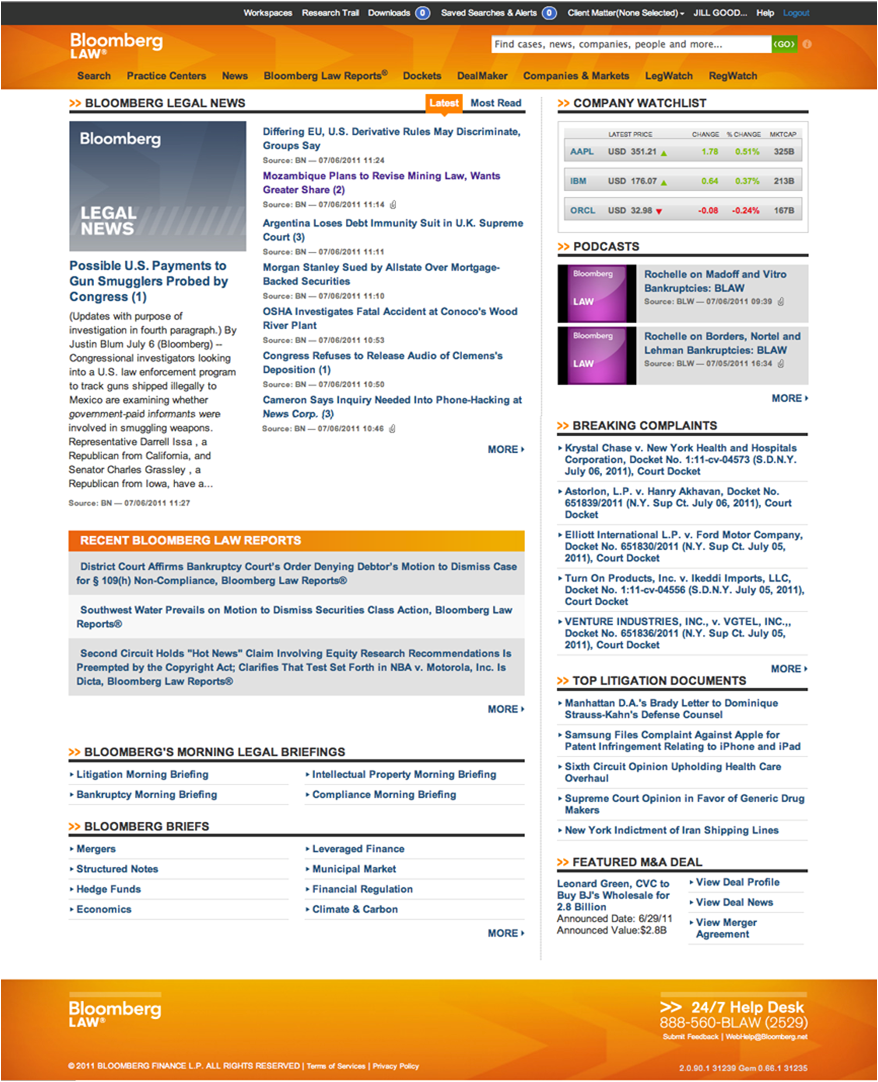
Bloomberg’s New Front Page

Cost containment

Bloomberg is offering a single subscription rate which will include all content that is added to Bloomberg. Andreozzi claims that it will be able to maintain the simplified billing and not impose new costs for “excluded” content, because Bloomberg is owned by Bloomberg, L.P. which is the third largest news provider and has a vast repository of financial analytics. Andreozzi points out that this will immunize Bloomberg from the third party content migrations between Lexis and Westlaw which have bedeviled users of American Lawyer publications and leading newspapers such as the Wall Street Journal in recent years. Bloomberg’s simplified billing stands in sharp contrast to the complex and multi-tiered billing systems which are the legacy of Lexis and Westlaw.
There is a growing consensus in the legal industry that in 5 years law firms may no longer be able to pass along Lexis and Westlaw charges to clients. Adreozzi believes that Bloomberg Law’s more transparent and predictable pricing model could more easily absorbed by firms as overhead since firms will not charged for additional content as it is added to the platform.

Lawyer as Rainmaker  Bloomberg’s focus on a core of business related practice areas allows them to leverage the deep “mother load” of business data created and owned by Bloomberg and seamlessly integrate it with practice materials. Bloomberg is the first legal service to code all litigation by industry, enabling a lawyer to easily focus in on caselaw impacting his clients business.

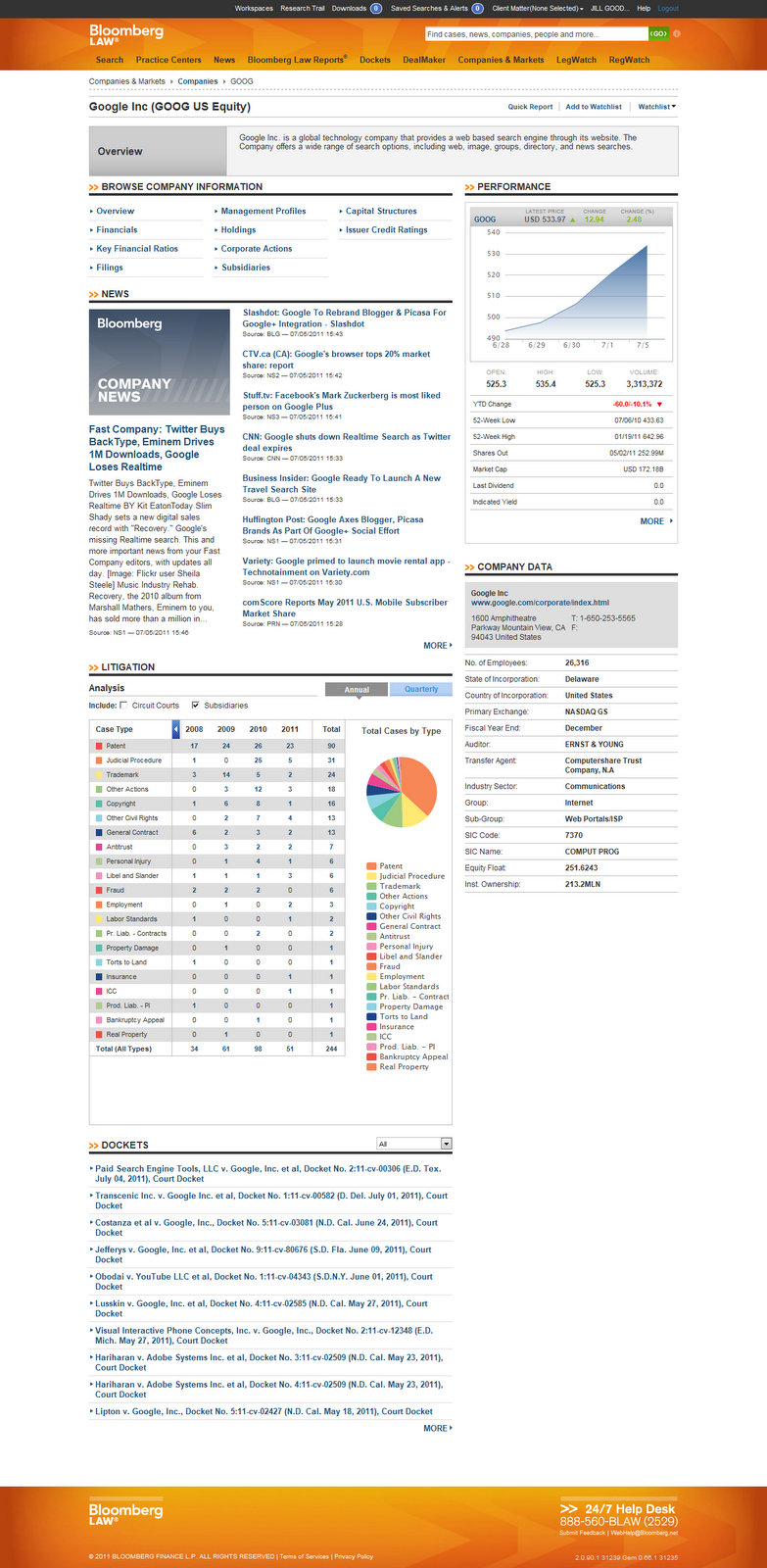
Andreozzi is rightly proud of the ease with which Bloomberg can generate an elegant and up-to-date company analysis which includes: breaking news, a litigation profile with graphs, a list of recent dockets, stock performance and basic company data. Since clients demand more loudly than ever that lawyers much not only know the law but also know their business, Bloomberg appears to have seized the lead in providing a simple way to generate a complex company profile right from the lawyers desktop.

The Future Belongs To…

I can’t make any predictions about the contours of the online legal market place in 5 years. But I do think that Bloomberg Law has gotten some key drivers right including: integrating law and business, simplifying the billing structure, integrating workflow into the research platform. Globalized legal practice will continue to have an impact and all of the major vendors incldung Bloomberg will need to respond to the changes in law firm demographics and financials.

My Favorite Things about Bloomberg Law

  • Industry Search in caselaw …brilliant!
  • Breaking Complaints. Bloomberg focuses on important business cases in important courts that generate leading business litigation. They have gotten the reputation for posting these important dockets ahead of the competition.
  • Foreign and International Dockets Include UK, Ontario, Canada, Hong Kong, EU, Royal Court of Jersey and the Grand Court of the Cayman Islands.
  • Dealmaker Provides sample documents to be used as templates or samples of deals which can be used for negotiation.
  • Shared folders Improve collaboration and workflow allow lawyers to share content with lawyers within their firms.
  • Practice Centers Aggregates links  to case law, major statutes and regulations, treatises, breaking news. custom watchlist, trends in litigation, forms, significant filings, law firm news.
  • Legwatch and Regwatch – allow you to link directly to the codes and monitor topics of interest.
  • Multi- media – Bloomberg is already offering blogs, podcasts and videos on their platform. Since Bloomberg is the only legal legal platform affiliated with a TV station can other kinds of media offerings be far behind?

Custom Company Reports


Custom Company Profile from Bloomberg Law


Preface: A partner once explained CALR write offs for me this way: “I don’t charge any of my clients for Lexis and Westlaw because I don’t understand the charges, I can’t control the charges, I can’t explain the charges and I can’t defend the charges.”Background: It wasn’t always this bad. I personally recall the early days of CALR. When Lexis rolled its behemoth Deluxe, terminal (it was about the size of a washing machine) into the Pace Law Library in about 1980, the main menu screen was 90% blank space. Lexis had only 3 files at the time which covered a limited mix of Ohio cases, Ohio statutes and some federal case law. Although you could view the full text an opinion online, you couldn’t print out the full case.

Westlaw decided to compete in this emerging area with a strategy of denial. They opted to protect their print reporter business by limiting their online product to include headnotes only! No full text searching or displaying of opinions. My first and only encounter with an early Westlaw “Headnotes Only” terminal occurred on a visit to the NY State Attorney General’s office Library in the World Trade Center. A library that was also notable for having its furniture built by residents of the New York State prison system. (Talk about cost control!).

By the mid 80s each system had added hundreds of full text libraries covering legal, business, scientific, as well as local, state and federal regulatory materials. Each vendor took a different approach to billing. Westlaw billed primarily based on time and Lexis billed based on transactions.

At this point both Lexis and Westlaw were sufficiently simple and their billing systems so straightforward that it was possible to provide the average associates with a simple set of principles and guidelines that could assure cost effective research.

Both systems were also completely “pay as you go”. The more you used – the more you paid. So there was strong incentive to limit the use of the systems and to strive for cost effectiveness. But that all changed….

The Fixed Fee Contract and the Death of Cost Recovery

By the late 1980’s both services started to offer unlimited access to a custom defined subset of content for a fixed monthly fee. Normally a significant number of databases were “excluded” from the contract and charged at retail rates. Although the vendors were now offering a fixed fee for a large chunk of content, they didn’t simplify the underlying rate structure. So firms were left to fend for themselves in developing a method for apportioning the fixed costs between clients and the firm use while staying compliant with ABA and court rules regarding disbursements. The most common 4 approaches under fixed fee contracts were 1) variable discount, 2) fixed discount, 3) blended rate discount or 4) overhead

Initially most firms chose one first two methods below

1) Clients were charged a variable discount based on the volume of use each month

2) Clients were charged a fixed percentage discount based on an estimate

Both of these methods made cost effective research training almost impossible because they required associates to mentally apply a discount to hundreds of unknown and undisclosed retail price points.

In an effort to clarify the message to client and simplify cost effective training some firm’s took an innovate approach:

3) Blended rates – A few firms have jumped off the bus and developed their own simplified billing systems which offered a predictable hourly and transactional rate for all files. This allowed lawyers to focus on research quality and relevance and not focus on the totally collateral issue of selecting the cheapest of 1 million options.

The blended rate was based on historical usage patterns. The increased predictability of the blended rate could provide a “win –win” for both the firm and its clients. Firms improve their cost recovery and the effective discount offered to clients improves over time as lawyers become more confident in their ability to predict and control costs.

4) Overhead. A small minority of firms treated the entire cost of online research as overhead. Some firms reverted back to cost recovery after a brief experiment. The dire predictions that all use will become overhead have not yet materialized.

But the flat fee contracts created an opening for clients to object to paying for online research at all… Since partners weren’t prepared to explain their firm’s particular algorithms for cost recovery – it was easier to agree to a write off than to argue. Even good faith attempts by firms to make a fair allocation of these fixed cost was lost if the fog of confusion.

And the Winners Are… The Consultants

The growing complexities of Lexis and Westlaw billing combined with the increased “push back” from clients spawned a cottage industry of “contract negotiators” who charge firms a hefty fee based on a promise to reduce the costs of flat fee contracts. Ironically the approach of some consultants actually causes cost recovery to decline which in turn results in a net increased cost to the firms.

Consultants became part of the problem. Since the majority of consultants have never done legal research and couldn’t tell a precedent from a pretzel, they overlook hidden costs of the contracts they recommend. A contract may reduce the monthly commitment of the flat fee contract while increasing the overall cost to the firm. These costs include, the increased time spent on lawyer training, increased write-offs due to the complexity of the contract and the unpredictability of the client costs erodes partners willingness to pass along the charges.

The Future of Cost Recovery

If cost recovery for online research is to survive at all, it will be as the result of a radical shift to simplicity and transparency. It appears that vendors are getting the message. Bloomberg Law entered the online market with a simplified approach to cost recovery including a limited number of price points and offering content and features which trigger no costs at all. Westlaw Next has dramatically fewer price points than the older Westlaw.com platform. Fastcase and Loislaw have been positioned as lower cost sources of primary law which firms treat as overhead and make no attempt at cost recovery.

All indicators suggest that since clients will continue to resist online research charges, firms will hedge against increased overhead by using one or several of the following strategies; cancelling either Lexis or Westlaw and selecting one major provider; exploring lower cost alternatives such as Bloomberg or Fastcase, or expanding or developing a specialized team of lawyer/librarians and research attorneys who conduct research and deliver the results to the associates and partners.

An Alternative title to this post might be “Vendor Sourcing: The Digital Edition.” Like the print issues outlined in my post of February 17th, “Vendor Sourcing: Thinking the Unthinkable…”, this post will examine how Lexis and Westlaw pricing strategies have shifted substantial administrative burdens onto their law firm customers which not only drive up administrative costs but have a perversely negative impact on the practice of law.

It’s that time of year again. All across the country academic and firm librarians are flocking to “bridge the gap” programs where they engage in their annual “hand wringing ritual” while trying to develop the right formula for preparing associates to perform cost effective online research in the “real world.” Since most law firms have a unique menu of “included” content, unique pricing plans and unique billing policies for the identical content – academic librarians are faced with the impossible challenge of training students for a universe in which there is likely 100% inconsistency in the pricing and billing policies across the firms where they will be summer associates.

Cost Effective Legal Research Training has become the “Bleak House” of every lawyer training program. It is unsustainably complex, groaning under the weight of its unending convolutions and permutations. A “doom loop” of confusion, errors and omissions.

The inspiration for this post occurred while reading the discussion on brain function and “information overload” in Nicholas Carr’s bestseller “The Shallows.” The proverbial “light bulb” suddenly lit up in my brain.

I submit for your consideration and debate, the possible truth of the following axioms:

1. Cost effective research training is a hopeless exercise. Think Prometheus – no matter how much you try to develop a set of cost effective rules, there are simply too many price points, too many exceptions to any rule, and too much transience in pricing. New complications will grow back tomorrow. There is no “still point” in this turning world.
2. Cost effective legal research training is counter-productive. Since there are an infinite number of invisible variables and undisclosed price variations, a lawyer attempting to conduct “cost effective” research is distracted from focusing on substantive legal research.
3. Subscribing to the myth of cost effective research training keeps the focus off the true culprits and keeps us from demanding a real solutions.There is probably no other disbursement that confounds and perplexes law firm partners or causes more embarrassment when posted on a client bill than online research charges. Partners blame librarians for providing insufficient research training, librarians blame associates for not absorbing cost effective research parameters, and associates blame their law schools for failing to prepare them to practice in the real world. Let’s all pivot in unison at point at the true culprits: Lexis and Westlaw.

1. Why Cost Effective Online Research Can Not Be Taught

Between them, Lexis and Westlaw have over 100,000 separately priced data files. Each of these 100,000 files has at least 5 different price points associated with it, including: hourly, transactional, cite checking, find and print, document printing, line printing and image printing. Some files have special charges if they generate reports or have an expandable table of contents. Then overlay this toxic brew with the pricing variations generated by “flat rate” contracts which trigger a special discount for some but not all content. This requires an associate to engage in an additional computation to account for a “firm specific” discount off of the undisclosed price points.

Do the Math: We have been expecting associates to be able to predict and control of costs of a system that involves about half a million undisclosed, possible price points.

The Madness Exposed. Handing an associate a Lexis or Westlaw password and asking them to be “cost effective,” is like handing someone a credit card and sending them into a store in which none of the merchandise is priced and then berating them when the bill comes in exceeding your budget. No consumer affairs department would allow a retailer to perpetrate this kind of thing on the public. How is it that almost every law firm in the US has put up with this for the past 3 decades?

2. Why cost effective research training is counter-productive.

The obsession with being “cost effective” distracts the associate from focusing on the real goal — finding the right answer. Here comes the brain theory. Effective legal research requires deep focus and concentration yet… “the myth of cost effective research” requires an associate to engage half of their attention on a collateral and competing analysis of factors which have nothing to do with the substance of the law. (Am I in hourly or transactional mode? Is this content included or excluded? Should I print or read online? Should I execute a new search or will that cost too much? Have I selected the cheapest file? Is it cheaper to print by the line or print a page  or print a document or should I email the results to myself?)

What about getting a good result for a client? Let me cut to the chase. The truly sinister part of the obsession with “cost effective legal research” training is that it subverts and derails the real purpose of online research: getting to the legal precedents and factual data that impact advocacy for the client. Associates who take the “cost effective gospel” to heart are often paralyzed and confused. They prefer to “Google for precedents” or engage in other outlandish inefficiencies to avoid using the premium research tools altogether.

3. Subscribing to the myth of cost effective research training keeps the focus off the true culprits and keeps us from demanding real solutions.

The bottom line: If Lexis and Westlaw really cared about cost effective legal research they would have developed simplified and transparent billing systems.

I have participated in countless librarian panels and advisory groups sponsored by both Lexis and Westlaw over the past 25 years and we have delivered a consistent demand for simplified and transparent billing systems. Instead of responding to this demand, Lexis and Westlaw have stood back and let us expend countless hours on hopeless training initiatives which were doomed from the start.

Lexis and Westlaw have the power but not the will to make their very complex billing systems open and transparent. When you go to select a file they could display the cost, but they do not. When you are online conducting a research session they could run a ticker showing how much you session has cost, but they do not. They could have a limited number of price points, but they do not.

Killing the Golden Goose.

I do not dispute the there is special value in being able to search databases with the breadth and editorial quality provided by Lexis and Westlaw. An executive at Westlaw recently told me that Westlaw now contains over 2 billion documents, (6 billion if you include public records). It is truly awesome to be able to execute a search across thousands of data sources and get a virtually instantaneous result. I still value the precision and control offered by fielded searching, proximity connectors and Boolean Logic which is not available from the “googlzied” search alternatives.

Premium content combined with premium editorial enhancements is something that clients might be willing to pay for if the costs could be calibrated to value delivered. I do not begrudge Lexis and Westlaw a fair return for their investment, but after 30 years the unchecked expansion in complexity, their billing systems have reached an unsustainable tipping point. They have in effect killed the “golden goose” of cost recovery or at least put it on “life support.”

One clearly unintended consequence of escalating costs and complexity has been to expand the ranks of partners and clients who currently refuse to pay for something that if rationally priced would be demanded as a justifiable cost delivering both value and efficiency.

When Lexis and Westlaw deliver simplified and rational billing systems we could actually develop cost effective legal research methods and classes that  could prepare associates to perform cost effective research  while remaining focused on the real goal: delivering the best result to their client.

I am posting the letter I received from ALM, Vice President, Sara Diamond in response to the questions posed in April 18th post: The ALM-Lexis Deal: Stop Hyperventilating and Consider Some Action Items

Dear Ms. O’Grady,

ALM has, as you noted, been making a concerted effort to reach out to the library community as we define, refine, and implement our digital strategy. We appreciate the opportunity to address the community regarding our strategy and encourage you and your colleagues to contact us with any questions or concerns in the future. One of the items we’re currently contemplating is how best to stay in constant, regular touch with the needs and opinions of the librarian community. We, like most publishers, need to work on that and have prioritized it as a goal. Any input you have on how best to accomplish this would be greatly appreciated.

In response to your questions, please note the following:

• ALM certainly has a longer-term goal of creating a robust, integrated platform that will include news, newsletters, treatises, research products, and more. The first foray in this developmental direction was the integration of several core ALM data sets into a common platform for the New York SmartLitigator, a new regionally-focused research product launched last September. Our future plan includes giving librarians and attorneys the choice of accessing our content either from an integrated ALM platform or, as of May 1st, from LexisNexis. Some of the necessary initial steps we’re undergoing as we move toward this goal of integration include moving our regional Smart Litigator, Law Journal Press Online, and Law Journal Newsletters to a common platform, digitizing all content, standardizing content types across divisions and regions, applying common taxonomies to content, and storing all content in a common content repository. We’ll continue to move aggressively to refine and implement our strategy in the months ahead.

• ALM will be upgrading its news platform to provide custom alerts. The first custom alert will occur with the re-launch of the New York Law Journal website later this year. We will include other custom alerts as we update web sites for other publications. This is certainly on our priority list for development given comments we have heard from librarians and attorneys regarding the usefulness of this feature.

• The individual news publications (e.g., New York Law Journal) will retain only a rolling six-month article archive going forward. Archives beyond the six month period will reside on Lexis. That said, the regional SmartLitigator products being developed by ALM will also include full news archives. The first of these regional products, the recently launched New York SmartLitigator, includes an archive of New York Law Journal articles going back eight years. Similar archives will be available in other regional SmartLitigator products going forward, with the New Jersey Smart Litigator and Pennsylvania Smart Litigator launching later this year.

Librarian questions, concerns, and critiques of our policies are always valuable in helping us shape our plans for the future. We thank you for your interest in ALM and appreciate your comments.

Sincerely yours,

Sara Diamond

Group VP, Substantive Law

ALM

We have been through drills like this before and this is no doubt, not the last content swap between Lexis and  Westlaw platforms we will face.

While waiting for some word from Lexis on how ALM content will be priced, I began conducting some internal due diligence. These items might be of interest to others.

Action Items

  • Check your firm’s most recent Westlaw contract  and  review for a “material change” clause or other clauses regarding the removal of content. 
  • Check your firms’ most recent Lexis contract for any language addressing content added during the contact period. However – since this is clearly 3rd party content – I see an “exclusion’ coming on. 
  • Request a usage report from Westlaw with an analysis of the last 6 or 12 months of ALM usage from 
  • Identify the ALM content being used (it may surprise you)
  • Identify the users
  • Look at the value of the useas an overall percentage of all Westlaw use. 

The magnitude of the usage or lack thereof will inform upcoming negotiations.

Managing ALM excluded content after it is on Lexis. Peter Charkalis from Onelog reports that Onelog’s next upgrade can provide custom warning screens when researchers try to access excluded content from a system such as Lexis or Westlaw. This custom message can direct resarchers to an alternative platform e.g. the LJP treatises or ALM news rather than using the content on Lexis.

Reviewing the ALM usage report triggered a series of questions regarding ALM’s digital strategy which I have outlined below in an open letter to ALM. Although we may not have answers immediately – just posing these questions may assist library leaders in assessing the addition of ALM content to their Lexis contracts.

  Dear ALM Executives,

 Let me first state how much I appreciate your recent efforts to reach out to many “thought leaders” in the library community to discuss a variety of digital strategy issues. I was willing to sit back and wait for ALM’s strategy to unfold but the recent sudden switch of ALM content from Westlaw to Lexis compels an airing of the unsettled ALM issues.

ALM currently has at least 3 digital platforms: the online research platform, the ALM media news platform and the Law Journal Press treatise platform. These all seem to function as stand alone platforms and don’t integrate with each other..

So here are my questions.

  •  Does ALM plan to have a robust, integrated platform including ALM news sources, newsletters, treatises and research analytics in the foreseeable future so we can direct most of our use to you and not a 3 party? 
  • Why doesn’t ALM at least upgrade their news platform to provide custom alerts? This functionality has been around for decades. There are very few news products around that don’t allow custom alerts. Is this being planned? (Don’t look now but relative newcomer Law 360 has just released a custom alerts component).
  • Does ALM plan to load a complete archive of news publications for subscribers to those news sources? If yes when? 
  • Is there any content that will remain exclusively available on Lexis and not available from any ALM platform for the foreseeable future? 

 For those of us who are responsible for providing our firm’s lawyers with the best content while controlling costs and reducing redundant purchasing of content, the absence of a long term  ALM strategy creates a special challenge.I assume I can speak for my colleagues when I say we all look forward to learning about ALM’s digital strategy.

…Come up with some Interesting New Tools for Legal Research.

Phil Rosenthal and Ed Walters both former associates from Covington & Burling began developing what they refer to as a smarter alternative to Westlaw and Lexis in the late 1990’s. After a modest amount of angel funding and a decade of development,  Fastcase now has  more than 500,000 paid subscribers, and partnerships with 20 state bar associations (including DC Bar, Virginia State Bar, and Maryland State Bar Association, and dozens of voluntary bar associations). Their iPhone and iPad app was the 2010 AALL New Product of the Year.

Fastcase has gone beyond caselaw and now includes, news, regulations, statutes and forms. But what caught my attention, was two unique features “Forecite” and “Interactive Timelines” which appear to offer completely fresh approaches to legal research analysis. Both features provide new visual cues for assessing research results.  The cost of a subscription to Fastcase  is several orders of magnitude below  the prices charged by Lexis or Westlaw for comparable primary source material.

But don’t let the low price tag fool you. Phil and Ed have developed some remarkably sophisticated new tools for research analysis which may give them an advantage with the younger generation of lawyers who are more graphically oriented and less textually oriented than prior generations. Some larger firms have also decided it is time to reassess the long term sustainability of maintaining two expensive contracts with Lexis and Westlaw. The ongoing recalibrations in the legal marketplace have created an opening for upstarts like Fastcase and Bloomberg Law to “make their case” that they deserve a serious look.

Phil Rosenthal attributes the inspiration for the Fastcase timeline display to his study of physics and the law.  Phil started out as a rocket scientist and entered Harvard Law School because he was interested in space policy. Ed Walters jokes that his practice at Covington & Burling focused on beer and softball. But he also admits to spending some of his time globetrotting between Washington and Brussels at the dawn of the Web, counseling software companies how to stay out of legal trouble in a newly Internet-connected world.

According to Ed “In good software design, one size fits none. We’re big into customization – research history, private libraries, settings, preferences, and views of search results.”

Forecite: Seeing the results your search terms don’t retrieve.

This new search feature “Forecite” now in beta, retrieves cases that are heavily cited in the search results but which do not match your keyword search criteria or which fall outside your date restrictions. They are basically running a citation analysis on the retrieved cases and identifying cases that you probably want to look at even though they don’t match your search parameters.

The Interactive Timeline: Thinking Outside the List!

For the past 30 years the dominant way to review search results has been “the list” of relevant cases. A list from a traditional legal research vendor can be sorted in a variety of ways, relevance, date, court hierarchy, but these variables must be assessed sequentially, one at a time. There is also a limit on the size of a list that can display on a screen. The Fastcase timeline can display ALL cases in one visual snapshot.  All of these results can be resorted, modified and redisplayed on the fly.

Phil articulates the goal this way. “ It is hard to know if you want to read the full text of a case. Traditional search results are only sorted in one way at a time, so it is hard to determine if you need to look at a case and too often important cases are missed. We make it easy to see four pieces of information about each search result, all at the same time. You can find that critical case right away. You can see trends.”

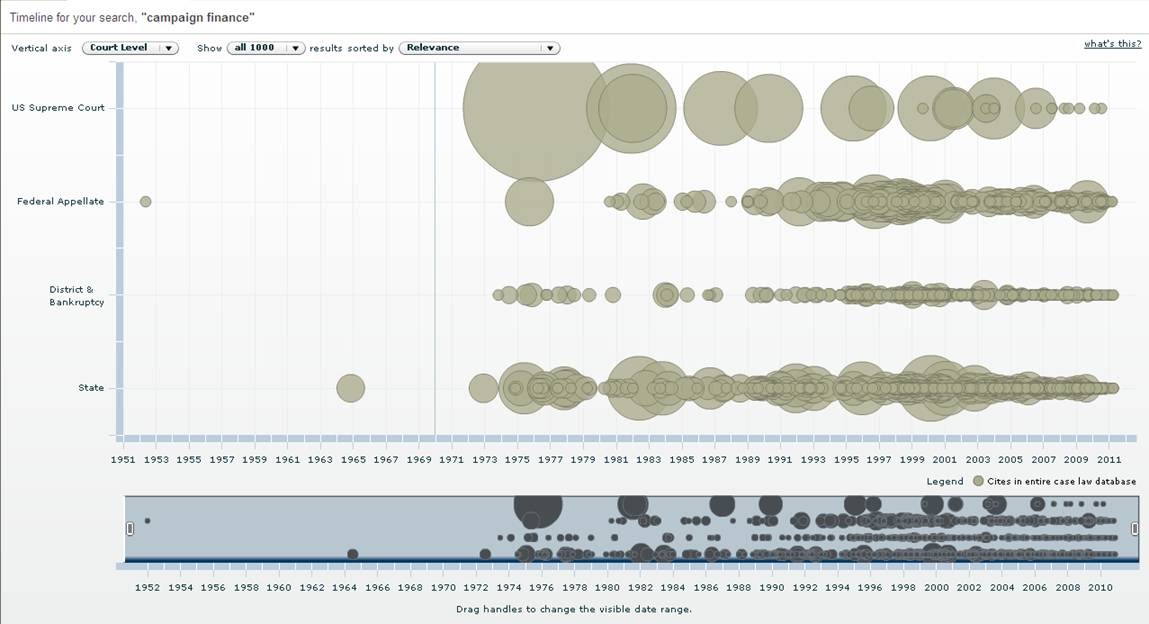
The chart below shows the interactive timeline for court opinions on the topic of  “campaign finance.” The 1976 U.S. Supreme Court decision Buckley v Valeo, 424 US 1,  which upheld campaign finance contribution limits stands out as the largest circle, i.e., the most cited case…cited 2,328 times. I performed special sort on the graph below showing the trends in campaign finance litigation by multiple jurisdictions: Supreme Court, Federal Courts and at the state level. Each circle represents a case, and the size of the circle indicates how often that case has been cited. If you hover over the circle you see the name of the case, the citation, a summary and the number of times cited.

The second timeline at the bottom allows you to readjust the time period displayed in the main chart. The results can be continually refined on the fly.

The Interactive Timeline, although plotted as a two-dimensional graph, actually shows four different pieces of information: 1) Decision date; 2) How many times the case has ever been cited; 3) How many times each case in the list has been cited by the other super-relevant cases in the search result (“cited within results”); and 4) Relevance, based on your specific keyword search. You can customize the view and switch out #4 to display the level of court that issued the opinion (U.S. Supreme Court at the top, lower state courts at the bottom.)You also get an overarching context and trend analysis for the history of campaign finance litigation.

Statutes the Next Frontier: Since Fastcase is pulling statutes from free state websites which are not universally reliable or current (even though published on the states official Websites),  I don’t see Fastcase as ready for ‘prime time” in statutory research arena.  When I asked Phil about this he responded with knowing grin and said “we’re working on it and we have some really new ideas.” This should be interesting… stay tuned.

Fastcase Phil and Ed in a Fast Car!
________________________________________
A digression on the Fastcase Tesla Roadster VIP  Event

In what is surely one of the most unusual marketing tie-in’s I have seen, Fastcase hosted an event at the Tesla Motors sale room in downtown DC this week.

I don’t run in the $100K electric roadster circles and I don’t usually get a chance to zoom around downtown DC with my hair blowing in the wind. And I am not even much of a fast car person but I have to admit: this car rocks. What I learned: Testa’s carbon fiber body is hard like steel and flexible like plastic. Zero gasoline.  It runs 245 miles per charge and it bolts from 0 to 60 mph in 3.7 seconds. (And I had the whiplash to prove it).

So what is the Fastcase and Tesla nexus? I don’t know but here is my guess:

• Both offer innovative engines (search and automotive)

• Both are entering a mature market place with game changing assumptions (low cost search and no carbon emissions engine)

Maybe we can get Phil and Ed to raffle that Tesla at their AALL booth in Philadelphia this July.

Japan News Alert from D&B

D&B has released a free search tool that allows individuals to identify companies that are located in the prefectures impacted by the March 11, 2011 earthquake and tsunami in Japan. This information will help organizations begin to assess their exposure to financial and business continuity risk resulting from the earthquake and tsunami as well as unfolding developments at the Fukushima Daiichi Power Station.

 D&B has identified roughly 150,000 businesses in the Fukushima, Miyagi and Iwate prefectures. Search tool allows searching by company name or D-U-N-S number. and will  provide information on which companies are in the impact zone. Click below to access the free search tool. D&B Japan Disaster Business Search Tool

American Lawyer Media released its early 2011 Economic Confidence Survey and law firm leaders are significantly more confident than they were only 6 months ago.

Cost saving trends between August 2010 and February 2011:

  • The number of firms intending to move to less expensive vendors is decreasing 
  • More firms will continue to cut business development spending  
  • Layoffs have reduced but pressure to control salaries and bonuses increased.
  • Pressure to reduce summer associate program spending is easing up.

 Biggest economic challenges include: 
  • Cross-selling to existing firm clients 
  • Responding to cost pressure from clients
  •  Pressure to use Alternative Fee Arrangements

 Hiring Compared to August 2010 more firms intend to hire attorneys, but staff hiring appears to be stalled. There is no indication that there will be an increase in staff layoffs.

Profits Per Partner: Partner morale regarding profits per partner increased almost 20% from August with almost 68% of respondents expressing optimism about 2011 profits per partner.

Implications: While this is reassuring news, the lessons of the recession should not be forgotton. Since clients are continuing to be economic pressure on billing arrangments, we will need to continue exploring content licensing arrangements which improve the value proposition for both the firm and clients.

Sunday’s Washington Post offered a thought provoking post-mortem on Howrey’s demise: Why Howrey could not hold it together.

It is hard not to respect Howrey for their continuous pursuit of innovation. (They also pulled off one of those amazing “only in DC” coups by having a Pennsylvania Avenue address even though they were in a building on E St NW.)

Steven Pearlstein’s story suggests that they were either the first or one of the first law firms to pursue a litany of novel strategies:

  •  Branding themselves and creating a slogan: “In court every day”
  • Aggressively pursuing a “free agency” growth strategy – – poaching laterals at a time when it was “not done” in a “genetleman’s” profession.
  • Swapping out the traditional summer associate bacchanal and replacing it with a bootcamp (about a decade before the recession hit)
  • Opening a offsite ediscovery facility in the suburbs of DC
  • Opening an office for off-shoring ediscovery in India
  •  Abandoning lockstep pay for associates
  •  Initiating an apprenticeship model for associates

Drum roll please:

  • In a profession of PC users, Howrey remained a committed Macintosh shop through the 1990’s. According to an April 2000 Law Technology News  story Howrey lawyers even posed for a Power Macintosh ad in the mid 1990’s.*

* I confess I tried to find the Howrey PowerMac ad but came up short, but I can instead offer to delight and amaze you with a Youtube  montage of Macintosh ads from the late 1990’s. The only lawyer I recognized here was Gandhi. But anyone who was a member of their firm’s “Y2K Committee” in the late nineties must see the parody mash up of Hal (from the 2001: a Space Odyssey) and the Y2k bug.

Why is Howrey Gone? Of course the economy was a factor, but Pearlstein cites other recent trends in the law firm marketplace including, the conversion of firms from true partnerships with shared personal risk to “no personal risk” LLPs and LLCs. Pearlstein suggests that the “free agency” model which was responsible for Howrey’s growth was also partially responsible for its demise. The combination of the easy bail out and  the LLP/ LLC structure of law firms creates a disincentive for partners to make a commitment to invest years in trying to resurrect a troubled law firm.

Whither Partnerships? or Wither Partnerships? Pearlstein concludes by suggesting that law firms will continue to fail unless they recommit to the traditional partnership model and stop focusing on the pursuit of “profits per partner.” I see evidence of a completely different future. I have recently had two separate conversations with former law school colleagues who are now large law firm partners. Two partners, in two different firms, in two different cities echo the same complaint. They as partners can’t find associates willing to stay with them to pull “all nighters” and work weekends. Both partners independently reported that bright young associates from the best schools refuse to put the practice of law ahead of their personal interests. Furthermore the next generation of associates appears to have no interest in making partner at all. So the bigger question may not be how many firms will continue to thrive but will any firm survive as a partnership if there are no associates grabbing for the “golden ring” of partnership?

Howrey is gone but it’s website lives on:

Howrey’s New Model: A Two-Year Associate Apprenticeship (June 2009)

Howrey hits India for “low-cost option” (February 2008)

“Howrey bucks trend with merit pay plan” (July 2007)