 |
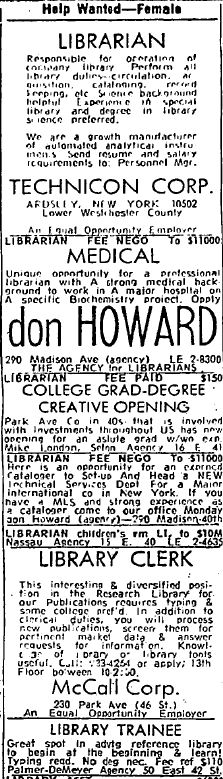
| NY Times Mar. 20, 1969 |
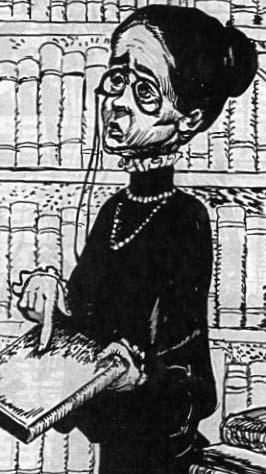 Bring on the Cartoons. As if gender were not enough of a problem, there is the relentless stereotyping of librarians. Name one other profession for which there is such a universally accepted and cartoonish image. We can all recite it: hair in a bun, sensible shoes, glasses, drab clothing, humorless, prudish, and forever “shushing.” Who would invite this character into the C-Suite! Earlier this year Lego released a “librarian” Lego that is remarkably similar to the 19th century stereotype.But “updated” with the word “shush” printed on her coffee cup. These are not empowering images and yet they are a cultural fixture. I don’t think a month passes in which I don’t encounter the “bunhead librarian” in an advertisement, in a movie or in an news story. This is the professional equivalent of a minstrel show character, that persists when all ethnic and racial stereotypes have been banished. Maybe you are thinking I should just “lighten up.” but consider the possibility that stereotypes create real professional consequences.
 book by Malcolm Gladwell.” Blink, the Power of Thinking Without Thinking”, which concludes with a chapter “Listening with Your Eyes.” It describes the difficulty which classically trained female musicians faced getting hired by orchestras. Conductors almost universally thought women were unsuitable for orchestras because their hands were too small, their lips were the wrong shape, their lungs couldn’t hold enough air…..you get the picture. No one thought they were being unfair to women. When women showed up for auditions, they just didn’t sound as good as the men. Then something happened. The mostly male musicians began to unionize in an effort to counteract favoritism and unfairness of conductors who sometimes only hired candidates who they knew or favored graduates from certain schools. One of the reforms that was instituted was called the “blind audition,” in which the musicians audition behind a screen. The conductor can only hear the music and makes judgments based on the quality of the music alone. Guess what, following the introduction of “blind” auditions, the number of women in symphony orchestras began to increase. In 1970 only 5% of the musicians were women. The number had increased to 25% in 1997 when a study was conducted by Claudia Goldin of Harvard and Cecelia Rouse of Princeton. ( Orchestrating impartiality: the impact of blind audition of female musicians.)”
What Else Could Explain the Low Numbers of Librarians in the C-Suite? Law librarians are among the most highly credentialed administrative staff in law firms. Most have at least one Masters Degree. They often have 2 advanced degrees, a Master’s Degree plus a JD, MBA or PhD. Law librarians have been in law firms longer than any other “non-lawyer” professional. Their positions date back to at least 1930. Information Technology folks arrived in the 1970’s and Marketing folks in the 1980’s and Professional Development folks in the 1990s. We had a 40 year lead and yet we have fallen behind in opportunities for professional advancement. The numbers of Finance, IT, Marketing and Professional Development Human Resources professionals in the “C Suite” far exceeds the number of librarians. No one can convince me that implementing the right information strategy is less critical than having the right technology, marketing, recruiting or lawyer training strategy.
At the first PLL Summit in 2010, 3 Geeks and a Law blogger, Greg Lambert raised some uncomfortable issues.. He pointed out that in the past 20 years librarians were continually at the forefront of introducing new initiatives and technologies. These innovations include providing firms with the first link to the Internet and introducing knowledge management (which by the way librarians invented in about 2000 BC), competitive intelligence and formal professional development programming. But instead of having their roles elevated, a strange thing happened… someone else was hired to lead each new initiative. Worst of all the people hired into these new roles were then elevated to the C-Level. The persistence of the pattern is too dramatic to be ignored. I am open to other explanations, but right now unconscious stereotyping and gender bias get my vote.
And now… I can’t help but wonder if during all these years when I was talking strategy and risk anyslyis, my words were drowned out by sound of a cartoon “shushing” in the Executive Director’s and Partner’s heads.
Leaning Up for the Next Generation. This is a subject no one wants to discuss. I can’t recall ever seeing an AALL program that addressed the issue of gender bias faced by our profession. The ABA and every law firm is trying to increase advancement opportunities for women lawyers to reach partnership. So why, as a profession that is about 80% female are we afraid to name the problem and begin to look for a solution. I want the next generation of information professionals to have a a shot at a seat in the C-Suite, but the first step toward recovery is admitting you even have a problem… and then call the problem by it’s right name.
______________________________