Only weeks after receiving the prestigious 2017 New Product Award from the American Association of Law Libraries, CARA is announcing today the release of a new “Brief Finder” feature.

Casetext’s CARA (Case Analysis Research Assistant) launched with the promise of helping lawyers find the most relevant caselaw.  Last August I reviewed CARA in a post: Citation Fingerprint, Celestial Footnotes and Opinion Sourcing: Casetext Launches CARA.

According to press release, the Brief Finder promises to surface the most relevant legal briefs filed in federal courts “by the county’s best law firms… With no extra work, litigators gain unprecedented visibility into how world-class attorneys have argued the same issues they are working on, giving CARA users an extraordinary competitive edge.”

Jake Heller, founder and CEO of Casetext  notes that “Every lawyer knows that the best way to find good arguments is to look to your peers — other great attorneys who have taken on the same issues and researched them thoroughly. But finding the right brief is hard and expensive. CARA Brief Finder makes finding these invaluable resources effortless. The Casetext VP of Legal Research Pablo Arredondo  underscores the editorial effort they put in to selecting briefs from only the largest firms, specialty boutiques and government agencies. “We started with hundreds of thousands of briefs and culled this down to tens of thousands of briefs from highly reputable sources.”

Use Cases. The press release highlights the following use cases:

·       Predicting opposing counsel’s arguments based on what similarly situated litigants have argued. By running drafts through CARA, CARA Brief Finder will surface previously filed briefs that both oppose and support a litigator’s arguments. See how other leading attorneys have approached the same issue you’re tackling right now—within seconds.

·       Making sure litigators don’t leave out any arguments. Review briefs filed by peers in the legal community to ensure you are not missing a key argument and that you’ve articulated those arguments as effectively as possible.
·       Helping litigators draft the most compelling briefs efficiently. Quickly and efficiently assemble the information litigators need to provide best-in-class service to clients.

First Low Cost Provider to Offer Briefs. Although premium services Westlaw, Lexis  and Bloomberg Law have offered a Briefs database for years, Casetext maybe the first low cost provider to offer searchable access to briefs and they are certainly the first to offer  access using an advanced algorithm to determine relevance.

Access Existing CARA subscribers will have access to “Brief Finder” for the duration of their subscription term at no additional charge.  The CARA Brief Finder” will be a separate module which can be added for an additional charge.

I recently had the opportunity to ask Arredondo a few questions about how CARA has evolved over the past year:

How many firms are on board?

We currently have deals with ten large law firms and dozens of smaller firms, in addition to hundreds of solo practitioners.  Casetext attracts over 1 million unique users to our site on a monthly basis.  

What has your growth been like?

Casetext has grown substantially over the last several months in three key ways: (1) we are growing our team, from engineers and data scientists, to account managers, (2) we raised a $12M Series B round of venture funding (the largest round ever by a legal research company) and we are actively deploying those resources to continue to create nnovative, effective products that attorneys can immediately start using in practice, and (3) in a short period of time we have sold subscriptions of our flagship product offering, CARA, to key firms across the country while expanding our presence to 75 law schools across the country. 

We decided early on to make CARA freely available to the courts.  Judges and clerks all over the country, both federal and state, appellate and trial, have started using CARA and we have been very encouraged by the early response.  At a training at one circuit court, the clerks where emphatic that litigants almost invariably overlook relevant case law. 

How has the product evolved?

The early and enthusiastic adoption of CARA by courts and law firms has given us great user feedback, which has guided the evolution of the product. One of the most critical improvements has been combining the power of CARA with keyword queries.  Currently CARA defaults to showing the top fifteen recommendations for the brief as a whole.  Attorneys interested in just one specific issue can easily enhance the search with a keyword query without losing all of the context-specific analysis that CARA provides.  

The other major improvement in the platform is that CARA now returns briefs as well as case law.  Our users are very excited about this and so are we.  Briefs can be one of the most expensive databases to access on traditional platforms.  We get these briefs from PACER; it is important to understand that we never store, much less use, the briefs that
attorneys upload for research.  In order to ensure quality, we have culled our brief database (which updates regularly) down to briefs filed by leading law firms, boutiques, non-profits and government agencies.  You can filter the briefs by jurisdiction or use narrow-by-keyword.


Last year, I met Arredondo when he approached me in a meeting room at the AALL Conference in Chicago and asked me to see a brief demo of CARA. This year Arredondo reports that Casetext will have a booth in the Exhibit Hall at the AALL conference in Austin this July. Congratulations to Heller and Arredondo and all the folks at Casetext on the AALL award and the Brief Finder launch.  I am reminded of an advertising slogan from the 70’s: “You’ve come a long way baby.”

Here is a link to the  the Press Release on the CARA Brief Finder.

For seven years the PLLIP Summit has been a major  event that enables law librarians and legal information professionals spend a rare day immersed with colleagues in a fast paced learning environment to help them optimize support  for the evolving needs of lawyers and law firms. This year’s program focuses on: Navigating the Critical Nexus of Knowledge and Legal Technology. As in past years the agenda includes an inspiring line up of legal innovation thought leaders:

Professor Gabriel Teninbaum, of Suffolk University Law School where he is  Director of Suffolk Law’s Institute on Law Practice Technology and Innovation. He teaches courses such as “Lawyering in the age of smart machines.”

 Professor Daniel Katz  of Chicago Kent Law School is a leading proponent of applying analytics to the law and legal profession. His bio describes him as “a scientist, technologist and law professor who applies an innovative polytechnic approach to teaching law. ” Both his scholarship and teaching integrate science, technology, engineering, and mathematics.  He is the Co-Founder & Chief Strategy Officer of LexPredict (a Legal Analytics company).

V. Mary Abraham, Law Firm Consultant extraordinaire. Since 2013 she has been a member of the faculty of Columbia University’s Master of Science in Information and Knowledge Strategy where she teaches collaboration, facilitation, social capital, innovation, and knowledge sharing. Mary is also famous for her Above and Beyond KM Blog.

There will also be a a panel of innovative information professionals. The Librarian Speaks: Promoting a Technology Agenda – will feature Margaret Bartlett, Information Resources
Librarian @ Locke Lord; Mark Gediman, Director of Research Services @Best Best  & Krieger; Gina Lynch, Director of Knowledge Management and Business Intelligence @ Paul Weiss; Nancy Rine, Director of Research Services & Conflicts @ Fried Frank.

Registration information listed under Pre-conference workshops here. 

The full summit agenda is included below.


2017 Summit Agenda

Navigating the Critical Nexus of Knowledge and Legal TechnologySaturday, July 15, 2017, 8:30 am – 4 pmHilton Austin – Austin, TX

Friday July 14, 2017
Opening Reception 6:30 – 9:00 pm
Bloomberg BNA is once again our generous sponsor for the PLLIP Summit Opening Reception on Friday, July 14 from 6:30 – 9:00 pm at a location to be announced soon. Stay tuned to this page for updates.
As in past years, there will be a separate page for RSVP for this can’t miss event.
Saturday July 15, 2017
7:00-8:30 am – Registration and continental breakfastgenerously sponsored by LEXISNEXIS
8:30-8:40 am – Welcome remarks: Alicia Pappas and Jeremy Sullivan, 2017 Summit Co-chairs
8:40-9:25 am-  Keynote AddressProfessor Gabriel Teninbaum, Suffolk University Law School – generously sponsored by WOLTERS KLUWER
Professor Gabriel Teninbaum will explore the legal innovation landscape and describe how that is impacting (and will impact) law librarians. Hear how large and small law firms are incorporating technology, responding to client demands and feedback, and how AI and other technologies and trends continue to impact the competitive legal landscape.  Delve into the roles of librarians in innovation, efficiency initiatives, and development of potential new revenue streams.

9:30-10:05 am –  Q&A w/ Professor Teninbaum

10:05-10:20 am – Morning Break

10:20-11:50 am –  Can Librarians Help Legal Organizations Become More Data Driven? – Professor Daniel Katz, Chicago-Kent College of Law
Data science is a growing field within the legal industry. As organizations within the legal industry attempt to become more data driven, the skills held by law librarians are well suited to help law firms, corporate legal departments, courts and non-profits craft and execute a legal data strategy. After some introductory comments, the session will begin with a hands-on session where teams will help draft a legal data strategy in response to a specific vignette. After working through the specific scenario, Professor Katz will conclude with a general discussion of how to bootstrap a data strategy within your organization using a blend of experts, crowd-sourcing and algorithms.

11:50-1:15 Lunchgenerously sponsored by THOMSON REUTERS

1:15-2:30 pm – The Librarian Speaks: Promoting a Technology Agenda – Panel session featuring Margaret Bartlett, Information Resources Librarian @ Locke Lord; Mark Gediman, Director of Research Services @ Best Best  & Krieger; Gina Lynch, Director of Knowledge Management and Business Intelligence @ Paul Weiss; Nancy Rine, Director of Research Services & Conflicts @ Fried Frank

A moderated panel of your peers will share real life examples of how they work with the IT department to achieve and promote an agenda that leverages technology and knowledge to further the goals of the organization.

2:30-2:45 pm – Afternoon Break

2:45-4:00 pm – Surviving – and Thriving – in a Period of Change, V. Mary Abraham, Columbia University
Are you a Change Guerilla or Guru? Guerillas work tactically to shape change from the middle. Gurus work strategically to lead change. Both approaches are useful (and sometimes necessary) when your law firm is undergoing change. In this interactive session we will explore key methods used by change guerillas and gurus that can enable you to survive and even thrive in the midst of change.

4:00 pm –  Closing remarks


The members of the Columbia Law Revue –   these law students are not only smart, but they are also clever  and some of them sing like Broadway headliners. Maybe we should invite them to perform at the American Association of Law Libraries Conference this summer.   This is the best legal research video since Craig Runde and Bill Lindberg produced the dancing Westlaw Reporters video back in the 1980’s. The  Westlaw Story video parodies music and scenes from the  Leonard Bernstein hit play Westside Story… it is  loaded with barbs about vendor booty to incentivize product adoption by law students but  also offers some honest critiques on the stengths and shortcomings of Lexis, Westlaw and Bloomberg Law. (All I can say is that it is a good thing that Mike Bloomberg is no longer mayor of NYC where Columbia is located — on the upper West Side.)

Thank you, thank you, thank you Columbia Law Revue!

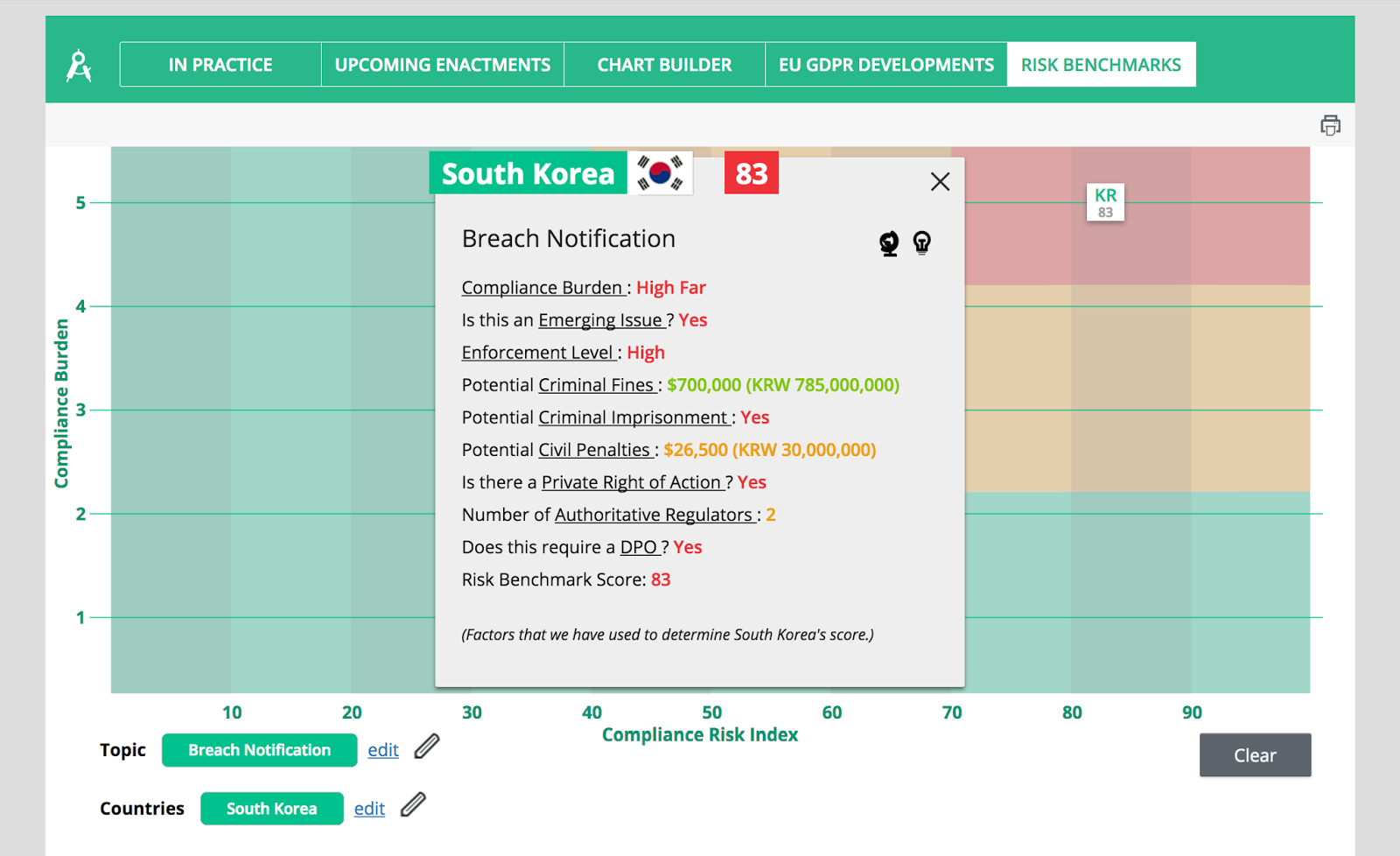
Yesterday Bloomberg Law released an important new feature in the Bloomberg Law: Privacy & Data Security product called the  Complaince Risk Benchmarks tool. The tool ranks the “burden” and compliance risks in 47 countries.  South Korea tops the list of data breach notification compliance risk earning a score of 87 out of 100.
 
 Bloomberg Law also released  a related report, “Anticipating the Burden ofRisk,” which provides an overview of the international regulatory environment and the risk landscape surrounding breach notification compliance. The report features an analysis of the countries with the highest compliance risk for breach notification, with write-ups on the top five countries, which include South Korea, Colombia, Mexico, France, and Japan.  
 
What is the Compliance Risk Benchmark?
The tool is designed to assist outside and inside counsel , and compliance professionals in assessing data compliance risk around the world.  To accomplish this they have created a risk score based on 8 risk factors analyzed using a proprietary algorithm. Compliance Risk Benchmarks  compares the  burdens and risks related to ten topics impacting global businesses including data security, data transfer, online privacy, and employee monitoring and surveillance.
Bloomberg Law’s Risk Benchmark
 The new tool and data provide a relative risk score for each country based on measures including
  •          enforcement level
  •         potential monetary penalties
  •           imprisonment
  •          litigation exposure.   


The Compliance Risk
Compliance Risk Benchmarks incorporates expert analysis from data protection professionals in each country as well as news and relevant laws and regulations from 55 countries with its robust data visualization feature Users can also go from viewing multiple countries to a snapshot of each country’s risk factors.  Comparative charts can be generated to show legal requirements for key issues such as: employee health information, online privacy, personnel records, electronic marketing, data transfer, employee background checks, employee monitoring and surveillance, data security, data collection and processing.
  
Algorithms and Visualization
The score is generated by a proprietary BloombergBNA algorithm and offers subscribers a wide range of interactive comparative charts. Upcoming legislation charts displays the status of proposed legislation and regulation across jurisdictions.
EU Compliance
Additional features in the platform include the EU GDPR development Timeline which provides access to legislative history, analysis and guidance on the complex EU data privacy laws and regulations.
Access

All Bloomberg Law subscribers now have full access to the benchmarking tool. Bloomberg Law: Privacy & Data  Security us also available as a stand alone product. Additional information regarding the product and contact information is available in the press release.

I am looking forward to speaking at  3 upcoming events during April and May. These programs are  sponsored by The Southern California Law Library Association (SCALL),  The ARK Group  and Janders Dean. It is always great to meet new colleagues and learn from professionals rising to challenges across the legal  profession.

It Takes More Than A Dumpster to Build a Digital Law Library, Southern California Law Library Association, Los Angeles., April 13, 2107

Driving Analytics into Practice: A high speed tour of the world of commercial analytics and predictive tools. Ark  Conference Business Intelligence & Analytics in the legal Profession, New York, April 27, 2017  

Does Your Firm Have an Insights Engine? It Used to Be Called the Law Library! Janders Dean  2017 Legal Horizons Conference, London UK, May 10, 2017.


Today I am summarizing the process initiatives submitted by readers responding to the Start Stop Poll.

The 2016-17 initiatives focus on: visibility outreach, targeted marketing, lawyer training and collecting attorney feedback and measuring value and satisfaction with resources and services. The more surprising response was a plea for the retention of print resources.

 Could we have reached the end of “the end of print?”
I have been reading a book called “The Revenge of Analog” which offers a fascinating catalog of “dead” analog formats which are being revived and re-positioned in new higher end niche markets: phonographic records, 35 millimeter film and yes… print magazines and books. Today my Sunday Washington Post – yes I read a paper newspaper –included a new “ Weekly TV Guide.”  I thought they eliminated the TV Guide over 10 years ago.
And then… there was in this year’s survey responses  I discovered a plea to slow the relentless elimination of print. “Stop eliminating print treatises that lawyers want to read the
old-fashioned way. Enough of the architects and finance people driving this: Our associates want print copies of the best books, and research shows that full absorption of knowledge is best achieved when reading print media.”
While every firm is at a different stage of migration from print to digital some firms may have reached the bone – there is no more to cut. Other firms will continue to eliminate print – but perhaps print will stabilize. There will be a core set of resources that will be deemed by firms and practices as necessary and worth the cost and the overhead.
Describe any ORGANIZATIONAL (task/process/initiative) that you STOPPED in 2016 or plan to STOP in 2017?


  • We stopped buying about 50% more of our print
    collection.
  • We stopped using ref tracker as we found it no
    longer worked for us and are looking at other ways to track reference requests.
  • KF call numbers
  • Posting upcoming training sessions on our SharePoint
    page (No one ever read them.)
  • We stopped creating a separate “classes
    with online materials” page on the law school website
  • Since we have reduced our collection, we no
    longer have a need to outsource our filing.
  • No longer keeping any ABA periodicals in print
  • Retired our legacy news delivery home-grown
    service.
  • Research team to focus on complex research. All Document
    retrieval  to be handled by
    paraprofessional team
  • Stopped daily review of new cases files.
  • Stopped doing new client intake research for new
    business department.


Describe any ORGANIZATIONAL (task/process/initiative) that you STARTED in 2016
·
We began analyzing usage of Courthouse News and its effectiveness in acquiring new business.


  • Improved data tracking of invoices to better see
    practice group allocation of resources.
  • Started tracking filing time/budget by title to
    target high maintenance print resources.
  • Started to revamp desk book distribution methods
    in effort to turn some titles digital.
  • Expanded the content and number of Lexis Advance
    Resource Centers (eLibraries)
  • More streamlined accounting
  • We added several more custom curated newsletters
    for practice groups
  • Switched
    news aggregation platform.
  • Systematic procedures to “market” the
    library’s services using “triggers” such as a new client, lawyer
    promotion.
  • We started getting in front of attorneys
    more.  Our plan is to do a ton of travel
    in 2017.
  • Replacing Manzama with  EOS
  • We’ve started including the clinic in our
    technology lectures
  • Enhanced data Collection
  • Supporting legal project manager
  • Competitive Intelligence team moved from
    marketing to Research and Knowledge team.
  • Litigation History Checklist Legal Research
    Competencies Self-Assessment Tool (based on AALL competencies)


Describe any ORGANIZATIONAL (task/process/initiative) you plan to START in 2017


  • Legal Research Platform RFP  eLearning Modules
  • Adding a 4-question survey to responses to requests, encouraging customers to comment on our service.
  • We are looking into KM and the also how to possibly apply AI to our practices.
  • Re-vamp the intranet and increase the library’s offerings of practice-group specific resource links and suggested research starting points.
  • Creating an internal knowledge repository for the library.
  • Writing procedure and policy manuals and cross training staff.
  • We are starting to drive use to specific online resources over print on a practice group basis
  • Improve real-time client pages using Thomson Reuters Intelligence Center
  • Knowledge platform revamp.
  • Focus will be on a number of knowledge management tools that bring efficiency to the practice.
  • Launch a new firm Intranet.
  • Launch SmartTasks
  • Launch LexisNewDesk and BNA Convergence dashboards
  • Relaunch a newly envisioned Knowledge services bulletin
  • Move off of CNS dockets to Bloomberg Enterprise dockets/Westlaw Dockets.
  • Install Research Hub
  • We plan to start including the incubatees in our technology lectures
  • Redesign our library’s Intranet page
  • Space planning
  • Reboot KM
  • Migrate from RefTraker to Quest
  • Making more presentations to practice groups and surveying the attorneys to find out what they use the most and what they would like to learn.
  • GeniePlus [Lucidea product] library management system. Upgrading from Inmagic DBTextWorks.
  • All document retrieval shifted away from research specialists and sent to document retrieval team in low cost center.
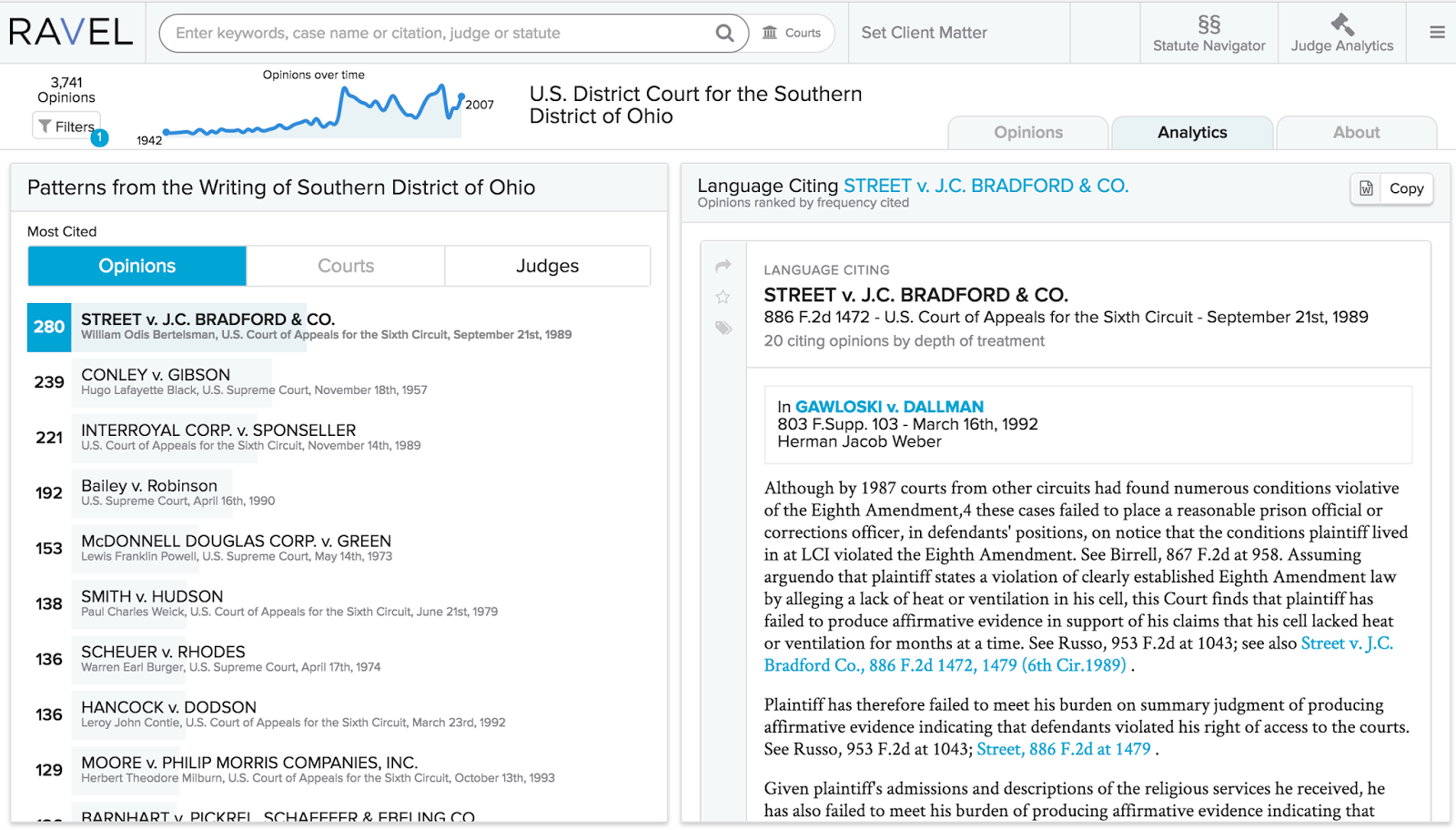
In December I offered readers the opportunity to respond to the 2016 Start/Stop Poll in which they could vote for the best new products and features and highlight the products that they planned to say good-bye to. The results of the process part of the survey are posted here.For the second year in a row Ravel Law Analytics has won the Dewey B Strategic Readers  “Start Stop Poll” for best new product. Lex Machina’s New Securities Module placed second. Ravel Law tied for best product in 2015 with Wolters Kluwer’s Cheetah search platform.

Ravel Law’s Court Analytics
 Additional products ( in alphabetical order) nominated by readers include:
  • Audit Analytics
  • D&B Onboard
  • Docket Navigator which is actually a patent analytics product
  • CARA from Casestext which reviews documents for missing precedent
  • Cheetah – Wolters Kluwer’s new platform replacing Intelliconnect which tied for first place last year.
  • iPad Pro 9.7/Pencil
  • Lex Machina’s Securities Module
  • LitIQ – linguistic analysis of documents
  • Luminance for product review and due diligence
  • Newsdesk – the LexisNexis news aggregation and curation platform.
  • Practice Point


 What was the best FEATURE/FUNCTION added to an information resource in 2016?
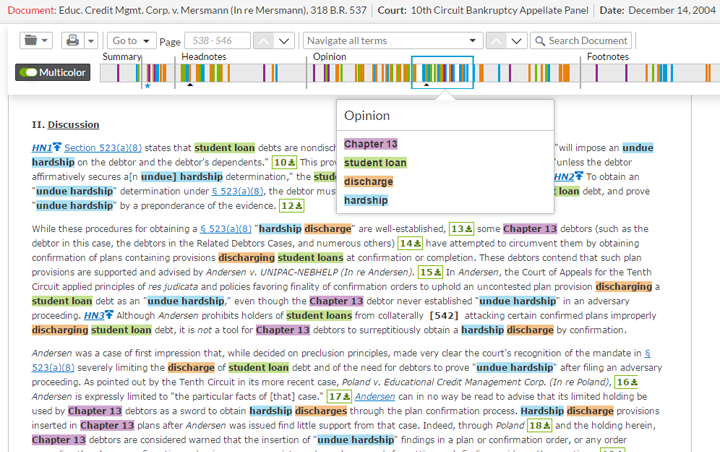
Lexis Search Term Mapping and navigation bar was voted best new feature added to an existing product.
LexisNexis Search Term Mapping
Additional features recommended by readers:


  • PDFs of significant complaints included in Court
    Wire emails for attorney self-service
  • “GRAB A” from Bloomberg Professional
  • Lex Machina Apps
  • Westlaw Answers
  • Practice Point
  • Bloomberg Law’s new business intelligence and
    analytics platform
  • Lexis Predictive Legislation
What PRODUCT did your department/organization STOP using in 2016 or plan to stop in 2017?
The perennial products on the chopping block are print materials as well as the high ticket Westlaw and Lexis enterprise contracts. As enterprise contracts for Lexis and Westlaw come up for renewal law firms grapple with the challenge of cancelling one and relying exclusively on the vendor. Only one respondent reported taking the sole online provider plunge by cancelling their enterprise Lexis contract in 2016.
Law firm budgets remain flat. The easiest way to bring in a new and innovative product is to cancel an existing subscription. The variety of products listed below suggests to me that resources monitoring platforms have enabled the surgical targeting of under-performing products. Information professionals are taking an active role in the strategic management of digital resources.


  • VC Experts
  • Hoover’s
  • RefTraker
  • InfoNgen (news aggregation platform)
  • West KM
  • CCH Cheetah
  • Practical Law
  • Lexis Publisher (moved to NewsDesk)
  • Courthouse News Service Jumbo
  • Checkpoint
  • ROSS
  • Debtwire
  • Intelligize
  • Capital IQ


What NEW INFORMATION/WORKFLOW PRODUCTS do you expect to be rolled out in your organization in 2017?
Electronic Resource Management products ( Research Monitor and Onelog  and Research workflow products  ( Quest and Reftraker)  were the two categories of products mentioned
most often as 2017 product implmentations to improve workflow.
Additinoal initiatives include:


  • We are looking at KM products
  • We have purchased a new intranet product and will be rolling it out in 2017.
  • Enterprise Proview for desk books from Thomson Reuters
  • Adding more Law360 modules.
  • BigSquare
  • Single sign-on/SSO/SAML for a variety of our legal research products, to eliminate the need for lawyers to have to enter credentials.
  • Lex Machina Antitrust Smart Tasks
  • Kira
  • Research Hub
  • Clarion BNA convergence dashboards
  • NewsDesk
  • I’m working on posting some of my technology
    sessions online using Panopto’s new quizzing feature.
  • Courtroom Insights
  • iManage — Document management system


 What product would you most like to see developed in Legal information technology area?
Improvements to access to litigation analytics from both state and federal courts with enhanced coding to improve strategic insights emerged as the leading product demanded by information professionals.


  • Access to all state court documents online, similar to PACER.  But better, and preferably free.
  • I would love for a way to be able to search across all the platforms we subscribe to, but I would even settle for a way to locate specific titles or products via a search. As long as that search doesn’t require us to catalog a vendor’s entire offerings!
  • State court complaints and dockets are coming online too slowly.  Disruption would be welcome in this category.
  • More transparent search engines.
  • We need a better financial system for tracking our expenses that goes deeper than our firm’s financial system allows.  An invoice often contains many titles, a mix of print and electronic, a mix of book versus subscription, and a mix of individual and department users.  We need a system that enables us to track AND REPORT at the granular level, preferably one that ties to Research Monitor usage and includes contract images, contract terms, licensed user info and more.
  • A litigation landscape tool that would allow you to more easily identify the high value cases (as opposed to the commoditized work) pertaining to a particular company. Lex Machina and Bloomberg are heading in that direction.
  • An easy-to-use “know your client” product that can produce reports and be used by “non-researchers”
  • Something that searches across all of our online subscriptions.
  • A low-cost news aggregator that provides info law schools need (and that we can afford)
  • I would like to see companies continue to improve access to dockets that have not been electronically filed and at reasonable cost.
  • Easier classification of emails into the document management system
  • A biometric device that will eliminate passwords.
  • Analytics


 What is your favorite app for personal use? (What do you use it for if it has multiple functions?)


  • Shazam
  • PocketCasts. I can organize podcasts by category (fun and work-related), sort and play podcasts set at specific speeds.
  • Words with Friends.
  • MTA bus time
  • Waze
  • Every Dollar
  • Google maps
  • Kindle app
  • Selfie Editor
  • Tile  app
  • Asana -online team and task management
  • Pinterest
  • Pokemon Go
  • “Find my IPhone”
  • Gas buddy locates gas stations and prices on a map.

Thanks to everyone who took the time to share their wisdom and insights with their colleagues.

Last night I delivered the Gillard Lecture at the St. John’s University Graduate Division of Library and Information Science. My presention was titled “Has the Librarian-ship Sailed?  Redefining the Profession in a Post Google World.”  I want to thank the program director Professor James Vorbach  for the wonderful reception. It was great to see a contingent of my LLAGNY friends who made the trek out to the Queens campus in the driving rain.  And then there was the inevitable technology glitch. An encrypted flash drive that would not run part of my presentation.

So Here it Is….The Missing “Wow Moment” of My Presentation

This Ted Institute video of Dario Gil on cognitive computing provides a jaw dropping scenario in which  a Watson enabled computer is responding to the types of complex business research questions which are fairly routine in a “big law” research environment.  In this video two business analysts are asking Watson to pinpoint companies matching specific criteria, industry, revenue, size. Watson can automatically populate a table with data after digesting a policy document.   But there is one major difference… between Watson and research specialist.


What About the Contextualizing Questions?
I intended to use the video to launch a discussion about how Watson’s performance compared to a live researcher? What would the future role be for Watson? A replacement for the research team or an adjunct “member” of the research team?

Complex research is a dialog. Researchers not only answer questions.. they ask them! This “socratic dialog” helps focus the requester on issues which provide important context for narrowing and focusing the research.

Without Big Data Skillsets – Big Data Could Generate Big Noise

Large data sets will play an increasingly important role in making new strategic insights available to law firms. As illustrated in the video augmented intelligence will speed the analysis once the data is identified. But someone has to select and vet the data. Information professionals possess the skillset required for making sure that “big data” is also “good data.”

Here is a short list of those skills:

  • The ability to locate the best and most appropriate data at the lowest cost
  • The ability to assess the quality of external data sources. All
    information is not of equal quality. The temptation to harvest free open
    source data could put a firm at risk especially if the data were to use
    used in advising clients.
  • The ability to assess the provenance of the data.  Is the data from a
    primary source? Or has it been handled and altered? By whom and how?
  • Expert knowledge of or ability to determine the reputation of the data source.  Is it known to be a reliable source? 
  • The ability to interview the requester and help them to define the scope and limits of their need.
  • The ability to query the data and uncover patterns which suggest
    the need to ask more questions or pursue additional lines of inquiry.           

Will the Future Give Rise to The Chief Query Officer?
Let’s face it…
In a Big Data world,  everyone will potentially have access to the same data…
In a Big Data world, advantage will be  gained by asking better questions….
In a Big Data world, every firm will be striving to be one question ahead of the competition…
…..And it will need to be the right question!
So will this give rise to the Chief Query Officer?


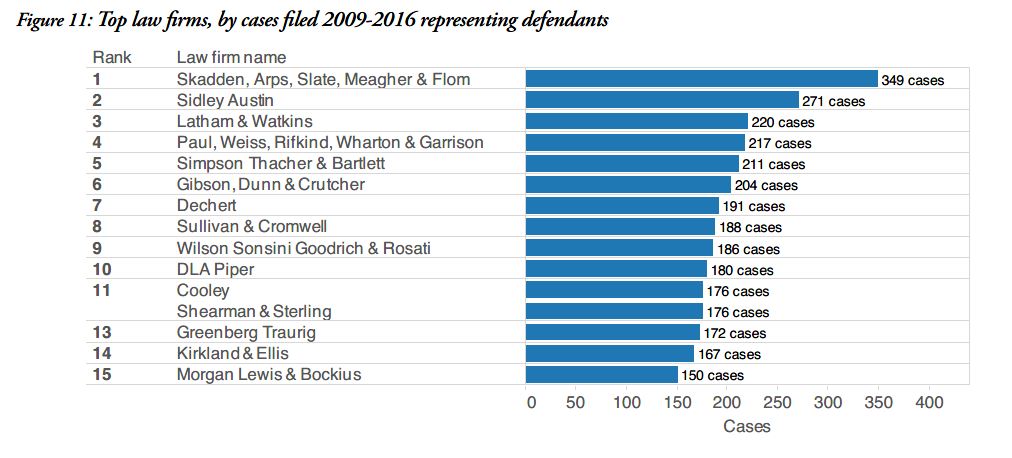
Only seven months after launching the Securities analytics module, Lex Machina has published their first  Securities Litigation Year in Review Report. The report examines key trends in securities litigation using data from 2009 through 2016. It also identifies the top plaintiffs, defendants their law firms and outcomes including damages.All cases are coded into one of the five categories of litigation: Securities Fraud
(§ 10(b) / 10b-5), CFTC Enforcement, SEC Enforcement Contested, SEC
Enforcement Settled Complaint and Shareholder
Derivative Suits.
SEC Enforcements With a Settled Complaint
 

Key findings on 2006- 2016 Trends:
  • There was a 23% increase in securities litigation in 2016 over 2015.
  • Citigroup, Merrill Lynch and Goldman Sacks are the top defendants
  • Goldman Sachs, Morgan Stanley and Credit Suisse  were subject to the highest damages (($5Billion each)
  • Approved Transaction settlement resulted int more than $32,5 billion in damages.
  • 25% of all securities cases were filed in the Southern District of New York.
  • Exchange Act violations are the most common cause of action.
Top Law Firms Representing Defendants
 A full copy of the report can requested and downloaded  here.

www.lexisnexis.com

LexisNexis has been on an extraordinary spree — buying up  companies that are almost always the brainchild of a former lawyer and always the product of entrepreneurial inspiration and grit.
The latest opportunity? target? victim? May be Ravel Law
Sources in the legal publishing industry are whispering that LexisNexis is about to acquire Ravel Law. I reached out to Daniel Lewis, CEO of Ravel Law and he politely responded with a “no comment.”

This would signal that LexisNexis is trying to dominate the legal analytics market the way they have grown to dominate the legal news market. Will Justly be next?

Lexis Content Acquisition Strategy? For the past few years LexisNexis  has been collecting legal content gems – Law360, Lex Machina, MLex, Knowledge Mosaic. Instead of integrating them into the massive LexisNexis organization, each company has remained a stand alone operation retaining their entrepreneurial culture, their key talent and their client relationships. The company has stated that core Lexis content is being leveraged to enhance the offering of the smaller companies.  This is a reasonable short term strategy. At some point Lexis should start aligning some of the content synergies to transform the old Lexis workhorse. Are they ready to do that?

The concern I have is that Lexis is collecting without integrating and streamlining. True they were showing of a limited integration of Lex Machina and Lexis at Legal Tech. This integration allows lawyers to see some analytics with their Lexis search results.

Is the “Tan Book” Litigation a Canary in the Coal Mine? Has Lexis Extended Itself Too Far?
I remember “Total Quality Management” business guru Tom Peters once commenting that companies must have a culture of quality. Coffee stains on the airline food trays suggest there might be something wrong with  engine maintenance.  Maybe not logical but   the “tan book” litigation issue does raise the flag of whether Lexis as a company can maintain the quality across their extended product lines. Most baffling is that Lexis asserted in an email to me that the “color books” are being created outside of Lexis. Think about that– they are not using the massive Lexis data streams which include updates of state statutes and regulations to assure that their annual statutory codes are kept up-do-date. I have visions of people with glue sticks pasting amended regulations over the old ones. Not a 21st century process. It begs the question “why?”

Why Don’t they Integrate and Build the Ultimate “Legal Research Service?”
This is the most baffling issue to me. LexisNexis has terrific assets that if combined could be game changing…. I understand wanting to keep the revenue from all of the legacy products but there is no evidence of an intent to integrate the products into a more powerful LexisNexis  platform.