Lex Machina is not a hard product to use. It is loaded with data and offers lawyers an infinite landscape of  data permutations. As I have often said “lawyers don’t want research products that make them feel like they are wiring a powerplant. They want to flip a light switch.” In 2014 Lex Machina launched three desktop ‘” apps”: the early case assessor, the motion kick starter and the patent portfolio evaluator.  These are the “lightswitchs” of litigation data discovery. Today they are announcing the release of two more “apps” the court and judges comparator and the law firm comparator.

Each of these new functions takes what was formally a multistep process and provides a ” fill in the blanks” template which in one click produces a set of charts comparing  up to 4 courts judges or law firms using custom selected criteria.
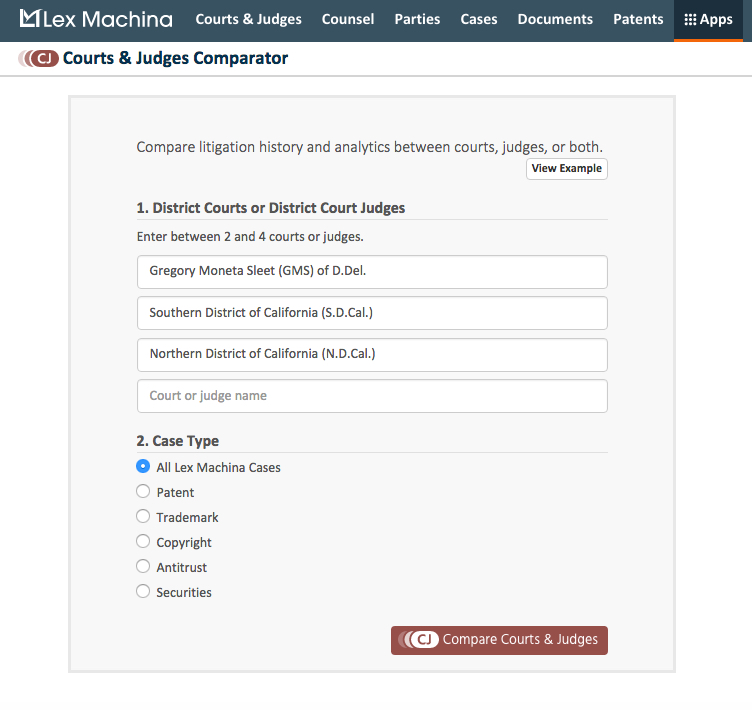
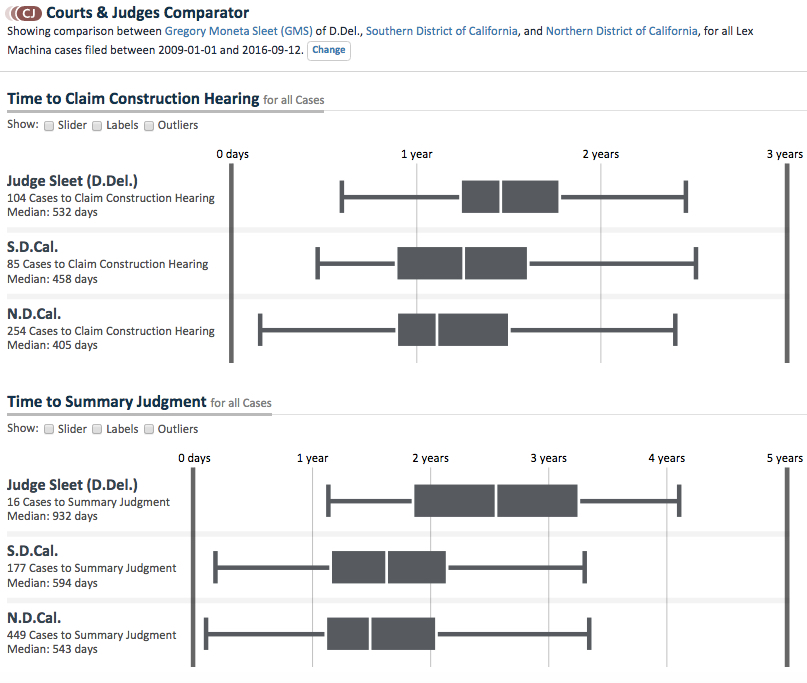
The Court and Judges Comparator
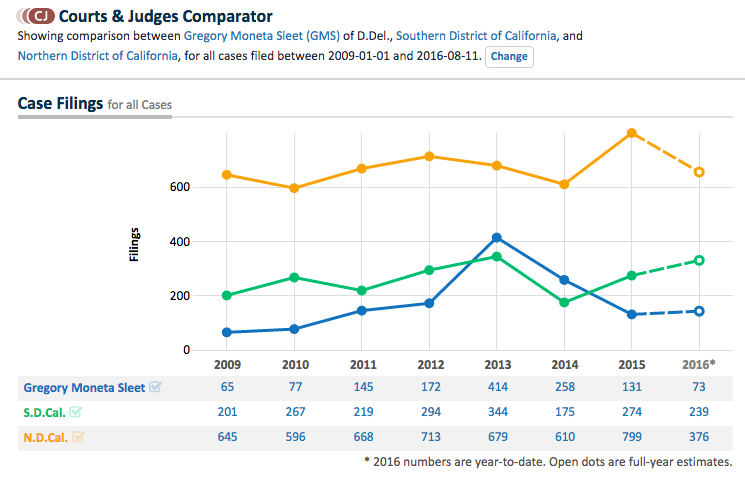
This function allows a lawyer to compare up to four districts or judges. There are two basic “use cases” for this app. One is forum selection:  comparing  trends in districts in order to determine the most  favorable jurisdiction in which to file. The other is to compare an assigned judge to alternate jurisdictions for when  considering a motion to transfer. In each scenario up to four judges and courts can be compared along multiple criteria: trends in case filings, assessing the expertise of the judge, average time for a  preliminary injunction grant, average time to  dismissal,  average time to claim construction, average time to summary judgment,  average time to trial.

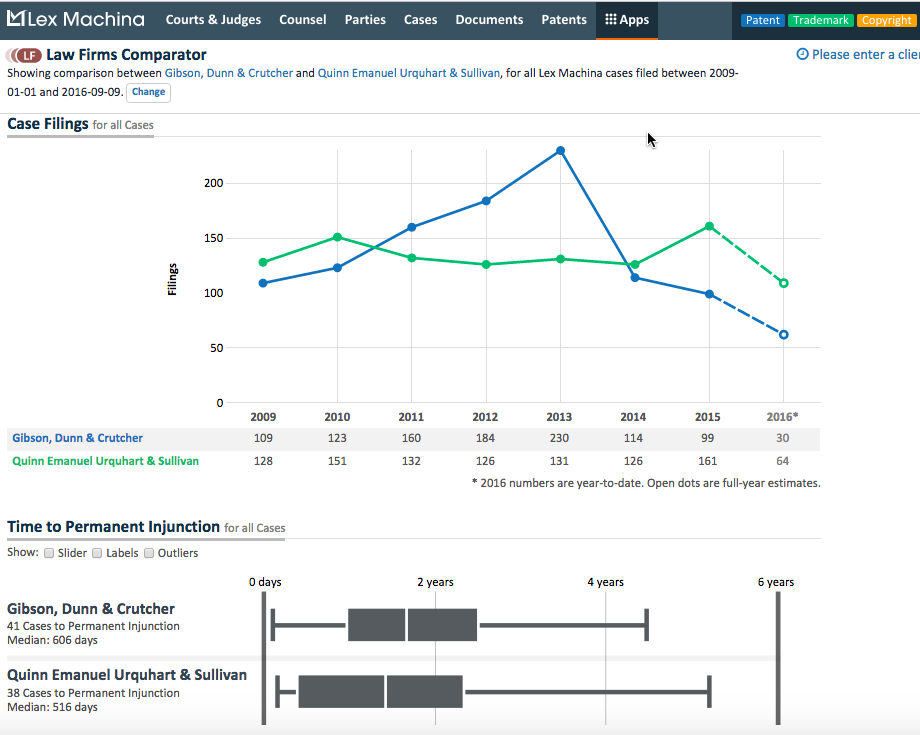
The Law Firm Comparator

This new app can be used by outside counsel in selecting law firms as well as by law firms seeking new business. A law firm can compare themselves to three other law firms across multiple criteria  including: volume of cases, number of open cases, number of terminated cases, party roles, success rates and remedies. GCs can compare existing outside counsel with competitor firms using these same types of metrics.
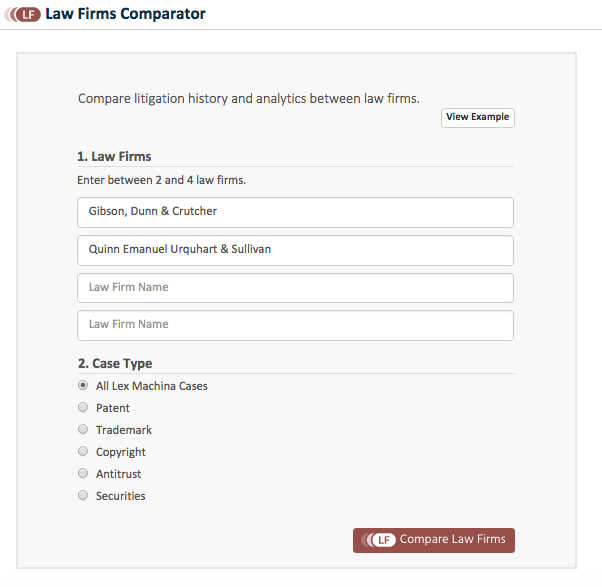
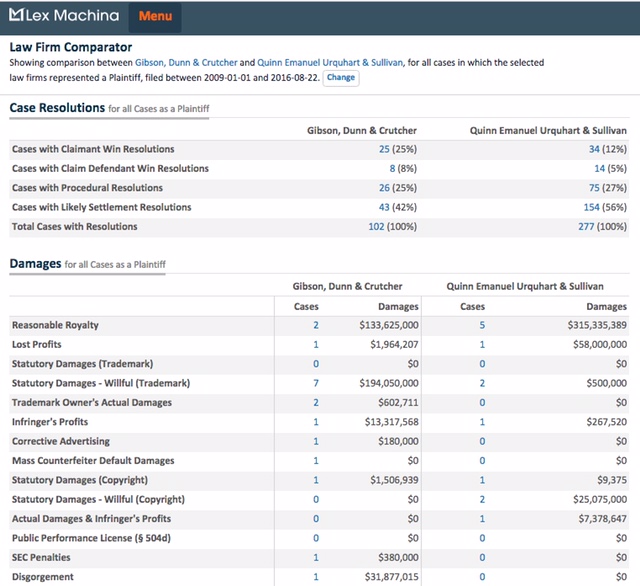
Even though the apps makes the production of comparative charts easy,  the expertise of a lawyer is still required to assess the meaning of the data and trends produced by the comparators.

The Lex Machina apps are “an add”  on to the Lex Machina subscription.

When I interviewed Owen Byrd, Lex Machina’s Chief Evangelist and General Counsel for this post he indicated that the engineers  at Lex Machina
would continue developing what he refers to as “easy buttons” for lawyers. New apps could include comparators for parties and individual attorneys– which I agree would be welcome additions to the comparator family.

Keep the “easy buttons” coming!

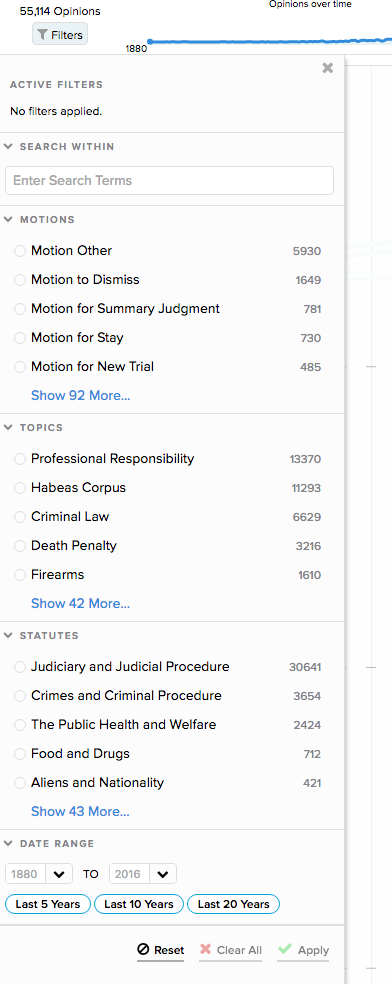
Last week Ravel Law announced a significant new enhancement to their caselaw research product. This new feature will enable subscribers to filter caselaw by  more than 90 motion types. Cases can now be searched by motion,  topic or  US Code section citations.
Ravel’s Motion Filters
Ravel employs advanced search algorithms to provide unique visual analytics in displaying caselaw search results.
t
Ravel Caselaw Analytics
 
Free the Law   Last year Ravel  partnered with the Harvard Law School on as special project to make all US caselaw available to the public. Ravel offers a free caselaw platform which currently includes all federal caselaw and the complete archive of caselaw from several states. They are working with the Harvard Law Library to complete the scanning of approximately 40 million pages of cases from the Law Library collection. The project is scheduled for completion in 2017.
Ravel also offers premium subscribers a “judges analytics” module which provides insights into judges precedential behavior in writing opinions.


Awards should not be announced over long holiday weekends. I almost missed the publication of the ABA Magazine 2016 Legal Rebels.

 I was delighted to see that lawyer/ librarian and information provacateur Sara Glassmayer was at the top of the list. Glassmeyer  who is currently a Research Fellow at the Harvard  Library Innovation Lab published the first census of  digital state primary source materials earlier this year. I reviewed Glassmeyer’s “census” free legal information last January. The report outlined the substantial shortcomings and inconsistent availability of “free”primary source information from each of the 50 states.

Additional Rebels in the legal information field include:

Guriner Sangha, lawyer and serial entrepreneur has been highlighted in Dewey B Strategic for founding two inf Intelligize and LitIQ.

Jimoh Ovbiagele  one of the founders of Ross Intelligence, the AI legal research system which has been grabbing headlines all year.

Also of note:

Deborah Read, managing partner at Thomson Hine’s profile highlighted the important role of the firm’s library and knowledge resources in helping her prepare for her new role as managing partner and transformation agent.

Congratulations to all the 2016 Legal Rebels! See the complete list of “rebels” and read their profiles here.


On Tuesday BloomberBNA’s President David Perla published a post on Above the Law lashing out at law firm “gatekeepers.” I am a big fan of the Bloomberg products and I think Perla brought a necessary entrepreneurial perspective to BloombergBNA. But Perla’s post was uncharacteristically condescending and well… snarky…which made me wonder if BloombergBNA was facing some kind  crisis or to use Perla’s phase “an inflection point.”  Was Perla really  suggesting that Bloomberg’s inability to displace Lexis and Westlaw was  the result of “ gatekeepers” and not at all the result of Bloomberg’s own market miscalculations? In fairness, most of these miscalculations predate Perla’s tenure….

When Bloomberg Law was re-launched in 2011, I interviewed Lou Andreozzi, the first BLaw CEO. Andreozzi anticipated that Bloomberg Law would take “significant  market share” away from Lexis and Westlaw. It is now 5 years later and I think it is safe to say that  BloombergLaw has not significantly eroded Westlaw or Lexis market share. Andreozzi’s  statement was made before Bloomberg purchased the Bureau of National affairs publishing company – so today some of Bloomberg BNA’s market share would be attributable to BNAs “preexisting  installed base of subscribers.”  Since Bloomberg is a private company there are no public filings to be examined. But one way to assess market penetration would be to compare how many ALM 100 law firms have enterprise contracts for each of the three major legal research platforms.  I am aware of fewer than 10 ALM law firms that have signed enterprise licenses for the full BloombergBNA legal research platform.* Lexis and Westlaw remain entrenched in the vast majority of ALM 100 law firms.

In my opinion Bloomberg Law should have been adopted by more law firms by now. It weaves business and legal content together seamlessly– but this unique approach was not enough to overcome the market’s primary objection. Bloomberg Law entered the market at the worst possible time – at the height of the Great Recession. Then Bloomberg executives made some strategic decisions which I believe have had a lasting and significant impact on the company’s ability to displace its competitors.
The product was priced too high.In 2009 when Bloomberg Law launched, the market was ready for a disrupter… at the right price.  Although Bloomberg Law was only partially built out, it was priced on par with Lexis and
Westlaw. Lexis and Westlaw enterprise contracts had ballooned between 1980 and 2000 because online research costs were being passed along to clients. By the time Bloomberg Law launched, clients were pushing back and online costs were viewed as overhead to be born by law firms. Bloomberg was right that  lawyers were ready to stop billing clients for online research but wrong about the price they would pay to achieve that
goal. Bloomberg didn’t recalibrate the Lexis and Westlaw price benchmarks down to a level which could be easily absorbed as overhead by a law firm.

 The citator problem. Bloomberg Law launched as a litigation research product, but lawyers didn’t understand or trust the product’s citator. There were early problems with the citator which slowed adoption of the citator even after the problems were corrected.

Courts wouldn’t accept Bloomberg Law citations in briefs. As recently as 2015, most federal judges were not accepting Bloomberg Law citations in briefs. This is serious shortcoming for a product which is sold with a premium price tag. It also meant that firms “had to” maintain a subscription to Blaw’s competitor products. It is simply hard to me to believe that Bloomberg could not have done something to accelerate the federal judges access to Bloomberg Law… Seven years is a long time for a major product to lack this major “use case.”In recent years Bloomberg has moved beyond being a caselaw research system. Bloomberg Law Transactions offers very sophisticated workflow and analytics capabilities. But the shortcomings outlined above had already burned through  some customer confidence and good will. Bloomberg executives, even to this day seem reluctant to “own” the impact of these product shortcomings.

Missing the Early Big Data Opportunity. Maybe Bloomberg should have started with a product for transactional lawyers rather than one for litigators. In 1982, Mike Bloomberg successfully disrupted the financial data market when he  launched Market Master (later renamed the Bloomberg Business terminal) to compete with Telerate and Reuters. Bloomberg decided to go beyond reporting market prices and started adding calculation functions to the terminals. As a company rooted in “big data” and analytics, Bloomberg was ideally positioned to launch a truly disruptive early “big data” product for transactional lawyers …. But instead …  they loaded and coded gigabytes of caselaw and attempted to compete with Lexis and Westlaw in the well established and increasingly commoditized case law research market. Was that the most innovative and “disruptive” approach to the legal market? Seems odd that Perla  would find  fault in law firm customers rather than in his company’s strategic choices in pricing and product development.

AALL has released the September/October  issue of Spectrum magazine. Articles of interest to law firm leaders include:

  • Zena Applebaum on 10 Best Practices for Competitive Intelligence;
  • Rand Christianson on managing your PR message;
  • Michael Saint-Onge – Upping Your Swagger
  • Sarah Mauldin and Diane Koppang on Legal Analytics
  • Mark Gediman on Artificial Intelligence
  • Jean O’Grady on 13 management behaviors which increase the risk of outsourcing

Additional articles of interest include an interview with Dean Sonderegger, VP of Wolters Kluwer Legal Markets and Innovation; a profile of incoming AALL President Ron Wheeler and a tech column  recommending 5 cool tools.

You can link to the entire issue here.

Last October Thomson Reuters announced the acquisition of a UK based company Business Integrity which had developed a document assembly product called Contract Express. According to the press release the product had already been adopted by an impressive list of Magic Circle” and Am Law 100 firms. The
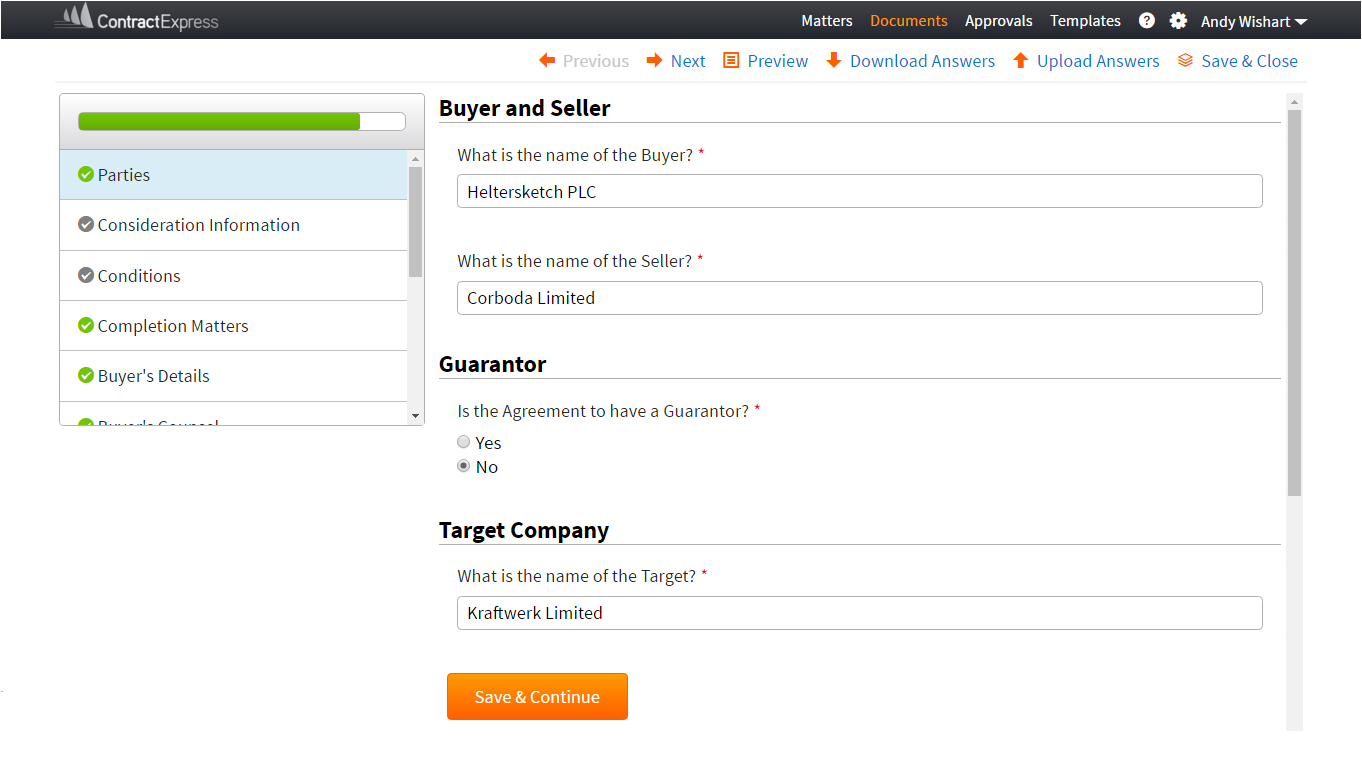
product offers enterprise licenses for large law firms and corporations.  I recently spoke with Andy Wishart, Global Head of Contract Express, to learn about the product and to get an  understanding of where it fits in the constellation of Thomson Reuters drafting products. According to Wishart, Contract Express can reduce the time a lawyers spends getting to a first draft by 82%.  Wishart Views Contract Express as a “second
generation” product which will lower the barrier of entry for “non-technologist“lawyers.
 Law firms are using the product internally to streamline the production of high volume documents. Several firms are leveraging the product as service for existing and potential clients. Corporations are integrating the product with Salesforce.com and provide employees with a self service document portal.  Contract Express can be
linked to a firm’s CRM and can integrate with Docusign.
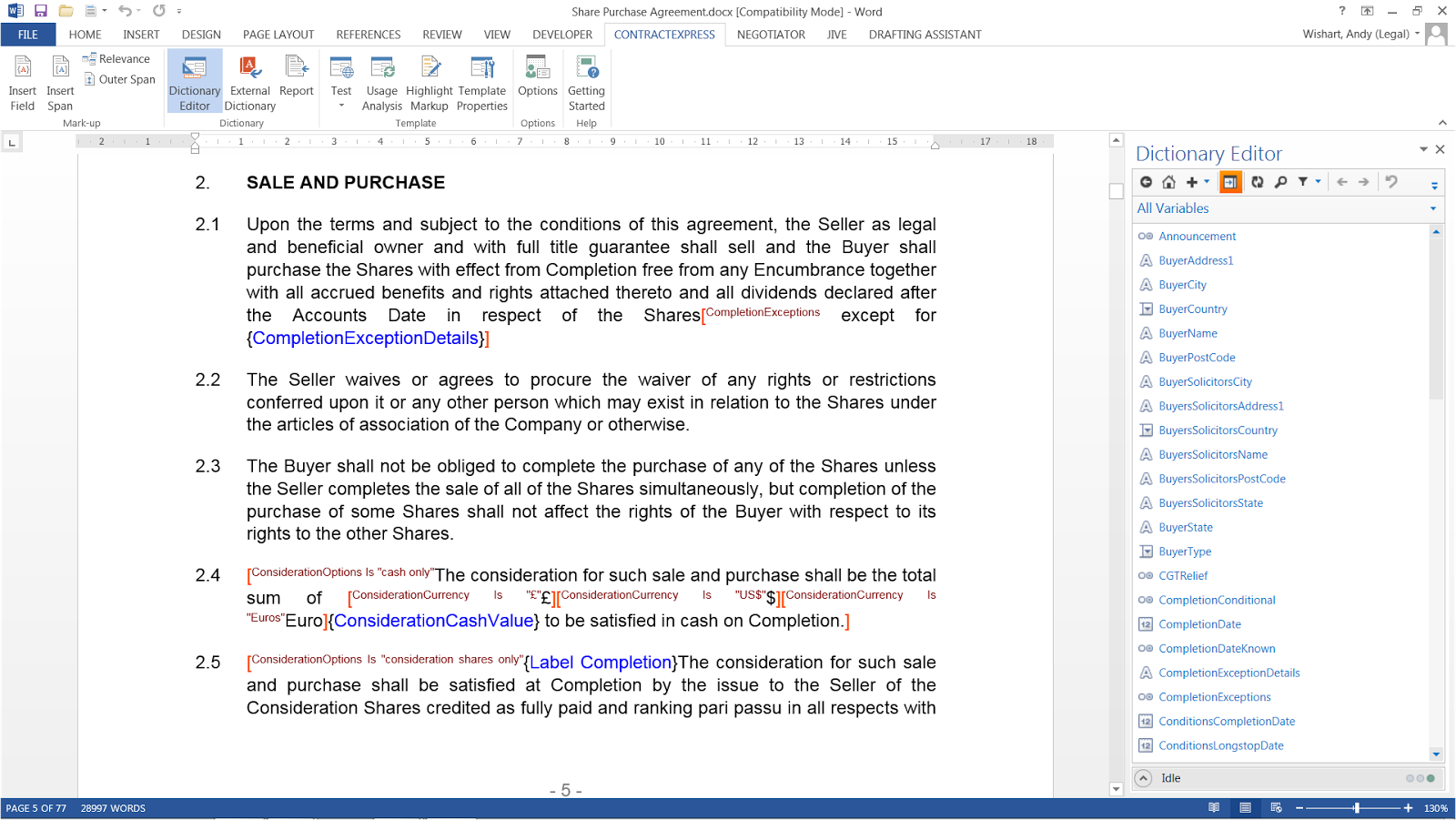
Contract Express Dictionary Editor
 Document assembly always sounded like an easy solution to me. But apparently many document assembly programs used by lawyers still require technical expertise  to create the templates. This requirement is often a bottleneck
which constricts the number of templates a lawyer or practice group can create.
The Contract Express website describes the productsadvantages:
“Unlike all other document automation products, Contract Express document automation understands lawyers’ “square bracket” legal markup notation. There’s no programming notation, no XML markup, no hidden codes or fields, no questionnaire scripting,
no use of proprietary editors, and no need to reapply styles to generated documents. This capability is unique to Contract Express contract automation software and protected by thirteen granted US patents with more pending.”
 I am not an expert on document assembly issues and I can’t comment on the uniqueness of the features listed above, but I have seen the product and I was pretty impressed. In June, Contract Express 6.0 was released and it offers several impressive new features:
Datasheets, Matters, Document Versioning and Contract Express Author.
Datasheets feature enables users to create dynamic views of the transactional information contained in documents
created by Contract Express. This advanced feature allows law firms and their clients to gain greater insight into their automated documents, surfacing valuable information such as key dates, non-standard clauses, deal values and more.
Document Versioning Documents created by Contract Express 6.0 are now fully versioned, meaning users can upload and share
manually edited documents with internal users and clients.
Matters The matters  feature in Contract Express 6.0 makes it possible to group one or more document templates around a specific
legal matter.The relevant answers in the questionnaire are populated in related documents. Its new Workflow Steps feature allows template authors to suggest the next template within a matter and ensuring necessary steps are followed.
Contract Express Author eliminates the need for creating a separate questionnaire, document, and metadata program. After a
lawyer marks up their template, Contract Express processes the Word file and automatically generates the questionnaire to guide lawyers and other users through a document.
Contract Express Questionnaire
Contract Express for Client Portals and Marketing Several law firms are using contract express as a differentiator. Seyfarthlink and Baker Donelson have portals that enable clients to enter to a branded Contract Express website. Clients can create documents in a self-service environment. Cooley LLP offers a free suite of Contract Express generated documents for start-up companies on its CooleyGo
website. Seyfarth Shaw offers clients Contract Express generate ddocuments on its SeyfarthLink portal.

Contract Express Integration with TR Drafting Products. According to Wishart,  future developments will include the integration of Contract Express into two other Thomson Reuters products: Practical Law and Drafting Assistant. In the near future a lawyer will be able to select a document from Practical Law hit a “draft” button  and use that document to create a Contract Express template, which is tailored to the needs of his or her client.

Given the relentless pressure on law firms to streamline workflow and develop innovative client support products, Contract Express is hitting two of the “hot button” issues which always get the attention of law firm leaders.

Thomson Reuters is currently offering free trials of Contract Express.

The July issue of Thomson Reuters Practice Innovations, highlights issues facing information professionals. Articles explore the current state of AI, Innovation in practice, Outside Counsel Guidelines,  Sustainable KM, CRM Data Quality and  New Career Paths  for information professionals. The full issue can be accessed here.

The Changing Focus of AI: Classic AI, Artificial Neural Networks and Biological Neural Networks.
by Elaine Egan, Shearman and Sterling,LLP  and Kathy Skinner, Morrison & Foerster, LLP

Thinking Outside the Stacks:  New Career Paths for Information Professionals
By Jean P O’Grady, DLA Piper, US, LLP

Unleash Your Innovators,
Ryan McLead, High Q

Outside Counsel Guidelines: Navigating the Changing Landscape of Client Demands
By Toby Brown, Perkins Coie, LLP

Sustainable KM,
by V Mary Abraham, Above and Beyond KM

Managing the CRM Abyss:Winning the Battle for Data Quality
By Krystyn Sornat, Sornat Consulting

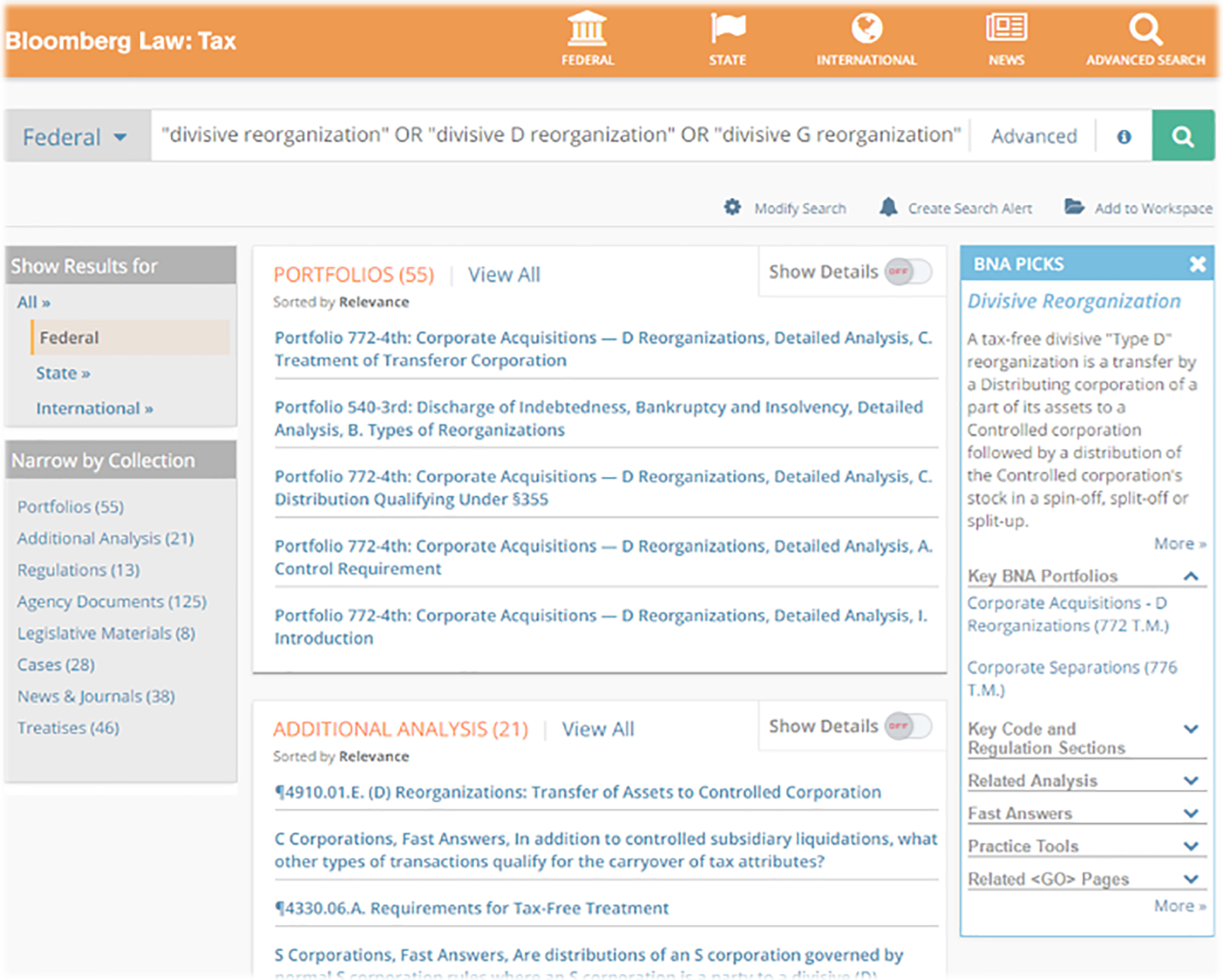
Anyone who has worked with tax lawyers knows that tax lawyers are different. They have a very exacting and demanding expectations for their tax resources. BloombergBNA recognized these high expectations when they undertook the development of a new tax platform.  The tax product  team spent two years and thousands of hours observing exactly how tax lawyers solve tax problems using BloombergBNA’s products as well as their competitors’ products. The result is a clean and intuitive dashboard offering both core tax resources and secondary materials as well as some totally unique new content and features.

Bloomberg Law Tax is “portfolio centric.” BloombergBNA has taken their most prized editorial editorial content and placed them in the center of the new platform. The Tax Management Portfolios are the “granddaddy” of practice guidance tools. Each of the more than 500 portfolios offer deep and practical advice on each narrow portfolio topic. Portfolios now cover federal, state and international as well as trusts and estates.

The portfolios are front and center in the platform design. A lawyer can easily search for a portfolio number or a IRS code section to begin their search. The editors of Bloomberg Law Tax wanted to build a “one-stop-shop” offering everything a tax practitioner could need in one place. Bloomberg Law Tax has all of the core “must have” primary content and extensive secondary analytical and practice material. Content is accessible using a variety of techniques including, keyword search, Boolean, and browsing topics.

Although most attorneys start their research with a  search, Bloomberg BNA has retained features which appeal to fans of portfolios in print. The portfolios can be navigated using an expandable table of contents, so that lawyers can have a “book-like” reading experience.


Cool tools – Let me take a moment to highlight what I regard as the coolest and most unique features of Bloomberg Law Tax. These include:

  • Transactional diagrams illustrate more than 800 complex fact patterns and link to the related portfolio.
  • International tax forms with translation from 70 foreign countries
  • International VAT navigator
  •  A state tax “nexus tool” creates a custom questionnaire that a client can use to determine tax liability in various jurisdictions.
  • Tax treaties includes original language version, and translation. Protocols highlight languages that has changed.
  • Base Erosion Profit Shifting BEPS tracker  – a “hot topic” in international
  • An archive includes full  IRS code versions back to 1913
  • Current codes update as changes occurs and include future effective date.
  • Fast answers – provide answers to common questions with a link to primary source of answer.
  • The citator includes regulatory materials.
  • Custom Chart builders: State comparison charts can we sorted by topic or jurisdiction and provide  answers and summary of relevant law.
  • International chart builders provide comparison of tax rates  across 114 countries.
  • Hot News tool – crawls state agency websites for latest developments which can be filtered by topic and state.
  • Workflow tools include research trails, electronic folders and notepads.

The End of the Line for Print Portfolios? Can Bloomberg Law: Tax convert the diehard print portfolio fans to a digital platform. Those of us who hire filers to comb pages into the portfolios week after week, can only hope that a platform offering digital portfolios which are updated on a daily basis and which offers “one click” access to all underlying caselaw, codes, regs and collateral materials will be a sufficiently compelling alternative to even the staunchest bibliophiles.

Access. Bloomberg Law Tax is available to all current Bloomberg Law subscribers  at no additional cost. It is also available as a stand alone subscription.

In Recent years the exhibit hall at the AALL Annual
Meeting & Conference has become a “go to ” destination of 
legal start-up executives  who act as
“roving evangelists” offering elevator
pitches and a quick demo in hotel lobbies and coffee shops. 
Image result for casetext logoThis year  in Chicago, I was “pitched” when I walked into the conference room
where I was about to moderate a panel on AI entitled “Can Robots Be Lawyers? “  Pablo Arredondo, the VP of Research at
Casetext offered to  show me a new
product called CARA.  After a brief demo,
I was interested enough to schedule a follow up webex.
Roving evangelists
I love talking to legal tech entrepreneurs. Having been
trained in traditional  legal research tools
and analytical techniques – I  love the “a-ha”
 moment when I realize that a new product
has  uncovered insights into data that
was essentially “hiding in plain sight.”  I had one of those moments in the CARA demo.
 
Casetext  which offers
free caselaw research, access to  analytical memos from 150 law firms and a “crowd
sourced “citator called  “We-cite”  is launching their first “fee based” product:CARA. Casetext
currently includes over 7 million primary  documents including case law from all 50
states. CARA stands for Computer Assisted Research Assistant.
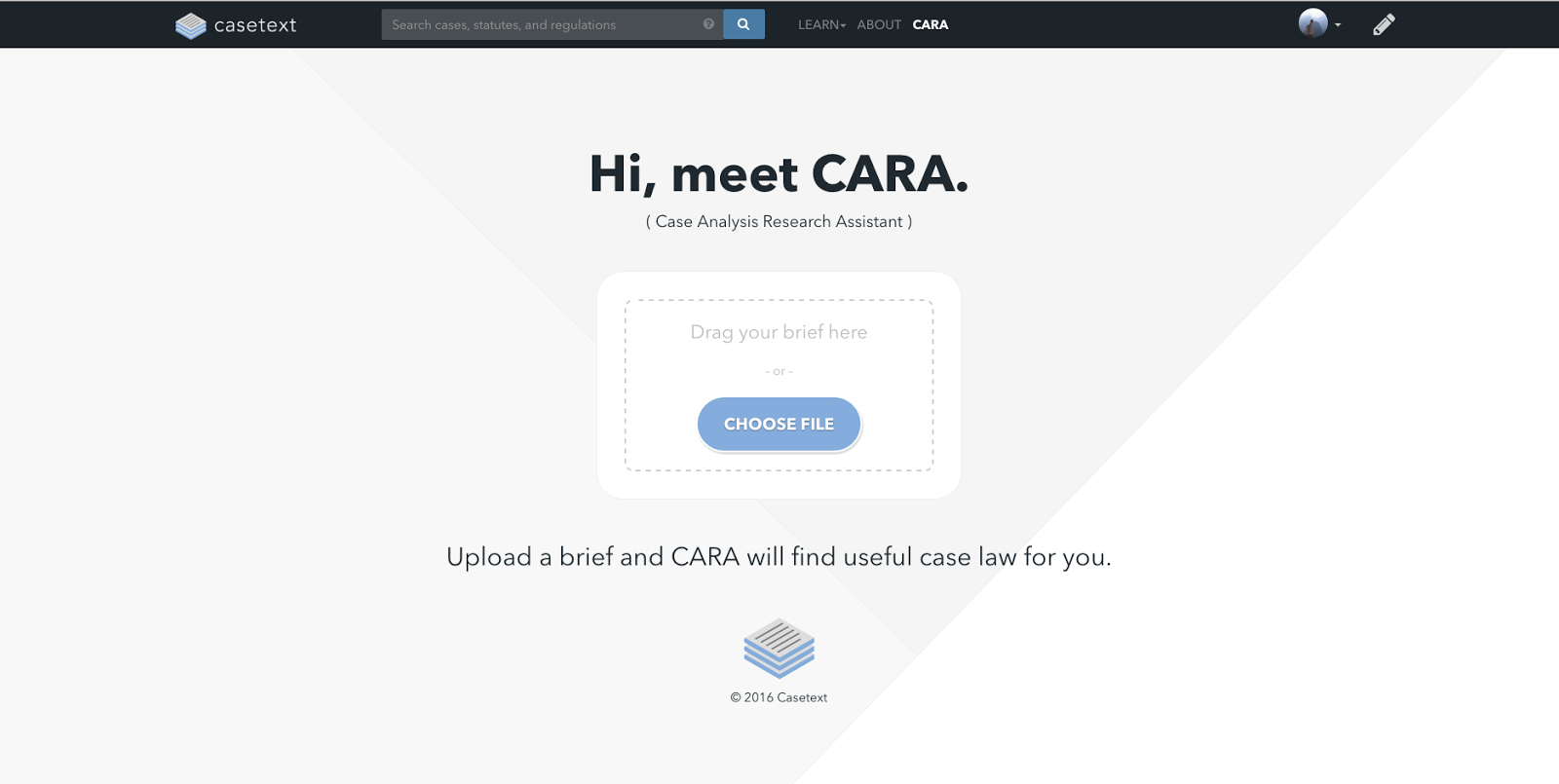
Drag and Drop document here

The Brief as Query.
CARA is very easy to use. All a lawyer has to do is drag and drop a brief into
CARA. Instead of searching with keywords, CARA uses the entire brief as the query
. CARA  data-mines the brief by
extracting both the text and the citations  from the document. The CARA analysis looks at
direct relationships and “implied” relationships between the cited cases in the
 brief and related opinions in the Casetext
database. CARA  uses latent semantic analysis
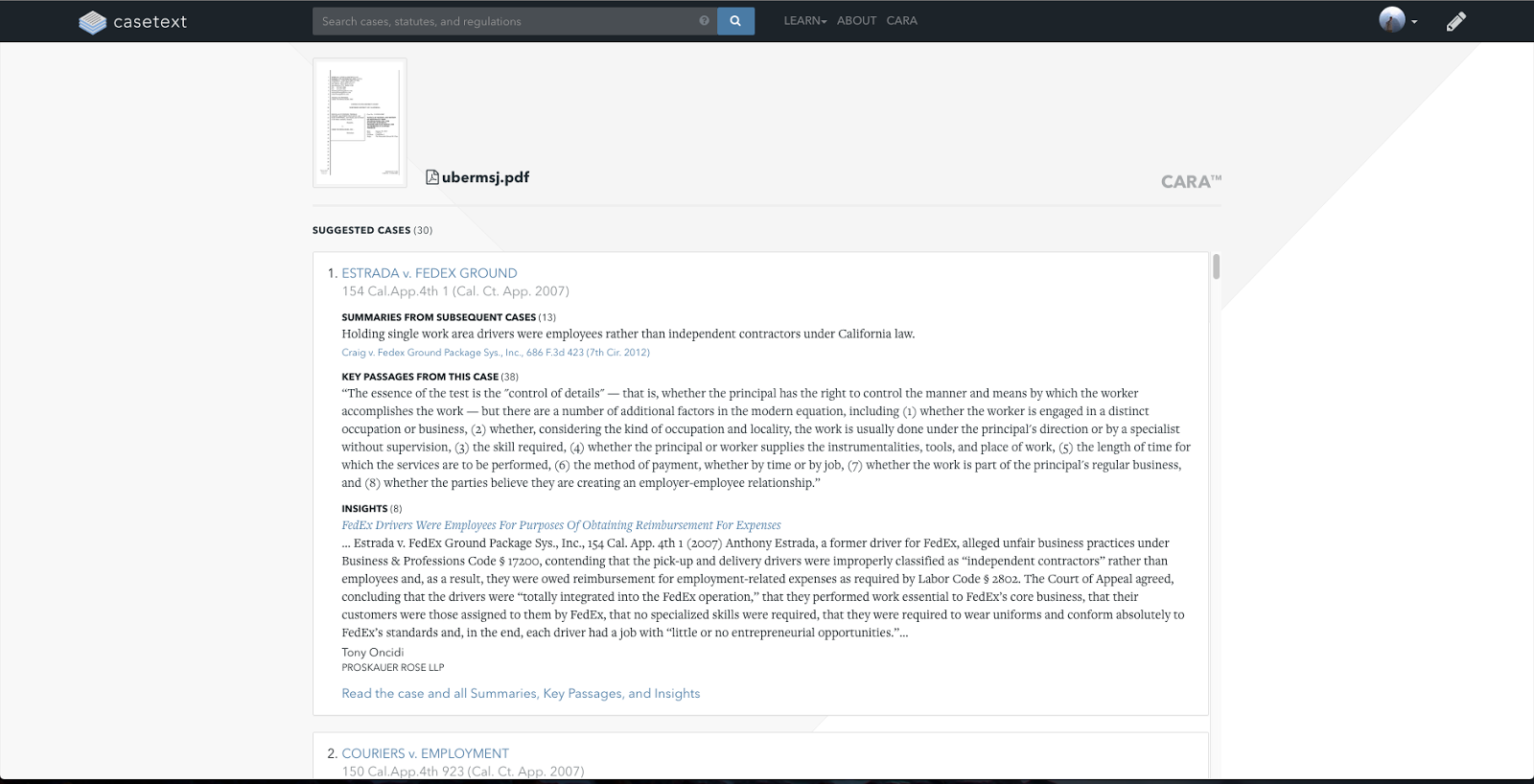
to sort the results. The CARA results report includes a list of “suggested
cases” and a CARA generated analysis of those cases.

                Suggested
Cases
– identifies cases not included in your document, which should be
reviewed for relevance before finalizing a brief.  A concise summary includes a citation and the
case holding derived from judicial “explanatory parentheticals.” There is a
direct link to the full text of the opinion on Casetext. If a lawyer is
analyzing an opponen’ts brief – this feature could identify vulnerabilities.
                Most
Cited Passage
– identifies the most cited text from other opinions.
                Insights
–  provides links related law firm memos
discussing the case

CARA results screen

Arredondo emphasized that Casetext understands the security
concerns of law firms. Casetext does not retain any brief – extracted data is
deleted after CARA delivers a report.
 

The evolving
vocabulary of legal research
New features and functions require their own taxonomy. CARA
is delightfully rich in new research concepts. Arredondo  describes the text and citation analysis  as  a citation fingerprint within the
document which analyzes how much that case discussed  and assesses “depth of treatment.”
Arredondo described “explanatory
parentheticals
” as the functional equivalents of case summaries written by Westlaw editors. An explanatory
paranthentical is a concise statement of a cited cases holding. The citing judge
signals the explanatory parenthetical with words such as “finding that, holding
that, concurring that.”CARA is the first system to  leverage  judge generated summaries, which are ubiquitous
throughout the common law.  So far
Casetext has identified 2.4 million  parenthetical summaries. Arredondo anticipates
 that the company will create a searchable
database of explanatory parentheticals which he describes as a “celestial treatise footnote.”
Geeks and research nerds like myself can look forward to reading
Arredondo’s  article  “Harvesting and Utilzing Explanatory Parentheticals
“ 1 LEGAL INFO. REV. 31 (2015-2016) which was just published.
What is the unique
value proposition?
According to Arredondo, several ALM 100 litigation
powerhouses are already running trials of CARA. CARA is positioned to
supplement rather than replace the major research services (Lexis, Westlaw,
BloombergBNA). Arredondo sees CARA as enhancing the speed of a final review of
a brief by quickly identifying cases that a lawyer may have missed.  CARA will also continue to be enhanced with
new features. A jurisdictional filter is expected to be released in the next few weeks.


ThomsonReuters Drafting Assistant will review a brief and  check if citations are valid but it does not
explicitly direct a lawyer to cases they may have missed.
Ravel Law’s Judge Analytics also provides unique insights into judges
precedential behavior  using historical
citation trends (Identifying which cases judges tend to cite to when they rule
in favor of or against a motion.) While Ravel provides insights driven by
judges, CARA provides insights driven by briefs. Ravel can be described as “judge
sourcing.” CARA can be described as “brief sourcing” their insights.
Do missed cases really matter? According to Arredondo, when  he recently provided training to  Clerks in the
Northern District of California,  they said that in drafting opinions they invariably reference decisions that were absent from both parties briefs.
Free Trial of Cara:
Anyone can setup a free trial at this link:
Yes Libraries are Shrinking Now What?

Two weeks ago American Lawyer Media released it’s 2016 library survey with the unfortunate headline “Downsizing continues at  law firm libraries.”  The headline is problematic for two reasons: 1. Shrinking libraries are old news and 2. Information professionals are driving some of the most important new technologies into the practice of law…. and yet this is not worth examining?

I certainly appreciate the effort ALM puts into the survey, but I suggest that it is time to reframe the entire survey so that more meaningful questions can be explored. Defining the survey as a “library survey” seems to have skewed both the lines of inquiry and the analysis. We are more than our books or lack thereof!


1. Old News. Would it surprise you to learn that the first library survey headline in 2002 was “The incredible shrinking library.” The vast majority of headlines for 14 years have focused on the print to digital transformation.

See for yourself  below. Keywords from  14 years of survey headlines: Downsized, digital, bookless, shrinking, less, squeeze, fewer…..

  • Downsizing Continues in Law Libraries. July 2016
  • The Bookless Library; Recent redesigns speak volumes about the changing role of firm libraries and the librarians who oversee them.  July 2015 
  • Beyond Recovery; Firms may soon be forced to throw in the towel on recouping online research costs, our annual librarians survey suggests.  July 2014 
  • Law Librarians Survey: The New Normal; Librarians have gotten accustomed to squeezing more out of their budgets, according to our 12th annual Law Librarian Survey  July 2013 
  • Law Librarian Survey: Read All About It; why are big-firm libraries slow to buy e-books?  July/August 2012 
  • Law Librarian Survey: The transition from print to online is full of glitches, our tenth Law Librarian survey finds.  July 2011 
  • Law Librarian Survey: More Bang for Fewer Bucks; Even as the recession levels off, law librarians challenge vendors’ pricing models. July/August 2010 
  • Law Librarians Survey: No More Sacred Cows  September 2009 
  • Going Digital; Caught Between the Paper and Electronic Worlds. Librarians Try to Speed Service and Corral Costs. AmLaw Tech; A Supplement to The American Lawyer; Library Survey  June 2004 
  • Less is More; Library Survey  June 2003 
  • The Incredible Shrinking Library Library Survey  June 2002 
  • 2. The Real Story of Innovation: The real headline of the 2016 survey was buried in the subtitle: ” Law libraries are phasing out print collections and reinventing themselves as sources of competitive intelligence and analytics.” Librarians and information professionals “own” one of the most critical areas of law practice transformation:knowledge. Innovative information products from the major vendors: Thomson Reuters, Wolters Kluwer, Lexis Nexis and BloombergBNA  as well as a raft of startups (Ravel, Fastcase, Casetext, LitIQ, Intelligize, Manzama and PacerPro — to name a few) are offering lawyers new insights and workflows leveraging augmented intelligence, big data insights, predictive analytics, intelligent documents and linguisitic analysis.

    Time to Change the Name of the Survey to Reflect Knowledge Innovation

    Last year the membership of the American Association of Law Libraries embarked on a controversial re-branding exercise. Members were asked to consider changing the name of the organization to the “Association for Legal Information.” I was a strong advocate for the name change and I believe that the ALM survey illustrates the problem of being identified with “libraries.”  As long as information professionals are seen through the shrinking prism of “libraries” we are defined primarily by our books… or the absence thereof. For some reason the book issue blinds people to the broad and critical roles we play in building knowledge enabled law firms.

    The 2016 “library survey” asked plenty of questions on emerging issues but these positive trends are downplayed and get only cursory treatment at the end of the article. There is an overblown examination of a “micro-trend”  in outsourcing  of library staff who are primarily involved in … you guessed it …book management not knowledge innovation.  By contrast…Between 10 and 20% of the survey respondents are involved in introducing analytics, machine learning, AI, workflow improvement and big data dashboards. Seventy percent are managing the exploding demand for competitive intelligence. These trends are the ‘green shoots” of law practice reengineering. Is not more recognition warranted? 

    Let’s Help ALM Rename the Annual Survey: Please send me your suggestions and I will pass them on to ALM. If we want to be known for what we are building and not for what we are shrinking we need to redefine the landscape of our influence.

    I will throw out my first suggestion: How about … “The Annual Survey of Knowledge Innovation”