The Poll: Please take
the brief (11 question)  2014-2015 Start
Stop Poll here.

New Year, New Beginning I am a great
believer in the New Year as offering us a New Beginning. I have been fortunate
enough to have spent my career in a profession where colleagues have generously
shared insights into their victories, hot tips,  short cuts, false starts and  just plain old bad choices. We are living in a
whirlwind of change: new products, new processes, new roles,  new organizational options, new expectations.  We can’t do it all so let’s help each other decide what’s worth doing. Let’s leap boldly into the future together.
 
Did you outsource? Centralize? Switch to a single online provider? Stop distributing deskbooks? Start offering eBooks? Embed your team? Start a competitive intelligence newsletter? Develop an app?
 
Knowing When to
Stop.

I am a big fan of Jim Collins author of the business classic
“Good to Great.” He counsels readers that deciding what to STOP doing is as
important as deciding what projects we START. It is so easy to continue doing
things – because we have always done them. Managing change is not easy. You may
take some heat… it’s part of the job. Change is the only constant. 

Make Room For
Value.

The speed with which old processes and assumptions become obsolete is
accelerating. We can only deliver more value by eliminating or streamlining the
routine, the redundant and the unexamined. 

The Wisdom of
Colleagues
.
In the spirit of collecting the wisdom of colleagues I am once again asking
readers to share what they  started or
stopped in 2014 and on what we plan to start or stop in 2015. What products did
we stop using? What new ones will we adopt in 2015?
 
The Poll: Please take
the brief (11 question) survey here.
 
The Survey will
remain open until January 15th and I will report on the results. Thanks in
advance to all participants.
___________________________________________________
Voting for the ABA Magazine Blawg 100 will remain open through December 19th. Dewey B Strategic is nominated in the “Legal Research and Writing” category. Vote here.

Several weeks ago the New York Times published an article
So Little Paper to Chase In Law Firm’s New Library 
about the
transformation of Kaye Scholer law library from print to digital. The law library community was universally outraged

Law Books Dumped

that the author was 1) completely surprised that law libraries were going digital and 2) overlooked the real story. Law libraries have been “going digital” for at least twenty years.

The demise of the print law library has been so obvious  and inevitable that the American Lawyer stopped asking about print resources in their 2006 annual law library survey. The real story which was not reported by the Times is the complexity of planning the print to digital library conversion.  A LOT happens before the dumpster arrives to cart off the books. The hero of the story is not the
architect who designed a law office without a room designated as a “library,” but the information professional who crafted the complex plan,
re-engineered the workflows and aligned the licenses and  resources on which the digital infrastructure rests. In Kay Scholer’s case the true hero of the story was Shabeer Khan. He didn’t get a mention in the Times story.


For the past two decades law librarians and legal information professionals have been assessing products and developing in house solutions to support virtual library resources. We have been sharing best practices and advising legal publishers on how to build the next generation of products that lawyers will be willing to use.
There is no universal solution. The law firms which have the foresight to invest  in  strategic information professionals are  most likely  to have substantial digital libraries
in place today. Many firms are running parallel digital and print libraries
because they are supporting both  the last of the “baby boomer partners” and the “born digital” generation of lawyers. The tipping point  from print to digital for most firms will be the relocation to new offices. The phasing out the physical collection will be the last step in a long and carefully laid plan.
Library size of a phone booth
Twenty years ago during a job interview with the Executive Committee of an
AmLaw100 law firm I was asked how soon I could reduce their 12,000 square foot library to a library that was “the size of a phone booth.” I would give the same answer today that I gave 20 years ago. Every law firm has a different mix of needs depending on its practice groups, the number of lawyers, the number of offices and the  number of jurisdictions where the lawyers practice. To build a digital library the most fundamental questions to be addressed are:
  • Have the resources been digitized?
  •  Do the digital resources offer format/functionality which the lawyers are willing to us
  • Is the resource available at the price the firm is willing to pay?

Answering those questions is just the beginning. This is an analysis that needs to be applied to hundreds and possibly  more than a thousand resources. In other words, the dumpster can only be filled when a raft of issues are resolved.


 Building Blocks of a Digital Library 1. Strategic Information Professionals are the most important  pre-requisite in designing a digital library strategy. Information professionals often have an MLS and/or a JD degree plus years of working with lawyers and legal materials. They need to have sufficient experience to assess the products and the lawyer workflows and to be able to re-imagine new solutions which unify and seamlessly authenticate resources in a  digital  desktop environment.  They begin the process by comparing the catalog of print resources with digital offerings available from a wide range
of publishers government agencies,major legal vendors, (LexisNexis, ThomsonReuters, Wolters Kluwer, Bloomberg), Small publishers ( Fastcase, Ravel) regional publishers ( JonesMcClure) and specialty publishers ( Practicing Law Institute, Law Journal Press) .
2. Finding tools
Traditional catalogs can be transformed in to portals by adding web enabled links which will bring the lawyer directly into the full text resource. Enterprise search  also can be used to identify resources and documents.
3. Practice portals
Information professionals can develop intranet pages and portals where links to digital practice resources such as treatises, statutes and databases can be organized and integrated with internal resources and other workflow tools.
3. Leveraging Flat fee contracts. Many firms have unlimited contracts with Lexis and Westlaw. An information professional will determine how these contracts can be leveraged to deliver IP authenticated access to selected
content  such as “treatise eLibraries,” cases, and statutes. All the major publishers will work with customers to create “custom user interfaces” and “one click gadgets” such as a “find and print” tool which will retrieve and print cases identified with a citation. Bloomberg Law was developed to serve as a digital library which can be left open and accessed as needed throughout the day.
4. EBooks. LexisNexis and ThomsonReuters offer hundreds of titles in eBook format. Fastcase offers advance sheet
eBooks. eBooks have the same content as print but offer additional functionality such as highlighting and linking to primary source citations.
5. Mobile Apps. Most of the major legal publishers have apps which provide all or some of their content to
existing subscribers who use mobile devices.
6. Licensing. licensing is one of the most complex and important risk management components of a digital library
strategy. Legal information professionals will map the workflow and determine the size of the licenses which will protect the firm from copyright and licensing violations. Newsletter licensing is so complex that a full explanation of the issues would warrant a separate post.
7. Electronic newsletters and custom alerts. One of the most tangible benefits of the digital library is the elimination of the “routing” slip which enabled newsletters to meander through organizations.  The lawyers at the bottom of the list often received newsletters  weeks or even months after publication. Electronic newsletter delivery puts everyone “at the top of the routing list.” New tools enable information professionals to offer consolidated news from various sources in a single custom newsletter. Curated news services provide individually selected custom alerts targeted to a specific
lawyer, practice group or clients.Tools for curating custom newsletters include Linex, Ozmosys, InfoNgen, Manzama and Attensa.
8. Academic and Bar Library Memberships. Information professionals work with local bar and academic libraries
to provide backup resources or to acquire resources via interlibrary loan. They also provide access to databases or retrieval of digital documents. One very innovative program from the New York Law Institute loans eBooks to member law firms.
9. Training. Converting lawyers from print to digital requires training. Webinars offered by the firm’s information professionals or vendors can smooth the transition. Concierge style “in office” training or roving trainers equipped with iPads can be leveraged to facilitate the digital library transition. Microsoft Lync  allows information professionals to virtually visit lawyers desktop and walk them through the use of a new resource.
10. Continuous Resource Assessment ROI. Digital products continue to evolve. New products need to be trialed and compared with existing resources. An information professional can implement a resources management product such as Onelog, Research Monitor, Lookup Precision or Quattrove which can help a firm collect usage data for determining the cost/benefit of each product. This data can also be used in future contract negotiations.


11. Password management.  IP authentication is the ideal access solution because it eliminates individual passwords and allows anyone in the organization to automatically access a resource. This is not always possible and the  management of individual passwords for lawyers can be a massive headache. The monitoring products mentioned above all have the ability to save passwords. When such a resource is not available,  the information professional will develop a digital vault where all of the lawyers passwords can be stored and retrieved as needed.
12 Cost savings and re-engineering workflow. Firms often focus on the real estate savings from eliminating the space of the library.  The reduction/elimination of print resources also reduces  costs associated with the maintenance and upkeep of print. These  costs include loose-leaf filing, serials check in, routing, labeling and maintenance of print. Staff can be retrained and reassigned to assist with password management and portal maintenance and  usage analytics.
Climbing the value ladder. The implementation of a digital library eliminates a host of necessary but lower value
administrative activities. This transition increases the time and attention which information professionals have available  to focus on higher value and trans-formative client support and business development work.
The digital library is a journey not a destination. Products and practice needs will continue to evolve. A new generation of analytics and “big data” products has begun to emerge and these will no doubt displace some existing resources. The role of the law librarian/information strategist will be to continually reassess the balance of resources,  capture and analyse the ROI of digital products and work with the practice groups to assure that they have the right mix of desktop resources to optimize client support.
A webinar on this topic:
The Law Library Association of Greater New York will be sponsoring a webinar program “Kaye
Scholer Library: New Model for Going Digital?”
on December 17th. Information is available at this link


REMINDER: Voting for the ABA
Blawg 100
still open at this link. Dewey B Strategic is nominated in the “Legal
Research and Writing” category.
Bloomberg is on an innovation roll. It was only two weeks
ago that BloombergBNA announced the

release of their new Banking Law platform. Today
they  announced the  release of Bloomberg Law: Bankruptcy Treatise
which  is now available to all Bloomberg
Law subscribers in the Bankruptcy Practice Center.  David
Perla, President of Bloomberg Legal  stated in an interview  that The Bloomberg Law Bankruptcy Treatise is  “redefining legal  treatises by using 21st Century journalism
techniques.”

Breaking the Treatise Paradigm or Was the Paradigm Already Broken?

The “streaming treatise” (my terminology not Bloomberg’s)  will  be forcing everyone to acknowledge
what has been obvious to law librarians for years… 
traditional  treatise publishing
is still producing products which are 
hopelessly out of date by 21st century standards. Anyone with a
smartphone lives in world of instant tweets, texts and news alerts about
breaking legal developments… so why are law firms still paying for print
supplements which contain news that was “new” six months ago?  Part of the reason  is that some treatises have achieved an almost talismanic status and lawyers almost fear to practice law without them… and have been willing to overlook their shortcomings.

Bloomberg’s
bankruptcy treatise is authored by a an editorial team consisting of Bankruptcy
judges and practitioners. “The treatise represents thousands of hours of research and writing
by skilled bankruptcy lawyers,” said The Honorable D. Michael Lynn, U.S.
Bankruptcy Court for the Northern District of Texas and Editor-in-Chief of the
Treatise.  “I believe it to be an
important and useful addition to bankruptcy literature.” The editorial
board includes 12 legal professionals including 5 Bankruptcy judges.  A complete list of editors and contributors is listed below.

According to the press release the treatise
“contains  over 600 chapters and
more than 13,000 pages of content and expert analysis from over 60 renowned
judges, law professors, and practitioners. 
The Bloomberg BNA editorial team, with input from outside contributors,
will update the material as bankruptcy rules change and courts apply and react
to them, ensuring that all aspects of federal bankruptcy law and local rules
are current.  For example, the latest
amendments to the Federal Rules of Bankruptcy Procedure, which went into effect
on December 1, 2014, appeared in the Treatise, with their first annotations,
that same day.” 

 Can the Bloomberg Treatise Compete with the Collier Brand From Matthew Bender?

Traditional legal treatises have been historically associated with the “Herculean” efforts of a single scholar. In Bankruptcy, Matthew Bender’s Collier on Bankruptcy has been the “gold standard” for decades.Bloomberg’s 13,000 page bankruptcy treatise is tipping  into Encyclopedia Britannica territory. Maybe
the law is too large to be digested by a single authority. Maybe the  era of the  treatise
“branded” under the name of a single scholar is  at an end. A search of all
federal opinions indicates that the “Collier
on Bankruptcy” has been cited in  US court
opinions over 10,000 times. The Volokh Conspiracy blog includes several posts on the nature of legal treatises.
One commentator asked if anyone really knew who Collier was and another  questioned
whether any of the original scholarship written by the named authors even
survive in the present day treatises. Embarrassed that I had no idea who Collier was myself,  I did some digging and located a brief entry in
Wikipedia.

The brief bio indicates that William  Miller Collier  didn’t
attend law school, he  “read the
law” and wrote the first edition of Colliers in 1898,  6 years after he was admitted to practice in
New York State. The  revered Colliers
treatise is now in it’s 16th edition and one can safely assume that Collier’s is
now an aggregation of content authored by a series of editors who  over the years have edited
away a significant proportion  of the contributions of William Collier.

 Will the” Real Time” Treatise Kill the Ebook Treatise?

Lawyers who rely on print treatises are not looking for
absolute timeliness. The latest pocket part or supplement to a print treatise
is at best six months old.  Supplements
to treatises often include only new citations to cases and have little
editorial revision. Ebook treatises give the impression of timeliness because
they are well …. digital. But digital does not necessarily assure access to
the latest legal precedents and commentary. 
Lexis and Westlaw both allow ebook subscribers to link out to the
current versions of cited  statutes or regs but they aren’t reissuing the main body of
the text on more than a quarterly or an semi-annual and sometimes annual basis.

Bloomberg’s “streaming treatise” is raising the ante and
exposing one of the more significant shortcomings of the legal ebook treatise– ebooks are not all that current.
I elaborate at length on additional  shortcomings in an earlier post about ebooks.
Why are legal publishers pouring digital content into 19th century wineskins?.

I asked Perla why Bloomberg seemed to have skipped over ebook
technology completely. According to Perla the first objection to ebooks is that they will
be less current than the online treatise they are now able to offer. In
addition he sees ebook platforms as trapping publishers in the
logistical  complexities of
supporting  muliti-distribution platforms
on a wide variety of mobile devises. Blaw has 
an app which works on all the major mobile platforms and that is all
they need.

Bankruptcy Law -Features and Functions include:
  • Case analysis tab  which include an algorithm generated headnote summaries the parts of the legal opinion which interpret in a bankruptcy code section. These can be sorted by date or relevance.

  • The most complete access to local bankruptcy rules available from any source.
  • Keyword searching. Blaw is “tri-lingual” You can use the search syntax for Westlaw, LexisNexis or BLaw
  • Statement of currency and proper citation format appear in a sidebar
  • Live links to all cases, statutes and court rules
  • Alerts – Now this may be  a first. You can set up alerts to be notified of changes to the treatise.
  • Workflow enhancements include queues and  folders

POSITIONING: Is Blaw aiming at the market for  Thomson Reuters  Practical Law and  Lexis Nexis  Practice Adviser?

There are certain features in the Bankruptcy treatise that look like the beginnings of a workflow and drafting tool. If Bloomberg is going to target the “process improvement” and drafting component of lawyers’ work, they  will enjoy one major advantage over their competitors.  LexisNexis and Westlaw are hampered by their bifurcated approach to research and workflow platforms. Both vendors have maintained their “cost recovery ” model for their online research products and developed separate platforms based on the “unlimited use” model for their drafting and workflow products. Out of the gate, Bloomberg has been building a totally integrated system,  everything is available on a single platform.  One has to assume that when they build out their workflow tools these will be fully integrated and available within the research environment.

Some Questions to Consider on the Future of Legal Treatises

 Bloomberg is going where legal
publishing needs to go, but they are leaving 
some gaps in our understanding of  both authority and precedent.
  • Is Bankruptcy Law  really a treatise? Or is it an encyclopedia? Does it matter?
  • Has Bloomberg invented a completely new publication form? It reads like a treatise but it is updated like a newsletter? To parody an advertising slogan… Is it “a breath mint and a candy mint?”
  • Has the law become too big to be mastered and digested by a single author?
  • Is it sufficient for a digital treatise to have a date stamp or should the citation include a time stamp?
I suspect  we are witnessing the transformation of
treatises from being the long incubating child of scholarly contemplation into the treatise as hyper kinetic prodigy–  spouting an endless stream of commentary  drawn from the roiling river of new cases, rules and statutes which inform our understanding of the law. The stakes have never been higher and the speed of change has never been faster. Practitioners need and clients demand that lawyers have resources which can keep them informed using 21st Century technologies. Bloomberg is once again out in front pushing the envelope of change.
_________________________________________

List of Bankruptcy Law Editors and Authors

Editors

Editor-in-Chief

Editors

JEREMY COFFEY, Brown Rudnick LLP

HON. JEFFERY P. HOPKINS, U.S. Bankruptcy Court for the Southern District of
Ohio
, Chief Judge

THOMAS E. LAURIA, White & Case LLP

PROF. DAVID A. SKEEL, University of Pennsylvania Law School, S. Samuel Arsht Professor of Corporate Law

PROF. CHARLES J. TABB, University of Illinois, Mildred Van Voorhis Jones Chair in Law

STEPHEN YOUNGMAN, Weil Goschal & Manges

Contributing Authors

OMAR ALANIZ, Baker Botts
L.L.P.

RACHEL EHRLICH ALBANESE, Akin Gump Strauss Hauer &
Feld LLP

CRAIG AVERCH, White &
Case, LLP

CLAUDE R. ‘CHIP’ BOWLES, Bingham Greenebaum Doll LLP

JASON S. BROOKNER, Gray Reed & McGraw, P.C.

CANDACE M. CARSON, Weil, Gotshal & Manges LLP

HON. CHARLES G. CASE II, U.S.
Bankruptcy Court for the District of Arizona
 (retired)

RYAN COPELAND, Kirkland & Ellis LLP

JOSIAH M. DANIEL III, Vinson & Elkins LLP

CASEY DOHERTY JR, Vinson & Elkins LLP

ROBERT GEBHARD, Sedgwick
LLP

SCOTT GREISSMAN, White &
Case, LLP

MATTHEW L. HARTE, Term Law Clerk to the Hon.
Jeffery P. Hopkins, U.S. Bankruptcy Court for the Southern District of Ohio

MARGARET HOWARD, Washington & Lee University

WILLIAM R. HOWELL, JR., Borehole
Seismic, LLC

TOBIAS S. KELLER, Keller & Benvenutti LLP

MATTHIAS KLEINSASSER, Kelly Hart & Hallman LLP

ANDREW M. LEBLANC, Milbank, Tweed, Hadley &
McCloy

DAVID P. LEIBOWITZ, Lakelaw

STEPHEN LERNER, Squire
Patton Boggs

KEVIN LEWIS, Law Clerk to the Hon. Kathleen
Cardone, U.S. District Court for the Western District of Texas

PAUL LOPEZ, Law Clerk to the Hon. D. Michael
Lynn, U.S. Bankruptcy Court for the Northern District of Texas

PROF. STEPHEN J. LUBBEN, Seton Hall University School of
Law

DOUG MAGNUSON, Law Clerk to the Hon. Brenda
Martin, U.S. Bankruptcy Court for the District of Arizona

JONATHAN D. MARSHALL, Brown
Rudnick LLP

CELESTE MILLER, McDevitt & Miller LLP

JILL NICHOLSON, Foley & Lardner LLP

SAMIR D. PARIKH, Lewis & Clark Law School

ANDREW PARLEN, O’Melveny & Myers LLP

IAN T. PECK, Haynes and
Boone, LLP

CHARLES M. PERSONS, Weil, Gotshal & Manges LLP

AARON POWER, Porter
Hedges LLP

DANIEL J. SAVAL, Brown
Rudnick LLP

MICHAEL C. SHEPHERD, White &
Case, LLP

FREDRIC SOSNICK, Shearman & Sterling LLP

JEFF VAN NIEL, Law Clerk to the Hon. August B.
Landis, U.S. Bankruptcy Court for the District of Nevada

WILLIAM L. WALLANDER, Vinson & Elkins LLP

Congratulations to all of the ABA Blawg 100 nominees. I am especially happy for friends, colleagues and bloggers  who were named to the ABA Journal Blawg 100 Hall of Fame: Greg Lambert, Toby Brown, Lisa Salazar and Ryan McClead  at 3 Geeks and a Law Blog #3geeks. (The 4 geeks were honored despite the fact that they can’t count. ;-))  and Bruce MacEwen of Adam Smith Esq  @adamsmithesq.  (I taught Bruce  everything he no longer needs to know about legal research, when he was an associate at Shea & Gould in NY. )
I would also like to thank Allen Pusey and the editors of the ABA Journal for taking the time to  focus on  these  labors of love, law and insomnia. Most of the legal bloggers I know have a “day job” and yet we write, often late into the night. I am honored to have my blog named to the 2014 Blawg 100.
 

You Can Vote Here: Now that the editors have made their picks, the ABA Journal is asking readers to weigh in and vote on their favorites in each of the 8th Annual Blawg 100’s 13 categories. Go to http://www.abajournal.com/blawg100 to register and vote. Voting ends at close of business on Dec. 19, 2014. 

__________________________________________


For Immediate Release: FOR THE THIRD YEAR IN A ROW, DEWEY B STRATEGIC WAS CHOSEN AS ONE OF THE ABA JOURNAL’S BLAWG 100 ( Washington DC Nov. 24, 2014) – Editors of the ABA Journal announced today they have selected Dewey B Strategic as one of the top 100 best blogs for a legal audience. The ABA Blawg 100 are selected from a field of over 4,000 law related blogs. Dewey B Strategic was voted the top “legal research and writing” blog in 2013 and is nominated in that category again.

In addition, the magazine has added 10 more bloggers to its Blawg 100 Hall of Fame, featuring the very best law blogs, known for their untiring ability to craft high-quality, engaging posts sometimes on a daily basis.

You Can Vote Here: Now that the editors have made their picks, the ABA Journal is asking readers to weigh in and vote on their favorites in each of the 8th Annual Blawg 100’s 13 categories. Go to http://www.abajournal.com/blawg100 to register and vote. Voting ends at close of business on Dec. 19, 2014. 

Dewey B Strategic  is nominated in the Legal Research and Writing” Category.

Dewey B Strategic is authored by the  Jean P. O’Grady a lawyer/librarian/knowledge strategist based in Washington DC.

“No longer to be confused as a fad or the realm of the tech-savvy, law blogs are rooted in the legal media landscape,” ABA Journal Editor and Publisher Allen Pusey said. “While traditional media sources often break news, law blogs dive deeper to offer insight into what the news means for clients, the legal profession and the public. They are sometimes-irreverent watchdogs of the bench and bar. And the ones on our list are well-written and, more often than not, entertaining.”

When advised of the nomination O’Grady  responded “Who me? Irreverent?”
Seriously, I began this blog in 2011 because almost all of the legal bloggers covering legal research and legal information/technology issues were men.  I just thought it was time to stand up and add a little “diversity of style and perspective” to the baritone chorus of “legal bloggers.”

About the ABA Journal:
The ABA Journal is the flagship magazine of the American Bar Association, and it is read by half of the nation’s 1.1 million lawyers every month. It covers the trends, people and finances of the legal profession from Wall Street to Main Street to Pennsylvania Avenue. ABAJournal.com features breaking legal news updated as it happens by staff reporters throughout every business day, a directory of more than 4,000 lawyer blogs, and the full contents of the magazine.

About the ABA:
With nearly 400,000 members, the American Bar Association is the largest voluntary professional membership organization in the world. As the national voice of the legal profession, the ABA works to improve the administration of justice, promotes programs that assist lawyers and judges in their work, accredits law schools, provides continuing legal education, and works to build public understanding around the world of the importance of the rule of law

Today Bloomberg BNA announced the launch of Bloomberg Law: Banking. Until now Bloomberg Law appeared to be focused exclusively on competing with Thomson Reuters and LexisNexis in selling legal research platforms on an enterprise basis. With the launch of Bloomberg Law:  Banking, Bloomberg seems to be taking aim at Wolters Kluwer, a company which  offers legal products tailored to specific practice group needs. The  new banking platform will offer a practice level slice of Bloomberg Law including banking news, analysis, cases, statutes, regulations, treatises, legislative tracking,  multi-jurisdictional content,  and workflow improvement tools. Completely new features include interactive 50 state charts and Banking Law Portfolios.

Bloomberg is determined to conquer the legal market one way or another.  It is only 4 months since lawyer and “legal rebel” David Perla was hired as President of Bloomberg BNA’s Legal Division. Perla who practiced law and founded Pangea3, an alternative legal services provider, is steering the company toward  weaving workflow and content into a single platform which drives efficiency.

 Bloomberg Law Pulls a “Head Fake”  Yesterday  BLaw appeared to be focused exclusively on the market space occupied by Lexis and Westlaw. Today they are steering into Wolters Kluwer territory. What gives? Since the initial rollout of Bloomberg Law in 2011 the company has offered only a scalable enterprise-wide approach to selling Blaw. Unlike Lexis and Westlaw, Blaw was  positioned as a core utility that could remain open on a lawyers desktop. Blaw was not built to be  metered and  parceled out in small pieces with costs charged out to clients. The law firm market has been somewhat slow to embrace the veritable “research nirvana” offered by Blaw.  I do not believe for a minute that the new offerings are an indication the Blaw is retreating from the enterprise market.

Bloomberg Law: Banking I was given an exclusive preview of BLaw’s new product. David Perla described Bloomberg Law: Banking  as being “built to  provide lawyers with  a dynamic, well organized, intuitive and interactive workflow solution.”  The platform includes some impressive new content and functionality which will also be available on the Blaw platform in the Banking Practice Center.  
 
Bloomberg Law: Banking

Why Financial Services? It is not surprising that they started with a financial services platform. This is one of the fastest changing areas of law  and subscribers will benefit from  the substantial editorial expertise of their BNA reporters and analysts who live in DC’s regulatory trenches. They have also leveraged the legislative resources of Bloomberg Government product and aligned all of these resources into a single powerful workspace for financial services lawyers. In an earlier interview Perla described his vision for combining Bloomberg’s strength in technology and business analytics with the BNA staff’s premier legal analysis in order to solve emerging challenges facing the legal profession better than their competitors. I particularly like the interactive charts.  They are intuitive and easy to  generate, yet they cut hours of research time off of a “50 state survey” project. This is a feature that they plan to continue expanding.

Special Features and Functionality

·       50 State surveys. Proprietary state law Chart Builders, which enable practitioners to easily create and export custom reports based on topics they select  in order to identify key banking requirements across multiple states.   There are currently 9 financial topics which include 7 to 10 subtopics  each which can be combined to create custom comparative charts All the charts include citation and links to the code sections. Cover hot topics such as “pay day lending” Additional topics are planned though the first quarter of 2015.

·         Dodd Frank Tracker monitors the ongoing implementation of Dodd Frank regulations.

·         A citator gives users the ability to verify their research, quickly determine the overall treatment of a case and identify the information they need. 

·       Trackers provide unique content on current regulatory and legislative activity and emerging banking law issues. Trackers can be customized to deliver news any time throughout the day.

·        Banking Law Portfolios. Following on the success of Tax Management and Corporate Practice Portfolios, the company is introducing the first “born digital” set of portfolios which are focused on banking..

 
50 State Survey Chart


Access

Existing subscribers will have the option of accessing the stand-alone Bloomberg Law: Banking platform.They will  also have  access to the same content in the  Blaw Banking Practice Center, although organized in the original practice center format.
 
 A demo of the product can be requested here.

Bloomberg
is playing a game of seduction.

The
folks at Bloomberg are no fools. They are not giving up on enterprise sales,
they have simply shifted into seduction mode. They are lifting the veil on
 a core cluster of assets derived from  Bloomberg Law and BNA but
they are also keeping some of “crown jewels” (financial and company
data)  behind the enterprise wall. It is a smart strategy that has the
advantage of creating a new revenue stream as well as engaging a new segment of
customers who may ultimately join the enterprise fold.
 
The current state of the
legal market also makes this an attractive approach. One size does not fit all.
Cost recovery for Lexis and Westlaw have continued to decline and this decline
effectively shrinks the pool of money available for new resources. Law firms
and individual practices have to be more strategic with their spending. Resources
which are highly targeted to the specific needs of a practice group may be
easier to justify in a budget. Perla also indicated that additional practice platforms are
planned. The platform approach will continue to  offer Bloomberg BNA new opportunities for
expanding their share of the law firm research and workflow market while also trying to onboard new firms to the enterprise platform.

Related Posts:

Welcome to Bloomberg Law, No Deals, No Discounts, No Apology.
____________________________________________

Here is the Press release:


FOR IMMEDIATE RELEASE 

CONTACT:

David
Peikin

703.341.5900

dpeikin@bna.com
 
BLOOMBERG BNA LAUNCHES BLOOMBERG LAW: BANKING,
ALL-IN-ONE LEGAL AND BUSINESS INTELLIGENCE
SOLUTION FOR BANKING PROFESSIONALS
 
Arlington,
Va.
(November 19, 2014) — Bloomberg BNA today
announced the launch of Bloomberg Law:
Banking
, which helps attorneys understand and navigate rapidly changing legal
and regulatory issues by providing integrated banking news, analysis, primary
and secondary sources and practical tools. 
 Bloomberg
Law: Banking
builds upon Bloomberg BNA’s market-driven
strategy of delivering the content, information and tools that professionals
need – an all-in-one resource in a single solution – to do their jobs more
efficiently and effectively in order to be more confident, proactive advisors
to their clients.  
 
Bloomberg Law: Banking is a
great product — it’s well-laid-out, easy to use and has all the information I
need in a single solution,” said Ron Glancz, Chair of Venable LLP’s Financial
Services Group.   “It incorporates all
the information I need – news, regulations, case citations, statutes and
interpretations and third-party content. 
I particularly like the product’s robust daily news, which I utilize
every day to assess the impact of new rules, laws, court decisions, and other
developments on my clients’ business.”   
 
Bloomberg
Law: Banking
features Bloomberg BNA’s timely and
trusted news, keeping practitioners abreast of changes in banking law and
helping them understand their implications by providing analysis of banking
legislation, regulatory requirements, and litigation in the courts.  Attorneys can provide sound legal guidance on
key banking law trends with access to analysis and insights from in-depth
Portfolios and treatises by some of the country’s leading banking experts and
practitioners. 
 
“Developed with the unique needs of the banking attorney in mind, Bloomberg Law: Banking provides guidance
to in-house and law firm counsel that enables them to get ahead of issues,”
said David Perla, President, Bloomberg BNA’s Legal Division.  “Bloomberg
Law: Banking
is the complete solution for banking professionals at law
firms, government agencies and financial institutions and is the latest example
of how Bloomberg BNA is rethinking how we solve our customers’ problems.
 
Bloomberg
Law: Banking
offers a number of practical tools,
including:
 
·        
Proprietary state law Chart Builders, which
enable practitioners to easily create and export custom reports based on topics
they select to identify key banking requirements across states.   
 
·        
A citator gives users the ability to
verify their research, quickly determine the overall treatment of a case and
identify the information they need. 
 
·        
Trackers, which provide unique content on
current regulatory and legislative activity and emerging banking law issues to
stay on top of regulators’ implementation of Dodd-Frank reforms and other
timely matters. 
 
The product is available on Bloomberg
Law’s
sophisticated legal research platform, which provides faster access
to the information users need through advanced search capabilities, case law citation
and easily accessible content.  Bloomberg Law, a
fully integrated legal and business intelligence research solution, combines Bloomberg
BNA’s trusted news and expert analysis with Bloomberg’s comprehensive
market data and cutting-edge technology. 
 
For more information on Bloomberg
Law: Banking
 and to request a free trial, please visit here.
 
About
Bloomberg BNA
Bloomberg BNA, a wholly owned subsidiary of Bloomberg, is a
leading source of legal, regulatory, and business information for
professionals. Its network of more than 2,500 reporters, correspondents, and
leading practitioners delivers expert analysis, news, practice tools, and
guidance — the information that matters most to professionals. Bloomberg BNA’s
authoritative coverage spans a full range of legal practice areas, including
tax & accounting, labor & employment, intellectual property, banking
& securities, employee benefits, health care, privacy & data security,
human resources, and environment, health & safety.


We all new it was coming. It was just a question of when. LexisNexis announced today that it  has rebranded one of it’s recent  acquisitions Knowledge Mosaic as Lexis Securities Mosaic.

At the time of the acquisition in January 2013 I wrote a post What Did Lexis Buy and Why Did They Buy it? What Will They Do With It?

Why Knowledge Mosaic? At the time, I asked Lexis executives why they purchased KM since Lexis already included much of the same securities regulatory materials in the Lexis system. The Lexis executives indicated that they were interested in acquiring the  KM expertise and the processes for tagging and mark up of regulatory materials which they recognize as uniquely tailored to securities research. The KM staff has a unique knowledge of the needs of securities researchers.Lieber also pointed out that KM had expanded well beyond SEC materials and that KM had unique approaches to collecting a wide array of federal agency materials. They had also amassed a collection of special agency documents which were not widely available. It appears that Lexis has followed though on many of their plans for Knowledge Mosaic.The new Securities Mosaic has moved from being a searchable database to an intuitive platform focused on the practitioners workflow.

What’s New?In addition to the name change, Lexis Securities Mosaic includes some additional changes:

  • The Interface is more “lexis-like”
  • The screen is more intuitive
  • Canadian SEDAR filings were added
  • “Quick Search” feature allows users to quickly pull
  • SEC Filings
  •  No Action Letters
  •  Private Placement Documents
  • SEDAR filings
  • The Home page provides feeds of SEC updates, law firm memos and global news.
  • The website includes this video overview:


    After Knowledge Mosaic. Securities Mosaic was the original name of the product. It was rebranded as  Knowledge Mosaic because the publisher had added an additional newsletter: Communications Mosaic. At this point it is not clear whether the Communications  product will be discontinued or rebranded and released in a separate platform. 


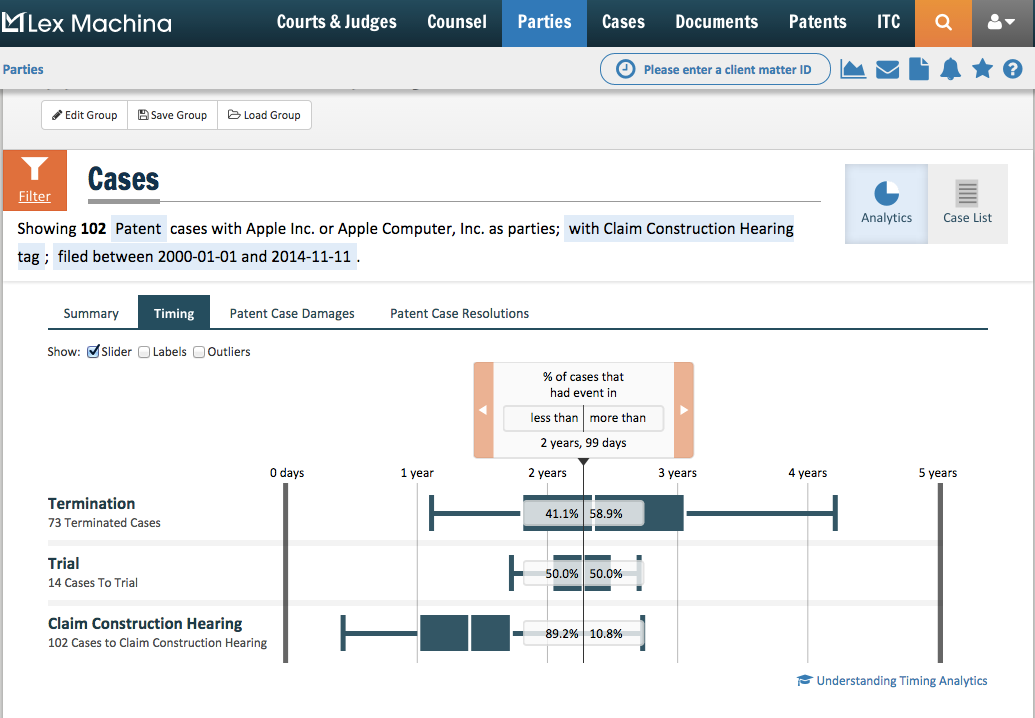
    Today Lex Machina is announcing the launch of  “Custom Insights”  functionality which will add two new high-voltage analytics tools: Caselist Analyzer and Motion Metrics to the  Lex  Machina platform. These interactive tools will put customized competitive insights within  reach of every subscriber. I found the variety, flexibility and granularity of Lex Machina’s  new offerings to be truly “breathtaking.”  In a few clicks the Custom Insights reports can display  interactive charts, trends and data based on highly specific criteria. Docket analytics platforms from  competitors such as Thomson Reuters, LexisNexis and Bloomberg Law  have allowed users to generate litigation reports based on a few standard criteria such as judge, law firm, party and cause of action. Lex Machina has enhanced
    Pacer data to allow deeper and more granular analysis of cases and motions. Until now these types of reports could only have been generated  after days or weeks of research.
    From Dockets to Big Data
    There is no shortage of products selling Pacer dockets. Most are selling access to flat data, not a transformative platform for insights and iterative analysis. Lex Machina which focuses on IP litigation is about to raise the competitive stakes for lawyers and Lex  Machina’s competitors in the docket analytics space.
    Lex Machina which debuted in 2010 as a platform for analyzing IP litigation. The Lex Machina platform combines natural language processing and machine learning. The data is further enhanced with some human curation and a healthy dose of data
    normalization. They use a custom taxonomy engine referred to as Lexpressions to analyse and assign tags to each docket. These tags enhance  precision and retrieval .If you ever wondered whether a judge was likely to grant a “motion to transfer” or wanted to estimate the “time to trial” in specific court, Lex Machina now offers such predictive analytics and insights. More than 20 data elements can be combined to create custom reports. (Tags include: Judge, Party, Role, Law firm, Lawyer, Case type, Case status, dates of filing or termination, trial date, damages, resolution, findings, invalidity.)
    The Wow Factor
    Each of the new modules includes at least one ” show stopping” new feature. Case List Analyser allows you to easily create a custom
    list of cases based on key word criteria. These keywords are identified in the docket or the underlying complaint or motion. A search for
    cases involving  “touch screen gestures” delivers a narrow universe of cases which deal with this very specific issue .
    The litigation history of these cases can be compared and analyzed.
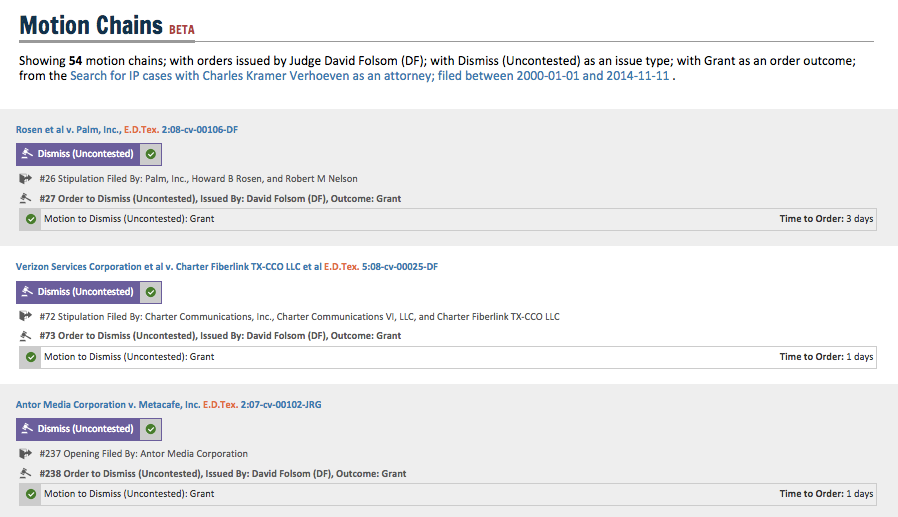
    Motion Metrics offers the ability to track “Motion Chains.” This feature enables aquick review of grants and denials for a specific case.
    Case List Analyzer
    Case List Analyzer: Key Features
    Build a strategy- select cases of interest using custom defined criteria. Then in a few clicks, create charts, expose trends using metrics  law firms, judges, parties issues, damages, patent findings.
    Custom Insights for Timing (Analyze Time to Termination, Claim Construction, Hearing, and Trial, to determine how long it
    may take to litigate your case and set your budget.

    Custom Insights for Damages (View a breakdown of patent case damages type(e.g. Reasonable Royalties, Lost Profits) overtime, to
    determine the risk and how much is at stake.)

    Custom Insights for Case Resolutions  (Review the resolution
    of selected terminated patent cases to view analytics on outcomes such as
    summary judgment, settlement, voluntary dismissal.)
        Custom Insights for Patent Findings  (View a breakdown of each finding of infringement, invalidity, or enforceability and analyze
    trends in those case histories)
    Motion Metrics
    Motion Metrics
    maps each motion in selected cases to determine outcomes.
    Track Motion Chains. Compare motion success by judge, party, or motion type, Examine motion chains and
    access the underlying documents.
    Judges History Determine which kinds of motions a judge tends to grant or denyAssess opponents motions history and patterns in cases similar to your own to develop a “motion strategy.”
    Today IP Tomorrow the World?
    Lex Machina does plan to expand beyond IP. Next up they plan to tackle the 80,000 commercial litigation cases filed in the US.As firms become more focused on understanding the cost of litigation and competitive pricing issues, Lex Machina is positioning itself to address one of the biggest pain points for law firms. Lex Machina’s new  Custom Insights tools will be raising the bar for both law firms and Lex Machina’s competitors. We may be witnessing the opening volley in a competitive analytics “war”  where established
    players and upstarts like Lex Machina vie for a foothold on  the litigator’s desktop.
    Here is the text of the press release:
    Lex Machina Launches Custom Insights: Personalized Analytics for Unprecedented
    Insights into Cases, Motions, and Trends
    New capabilities enable lawyers to design their own approach to crafting winning IP
    strategy
    Menlo Park, November 12, 2014
    – Lex Machina, creator of Legal Analytics®, today raises the
    bar for legal technology by introducing Custom Insights with the new
    release of its Legal Analytics platform. With traditional legal research
    tools, it’s difficult not only to find relevant cases, but also to glean key
    strategic insights, unless attorneys are willing to drill into each and every
    case. This is where Lex Machina gets started. Custom Insights helps
    attorneys surface strategic information from only those cases or motions they
    care about, quickly and easily.To mark the launch of these
    exciting new capabilities, Lex Machina will be hosting a webcast on November
    13
    to demonstrate how in-house and law firm counsel can
    leverage Custom Insights in their workflow.
    “Since launching our
    platform in October last year, our engineers have worked closely with Lex
    Machina’s customers to take Legal Analytics to the next level,” said
    Josh Becker, CEO, Lex Machina.  “More than predefined charts and graphs,
    our customers wanted the flexibility to apply analytics to the cases and
    motions that matter to them. With Custom Insights we are delivering a
    groundbreaking capability that changes the business and practice of law.”
    Lex Machina is introducing these
    new capabilities that provide attorneys with Custom Insights:
    Case List Analyzer
    The new Case List
    Analyzer
    puts lawyers in the driver’s seat by enabling them to select cases
    based on specific criteria and filter the results by case type, date range,
    court, judge, patent findings, and more. Available on every case list page, Case
    List Analyzer
    helps lawyers uncover strategic information and visualize
    trends – from how to approach a case, to how to litigate, or how to defend
    against legal action. With one click they can see trends and gain actionable
    insights across their case selection.
    “Case List Analyzer allows
    me to quickly compare judges, law firms, parties and patents, using the
    criteria I care about.  I can find a judge’s tendency to award damages of
    a specific type,” said Scott Hauser, Deputy GC Ruckus Wireless.  “Custom
    Insights enables me to craft winning IP strategy.”
    Motion Metrics
    This new feature identifies
    the docket events and documents connected to a specific motion, and offers Custom
    Insights
    into all activity that led to a court’s grant or denial of that
    motion. With Motion Metrics, attorneys can get Custom Insights for
    each motion chain within a case to analyze the performance of judges, or
    opposing counsel, and also compare motions across districts, judges, parties,
    and law firms.
    Attorneys are able to
    compare motion outcomes and select the strategy that has the highest
    probability of producing the desired results.
    Motion Metrics may
    reveal that a judge almost never grants a motion for summary judgment,” said
    Miriam Rivera, former Deputy GC at Google.  “The ability to see this
    information in an instant, not only saves a tremendous amount of time, but also helps me for the
    first time to quantify my ROI.”
    About Lex Machina
    Lex Machina is defining Legal
    Analytics
    , a new category of legal technology that revolutionizes how
    companies and law firms compete in the business and practice of law. Delivered
    as Software-as a-Service, Lex Machina creates structured data sets covering districts,
    judges, law firms, lawyers, parties, and patents, out of millions of pages of
    legal information. Legal Analytics allows law firms and companies, for the
    first time ever, to predict the behaviors and outcomes that different legal
    strategies will produce, enabling them to win cases and close business.
    Lex Machina is used by
    companies such as Microsoft, Google, and eBay, and law firms like Wilson
    Sonsini, Fish & Richardson, and Fenwick & West. The company was created
    by experts at Stanford’s Computer Science Department and Law School. In 2014,
    Lex Machina was named one of the “Best New Legal Services” by readers of The
    Recorder,
    American Lawyer Media’s San Francisco newspaper.
    Media Contact:
    Nicholas Gaffney
    415-377-1131


    American Lawyer Legal Intelligence just released a new report

    The State of the Big Law Market” which they have described as the first of what will be an annual report. The inaugural report was authored by Aric Press, Editor in Chief and Mary Cho, Legal Intelligence Analyst. It is not only the content and analysis that is new but the report represents a more in depth and historical treatment of law firm trends than ALM has undertaken in the past. Finally ALM is taking deep dive into the ALM Intelligence data archive they have been building for the past few decades. The ALM metrics are also supplemented with data from the US Census, Tymetric, Peer Monitor, Citigroup and Wells Fargo in order to provide multiple perspectives on complex and sometimes contradictory trends. I hope that ALM with continue to find new ways of utilizing their data archive to provide new insights into legal market trends.

    The report is framed around 4 key trends with which we are all painfully familiar. Nothing has been the same since the collapse of Lehman in 2008.


    Four Large Trends


    Legal spending by corporations has still not recovered from the Great Recession, yet firms continue to increase their hourly rates.
     
    Amlaw 200 firms have collectively increased their share of the market.
     
    Fewer partners are getting a greater share of the profits.
     
    The law firm market is increasingly segmented. The top 10 firms are getting richer and pulling away from the rest.


    Notable observations


    Despite the lower volume of legal work companies send to law firm, the rates paid by clients have increased.
     
    In 2013 law firms set records for gross revenue and profits per partner. But in inflation adjusted dollars firms actually had the lowest profits per partner since ALM began tracking the AmLaw 200 in 1998.
     
    Partnership ain’t what it used to be. It is less available, less permanent, and more transferable.
    The ranks of non equity partners continue to grow.
     
    Non equity partners get a bad rap but this report suggests that they offer a considerable upside if they can be managed effectively. Most law firms have not figured this out and non equity partners remain a drag on profitability.
     
    Law firms are segmented by size, reach and economic success. Within each of these microcosms the gap between largest and smallest/ most and least profitable is growing.
     
    The success segment. The top 10% have several things in common, most started in New York, most continue to get premium rates, and they can afford the best laterals.
     
    More AmLaw 200 firms will disappear.
     
    For all the hype about technology and nimble innovators, Big Law has still not been replaced by lower cost alternatives and they report suggests this will not happen any time soon.


    Can Law Firms Create Client Needs?


    The one conclusion I disagree with is that law firms can’t create client needs…Law firms must sit and wait for business. This, I assume is based in the traditional model of lawyers as litigators or dealmakers. They must wait for events to occur which are beyond their control and then compete for the opportunity.

    Could law firms not create the need for specialized advisory and risk management services? Haven’t consulting firms generated huge revenue streams from selling their expertise? As commercial trade becomes more global and as regulations become increasingly complex … there is certainly an opportunity for law firms to “create the need” for preventive law and advisory services.


    The Aggravating Conclusion


    For all the great data and analysis I was expecting a grand overarching rubric for law firm success. Yet there was a recurring theme that some law firm trends simply defy analysis.

    The report ends with some optimism about the future of big law. The final analysis seems to be that each law firm is so unique that it essentially exists in its own “micro-climate.” So firms using similar strategies may experience dramatically different outcomes. To use the prevailing trope… all law firm strategies are “bespoke.” There is no one answer that fits all law firms.

    Are lawyers and large law firms doomed to a perpetual “Hunger Game”… forever competing for a dwindling pool of partnership opportunities, clients, profits and reliable strategies for the future?
    American Lawyer Legal Intelligence has just released a new

    report
    ‘The State of the Big Law Market” which they have described as the first of
    what will be an annual report. The inaugural report was authored by Aric Press, Editor in Chief
    and Mary Cho, Legal Intelligence Analyst. It is not only the content and analysis that is new but the
    report represents a more in depth and historical treatment of law firm trends than ALM has undertaken in the past.
    Finally  ALM  is taking  deep dive into the ALM
    Intelligence data archive they have been building for the past few decades.  The ALM metrics are also supplemented with data from the US Census, Tymetric, Peer Monitor,
    Citigroup and Wells Fargo in order to provide multiple perspectives on complex
    and sometimes contradictory trends. I hope that ALM with continue to find new
    ways of utilizing their data archive to provide new insights into legal market
    trends.

    The report is framed around 4 key trends with which we are
    all painfully familiar. Nothing has been the same since the collapse of Lehman in 2008.
     
    Four Large Trends 

    Legal spending by corporations has still not
    recovered from the Great Recession, yet firms continue to increase their hourly
    rates.

    Amlaw 200 firms have collectively increased
    their share of the market.

    Fewer partners are getting a greater share of
    the profits.

    The law firm market is increasingly segmented.
    The top 10 firms are getting richer and pulling away from the rest.

    Notable observations
    Despite the lower volume of legal work companies
    send to law firm, the rates paid by clients have increased.

    In 2013 law firms set records for gross revenue
    and profits per partner. But in inflation adjusted dollars firms actually had
    the lowest profits per partner since ALM began tracking the AmLaw 200 in 1998. 

    Partnership ain’t what it used to be. It is less
    available, less permanent, and more transferable.

    The ranks of non equity partners continue to
    grow.

    Non equity partners get a bad rap but this
    report suggests that they offer a considerable upside if they can be managed
    effectively. Most law firms have not figured this out and non equity partners
    remain a drag on profitability.

    Law firms are segmented by size, reach and
    economic success. Within each of these microcosms the gap between largest and
    smallest/ most and least profitable is growing.

    The success segment. The top 10% have several
    things in common, most started in New York, most continue to get premium rates,
    and they can afford the best laterals.


    More AmLaw 200 firms will disappear.

    For all the hype about technology and nimble
    innovators, Big Law has still not been replaced by lower cost alternatives and
    they report suggests this will not happen any time soon. 
    Can Law Firms Create Client
    Needs?
    The one conclusion I disagree with is that law firms can’t
    create client needs…Law firms must sit and wait for business. This, I assume
    is based in the traditional model of lawyers as litigators or dealmakers.
    They must wait for events to occur which are beyond their control and then
    compete for the opportunity.
    Could law firms not create the need for specialized advisory
    and risk management services? Haven’t consulting firms generated huge revenue streams
    from selling their expertise? As commercial trade becomes more global and as regulations
    become increasingly complex … there is certainly an opportunity for law firms
    to “create the need” for preventive law and advisory services.
    The Aggravating
    Conclusion
    For all the great data and analysis I was expecting a grand
    overarching rubric for  law firm success. Yet there was a recurring theme that some law firm trends simply defy analysis.
    The report ends with some optimism about the future of big law.
    The final analysis seems to be that each law firm is so unique that it
    essentially exists in its own  “micro-climate.”
     So firms using similar strategies may
    experience dramatically different outcomes. To use the prevailing trope… all
    law firm strategies are “bespoke.” There is no one answer that fits all law
    firms.
    Are lawyers and large  law firms doomed to a perpetual “Hunger Game”… forever competing for a dwindling pool of partnership opportunities, clients, profits and reliable strategies for the future?

    Congratulations to our Baseball and the Law Trivia Crossword Winner Alex Samuel!
    Alex is an IP attorney from Concord, NH. He is a 2012 graduate of the University of New Hampshire Law School. Alex was the first person to submit a completed crossword with all the correct answers.

    I will leave the puzzle active for those of you who want to continue enjoying the challenge.