Skip to content
Susan Hackett, The CEO of Legal Executive Leadership
kicked off the  2014 Private Law Libraries Summit with a bang. This year’s theme was  “The Voice of the Client” and  Hackett delivered a powerful message which
focused on “Re-engineering the Role and Value of  Private Law Librarian:  Practical Strategies for Leadership in Serving
Corporate Clients.”


Susan Hackett Points the Way
Photo (c) Bess Reynolds

We’ve Come A Long  Way. I couldn’t help but contemplate the  trajectory which the Summit has taken since the first Summit in 2010. Although the theme of the  first Summit was “Change as Opportunity,”  it was fear and bewilderment that fueled the discussions. By 2014 the Summit had moved information professionals from survival at the margins to front and center in the delivery of value to clients. Not only did we have Hackett the former Sr. VP and GC  of the Association of Corporate Counsel delivering the keynote, but she was followed by a panel of In House Counsel who reinforced and validated Hackett’s insights into the value librarians can bring to multi-disciplinary  client support teams. It is time for information professionals to move from the shadows  of administrative support to center stage  with a seat at the client table and with a voice in the value and process improvement discussions.

Clarifying the Context. Disruption in the legal profession is not solely
the result of the recession. Law firms will continue to struggle if they don’t
realign their business strategy with delivering value to clients. Law firm’s continue
to focus on cost, profit and pricing
which are the symptoms of dysfunction and not the root cause.
The Real Problem Is Client Disconnect: Lawyers still want
to sell their expertise by the hour. Clients want to buy business solutions and
efficiency.
The Opportunity: Information professionals are uniquely
suited to help lawyers leverage the firm’s knowledge resources and develop new
products, processes and multi-disciplinary strategies which will respond to the client demand for efficient business solutions.
The Innovators Hackett highlighted the innovative
initiatives at  two law firms Seyfarth
(Lean Six Sigma) and Eversheds (Agile) and two Legal Departments Intel (Dynamic
KM) and Cisco (Global Center of Excellence) as examples of workflow reengineering.
Clients Love Data Start demonstrating value by doing time trials. How long
does it take for an associate to perform a function that we as information professionals can demonstrably
deliver more quickly. Measure the time saved and translate into a value to clients.


Hackett’s Examples of Staffing Innovation


•      Focus on each person’s highest use, not pushing work down


•      Demand
Management Practices – firms and clients


•      “Captive”
work centers to drive down project costs


•      Design
a new kind of “contract lawyer” – you/your team.


•      Direct
client and firm exposure: training, client deep dives, issue monitoring, etc.


•      Assist
with feeding or writing blogs, Tweets, Social Media – push knowledge to firms
lawyers and clients


•      Sourcing
increasingly sophisticated work to those who do it faster and cheaper than
lawyers


Hackett’s Examples of Knowledge Innovation


•       Aggressively
collect, catalog, and manage data, including big data. Offer it up to clients.
•       Create
a collaborative knowledge library of firm practices or one that shares clients’
practices.  Offer it
up to clients.
•      “Proof
of Concept” Discussions – questions posted online in firm communities are
answered communally and archived.


•      Assign
associates to capture partner knowledge experience as part of their training –
catalog it for future training.


•      Make
knowledge capture a legacy project for elder partners


•      Create
playbooks, process maps, trainings, etc. 

Disruption
Equals Opportunity
. According to Hackett the primary competition for law firms
is not other law firms, it is the legal department itself. As legal departments
become more efficient, information innovators can help law firms develop value
strategies and services which can help firms compete effectively with their
clients.


The Bottom Line: Stop selling ourselves to our law firms, start selling our value to the clients.


The July Issue of Thomson Reuters Practice Innovations has just been released. Great mix of articles on cutting edge law firm management issues.

  • By
    Janet Accardo, Director of Library Services at Skadden
    Arps Slate Meagher & Flom LLP, New York, NY
  • Paying Attention to the Canaries in KM’s Mineshaft
    • By
      V. Mary Abraham, Co-Founder at Broadli Inc., New York, NY
  • Law Firm Space Planning as a Knowledge Management Strategy 
    • By
      Jean O’Grady, Director of Research Services, DLA Piper, Washington, DC
  • Crowd sourcing and Work Synergies
    • By
      Elaine M. Egan, Manager, Libraries and Information Centers—Americas, Shearman
      & Sterling, LLP, New York, NY
  • Big Law: Big Data, 
    • By
      Lynn R. Watson, Director of Information Resource Technologies, Hogan Lovells US
      LLP, Washington, DC
  • Managing Risk Disruption Through Internal Risk Structures: An interview with Donald Caputo, Chief Internal Auditor, Shearman & Sterling
    • By
      Elaine M. Egan, Manager, Libraries and Information Centers—Americas, Shearman
      & Sterling, LLP, New York, NY
  • Risk Avoidance through Succession Planning, 
    • By
      Ronda Fisch, Director of Research & Library Systems, Reed Smith LLP,
      Pittsburgh, PA

    It is more than a year  since Judge Rakoff dismissed Edward White’s case against Westlaw and Lexis for copyright infringement. A memo explaining the rationale was promised and it has finally been delivered. On July
    3, 2014,  Judge Rakoff released a Memorandum and Order which provides a fair use analysis of the decision and reaffirms the 2013 dismissal.


    White’s
    copyright claim can be traced back to his dismissal as class counsel in the
    case of Beers v XTO Energy, Inc. No. Civ 7-798-L in the Western District of
    Oklahoma. White was afraid that the “newly proposed class counsel or other
    lawyers would use his work product” He registered copyrights on the
    Summary Judgment Motion and the Motion in Limine briefs which had been filed in the Beers case. However prior to
    registering the copyright he had filed the motions with the court using Pacer’s
    electronic filing system. Westlaw and Lexis both subsequently  retrieved these documents from
    the Pacer system and added the documents to their legal research systems. Once a document was filed on Pacer it became available to the
    public online and in the court clerk’s office.

    Rakoff’s
    Memorandum cited the “Fair Use” defense in Section 107 of the Copyright Act of 1974
    providing the rationale for the dismissal. The memo also stated that under the facts of the White case, 3 of the 4 factors
    favor “fair use” and one factor was neutral.


    The
    Fair Use Balancing Test Applied

     1.
    The purpose and character of the use
    . Citing Campbell v Acuff-Rose Music, Inc.
    501 US 569, 578 (1984) the court found the Lexis and Westlaw’s use of White’s
    briefs was transformative. White created the briefs to achieve a specific
    outcome for a client.  Westlaw and Lexis used the briefs in creating an
    interactive legal research database. The memorandum states that the editorial processes undertaken by
    Lexis and Westlaw in “reviewing, selecting, converting, coding, linking and identifying
    the documents add something new and change the character and purpose of the
    work.

    2.
    The Nature of the copyrighted work.
    Fair use is more likely to be found in
    factual works than fictional works. The memorandum states that “Briefs
    are functional presentations of fact and law.” Since the briefs were filed with
    the court it is harder to claim that they are “unpublished.”  

    3. The amount and substantiality of the
    portion used in relation to the copyrighted work as a whole
    .
    Lexis and Westlaw copied the entire documents.  There is precedent where courts have concluded that  copying the whole work “does not necessarily weigh against
    fair use because copying the entirety of a work is sometimes necessary
    to make a fair use of the image.” BillGraham Archives v. Darling
    Kindersley
    Ltd., 448 F.3d 605, 613 (2d Cir. 2006). Although
    defendants here copied the entirety of White’s briefs, such copying was
    necessary to make the briefs full text
    searchable. The Court found that Lexis and Westlaw only copied what
    was reasonably necessary for their transformative use, and concluded that that
    the third factor is therefore neutral. 

    4.
    The effect of the use on the potential market for the work.

    Regarding the fourth factor,
    a finding of fair use is disfavored “only when
    the market is impaired because the material serves the consumer
    as a substitute, or . . supersedes the use of the original.”
    Bill Graham Archives, 448 F.3d at 614 (quoting Pierre N. Leval, Toward
    a Fair Use Standard,
    103 HARV. L.REV. 1105, 1125 (1990)). In
    determining whether such a market exists, the Second Circuit
    “looks at the impact on potential licensing revenues for ‘traditional,
    reasonable, or likely to be developed markets.'”

    In this instance, West’s and
    Lexis’s usage of the briefs is in no way economically a
    substitute for the use of the briefs in their original market: the
    provision of legal advice for an attorney’s clients. White himself
    admits that he lost no clients as a result of West’s and Lexis’s usage.

     Isn’t It Really Just A Question of Precedent?
    I agree with the outcome  of the White case but I find the Court’s analysis somewhat strained. I think the more obvious reason to dismiss the copyright claim would be based on a public policy rationale. In the common law system a completely original brief citing no precedent would be pretty useless and unpersuasive. All legal briefs are inherently “derivative” and It serves the ” interests of justice” for the briefs and legal arguments which are made to courts to be available for public review.
    Related Posts:

    2014 Summit: The Voice of the Client

    Monday June 16th is the last day to Register for the 2014 Private Law Libraries Summit and the last day to get the early bird registration for the AALL annual meeting.
    2014’s Summit is scheduled for Saturday, July  12, 8:30 am – 5 pm in San Antonio at the Marriott Rivercenter. Also mark your calendar for the Friday night July 11 Summit reception from 6-8:30.

    The PLL-SIS Summit, now in its fifth year, continues as a vehicle for examining the impact and opportunities presented by change.  This year the Summit will consider “The Voice of the Client” by delving into ways librarians can help their firms deliver legal services more efficiently and add value through client-facing initiatives.

    In the morning, a keynote presentation and a panel discussion will address the value that librarians can bring to the lawyers and clients they serve by examining how real-world practice innovations and changing models of legal service delivery are combining to create new opportunities for library professionals.

    Following a relaxed networking luncheon, interactive afternoon break-out sessions will explore practical means of adding value to your firm via client facing initiatives,  and will explore the role librarians can play in advocating for library client facing initiatives. The breakout sessions will be presented twice so that Summit participants can benefit from two of the three afternoon sessions.
    Please visit the 2014 Summit blog for updates and to obtain more information as the final agenda, programs and speakers are confirmed.

     2014 Agenda

    AALL PLL-SIS – Summit V: The Voice of the Client
    Saturday, July 12, 2014, 8:15 am– 5 pm
    Marriott Rivercenter – San Antonio, TX
    Friday July 11, 2014
    Opening Reception 6:00 – 8:30 p.m.

    Bloomberg BNA is pleased to be the sponsor of the PLL Summit Opening Reception on Friday, July 11, 2014 from 6:00 pm to 8:30 pm at the Lone Star Palace in The Hyatt Regency San Antonio,  123 Losoya Street, San Antonio. Directly overlooking the Alamo,  the Lone Star Palace is adorned with contemporary Texas flair and is a short walk from the conference hotels.  PLL Summit attendees can enjoy the view and a Texas-style reception in this beautiful location on the San Antonio River Walk.
    Please RVSP for the opening reception by July 3 online at www.bna.com/pllsummit.  Contact Abigail Ellsworth Ross at ross@hklaw.com or 202-434-4148 with any questions.  We hope to see you there!

    Saturday July 12, 2014
    7:00-8:30 am Registration and continental breakfast – generously sponsored by LexisNexis
    8:30-8:45 am Welcome Remarks: Jean O’Grady, PLL Chair and Marcia Burris and Cheryl Niemeier, Summit Co-chairs.
    8:45-10:15 am Keynote Address – Re-engineering Law Firm Librarians – Susan Hackett, Founder, Legal Executive Leadership – generously sponsored by Wolters Kluwer
    10:15-10:30 am Coffee break – generously sponsored by Fastcase
    10:30-11:45 am Morning Panel – The Clients Speak: Extending the Role of Librarians in the Age of Corporate CounselCasey Flaherty, Corporate Counsel,Kia Motors America; John Rosero, Vice President, Prudential Corporate Counsel
    11:45-1:00 pm Networking Luncheon- generously sponsored by Thomson Reuters
    1:00- 2:30 pm 3 concurrent interactive breakout sessions: attendees will attend 2 of 3 sessions

    2:30-2:45 pm Afternoon break
    2:45-4:15 pm Repeat of 3 concurrent interactive breakout sessions: attendees attend 2 of 3 sessions
    4:20-5:00 pm Reporting and Wrap-up

    2014 Summit Agenda & Speaker Pages

    Separate registration is required for the Summit, and is found on the AALL Annual Meeting Registration form.

    The PLL Summit is supported by the generous sponsorship of Bloomberg BNA, Fastcase, LexisNexis, Thomson Reuters and Wolters Kluwer

    “Lawyers need an answer, not
    a book.” Vice President Jason Wilson

    Jones McClure is one of the
    last independent legal publishers. They were founded in 1992 to fill the need for “user friendly law books.” They
    have taken their time going digital and now they are breaking with the large
    legal publishers by rejecting eBook 
    technology– but this is no surprise.

    Jones McClure is young company, a bit edgy and decidedly  independent.
    They have been rebuffing acquisition overtures from the major publishers for years.
    I checked out their blog and was met by a screaming headline ”Phone Sex and No Fault
    Divorce.” They understand what appeals to their customers.

    Jones McClure publishes 26
    titles mostly on Texas practice and 7 non-Texas titles. Their federal titles include The O’Connor’s Federal
    Rules
    and their compilation of IP laws which are less
    expensive than similar titles from the major legal publishers. Until  today they were a strictly a  book publisher.
    The New Platform
     
    This week Jones McClure
    rolled out a new approach to rulebook research with the release of   O’Connor’s Online . O’Connor’s is the tradename of their court
    rule and code publications. The company’s press release quotes President Baird  Craft: “Two keys to the service were search and
    user experience. For search, we worked
    with an industry leader, MarkLogic, and have built a sophisticated search
    system, one that we will continue to tweak as more customers come online. For
    user experience, we emphasized to the designers and developers that when a customer
    is researching, they should always see three things: search results, a table of
    contents, and the actual  content itself.”
    O’Connor’s.com  has the clean book like appearance of an eBook
    but there are no pages to turn.
    The system defaults to federated search.  Filtering is the primary discovery function. Filters
    are customized by product. Content can be bookmarked, highlighted, and marked
    up with notes, all of which can be saved in easily accessible folders for
    quicker retrieval. Content includes rules, annotated codes,forms and practice
    commentary. Formatted forms are generated on the fly and can be downloaded and
    saved to a local drive.

    O’Connors Online


    Giving Customers More Than They Paid For
     
    It should be no surprise that
    instead of following Lexis and Westlaw down the rulebook road to eBooks, Jones
    McClure held back and assessed their options.  Vice President Jason Wilson described the
    rationale this way.  “Jones McClure sees
    itself as a content publisher not a book publisher.”  An eBook platform would limit their ability to
    expose customers to new editorial content. They are basically turning the traditional
    new product sales model on its head. Large publishers have often offered
    existing content in a new format and asked customers to pay twice for the same
    thing. Jones McClure is offering book customers access to a digital version of
    the book and a wealth of new content to enhance the customer
    experience for a modest additional cost. Unlimited access to O’Connor’s Online costs $600 a year. It can also be purchased on a month-to-month basis for $75 a month. Their book sales have been growing
    and they are confident that the digital platform will not erode print sales.
    You Can Quote Us But Don’t Cite Us
    Jones McClure takes a
    shockingly pragmatic view of how lawyers use their content. Wilson describes the
    platform as an “answer delivery system.”  Jones McClure knows exactly how lawyers
    work. They cut and paste from sources and Jones McClure doesn’t care. They are
    happy to see their editorial text appear in court opinions. If their commentary
    was persuasive to a judge, they are  serving the
    needs of the lawyers and their clients. They don’t need to get the credit –
    they just want loyal customers. Of course they are not talking about someone
    downloading and reselling their database, but they have a healthy tolerance for
    the reality of legal drafting. Let’s face in a common law system, everything is a derivative work based on
    precedents written in the past.
     
    The Innovation Pipeline
    The O’Connor platform has a
    built in customer pipeline. Users are encouraged to send suggestions directly to
    the editorial staff. Suggestions are also posted on the website where other
    customers have an opportunity to vote on suggested changes and content.


    Customer Feedback Function


    Future Developments
    According to Vice President Jason
    Wilson, they are building a product which will automate the drafting of documents based on their forms.
    The automated  forms will take advantage of
    the logic that is already built into their forms. The goal is to “follow the rule of ten,” namely don’t ask more
    than ten interview questions before the user can get into the form and start
    editing. They are hoping to launch that product in 2015.


    ALM
    legal Intelligence has released is second special report on Pricing
    Professionals. “Pricing Professionals: Essential to Law Firms, An Ally to Clients.” The survey was conducted in April 2014. Although pricing has been in
    place longer in larger firms, the function is found across all size firms. In
    just one year since the first report, pricing has moved from a tactical
    function to a strategic function. One consequence of this is that individual
    lawyers have less control over how matters or a portfolio of work will be priced. The
    pricing professional, the executive director, the CMO and Practice group
    leaders may all have input on the pricing decisions. The bottom line is that if
    a law firm doesn’t bring their own pricing expert to the table..  the
    client will! The report suggests that law firms have begun to put the people
    and processes in place to support a serous pricing and profitability assessment
    function. 


    The
    report’s key findings affirm the increasing importance of the pricing professional:
    • 76% of firms have pricing professional up from 68% in 2013
    • More than half of firms have had a pricing officer  for more than two
      years.

    • The top reasons for establishing a pricing function are to help with AFAs, to
      respond to cost pressures from clients, and to get a better understanding of
      the ROI for various matters.
    • Pricing officers are often a member of the firm’s senior leadership team.
    • Direct
      involvement in client discussions has increased.
    • 93% of respondents expect increasing use of AFA’s
    • Pricing officers increasingly  provide responses to RFPs
    • Despite all the efforts, only 36% of firms report that the are very confident
      that they understand the cost of a matter when they price it.
    • The majority of firms report that pricing efforts increased profitability
    In
    Search of the Pricing Software

    Pricing
    officers are waiting for someone to develop a software product to help with the
    analysis. The ideal software solution would model
    non-hourly pricing, help with matter intake, connect with LPM matter
    management and provide clients with a view of the matter management process.

    How
    to Get Hired as A Pricing Officer?

    While the data in the report is interesting the most compelling reading is the quotes from the pricing professionals themselves. They are an adventurous group who took on a vaguely defined, high profile job to which law firm have attached  even higher expectations … They toil without the comfort of a job description. Basically pricing professionals are inventing their roles as they go along. It is not for the feint of heart. The
    key criteria for hiring a pricing professional are 1) a financial
     skillset  2) people skills 3) prior experience in a pricing role, I would add to that list “nerves of steel,”

    New York Times DealBook reported today  that ALM Media will be acquired by an investor consortium led by Wasserstein & Co. It was reportedly sold for significantly less than expected. The purchaser owned ALM once before. The company sold for $630M in 2007 but today’s deal price is reported at $417M.

    By my count this is the 5th sale of ALM in the 17 years since founder Steven Brill sold ALM to Time Warner in 1997.   What could another PE owner bring to the table that will enhance the value of the American Lawyer Resources to law firms?  My worst fear is that the only thing it may bring is higher prices.  It’s not that ALM has been in a holding pattern. They have continued to add innovative products and in January of this year, there was a major relaunch of the Law.com platform. The glossy new platform unbundled ALM content from its historically jurisdictional focus and moved to a practice focus. They have also invited in content from a “Huffington Post” style stable of outside commentators. But we live in a big data world and in my view ALM content is just begging to be integrated into a larger universe of legal and business data.

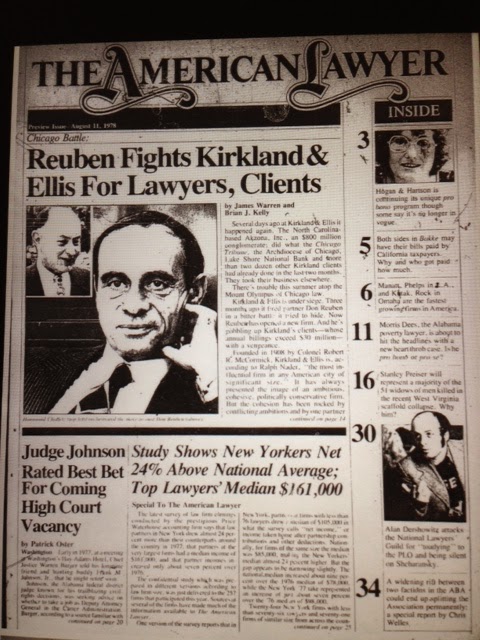
    The first issue of American Lawyer 

    Don’t get me wrong I have a deep respect and even fondness for ALM. We both entered law firms at about the same time. In 1980 I was a brand new librarian. When an issue of the American Lawyer arrived I had the distinct  sense that it should have been kept behind the circulation desk and covered in a brown wrapper. By 1980 standards it was a tawdry business. It had the same “ewe” quotient as the early postings on the Above the Law blog. No one wanted to be seen reading it and yet everyone had to take a look at the latest issue. Partners soon realized  that it was better to respond to an inquiry from an ALM reporter  than to let American Lawyer control the message. Imagine a time when there was no such thing as a law firm Chief Marketing Officer.

    As a consumer of legal information products I think that there would be more interesting  product development synergies if  ALM was acquired by one of the major legal information publishers and certainly some of these companies have content gaps that could have been filled nicely  by  ALM products. ALM would also benefit from the global network which each of the major vendors would bring to the deal. The business and practice of law is going global. ALM needs to develop a strategy and assets which enables them to  satisfy the growing demand for international law firm, dealflow and litigation news and analytics.

    The New Legal Journalism – Caselaw wrapped in an envelope of personality.

    For much of the last 30 years ALM had a virtual lock on being the “tattler” of the legal profession while providing a steady stream of substantive legal news. Over the  years ALM’s journalism has gained mainstream  legitimacy. They invented some of the basic yardsticks of law firm performance through their profitability and diversity rankings. In recent years they have ceded the “bad boy journalist” role  to the Above the Law blog, They have also faced head on competition from Law360 – an upstart digital newsletter that against all the odds claimed market share at the dawn of the great economic reset. Law360 created a legal news product line which  can best be described as a kind of journalistic “crack.” They have succeeded by delivering legal developments slathered in  personality. Lawyers names, firm names, client names and competitive rankings are dominant features of every issue of Law360. Lawyers find a lot to criticize in Law360 reporting and analysis and yet they can’t live without it. 

    A little History 1979 – The Year the Veil Lifted

    Until 1979 lawyers occupied private islands of professional secrecy. But 1979 marked the birth of 3 publications which drew back the veil which had historically  shrouded the legal profession from public scrutiny. The Legal Times of Washington, The National Journal and the American Lawyer each focused on a separate niche in the legal market. Today they are all part of the ALM media empire which also publishes over 2 dozen regional and topical  publications such as the New York Law Journal. The Legal Times focused on the federal government and DC law firms. National Law Journal produced  long feature articles on serious  legal issues of national  impact. .A contemporary article indicated that it saw itself as the Wall Street Journal of the law

    The American Lawyer was the brashest of the three—it  turned the klieg lights on  the finances  and foibles of lawyers and their clients. The American Lawyer  was the brain child of co-founder Steven Brill a Yale Law grad who had written a law column for Esquire magazine.  American Lawyer was originally published in a tabloid  newspaper  format and featured large photographs and fancy graphics. …An unseemly intruder which didn’t fit well  on the beige, buckram lined library shelves.

    Brill  transformed legal  reporting  from a snooze-fest  to a slug-fest. by exposing the salary disputes,  professional blunders, partner defections and client controversies that erupted at even the most prestigious of “white shoe” law firms. Columbia Law Review once  referred to  American Lawyer as “ pushy, shrill, long winded, self-righteous, smug and downright nasty.” And yet lawyers couldn’t turn their eyes away. Law firms kept subscribing. By the end of their first decade they had created a new kind of competition among large firms by developing the infamous Amlaw 100 list which reported revenue per lawyer and profits per partner. Over the years ALM ventured beyond print.

    Beyond Print. In 1991 they launched Court TV  – a “reality TV” channel which brought live coverage of trials into American living rooms. It created a new class of lawyer-pundits who provided motion by motion commentary on high profile trials – think OJ Simpson. They also launched Counsel Connect an early social media platform which allowed lawyers and outside counsel to connect and post comments and share expertise. Counsel Connect was the brain child of David Johnson who had left the practice of law at Wilmer Cutler & Pickering to become a law and technology pioneer. They went online with the Law.com platform which was recently transformed and relaunched.They now offer apps to provide mobile access to their news products.

    Other ALM product offerings include legal treatises and newsletters  under the Law Journal Press imprint, the ALM Legal Intelligence platform which provides business analytics and a growing line of  specialty studies on the business of law. They have recently expanded their competitive intelligence capabilities with Rival Edge which tracks lawyer headcount, firm marketing events and practice changes as well as, lateral partner moves and billing rates. They provide seminars and CLE. They host the national legal technology conference LegalTech. For a relatively small publisher they have staked out  a  strong brand and a presence across a wide swath of the legal practice and management landscape. The have put a toe into the growing workflow improvements space with the SmartLitigator.

    The Contenders

    LexisNexis  The acquisition of ALM by LexisNexis would have been a downright disaster for law firms. Lexis already owns Law360 which is the only serious competitor to ALM in reporting on both the legal profession and legal developments. LexisNexis also has an exclusive license to provide access to the ALM archives on the Lexis platform. Outright ownership of both Law360 and ALM would have given LexisNexis a near monopoly on “business of law” news publications. Anyone who has negotiated with Law360 knows that they are making shameless demands double digit for price increases. The market needs an alternative.

    Thomson Reuters  Well… Thomson Reuters the owner of Westlaw is in  the news business. Thomson Reuters hired veteran ALM journalist Allison Frankel and as far as I can tell she is focused on writing for existing Westlaw subscribers. West owns the hyper-niche Andrews Litigation Reports newsletters now branded as Westlaw Journals, but these are focused on very narrow slices of the law and don’t cover the business of law or law firms. West clearly has access to breaking  caselaw, regulations, statutes, news and editorial talent.    It appears that they are just not interested in developing or competing in the Law360-ALM space.
             
    Bloomberg Law  is also part of a media empire. Like TR, Bloomberg is reporting on law firm activities in news stories that are delivered on their platform but they are making no move to create an identifiable independent “business of law” product or to produce law firm rankings and competitive metrics. In 2011 they purchased the Bureau of National Affairs which  publishes sophisticated legal and regulatory newsletters which are sold independently from the BLaw platform.  The ALM local news  legal intelligence, ranking and the competitive intelligence assets, Rival Edge and Law Journal Press treatises could have filled some gaps in the BLaw offerings.

    Wolters Kluwer which publishes a wide range of practice focused libraries  and newsletters is the publisher that I believe could have benefited most from the acquisition of ALM.WK released a suite of daily topical newsletters in 2013. Like their competitors at BNA – the WK writers are the “A students” who take a sober approach to the serious task of reporting on the law. What they both  lack is the relentless churn of personality which has pushed Law360 to the head of the pack. ALM is awash in law firm news and intelligence which could be used to deliver more “personality” into the legal news mix. WK also lacks a clearly defined product offering targeted at  litigators. Sure lots of their content such as the Federal Securities Law Reporter is useful to litigators but they have no product that I can think of which was targeted for the huge pool of litigators throughout the US. ALM has an existing and loyal base of litigators from around the country who rely on their local court coverage in their regional news offerings.  More recently ALM developed a product called Smart Litigator which combines research, forms, judges information, verdicts and drafting tools in one platform.

    Information Wants to be Linked

    ALM has a compelling mix of editorial content, primary source material and law firm analytics. Over the next decade business data and analytics will play an increasingly important role in the business and practice of law. I am frankly baffled that none of the major publishers stepped up and bought ALM this round…. But if history is any indicator ALM is likely to be on the block again within the next 5 years.

    Redesign Law is debuting at the Association of Legal Administrators Annual
    Conference which begins today in Toronto. One of the most “buzz worthy” events is likely to be the Law Office Design Lab which was created by the Gensler global design firm. Attendees will have the opportunity to step into the law firm of 2035 with an interactive guided tour of a 5,000 square foot prototype which includes a variety of workspace “vignettes.” Technology and prototype furnishings were contributed by Microsoft,  Thomson Reuters, Herman Miller, Steelcase, Knoll, Interface, Creative wood, POI, Interface,Bernhardt Design and Hitplay.

    According to Steve Martin Principal at Gensler’s DC Office, The Law Office Design Lab “has been an enormous undertaking
    with significant personal contributions of time and energy by Gensler
    professionals from many of our offices, leading and participating on committees
    and weekly conference calls coordinating so many details.  It has also been rewarding seeing our next
    gen leaders rising to the occasion and blossoming in their roles on this! Very
    exciting!”

    The Key Concepts of ReDesign Law Are:

    1. Less is more. Smaller offices, more interiors offices
    2. Build more variety and choice into people’s work environment.Gensler’s workplace study indicated that there is a 12% increase in productivity when people have workspace choices.
    3. Future Proof your environment. Create space which can expand, contract and be reconfigured as needed.
    4. Ubiquitous technology enhances collaboration and mobility
    5. Connect the Dots. Face to face interactions still build social capital
    6.One size doesn’t fit all. Find the workplace strategy that works for your firms.

    Gensler has a 2 minute video introducing the Redesign Law Concepts here.

     Many of the new design concepts disrupt the historically hierarchical design paradigm which infused law firm space planning in the past. If the opportunities for improved collaboration and productivity are not sufficiently compelling reasons to embrace change, the potential savings in real estate costs are likely to grab the attention of law firm leaders. According to Gensler’s Martin, a 25,000  square foot office in Washington DC would realize a savings of $25,000 per lawyer per year by going to “one size office” plan for both partners and associates.

    “The future is  here: The risk is not embracing it.” ReDesign law!

    In recent weeks the publications divisions of both the American Bar Association and the American Law Institute have sent out surveys seeking private firm librarian input on their electronic resource development  plans. I encourage private firm librarians and knowledge specialists to participate and provide feedback. Both publishers  clearly recognize  who the experts are!

    The American Bar Association Survey can be found at this link.

    The American Law Institute  Publications Department sent out a survey  with this message:

    The Subject Line of the Email is  “American Law Institute Publications Department”

    The American Law Institute invites you to participate in a survey about your firm’s current and future use of Restatements and Principles, in both print and online format.

    Our goal is to deliver our publications in the most efficient and effective way, ensuring our customers’ satisfaction and strengthening our relationship going forward.

    Regardless of whether you choose to participate in this survey, you are welcome to contact us should you need access to project drafts, meeting proceedings or any other ALI materials. Please contact Pat Daly at pdaly@ali.org for more information about access to ALI materials.
    ALI send links which were unique to each email address. If you did not receive a survey please contact Pat Daly at the above email address.  The Survey will close June 30, 2014.
     
    Participation Pays Off

    I encourage my colleagues to participate in these surveys. This is an opportunity to provide valuable insights on  lawyer research workflows as well as technology and platform preferences. All too often we have seen products which were seemingly developed by technologists who were enamored with technology but oblivious to real practitioner needs. We forfeit the right to complain when we pass up on opportunities to participate in product planning and development.

    Today Thomson Reuters is announcing the
    release of the 10th edition of Black’s
    Law Dictionary
    edited by Bryan A. Garner. New editions of standard reference
    works don’t often warrant a press release or a  blog post,  but Black’s 10th
    merits both. If you have a Black’s Law Dictionary  predating
    1996 when Garner took over as editor, its
    ripe for the recycling bin. Time
    to invest in a new edition. The new Black’s  includes 50,000 definitions, 4,000 Latin legal maxims,  7,500 new terms and 16,000 new definitions.

    Why Dictionaries Still Matter. If you are wondering if dictionaries still matter,
    consider Garner’s explanation of why they do. I am paraphrasing here. The legal profession is essentially
    a profession of writers.Lawyers are writers who need to be persuasive.
    Words are their primary tools of  persuasion – so they better understand how to
    choose the right word.

    Andy Martens, global head of Product and Editorial for Thomson Reuters also made this compelling statement in the Thomson Reuters press release: “The
    law is understood and enforced according to the words that define it, making Black’s Law Dictionary as important to
    the practice of law as is our common understanding of its language.”

    The Lexicographer Garner who is regarded as the world’s leading, legal lexicographer warrants a
    blog post of his own. Its hard not to be intrigued by someone who has been the
    subject of a front page New York Times story — on a controversy involving legal footnotes no less, co-written books with
    a Supreme Court Justice (Scalia) and rewritten the rules of golf in plain English.  But that’s a story for another day.  In addition to being the editor of Black’s, he is a professor at Southern Methodist University Law School, and runs a company called LawProse which teaches legal writing to lawyers and judges.

     The History of Black’s From Surviving to Thriving 

    Thirty
     years ago  law libraries were  likely to have 3 leading
    American law dictionaries, Bouvier’s,
    Ballentine’s and Black’s. John Bouvier wrote the first American dictionary in 1839 as a response to the difficulties he encountered in his admission to the bar. Henry Campbell Black, a lawyer from Ossining, New York authored A Dictionary of Law in 1891 when Bouvier’s was in it’s 14th edition. Ballantine’s  was published by Lawyers Cooperative Publishing but hasn’t been updated since 1969. Black’s is the only dictionary which has not only
    survived but is thriving in the 21st Century. 

    There were several  decades in the mid 20th century when the quality and
    editorial standards of Black’s slipped.  Since 1996 Garner has essentially
    rewritten the whole dictionary while refining and redefining it’s mission and
    scope. He has overseen the weeding out on non-legal terms. Just because a
    judicial opinion included a definition of  something like “Boston cream pie”
    – that doesn’t make the phrase a legal term. He added pronunciation guides,
    removed West key numbers, expanded and refined definitions, added sources, first use dates and quotations.

    One of the most
    ambitious aspects of Garner’s vision is the addition of historical notes and
    examples of usage. In an interview Garner noted that  Google Books
    was an invaluable
    source for pinpointing  original usage. According to Garner he tries to provide the Locus
    Seminus
    (seminal remark) as the basis for understanding the term. He has also expanded
    bibliographic coverage,  citing  twice as many sources as the 9th
    Edition.
    The earliest usage dates in English-language contexts for nearly
    all terms are also included. In an interview Garner credited Yale Law Library’s
    Fred Shapiro with providing these dates. Black’s is the only legal
    dictionary with this feature. Quotations are included
    to be both illustrative and substantive..

     What’s
    New
    ?
    ·      Mommy track ,affluenza defense,
    bioweapon, cryptanalysis, gazump, hacker, legaldygook, intrapreneur,  one-bite rule, psephology, unperson,
    and zero-tolerance law, are all included for the first time in the 10th edition.
    ·        
    Quotes have been
    added from 1,000 treatises.
    ·         Enhances and validates over 1,000 Latin maxims
    ·        
    New
    Latinisms include “lex sportiva
    internationalis”
    the law of international sports.
    ·        On
    the
    Hipster front, David Lat of Above the Law is credited with inventing  new
     terms “benchslap,” “ judicial diva” and “litagatrix.” Garner gave Lat
    credit for reviving   “litagatrix”  if not originating the word which was first used in 1771 
         (presumably in a context not involving black leather and hardware.)
    It Takes A Village (of Word
    Nerds)
    While Garner  has  provided the
    vision for the evolution of Black’s he supported by a devoted army of attorneys, researchers and
    librarians around the country and around the world who contribute expertise to
    the enterprise. The press release quotes Garner as stating that  “Every
    term has been reviewed for accuracy by attorneys across the country.” “Latin
    maxims have also been thoroughly reviewed and edited, with 900 new maxims
    added.”
    Prescriptive vs Descriptive
    One of the first things I learned in graduate school about the
    evaluation of dictionaries is to determine if they are descriptive or
    prescriptive. Garner places Black’s squarely in the descriptive camp. He doesn’t
    tell lawyers how to use words. (He has another book that does that). He describes the way each word and phrase has
    been used. He also strives to be balanced,  objective and neutral as possible no matter what
    the subject. In a wired world of extreme opinions and partisanship this is a refreshingly novel, “agenda-less” approach.
    Primary vs Secondary
    Dictionaries are normally regarded as secondary sources. One of Garner’s missions has been to  transform  Black’s from a secondary source to a primary source. In Garner’s view Black’s has  become  “a primary
    lexicographic resource.” I would have to agree – the magnitude of the Garner’s (and his merry band of “word nerds”) original editorial efforts have transformed Black’s from an uncritical compilation of definitions to a work of scholarship.
    My Favorite Legal Word?
    Yes I curled up with this hefty, handful and read chunks of Black’s. I came away with a favorite phrase: “Master in
    Lunacy.”  “A degree awarded to someone who enters law school in 2014” perhaps? Let your imagination run wild and pick up a copy of Black’s 10th to
    find the answer.

    ______________________________________

     Sources:

    Yates, Sarah, Blacks Law Dictionary: The Making of an American Standard, 103 Law Library Journal 2 (2011-2)

    Preface to the Tenth Edition Black’s Law Dictionary

    Lawyer2lawyer Podcast interview