ALM Legal Intelligence released  a new report 2014 State of Digital & Content Marketing.
The digital era pushed  every law firm into fierce publishing mode. Every
law firm publishes alerts, newsletters, tweets, blogs, articles and special
reports. This ALM report examines the challenge of being heard above the roaring
ocean of content. It has never been more important for law firms to establish a
strategy for creating disseminating and measuring content.

When
an earlier study was published in 2010 in house counsel were  welcoming
new content. By 2014 law firms seem to have overshot the mark and clients are
in a state of law firm
news fatigue.

How
do law firms make their content stand out? The report recommends that law firm
“embrace principles of corporate journalism” which combines market
intelligence and subject matter expertise with voice and polish of professional
journalism. The survey studies both the content producers: law firm CMOs and content
consumers:  in-house counsel.   
  • Produce content aliened with the firm’s strategy
  • Enhance consistency quality reach and self life of existing content
  • Ensure that content reaches intended audience 

Key
findings on GCs
 

  • Lawyers
    should be on Linked in
    . In house counsel are using Linked into connect and
    participate with groups led by outside counsel. Linked-ins new open publishing
    platform will allow lawyers to product content to help gain attention.
  • Blogs Still Matter Although
    blog readership is plateauing they can still be influential. Make sure your
    blogs are relevant timely and compelling.
  • Readers
    trust curators
    such as JD Supra
  • Mobile
    is eating print’s lunch.
    In house counsel’s reading of print media dropped
    significantly. Las firms need to have mobile optimized websites and apps.
  • GCs
    are “lurkers: on social media.
    They may not participate but they are these. 71%
    of GC are in “listen only”  mode on social media.
Key
CMO Findings
 
  • 84%
    of CMOs expect to produce more content
  • Only
    29% of law firms have a dedicated content manager overseeing content strategy
  • Firms
    tend to hire marketers instead of content specialists
  • Only
    25% of respondents have a documented content strategy
  • Top
    goals are demonstrate thought leadership, build the brand and increase exposure
    of individual attorney 
  • The
    biggest obstacle  to improving content is lack of engagement from attorneys,
Firms must develop digital content strategies in order to create compelling and distinguished content that GCs will not only read but feel compelled to share with others.
Library Week has brought us a
gift from “the land downunder.” The Australian Law Librarians’ Association

(ALLA)  and 3 other Library
organzations (The
Australian Library and InformationAssociation (ALIA), Health Libraries
Inc (HLInc),Health Libraries Australia
(HLA)) collaborated on a study
to measure the Return on Investment of Australian special libraries.The partners commissioned
award-winning firm SGS Economics and Planning  to study special
libraries across the nation. This week,  the final report was issued “ Putting a Value on Priceless”  which provides an independent assessment of the return on investment provided to organizations which have their own special
libraries and information services in Australia.

The Survey
was conducted between June and September 2013 and was supplemented by in depth case
studies. 5% of Australia’s 2200 special libraries
participated.

Conservatively,
special libraries are estimated to deliver $5.43 in value for
every one dollar spent. The true value is likely even higher

The study
does not calculate the additional economic benefit of
two benefits which information professionals provide. 1. improved
quality of results provided  and 2. the
savings negotiated by librarians in procurement and assessment process. So it may not be a stretch to assume that if these other factors were calculated in the ratio of value to cost might be 10 to 1. So the 5.43 to one ratio is quite conservative.

The report concludes that an increased investment in libraries and hiring
of more information professionals would “ unleash the potential for significant
incremental benefits.”

 Benefits Provided by Information Professionals

·        
Assure
that decisions are supported by solid facts

·        
Develop
a customized suite of print and digital resources to support the organizations
needs

·        
Provide access
to non digital resources though expert
knowledge of external resources and resource
sharing from other special and academic libraries

·        
Source
obscure facts. Saves time and costs less per hour to accomplish result than if project assigned to a non-librarian

·        
Higher
quality results. The average researcher uses
a basic Google search and never looks past the first 2 pages of results. 98% of
non-librarians have never used the advanced
search on Google.

·        
Libraries 
support organizational due diligence and reduce risks of ill informed decision
making. In the case of law firms this means providing bad advice to clients and risking malpractice
claims.

The Report Identifies The Services Provided by Information Professionals:

·        
Fast and thorough searches, presenting the latest, most
comprehensive and accurate information to executives and practitioners.
·        
Training to enable library users to carry out their own searches
of electronic databases more efficiently and effectively.
·        
The
expertise of the information professionals is what drives the $5.43 ROI per
dollar.
·        
Filtered, evaluated and packaged search results.
·        
 Relevant, tailored, current information from national and
international sources.
·        
Assistance for people who are studying for a tertiary
qualification and training to achieve a higher level of competency.
·        
 Manage a dynamic collection of physical and online resources, so
staff can access  
up-to-date, authoritative resources, and make well-informed
decisions.
·        
Negotiate with publishers of books, journals and online resources,
to achieve the best value for the department.
·        
Ensure the materials and the ways they are used are copyright
compliant.

I want to thank all of the Australian Library Associations for
undertaking this study. Library Directors  around the world have been seeking the elusive ROI
metric for years. AALL is undertaking a Value of Law Libraries Study and it
will be interesting to see if they can also provide a solid RIO metric for US law
libraries. If the studies deliver consistent results it will strengthen the credibility of  these metrics as reliable benchmarks.  I am happy to
celebrate Library Week with the highly useful metric provided by the
Australian Special Libraries/SGS Economics and Planning report.

“The word “librarian” hardly covers the breadth of our universe.  We are strategic leaders, research analysts, taxonomists, teachers, digital pioneers, app developers, knowledge managers, information literacy evangelists and competitive intelligence gurus. In short, we are both  educators and digital cartographers who build the bridges and help researchers chart the course  between knowledge from  the past and data which will become knowledge of the future”

A version of this post  first appeared as a Foreword in the book Law Librarianship in the Digital Age, edited by Ellyssa Kroski. It highlights some of the important themes to consider as we kick off  “Library Week 2014.”
 

My first reaction to Law Librarianship in the Digital Age was, “I wish there had been a book like this when I was in graduate school.”  But eBooks, iPads,  virtual reference, webinars, cloud computing, web scale discovery, apps and avatars  were the stuff of fantasy. So if there were such a book it would have been classified as “Science Fiction.”  In the 30 years since I entered the profession the externals of librarianship have been wildly transformed. But the core mission of the profession, which is matching people to knowledge, remains intact and drives a vision of the future which distinguishes our profession from all others. We are charged with preserving and optimizing access to knowledge. We wear all the hats: grinding, finding, minding and connecting. For those who still think of the “bun headed” cartoon  librarian  stereotype, this book will be a rude awakening. The editor has assembled an impressive line-up of thought leaders to provide strategic insights into the various facets of digital information preservation, presentation, access and management in a variety of contexts.
This is the proverbial best of times and worst of times. Since the collapse of Lehman Brothers in 2008 the law firm market has been thrown forward into an altered world where technology, client pricing pressures and globalization have generated a truly “ disrupted market.”  New kinds of legal practices are emerging such as virtual law firms,  coupled with  the emergence of offshored legal drafting and e-discovery centers.  As law firms have retrenched, their hiring of new associates has reduced. Law schools are faced with  falling enrollments due both to the high cost of legal education and the uncertain job prospects. We will all adapt what we do to address the changed environments and reinvent ourselves and our services as we have done before.
Graduate curriculum for legal information professionals needs to focus on cultivating the wide range of professional competencies outlined in the book. The word “librarian” hardly covers the breadth of our universe.  We are strategic leaders, research analysts, taxonomists, teachers, digital pioneers, app developers, knowledge managers, information literacy evangelists and competitive intelligence gurus. In short, we are both  educators and digital cartographers who build the bridges and help researchers chart the course  between knowledge from  the past and data which will become knowledge of the future
But this book isn’t just a practical handbook for students, it contains  a wealth of “state of the art information” for practitioners and those thinking of a career change into law librarianship.
The editor has selected a range of topics which offer an exploration of both the core practice issues and the transformational initiatives in  law school, government  and law firm library environments. Each kind of library may adopt new practices ahead of each other, and then inspire and cross-fertilize new initiatives in another environment. Seeing how an academic library promotes distance learning provides inspiration for law firms that are increasingly globalized. The competitive intelligence initiatives in law firms may be adapted to customized faculty research needs.

The Intersection of Technology and Humanities. Steve Jobs attributed the success of Apple to the fact that it existed at the intersection of technology and humanities.  Jobs was referring to the kind of  multi-disciplinary thinking which our professional excels at.  We connect technology, law and the multitude of social, literary, technical and scientific issues which stream through legislation, case law and commercial activities.
I have to admit I was someone who entered the profession because I liked books.  I especially loved breathing the air in a cloistered alcove of a research library surrounded by aging volumes. And yet I entered the profession as it was about to tumble into decades of technological change and professional uncertainty. Libraries as places are shrinking  As we all know, change  leads to opportunity and we face the opportunity to radically transform both libraries and our profession. Law Librarians in the Digital Age provides a panorama of how traditional functions such as research, collection development,  technical services and administration have been and will continue to be transformed by the innovative professionals who contributed to this book.
A post on Above the Law today noted the launch of Lexis on April 2nd 1978. I recalled reading that there was an Ohio Bar system which predated Lexis so I did some research. Lexis created a  history of online research Timeline  for its 30th anniversary. This timeline points to the initiatives by the Ohio State Bar Association. In 1965   bar members James F Preston Jr and William G Harrington created the seminal definition of electronic legal research as a “non-indexed, full text, online, interactive, computer assisted service”
The bar association later created a non-profit called Obar (Ohio Bar Automated Research  Corporation) which retained a small technology company Data Corp. to create a database of the Ohio cases and statutes. The company was subsequently purchased and became Mead Data the original owner of Lexis.
The Original Lexis DeLuxe Terminal

All this mental time travel reminded me of my first encounter with a Lexis terminal when it was wheeled into the Pace University Law Library in 1979. The Deluxe terminal shown here was the size of a washing machine and despite its weight and girth it was remarkably “dumb.” It had no computing power. It dialed up and searched a remote database over telephone lines. It could not print out a full case, but you could print a section of “key words in context” KWIC  on exotic silver paper. I mused about the empty directory screen which listed only 4 databases – cases and statutes from New York and Ohio. I wondered for nano-second why I hadn’t pulled out my iPhone in 1979 and taken a picture of the barren black screen on the Deluxe terminal —  ooops the iPhone was 30 years in the future.

More Shots From “The Lexis Museum”
The Pre-GUI Lexis Display
The Deluxe was replaced by the compact Ubiq terminal.
The many faces of Lexis


Lexis And ABA Enter eBook Agreement

ABAToday LexisNexis and the American Bar Association announced an agreement to have over 200 ABA eBook titles available through the LexisNexis Digital Library– the LexisNexis eBook platform. Access to the ABA Library will be available on a subscription basis through theLexisNexis Digital Library. Single user titles will continue to be available through the ABA bookstore

While I applaud this initiative, I am a proponent of the multi-modal approach -publishers should make information available through many platforms. Let the users decide how they want to consume the information. There was a time when Lexis offered a searchable library of ABA publications on the LexisNexis platform, maybe we can go back to the future….
 The March Issue of  Thomson Reuters Practice Innovations has been released.

The Power of 360-Degree Feedback: One Firm’s Experience By Sharon Meit Abrahams, Foley& Lardner LLP, Miami, FL and Merrick Rosenberg, President

and cofounder, Team Builders Plus,Marlton, NJ

The Future of the Law Chain and Evolution of Law School Curriculum By
Jeffrey Brandt, Principal,
Brandt Professional
Services, Ashburn,
VA

By
Ari Kaplan, Principal,
Ari Kaplan
Advisors, New
York, NY

By
Lynn R.Watson,
Director of
Information Resource Technologies,
Hogan Lovells
US LLP, Washington,
DC
Is CRM a Dying Resource or Is There a Place for it in Today’s Law Firms? By
Silvia Coulter, Principal, LawVision
Group, Boston,
MA


LLC,
Boston, MA
In the second installment of Mimesis TV, Lee Pacchia interviews Michael McDevitt, the non-attorney CEO and owner of  the Tandem Law Group @tndgrp. McDevitt’s interest in owning and being CEO of a law firm arose from his frustration at being a CEO who was a law firm client. He found that law firms  were not responsive to his business needs. He jumped at the opportunity to become a CEO and partial owner of an innovative law firm Tamdem Law Group. McDevitt sees his role  as helping the organization run effectively but he also participates in business development and meetings with new clients.

There has been a fair amount of  legal press covering the emergence of  alternative business structures  for UK law firms  Here in the US, The DC  Bar Ethics Rule 5.4  also allows non-lawyer ownership of law firms. To date it has mostly been used by lobbyist-law firms.

Pacchia’s interview with McDevitt explores the unqiue  structural goals (stay small) culture (hire the right kind of lawyers and help them thrive) business development strategy ( referals from existing clients) and fee structures ( hourly, success rates and taking equity interest in the client)

Yet accoding to McDevitt, building the law  firm of the future has a lot in common with small law firms of the past… watch the video


ALM
Legal Intelligence just released a white paper Finding the Right Balance: Nonattorney Law Firm Staffing Trends. ‘ (Cover title: Law firm staffing—Finding
the Optimal Mix. “)   The survey was conducted during January and February 2014. The report studies the ongoing efforts by law firms to “optimize” support staff functions and ratios.It appears that law firm pulling back from the relentless focus on shrinking staff and management t is now trying to focus on  staff optimization. Optimization includes upgrading functions and identifying the right mix of talents. Providing lawyer with billing support used to mean clerical help. Today billing support requires staff who can provide analytics. Libraries have shifted from managing books to overseeing competitive intelligence and knowledge manageme nt.


Key findings

  • Large
    law firms spent 16-6% of overall revenue on non attorney staffing. For 3-4 of
    respondents staffing is the same or  flat for 2014. (51% flat
    22% increase). I guess the good news for the market is that only 25% may be
    reducing staff.
  • Library services is the most thinly staffed non attorney staff function.
  • Legal Support, Marketing, Litigation Support and Library Service are still largely staffed with law firm employees. Office services is the function which is most commonly outsourced.
  • Legal support/secretarial  is the area that experienced the most widespread reduction in 2013. 69%
    of firms report reductions in this area.
  • Marketing and Business Development is the area that saw the most increase. 48%
    of firm report an increase in  full time part time or contact staff over the past 3 years.
    23% expect to increase. in 2014.
  • The
    technological self sufficiency of young lawyers is having an impact on
    staffing.
  • Legal Support/secretarial is taking on more timekeeping and client
    support  functions.
  • Libraries are morphing into centers of competitive intelligence and
    knowledge management.
  • Amlaw
    ranked law firms spend a lower proportion staff support to revenue 15.3%
  • Although
    outsourcing  has  been trending up,  15% of firms reported that they had returned a
    function in -house after outsourcing. For the vast majority of firms non attorney
    functions remain firm owned and on site.
  • Firms
    need increasingly sophisticated staff. Billing work used to be clerical now it
    is analytical.
  • Shift
    from print to digital resources means library staff must support managing access,
    passwords training. Everyone can do their own basic research, librarians perform more complex
    and specialized research.
  • Cost of Marketing
    is justified by business expansion, protecting competitive advantage,
    client retention.
  • Staff
    morale can be a competitive advantage for the firm.
  • The prospect of layoffs is
    the number one factor impacting staff morale.
Optimal
staffing  is not low staffing. Optimal staffing allows  a firm to enhance productivity and profits. Sophisticated clients want to know that the firm has sufficient staff to support their work effectively. Law firms are only as good as their people — and  non-lawyer support staff are important  for successful business management and client support.
DISCLAIMER: this blog does not now,  and never has had any connection to Dewey LeBoeuf. The last time I wrote a post about the colllapse of Dewey LeBoeuf some people thought I had worked at Dewey. Last week a reader asked me to settle a bet about my blog name. Did it refer to Melville Dewey or the fictional law firm “Dewey Cheatem and Howe?” Dewey Cheatem & Howe has been used by humorists from The Three Stooges to The Car Talk  Magliazzi Brothers, as a parody of the most negative stereotype of lawyers as scheming scam artists....

In recent  weeks the space between Dewey LeBoeuf and “Dewey Cheatem and Howe” was narrowed with the filing of a 106 count indictment of Dewey LeBoeuf’s former senior leadership team. I am reminded of country singer Kinky Friedman’s line that “it is only one small step from the limousine to the gutter.”


Zach Warren Follows Dewey Leaders (c. ALM)

The Indictment in “The People of the State of New York against “Steven Davis, Stephen DeCarmine, Joel Sanders and Zachary Warren” is in the running to be the most depressing and appalling read of 2014. The stars of this document are the Managing Partner, The Executive Director and the Chief Financial Officer…smart men who were foolish enough to leave a trail of damning emails. But the indictment wasn’t limited to people in “the C Suite.”

The emails cited in the indictment suggest the insidious way in which Dewey LeBoeuf’s leaders turned staff into accomplices in “cooking the books”. An email from Sanders the CFO asks an employee to “find another clueless auditor for next year:” There are references to the CFO offering
to take employee C to lunch to reassure him because “he is hearing and
seeing too much.” Employee C asked Employee N for backdated checks. The
sinister web appears to have threaded its way into many corners of the
finance department. The section entitled “overt acts”  introduces employees  A,B, C, D, E , F and N who testified about various aspects of the fraudulent activities which they observed or participated in. Additional staff members are subjects of a related  SEC indictment

The NY State indictment alleges that staff were asked to “make adjustments” to business records, reclassify disbursement payments, reclassify ” of counsel” payments, reverse disbursement write-offs. charge firm costs to clients, miscode credit card expenses, reclassify salaried partner expenses, .produce back-dated checks, apply loan repayments as revenue. The “grand scheme” was designed to hide the true financial condition of the firm from the partners, the firms auditors and investors. Were staff really supposed to second guess the decisions of the managing partner, executive director and CFO? Are staff supposed to discern the line of demarcation in gray space where “sharp lawyering” and “creative accounting”  techniques morph into fraud?

Count One Hundred and Six: Conspiracy : Is Your Staff Bonus a Deal with the Devil?
Dewey’s Managing Partner, Executive Director and the Chief Financial Officer are charged with 105 counts of grand larceny and falsifying business records. At count 106 the name Zachary Warren appears. Warren was a 28 year old client relations manager. He is charged with the crime of “conspiracy in the 5th degree .”  A recent New York Times article “A Dragnet at Dewey Snares a Minnow” details the plight of Zach Warren. After graduating from Stanford University, he applied for a job as a paralegal at the pre-merger LeBoeuf Lamb firm but was offered a job doing client collections. He was then promoted to a role as Client relations manager where he fell into the orbit of the “two Steve’s” shenanigans. After leaving Dewey LeBoeuf in 2009 he went to Georgetown Law School, was admitted to the bar and clerked for 2 federal judges. He has a job offer from DC law firm Williams and Connelly. And now he has been indicted for trusting the leadership at Dewey LeBoeuf. A bit of a “curve ball” at the start of an otherwise promising career.

As Bruce MacEwan pointed out in his keynote at the 2013 PLL Summit : “the law firm world is still highly stratified. There are lawyers and non-lawyers.” The lawyers give the orders…. Staff follow them. Is someone in the  New York County DA’s Office actually confused about the pecking order in law firms? Certainly there have been cases where a staff member “goes rogue” on their own and commits fraud without the knowledge of firm leadership – but that is not what happened at Dewey. .

A Colossal Failure of Culture

Since 2007 law firms have thinned both lawyer and staff ranks with layoffs, outsourcing, onshoring and automation.  While these activities may be both necessary and great for the bottom line,  firms should consider how the chronic state of uncertainty may be fraying the threads of common culture. Not only may staff be losing touch with firm culture i.e. not recognizing when they are being asked to do something which is unethical, but staff may become more likely to keep their heads down and be compliant if they witness inappropriate behavior.  Will staff feel they are risking their own jobs by questioning the judgment of their boss?

In organizations with a strong culture there are cues about the ethical boundaries. The firms of Dewey Ballantine and LeBouef Lamb had undergone the cultural trauma of “a merger of equals.” In the wake of a merger, staff are working under enormous stress and uncertainty: new bosses, new processes, new technologies, new  rules. Suddenly no one is sure what the cultural norms are. To make things worse, the Dewey LeBoeuf  merger occurred in October 2007 right as whole legal marketplace was tumbling into  the seismic upheavals of the Great Recession.

Are Whistle-blowing Programs the Solution?

The ABA rules require a lawyer to report unethical behavior, but what about staff? Will Dewey LeBoeuf be a wake up call which prompts firms to create a clearly defined and safe protocol allowing staff to report questionable activities to an ethics partner or the firms general counsel?
Rule 8.3  of the ABA Model Rules of Professional Conduct  requires lawyers to report misconduct of another lawyer but most staff are not lawyers. I could not locate any rule requiring lawyers to create mechanisms such as a Whistle-blower program to facilitate staff reporting of misconduct within the law firm environment. Law firms have gotten bigger and it has gotten harder for lawyers to have direct knowledge of misconduct being orchestrated down the hall but executed by staff in the back office.
The indictment of Zach Warren should be a wake-up call for staff and for law firm leaders. Staff need to do a”gut check” and seek a second opinion from Human Resources or the firm’s ethics partner if they have any suspicion that they are being asked to do anything illegal or unethical. The price of  just “going along”  is too high. I am sure there’s little comfort in knowing your former boss is walking ahead of you in handcuffs. Just ask Zack Warren.  

Related: Dewey Leboeuf and The Due Diligence Imperative

Lee Pacchia formerly of Bloomberg TV launched a new web based TV program  “Mimesis Law” which focuses on the the business and practice of law.  He plans to partner with law firms, law schools and other legal service providers to create new streams of web video content.

Lee kicks off  with an interview with  consultant Kent Zimmermann of the Zeughauser Group. Zimmerman discusses the  indictment of several Dewey & LeBoeuf  leaders, the reasons for the Dewey collapse and the implications of the collapse and indictment for other firms.. Other topics include revenue results for 2013, changes in the competitive legal landscape and the spectacular performance of some  regional firms.

The program has all the high production quality of the Bloomberg interviews.  Pacchia  is  lawyer and has  interviewed a wide swath of law firm partners, academics and consultants at his last gig,  He has a command of the issues and moves the discussion along.. Invest a few minutes and come away with some insights.

I am looking forward to the next installment. Good Luck Lee!


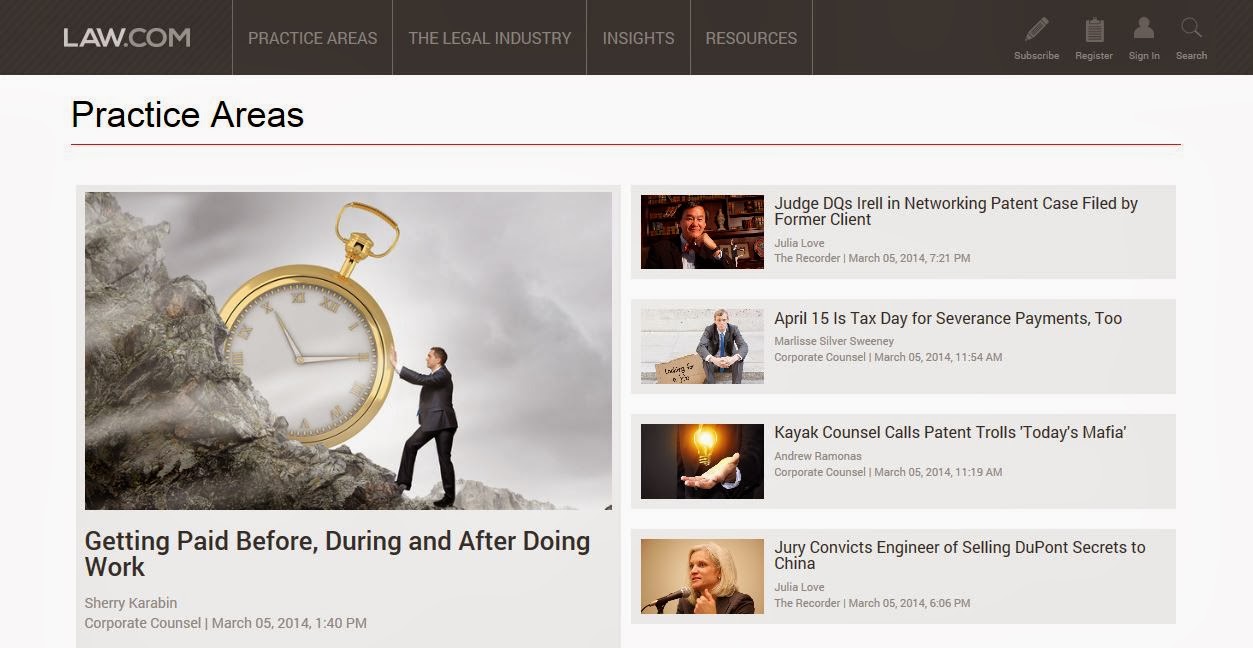
Earlier this
week readers were introduced to a whole new Law.com website. It is clean,
contemporary, graphic and well… glossy. In January ALM rolled out 18 redesigned
websites for its regional and national publications. ALM’s content has always
outshined it’s technology and finally they seem to have developed a slick new
“eye-candy” platform which enhances the content and makes it more accessible.


One major
content change is the pivot away from a jurisdictional emphasis to a
substantive practice focus. Content from the regional and local jurisdictional
publications will be selected by the editorial team for inclusion on the new
platform. For the first time content from all the ALM resources are brought  together in a single platform– including selected
content from the more exotic “Legal Intelligence” and “Rival Edge” platforms.
 

Contributor
Network – a la Huffington Post

ALM is
developing a new Huffington Post type stable of commentators with its
contributor network. So far they have about 160 contributors including practitioners
and law professors who will write articles commenting on important issues in their area of expertise.

 The Layout  The top navigation bar provides access to the main content sections:

Practice The launch includes 5 topical practice
sections, Intellectual Property, Corporate and Securities, Labor and
Employment, Appellate, Class Actions and Product Liability will include content curated by ALM
editors. Each area will include 8 to 10 stories a day..

 Industry  This
section will focus on stories involving law firm management, finance, major
cases, law schools. lateral moves, who’s getting what clients…. This also includes
my favorite section here is called “The Hot Seat”  which provides a daily dose of lawyers
behaving badly.

Insights – Will expose data and provide
graphics from the ALM Legal Intelligence  reports and surveys  and from the  Rival Edge product.  They will not provide the full reports but
will selectively expose data an summaries of reports which is a terrific cross
selling strategy  highlighting the lesser
known legal intelligence products.

Resources – Includes links to other ALM
resources such as Rival Edge, Minority Law Report, CLE center which require
separate subscriptions. The Law.com legal dictionary is free so I tried it.
Today’s headline grabbing word “upskirting” had not yet made it into the
dictionary.

There’s Also an App. There is also a new Law.com App which
is available in iTunes store. The app scales the content to any sized device
and makes downloaded documents available for reading offline.

 New Subscription
Models

ALM is offering 30-day free trials to the site and three
subscription packages (paid annually):

Basic: Two
practice areas or digital access to two publications for $49.99 per month.

Plus: Three
practice areas or digital access to three publications for $79.99 per month.

Elite:
All-access subscription for every practice area and digital access to all
publications for $99.99 per month

The large law firm pricing model has not yet been
determined.

What’s Next? Natalie Gorman the Editor in Chief expects
the platform to continue to evolve.  “We’re very excited about the new site. We’re
also eager to improve and expand what we offer through it. We’ll definitely be
growing the Contributor Network, we will add new practice areas, we will have
new columnists on the site, and we’ve got a number of new features that we’ll
debut over the course of the coming year, some of which are already in development.
We intend for the site to evolve rapidly and frequently

 My two cents

.How about “Sector”
coverage?
I agree with the new focus on substantive practice issues, ALM should
consider expanding to sector coverage since firms have recently started to
focus on business sector expertise.

 Law Journal
Press
– Please tell me that the Law Journal Press Treatise collection is in
the queue  to get a dramatic modern tech
makeover like Law.com!