image
Vote Here

Last week Dewey B Strategic was named one of the ABA Journals “Blawg 100” for 2013. The “Blawg 100” are designated by the editors of the ABA Journal as the  100 best blogs for the legal audience each year.  Readers can now vote for the best blawg in 13 categories.  Click here if you would like to vote for Dewey B Strategic as the best blawg in the “Legal Research/ Writing” category.Go to http://www.abajournal.com/blawg100 to register and vote. Voting ends at close of business on Dec. 20, 2013

Congratulations to colleagues Sarah Glassmeyer (SarahGlassmeyer(Dot)com), Greg Lambert (3 Geeks and a Law Blog), Bruce MacEwen, (Adam Smith Esq.) and Jordan Furlong ( Law21) who were also named to the  7th Annual  “Blawg 100.”

 The ABA Journal is asking readers to weigh in and vote on their favorites in each of the 7th Annual Blawg 100’s 13 categories. Go to http://www.abajournal.com/blawg100 to register and vote. Voting ends at close of business on Dec. 20, 2013.

Press Release:
November 25,2013. Dewey B Strategic  was chosen as one of the ABA Journal’s Blawg 100.- Editors of the ABA Journal announced today they have selected Dewey B Strategic as one of the top 100 best blogs for a legal audience.In addition, the magazine has added 10 more bloggers to its Blawg 100 Hall of Fame, featuring the very best law blogs, known for their untiring ability to craft high-quality, engaging posts sometimes on a daily basis.

Now that the editors have made their picks, the ABA Journal is asking readers to weigh in and vote on their favorites in each of the 7th Annual Blawg 100’s 13 categories. Go to http://www.abajournal.com/blawg100 to register and vote. Voting ends at close of business on Dec. 20, 2013.

Dewey B Strategic is authored by Jean O’Grady. “In our 7th year selecting the Blawg 100, we recognize that it takes more than luck to make it onto our list. Bloggers with the creativity to attract readers to their blogs and keep them engaged continue to be a pleasure to celebrate each year,” said ABA Journal Editor and Publisher Allen Pusey. “Congratulations to this year’s 100 honorees and the 10 who were inducted into our Blawg 100 Hall of Fame.”

About the ABA Journal:
The ABA Journal is the flagship magazine of the American Bar Association, and it is read by half of the nation’s 1.1 million lawyers every month. It covers the trends, people and finances of the legal profession from Wall Street to Main Street to Pennsylvania Avenue. ABAJournal.com features breaking legal news updated as it happens by staff reporters throughout every business day, a directory of more than 3,600 lawyer blogs, and the full contents of the magazine.

About the ABA:
With nearly 400,000 members, the American Bar Association is the largest voluntary professional membership organization in the world. As the national voice of the legal profession, the ABA works to improve the administration of justice, promotes programs that assist lawyers and judges in their work, accredits law schools, provides continuing legal education, and works to build public understanding around the world of the importance of the rule of law.

Partners and associates competing for work

On November 14th, ALM Legal Intelligence released a new report “Turf Wars: Defining New Roles and Competing for Business.”  The report is yet another examination of the ongoing impact of the “Great Recession” on the transformation of large law firms. The report contrasts results with a similar 2011 study and in just two years there are significant shifts in trends. The 2011 report focused on down sizing, the 2013 report focuses on ” Right sizing.” Working smarter in order to meet client demand for efficiency requires an emphasis on project management, knowledge management and business development.
.

The real headline of 2013 is the struggle between partners and associates for billable hours. Partners who are feeling Insecure about workload are  hoarding work. Although firms have begun hiring again, partners are focused on project management and business development and neglecting associate  development and training.
Chief Satisfaction Officers  The biggest change in partners roles in past 5 years is the increased emphasis on business generation and marketing.   One partner  respondent describes his role as “Chief Satisfaction Officer.”
In 2011, the report  tracked the increase in non-equity partners. This report focuses on the nebulous definitions of the   “Of Counsel”  roles. Some of the definitions are too harsh and  depressing to repeat. But the counsel role is a win-win if the firm gets to keep valued talent who lack a client base and the attorney gets more work-life balance.

Key findings:

  • 46% of respondents indicate that firms are beginning to introduce project management
  • Recruiting is 
    focused on  experienced lawyers with both project management experience and knowledge
    of clients industries.
  • Three
    quarters of respondents had reduced support staff in the last year 
    and 50% expect this continue in 2014
  • Over
    next three years Legal Process Outsourcing is expected to increase for 19% of respondents ( but we don’t
    know if this is their first round of outsourcing or if they are extending ououtsourcing into more functions)
  • Reliance
    on contract lawyers is  slowing, down from 29% 2011 to 20% in 2013.Respondents indicate that the revolving door
    of contract attorneys too hard to manage.
  • 44%
    of respondents want to increase permanent associates. Only 1/3 indicated firms
    should increase partner track associates.
  • Complaint that partners are hoarding work from associates.56% respond that partner are doing
    more work than associates.
  • Non
    equity partners continue to increase.
  • Since
    clients are refusing to pay for associates, associates are receiving less
    training and hands-on experience
  • Partners
    spending time on marketing rather than training associates. Associate training squeezed
    out.
  • In associate
    recruiting, practice expertise more important than Ivy league education or GPA.
  • Top
    factors impacting morale “failure to eliminate dead weight, lower compensation
    than other firms and too much work for current staff levels.
  • Firms
    have brought in CFOs and COOs but don’t’ give them the authority to implement
    financial reform. Firms not planning beyond the end of the fiscal year.
  • Predicts
    a volatile staffing picture will continue. Top challenges are  Hiring and retaking talent and establishing right  partner associate leverage ratios.

Knowledge Management and Project Management Reign. The report underscores the need for skilled professionals who can assist lawyers in driving efficiency through project management and knowledge management. Staff who perform routine commoditized work, will continue to be under considerable scrutiny and vulnerable to  outsourcing. More strategic staff, especially those who can help partners implement and leverage project management and knowledge management will continue to be in demand.

I was an 8th grader when the school’s new public address system suddenly erupted. with crackling, fragments of a radio news report. We giggled at first thinking that Sister Agnella had hit the wrong button on the “cutting edge” communications system.  What was a motorcade? A Trade Mart? Three shots fired! President Kennedy….It was a Friday. We were sent home. The streets of New York City were silent. The beginning of a long national wake.

Although I live in a world of “primary sources,” this is the first time I have read the undelivered Trade Mart Speech (reprinted below).  I now notice that President Kennedy was scheduled to deliver the  speech at  1pm CST, instead he was pronounced dead at that exact moment. The speech primarily focuses on complex, contemporary, foreign defense issues.A few timeless quotations from the speech:

  •  “Ignorance and misinformation can handicap the progress of a city or a company, but they can, if allowed to prevail in foreign policy, handicap this country’s security. “


  • ” America’s leadership must be guided by the lights of learning and reason — or else those who confuse rhetoric with reality and the plausible with the possible will gain the popular ascendancy with their seemingly swift and simple solutions to every world problem.”
It concludes with this very moving paragraph:
“We, in this country, in this generation, are — by destiny rather than by choice — the watchmen on the walls of world freedom. We ask, therefore, that we may be worthy of our power and responsibility, that we may exercise our strength with wisdom and restraint, and that we may achieve in our time and for all time the ancient vision of “peace on earth, good will toward men.” That must always be our goal, and the righteousness of our cause must always underlie our strength. For as was written long ago: “except the Lord keep the city, the watchmen waketh but in vain.”
The “Dallas Trade Mart” Speech:
I am honored to have this invitation to address the annual meeting of the Dallas Citizens Council, joined by the members of the Dallas Assembly — and pleased to have this opportunity to salute the Graduate Research Center of the Southwest. It is fitting that these two symbols of Dallas progress are united in the sponsorship of this meeting. For they represent the best qualities, I am told, of leadership and learning in this city — and leadership and learning are indispensable to each other. The advancement of learning depends on community leadership for financial political support, and the products of that learning, in turn, are essential to the leadership’s hopes for continued progress and prosperity. It is not a coincidence that those communities possessing the best in research and graduate facilities — from MIT to Cal Tech — tend to attract new and growing industries. I congratulate those of you here in Dallas who have recognized these basic facts through the creation of the unique and forward-looking Graduate Research Center.This link between leadership and learning is not only essential at the community level. It is even more indispensable in world affairs. Ignorance and misinformation can handicap the progress of a city or a company, but they can, if allowed to prevail in foreign policy, handicap this country’s security. In a world of complex and continuing problems, in a world full of frustrations and irritations, America’s leadership must be guided by the lights of learning and reason — or else those who confuse rhetoric with reality and the plausible with the possible will gain the popular ascendancy with their seemingly swift and simple solutions to every world problem.
There will always be dissident voices heard in the land, expressing opposition without alternative, finding fault but never favor, perceiving gloom on every side and seeking influence without responsibility. Those voices are inevitable.

But today other voices are heard in the land — voices preaching doctrines wholly unrelated to reality, wholly unsuited to the sixties, doctrines which apparently assume that words will suffice without weapons, that vituperation is as good as victory and that peace is a sign of weakness. At a time when the national debt is steadily being reduced in terms of its burden on our economy, they see that debt as the single greatest threat to our security. At a time when we are steadily reducing the number of Federal employees serving every thousand citizens, they fear those supposed hordes of civil servants far more than the actual hordes of opposing armies.

We cannot expect that everyone, to use the phrase of a decade ago, will “talk sense to the American people.” But we can hope that fewer people will listen to nonsense. And the notion that this Nation is headed for defeat through deficit, or that strength is but a matter of slogans, is nothing but just plain nonsense.

I want to discuss with your today the status of our security because this question clearly calls for the most responsible qualities of leader- ship and the most enlightened products of scholarship. for this Nation’s strength and security are not easily or cheaply obtained, nor are they quickly and simply explained. there are many kinds of strength and no one kind will suffice. Overwhelming nuclear strength cannot stop a guerrilla war. Formal pacts of alliance cannot stop internal subversion. Displays of material wealth cannot stop the disillusionment of diplomats subjected to discrimination.
Above all, words alone are not enough. The United States is a peaceful nation. And where our strength and determination are clear, our words need merely to convey conviction, not belligerence. If we are strong, our strength will speak for itself. If we are weak, words will be of no help.
I realize that this Nation often tends to identify turning-points in world affairs with the major addresses which preceded them. But it was not the Monroe Doctrine that kept all Europe away from this hemisphere — it was the strength of the British fleet and the width of the Atlantic Ocean. It was not General Marshall’s speech at Harvard which kept communism out of Western Europe — it was the strength and stability made possible by our military and economic assistance.

In this administration also it has been necessary at times to issue specific warnings — warnings that we could not stand by and watch the Communists conquer Laos by force, or intervene in the Congo, or swallow West Berlin, or maintain offensive missiles on Cuba. But while our goals were at least temporarily obtained in these and other instances, our successful defense of freedom was not due to the words we used, but to the strength we stood ready to use on behalf of the principles we stand ready to defend.

This strength is composed of many different elements, ranging from the most massive deterrents to the most subtle influences. And all types of strength are needed — no one kind could do the job alone. Let us take a moment, therefore, to review this Nation’s progress in each major area of strength.
First, as Secretary McNamara made clear in his address last Monday, the strategic nuclear power of the United States has been so greatly modernized and expanded in the last 1,000 days, by the rapid production and deployment of the most modern missile systems, that any and all potential aggressors are clearly confronted now with the impossibility of strategic victory — and the certainty of total destruction — if by reckless attack they should ever force upon us the necessity of a strategic reply.
In less than 3 years, we have increased by 50 percent the number of Polaris submarines scheduled to be in force by the next fiscal year, increased by more than 70 percent our total Polaris purchase program, increased by more than 75 percent our Minutemen purchase program, increased by 50 percent the portion of our strategic bombers on 15-minute alert forces. Our security is further enhanced by the steps we have taken regarding these weapons to improve the speed and certainty of their response, their readiness at all times to respond, their ability to survive an attack, and their ability to be carefully controlled and directed through secure command operations.
But the lessons of the last decade have taught us that freedom cannot be defended by strategic nuclear power alone. We have, therefore, in the last 3 years accelerated the development and deployment of tactical nuclear weapons, and increased by 60 percent the tactical nuclear forces deployed in Western Europe.

Nor can Europe or any other continent rely on nuclear forces alone, whether they are strategic or tactical. We have radically improved the readiness of our conventional forces — increased by 45 percent of the number of combat ready Army divisions, increased by 100 percent the procurement of modern Army weapons and equipment, increased by 100 percent our procurement of our ship construction, conversion, and modernization program, increased by 100 percent our procurement of tactical aircraft, increased by 30 percent the number of tactical air squadrons, and increased the strength of the Marines. As last month’s “Operation Big Lift” — which originated here in Texas — showed so clearly, this Nation is prepared as never before to move substantial numbers of men in surprisingly little time to advanced positions any- where in the world. We have increased by 175 percent the procurement of airlift aircraft, and we have already achieved a 75 percent increase in our existing strategic airlift capability. Finally, moving beyond the traditional roles of our military forces, we have achieved an increase of nearly 600 percent in our special forces — those forces that are prepared to work with our allies and friends against the guerrillas, saboteurs, insurgents and assassins who threaten freedom in a less direct but equally dangerous manner.

But American military might should not and need not stand alone against the ambitions of international communism. Our security and strength, in the last analysis, directly depend on the security and strength of others, and that is why our military and economic assistance plays such a key role in enabling those who live on the periphery of the Communist world to maintain their independence of choice. Our assistance to these nations can be painful, risky, and costly, as is true in Southeast Asia today. But we dare not weary of the task. For our assistance makes possible the stationing of 3.5 million allied troops along the Communist frontier at one-tenth the cost of maintaining a comparable number of American soldiers. A successful Communist breakthrough in these area, necessitating direct United States intervention, would cost us several times as much as our entire foreign aid program, and might cost us heavily in American lives as well.
About 70 percent of our military assistance goes to nine key countries located on or near the borders of the Communist-bloc — nine countries confronted directly or indirectly with the threat of Communistic aggression — Viet-Nam, Free China, Korea, India, Pakistan, Thailand, Greece, Turkey, and Iran. No one of these countries possesses on its own the resources to maintain the forces which our own Chiefs of Staff think needed in the common interest. Reducing our efforts to train, equip, and assist their armies can only encourage Communist penetration and require in time the increased overseas deployment of American combat forces. And reducing the economic help needed to bolster these nations that undertake to help defend freedom can have the same disastrous result. In short, the $50 billion we spend each year on our own defense could well be ineffective without the $4 billion required for military and economic assistance.

Our foreign aid program is not growing in size, it is, on the contrary, smaller now than in previous years. It has had its weaknesses, but we have undertaken to correct them. And the proper way of treating weaknesses is to replace them with strength, not to increase those weaknesses by emasculating essential programs. Dollar for dollar, in or out of government, there is no better form of investment in our national security than our much-abused foreign aid program. We cannot afford to lose it. We can afford to maintain it. we can surely afford, for example, to do as much for our 19 needy neighbors of Latin America as the Communist bloc is sending to the island of Cuba alone.
I have spoken of strength largely in terms of the deterrence and resistance of aggression and attack. But in today’s world, freedom can be lost without a shot being fired, by ballots as well as bullets. The success of our leadership is dependent upon respect for our mission in the world as well as our missiles — on a clearer recognition of the virtues of freedom as well as the evils of tyranny.
That is why our Information Agency has doubled the shortwave broadcasting powers of the Voice of America and increased the number of broadcasting hours by 30 percent, increased Spanish language broadcasting to Cuba and Latin America from 1 to 9 hours a day, increased seven-fold to more than 3.5 million copies the number of American books being translated and published for Latin American readers, and taken a host of other steps to carry our message of truth and freedom to all the far corners of the earth.

And that is also why we have regained the initiative in the exploration of outer space, making an annual effort greater than the combined total of all space activities undertaken during the fifties, launching more than 130 vehicles into earth orbit, putting into actual operation valuable weather and communications satellites, and making it clear to all that the United States of America has no intention of finishing second in space.

This effort is expensive — but it pays its own way, for freedom and for America. For there is no longer any fear in the free world that a Communist lead in space will become a permanent assertion of supremacy and the basis for military superiority. There is no longer any doubt about the strength and skill of American science, American industry, American education, and the American free enterprise system. In short, our nation space effort represents a great gain in, and a great resource of, our national strength — and both Texas and Texans are contributing greatly to this strength.
Finally, it should be clear by now that a nation can be no stronger abroad than she is at home. Only an America which practices what it preaches about equal rights and social justice will be respected by those whose choice affects our future. Only an America which has fully educated its citizens is fully capable of tackling the complex problems and perceiving the hidden dangers of the world in which we live. And only an America which is growing and prospering economically can sustain the worldwide defenses of freedom, while demonstrating to all concerned the opportunities of our system and society.

It is clear, therefore, that we are strengthening our security as well as our economy by our recent record increases in national income and output — by surging ahead of most of Western Europe in the rate of business expansion and the margin of corporate profits, by maintaining a more stable level of prices than almost any of our overseas competitors, and by cutting personal and corporate income taxes by some $11 billion, as I have proposed, to assure this Nation of the longest and strongest expansion in our peacetime economic history.

This Nation’s total output -which 3 years ago was at the $500 billion mark — will soon pass $600 billion, for a record rise of over $100 billion in 3 years. For the first time in history we have 70 million men and women at work. For the first time in history average factory earnings have exceeded $100 a week. For the first time in history corporation profits after taxes — which have risen 43 percent in less than 3 years — have an annual level of $27.4 billion

My friends and fellow citizens: I cite these facts and figures to make it clear that America today is stronger than ever before. Our adversaries have not abandoned their ambitions, our dangers have not diminished, our vigilance cannot be relaxed. But now we have the military, the scientific, and the economic strength to do whatever must be done for the preservation and promotion of freedom.
The strength will never be used in pursuit of aggressive ambitions — it will always be used in pursuit of peace. It will never be used to promote provocations — it will always be used to promote the peaceful settlement of disputes.

We, in this country, in this generation, are — by destiny rather than by choice — the watchmen on the walls of world freedom. We ask, therefore, that we may be worthy of our power and responsibility, that we may exercise our strength with wisdom and restraint, and that we may achieve in our time and for all time the ancient vision of “peace on earth, good will toward men.” That must always be our goal, and the righteousness of our cause must always underlie our strength. For as was written long ago: “except the Lord keep the city, the watchmen waketh but in vain.”

Sources:  Original press release with full text of speech

Read more: JFK’s Assassination: Portrait of an Era When Newspapers Mattered | LIFE.com http://life.time.com/icons/jfk-assassination-a-portrait-of-an-era-when-papers-mattered/#ixzz2lNiDdJSX

It is hard to believe that less that 20 years ago law firm partners followed a relatively safe and dignified trajectory from junior partner through retirement.. American Lawyer Media released a report this week: “Up or Out: When Partners Need to Go.”  which paints a grim and unsettling landscape of  partner termination practices in large law firms. The survey was commissioned by SJL Shannon and conducted  by ALM Legal Intelligence in the summer of 2013 .

Since the Start of the Great Recession law firms have had limited ability to raise rates, face pressure to offer discounts and alternative fees and have already cuts staff and expenses to the bone. The vulnerability of firms is further intensified by the fixed pool of clients. The only way to grow business is to poach clients from other firms. This is often accomplished though the hiring of lateral partners.
 

Lateral Partners: Failing Early and Often. Senior Fellow  James  Jones from Georgetown Center for the Study of the Legal Profession is  quoted as stating that lateral hires have only a 50% chance of succeeding. Many law firms recruit partners without first determining how they fit in the firm strategy or defining the metrics by which the new partner will be measured. The processes for communicating a failed lateral match to the partner is the most depressing piece of this somber report,

The report suggests that a new round of partner cuts is the next strategy for improving the balance sheet. The only positive news in the report is that terminated partners reported that they  found new positions within 2 to 4 months. Most didn’t face reduced compensation and were able to retain their clients through the move.

Key Points

•    53% of the departing partners have been at the firm less than 6 years
•    Law firms and partners provide contradictory explanations for partner departure. 55% of law firms reported that departures were voluntary vs. 93% of partners reported that they left voluntarily.
•    The top reason for partner “lay offs” were due to :the inability to develop and cultivate new clients or sustain a book of business.
•    77% of partners report that they learned about their performance issues for the first time on the day they were terminated.
•    Only one in ten partners received outplacement assistance
•    Lateral partners are left to fend for themselves with out guidance, feedback or an integration strategy.
•    44% of terminations are not communicated by law firm leaders such as Executive committee or Practice Group leaders.
                                                                                                    
Lateral Partners Fail Early and Often One of the most stunning aspects of the report is the revelation that  from a human resources perspective, partners  are treated worse than the average  law firm file clerk. I think it is safe to say that no Amlaw 200 firm would dream of terminating a staff member without a well documented performance plan and a series of formal warnings. Some law firms are reported to rely on passive aggressive activities such as cutting pay  and with-holding support rather than having an honest conversation.

Recommendations
Develop Strategic Hiring Plans Law firms need to develop framework to align hiring with  overall firm strategy and develop time lines and metrics to guide performance and communication with lateral partners.

Fix the Exit Process. Firms need to treat exiting partners like valued alumni who become part of the firms referral network. Mishandled terminations hurt the films reputation as well as internal morale.

Firms Better Act Quickly
 Earlier this week ALM Daily reported on the recent Wells Fargo and Citiback Law Firm financial surveys:

 “The underproductivity is largely centered in the partner level of all the law firms,” says Jeff Grossman, of Wells Fargo, who notes that associates are logging many more hours than partners. “It continues to be one of the biggest challenges law firms are facing. … Not enough partners are being asked to leave….”

Last
week the Special Libraries Association and the Financial Times released a
report “The Evolving Value of Information Management.”  First of all, I want
to applaud SLA and the Financial Times for this innovative partnership which
obviously addresses a mutual need to foster the value of  both premium
content resources and sophisticated content advisers.

I
do agree with the reports conclusion that we face  unprecedented opportunities. But we need to also acknowledge unprecedented
vulnerability if we do not adapt. This report includes some valuable observations including…..

The
Five Essential Attributes:
  • Communicate
    Your Value
  • Understand
    the drivers
  • Manage
    the process
  • Keep
    up on technical skills
  • Provide
    “decision ready” information

Crossing
the Analysis Divide

The  5th attribute above  is the most important of all. Providing “decision ready”
information will take care of number one, communicating our value. Information professionals need to get comfortable analysing, distilling and designing consumable information.The emergence of big data, will create a host of new opportunities requiring a higher level of analytical skills which can benefit  both the business and practice of law. The value proposition will increase and become more visible if these opportunities are seized.
 
How relevant is the study in the law firm context? There
is a Credibility Gap in The Performance Gap Data
 

Much as been made of the performance gaps reported in the survey. The report cites legal information professionals as having overestimated the value of their services compared to their colleagues assessment of the information professionals’ value. They have the biggest “performance gap.” But how credible is the data?

In
preparing a “decision ready” assessment of the report,  I focused on the 
survey data that was provided in the introduction.  That data is remarkably skewed. There were 832
respondents to the survey and the vast majority of the respondents were information
professionals (83%).  Since it is reported that only 17% of the
respondents we in a legal environment we have to assume that there were only
149 respondents in the legal field. If 83% of those respondents were
information professionals, then there were only 25 legal information consumers.
Furthermore it is unclear who those legal information consumers were. How many
were partners, associates, C-level executives in other areas such as finance,
IT or marketing?  When I “run the numbers” the large performance gap
which is suggested  in the legal context has a lot less weight.

The
Perception of Value and the Lawyer /Non-lawyer Schism
  

Seriously,
did the drafters of this survey think that lawyers would view anyone but
lawyers as strategically important  to the practice of law? More precisely would any lawyer
view his/her fellow lawyers as delivering more value than his/her own work product? I
think not! 

If we did want to assess the value of information professionals this would have to be done in the context of how lawyers rate the value of other administrative professionals in their organization ( IT, Finance, Marketing, Professional Development).
Our value needs to be contextualized in the perspective of the overall legal
environment to have any meaning.

The Value of  Everything is Being Questioned in Law Firms

You name it, the value partners, associates, senior counsel, staff, office space… every aspect of the business and practice of law is under scrutiny due to the ongoing turmoil of the legal market. Indeed, firms  are even questioning the value of certain client relationships!  Has there ever been a more uncertain time to ascertain a value proposition? Nonetheless questions must be asked, but they must be asked carefully and in the proper context.

Other Disconnects from The Legal Context.

The report states that the most cited threat articulated by information professionals in the survey, is that people are bypassing the library and doing their own Google research.

Thanks to Lexis and Westlaw,  lawyers have been doing their own online research for the past 30 years. The current generation of senior partners grew up using one of the more primitive software versions of Lexis and Westlaw. Legal information professionals have been facilitators and trainers encouraging the direct effective use of online resources. Over the past 30 years, instead of coveting the gatekeeper role, legal information professionals have continued to expand and facilitate direct disinter-mediated access to research of the “fact checking” “document pulling” variety – which is the kind of thing that Google is good for. They have instead focused on expanding their portfolio of complex research offerings which address the entire lifecycle of business and practice workflows from competitive intelligence to the emerging opportunities in big data.

My Advice: IF YOU ARE STILL THREATENED BY GOOGLE YOU HAVE NOT CLIMBED THE VALUE CHAIN – START TOMORROW OR IT WILL BE TOO LATE.
 
The
Best News in this report…

is
the suggestion that executives are ready to engage with information professionals and they anticipate that
such engagement will increase over the next 3 years.
 
Despite its shortcomings, the report is an interesting read with useful, actionable insights, but more is needed.
We need a study which focuses on the unique challenges legal information professionals in the law firm environment.


Rich Leiter the host of Law Librarian Conversations has invited the PLL Board  (including myself) to be guests on the show at 1pm est. today, October 23. The chat room will be available at the show’s website.

Here are some of the topics to be discussed: 

1.
The PLL Board has proposed that members consider changing the name of the Private Law Libraries SIS to a name focused on the future of the profession rather than the past.
I outlined my thoughts on this issue in the PLL newsletter. “What’s in a name?”  

2.
How are things changing in law firms that effect library services? What is the
new normal? 

3.
The  Success of the PLL Summit 

4.
How are firm libraries changing? 

5.
What should we academics know about what our students will be doing in your
firms that they don’t know? What kinds of research skills do students need
today? Is it true that firms are canceling all print formats of materials?


Listen or Talk : Here is the link to the link to the show for people who want
to listen in: http://tinyurl.com/kh6oon6/ Listeners
who want to call in and “Join the conversation” can call in at
347-945-7183


The latest issue of  Practice Innovations from Thomson Reuters was just released and it includes an interesting array of articles of interest to law firm executives. The lead article focuses on the  Global Practice of Law. The rest of the articles focus on various aspects of how technology, law firm economics and changing demands are impacting how we work and support the practice of law in law firms. These articles focus on: Digital Identities, Competency Modeling, Legal Pricing Professionals and The Future of the Legal Secretary. It also features a book review. The Next IQ

 Below you can link directly to articles of interest.

Global Practice From the US Perspective by Carol Silver, Professor of Law Indiana University Maurer School of Law (Jan 2014, Professor of Global  Law and Practice, Northwestern University Law School.)

Redefining Digital Identities by Lynn Watson, Director of Information Resources and Technologies, Hogan Lovells, US LLP

Competency Modeling: Defining the Criteria that Drive Individual and Organizational Success by Kancy Krauss, Learning and Organizational Consultant

Legal Pricing: An Emerging Profession by Steven Petrie, Chief Strategy Officer, Faegre and Benson

Secretarial Roles in Transition: Laid Off, Outsourced and Reengineered. The Future has Begun
by Jean O’Grady, DLA Piper US, LLP

Book Review: The Next IQ:The Next Level of Intelligence for  21st Century Leaders by Arlin N Reeves. Reviewed by William Scarbrough, COO, Bodman, PLC

About Practice Innovations

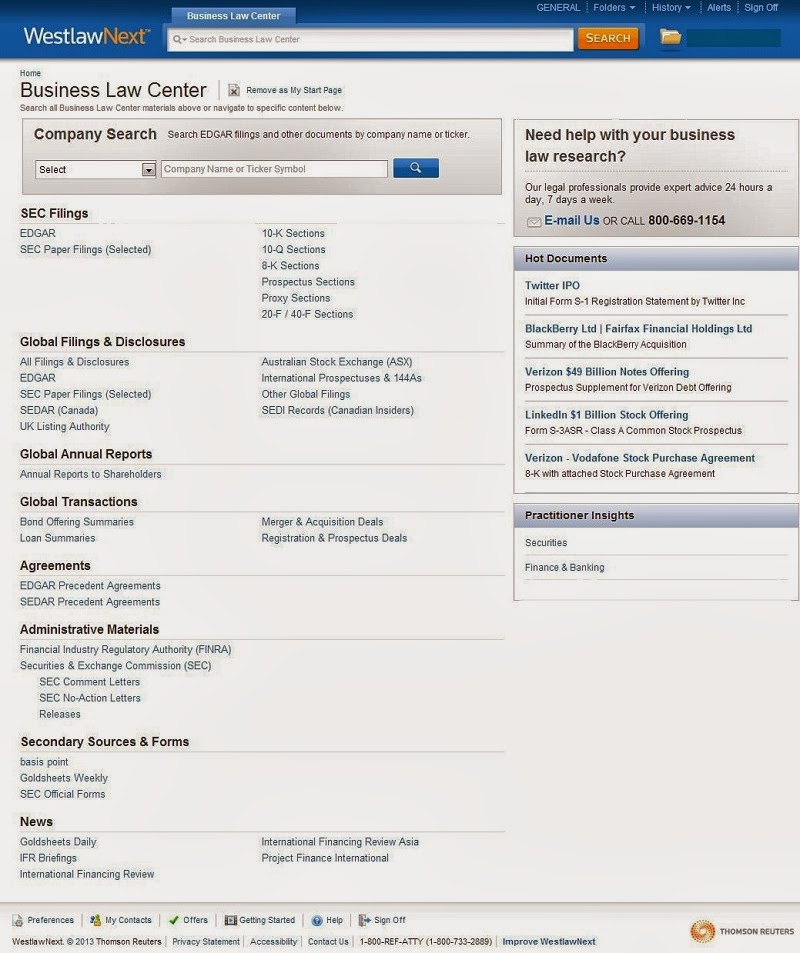
Today Thomson Reuters announced that it had launched the latest incarnation of Westlaw Business as “The Business Law Center on WestlawNext.” There have been seismic shifts in law firms and the legal publishing industry since Thomson Reuters first waded into the corporate practice market in 2005 with the acquisition of Global Securities Information (GSI). Seven years on, TR has to overcome customer cynicism and a complex range of competitors including: the big, rich and innovative (Bloomberg Law); the small and innovative (Intelligize); the small and commoditized (10K Wizard) and direct competition from Lexisnexis/Knowledge Mosaic. 

A Brief History of The Big Bungle(s)
In 2005 Thomson Reuters acquired one of the most beloved legal research brands, Global Securities Information (GSI) owner of the LivEdgar product. GSI had a long history of providing securities research and retrieving documents from the public reading room of the SEC. It was the first product to offer “real time” access to SEC documents. To lawyers and researchers the “good will”of the GSI brand extended beyond the product to the extraordinary GSI customer support team of expert securities researchers. The team functioned as a trusted extension of the firm’s research team. It was in effect, an early “legal process outsourcer” which specialized in complex securities research. GSI also featured a simple “pay as you go” pricing. $10 to login and $2 a minute.
According to a former GSI insider, the company had many suitors, but Thomson Reuters beat out the competitors because they promised GSI’s founders that they would not fire the GSI customer support team. The team was not fired but it seemed to wither away and was unable to perform as it had when part of a small company. West’s customer support for their legal product remains one of the best in the business. That said, their attorney research generalists were not prepared to deliver the level of expertise developed by years combing through 10K exhibits or the mining the mysteries of private placement documents. Thomson Reuters also decided to discard the powerful LivEdgar brand.  
·       In 2007 Thomson Reuters relaunched LivEdgar as WestlawBusiness. It was a “stand alone” corporate research platform, separate fromWestlaw which offered SEC documents and specialized practice centers. The securities filings were no longer the centerpiece. They eliminated the low cost “pay as you go” model and instituted a hefty, flat monthly fee which was roundly criticized by the law librarian community. Customers grumbled that the personalized customer support was gone. To make matters worse, Westlaw Business launched at the dawn of “the great recession.” Transactional work tanked, armies of lawyers got “pink slips” and budgets contracted.
· In late 2010, Thomson Reuters created a GRC (governance, risk & compliance) business unit under the “Thomson Reuters Accelus” brand, and Westlaw Business was a part of it. Westlaw Business was renamed “Business Law Research.”
· In 2011 TR decided to eliminate the dedicated corporate research support team and moved support to the general Westlaw legal research support team. This resulted in large numbers of the Westlaw Business support team departing for upstart competitor Intelligize.
· In early 2012, amidst a company-wide reorganization, Business Law Research was moved back out of GRC and returned to TR Legal. It continues to be officially called “Business Law Research” but moved under the “Thomson Reuters Westlaw” brand.
· Today, it is launching as the “Business Law Research Center.”
Introducing the Business Law Center on Westlaw Next  
1. Experts on Call. Making Amends to the GSI Loyalists.
The promotional flyer announces “You talked. We listened.” Not much a stretch to imagine that they are trying to reclaim the glory days of GSI customer service. The flyer  also proclaims: “We can do the legwork for you, especially when you are faced with difficult request.”  “Call our experts to discuss approaches to difficult requests.”  Enhanced customer service promises “our Business Law Research Experts monitor the progress of your service ticket to insure timely resolution.” TR has reportedly recruited some former GSI customer support staff.. The business support team will offer 24/7 coverage. The customer support pitch is being promoted as much, if not more than the content. 
2. The Business Law Center on Westlaw Next Features
The latest incarnation of Westlaw Business offers the Business Law Center where it features the faceted search capabilities of Westlaw Next.
o Filter search results using dozens of categories of information
o SEC filings will display related agreements and SEC comment letters
o New search templates for M&A, Capital markets, Loan and Bond transactions.
o Foldering – organize and manage documents and selected text in folders which can be shared with collaborators
o Search by relevance: results can be sorted by date ranges or transaction values..
o Experts on Call- provides 24/7 support by email or phone from team of corporate and transactional research experts.
o Global filings include filings Canada, UK and Australia
Coming Next 
o Export data to spreadsheets

o Improved navigation through exhibits.

o Compare text of documents within the Business Law Center

o Improved no-action letter functionality

o Trending Topics on the main page

o Flexible Bill Back Optional ability to skip client-matter entry screens
The Business Law Center has an intuitive look and offers advanced filtering of document keywords and features. It offers a wider range of content with deeper contextual linking between securities filings and regulatory materials. It offers the future promise of linking to the Practical Law “know how.” It has changed so dramatically from the original Westlaw Business that it will be worth a second look by customers who wrote off the Westlaw Business brand during one of its prior incarnations. The market is likely to be both highly skeptical and highly sensitive to pricing. Transactional activity has ticked up since 2007 but Thomson Reuters will likely have to displace smaller competitors who have made significant headway in many firms. The Business Law Center will be on theWestlaw Next platform in a separate “zone.” It will require a separate subscription. Existing Westlaw Business customers who subscribe to Business Law Center will have access to both Business Law Center and Westlaw Business platform included in the price of the Business Law Center subscription.
Fighting for Control of the Transactional Desktop
The speculation will begin about whether the Westlaw Business Center will reclaim the lost legacy of GSI. Clearly that is only a short term issue for TR. This relaunch is surely about regaining lost “good will” and reinforcing credibility in the corporate practice space. But I suspect that the Business Center is a beachhead from which a greater initiative will be launched. It is becoming increasingly clear that as content has become commoditized, the large legal publishers will maintain their growth and advantage by providing more integrated content, enhancing context and folding content into tools for process improvement.
The launch of the Westlaw Business Center needs to be viewed in the context of TR’s recent acquisitions and other product launches. In this year alone TR finalized its acquisition of Practical Law Company, and launched integrated workflow products Concourse for in-house counsel and Firm Central for small firms. The emergence of Bloomberg Law will probably motivate TR to accelerate the integration of data from Thomson Financial with corporate and legal information. 
I think we are about to witness a wave of aggressive product development and fierce competition as legal publishers grapple for control of the transactional lawyers desktop by offering increasingly sophisticated workflow tools. Riffing on Neil Armstrong:…” One small step towards securities research, followed by one bold leap to control the desktop.”
This week ALM Legal Intelligence released : Diving In… Or Baby Steps – Legal Process Outsourcing in Corporate Legal Departments.

The survey which was conducted in the Summer of 2013 surveyed corporate legal departments regarding their views on legal outsourcing.. The survey defined outsourcing as sending work to a non-law firm entity either in the US or abroad. They also included work outsourced by the outside counsel on behalf of the client. The survey suggests that legal process outsourcing may not be on the explosive growth trajectory that has been  repeatedly predicted. The report cites a Datamonitor study which had predicted that legal outsourcing revenue would grow from $400M in 2010 to $2.4 billion in 2012. In fact the 2012 revenues were 1.1 billion. The slower growth is corroborated by the ALM study. LPO represents a small percentage of all legal spending. The majority 64% spend less than 10% of their budget on LPO. GC’s don’t seem to be interested in expanding their use of LPOs. 68%  of GC believe that the savings will not be worth the trouble.The study also implies that law firms are not all that threatened by LPOs since they are encouraging and facilitating the use of LPOs  by clients, for work that they apparently have no interest in taking on themselves.

Here are some of the key findings

  • The main motivations for outsourcing are cost savings and to improve speed of delivery not to improve quality
  • Only 21% of GCs outsource in order to improve quality.
  • More than 48% cited lack of quality or lack of familiarly with clients business as an obstacle to outsourcing.
  • 45% of GCs said they were encouraged to outsource by their outside counsel.
  • In house counsel didn’t cite LPO as the most important way to rein in costs. ( Bringing more work in-house was the top strategy).
  • The cost savings derived from outsourcing are shrinking ( rising labor costs)
  • 90%  of responding GC’s  who had not yet outsourced didn’t have any interest in trying outsourcing in the next 3 years.
  • One third of the respondents indicated the more than half of the outsourced work was work that was previously sent to law firms.
  • Document review and ediscovery are the most common functions outsourced
  • Most work is outsourced in the US not abroad.( 65%)
  • For every dollar spent on outsourcing law firms lost fifty cents.
  • Law firms have decided on their own that they don’t want to perform certain kinds of repetitive work and are encouraging clients to outsource certain work.

The Tidal Wave That Wasn’t
The most surprising “take-away” from reading  this study is the evidence that legal process outsourcing may not be the growth industry which  legal management consultants have been predicting.  GC’s  report that their interest in LPC is waining not growing because perceived disincentives are expanding.. Security and quality concerns are slowing and possibly reversing the growth . Many GC appear to believe that outsourcing is simply not worth the effort and the complications won’t justify the cost. For GCs who want to cut costs, the LPO option is way down the list of priorities.

 “In recent years fewer business leaders have come from the ranks of lawyers. Our intention with the Doctoroff program is to go ‘back to the future’ and reestablish the JD as a compelling option for anyone who is bright, ambitious, and ready to become a leader in business.”  — Dean Michael Schill

Last
week the University of Chicago Law School, announced  an innovative
business leadership program  supported by a $ 5 million gift from Dan
Doctoroff, CEO of Bloomberg L.P. (a 1984 Law School alum), and his wife, Alisa (a 1983 grad of the Business School)..The Law School will establish the Doctoroff Business Leadership Program. The
Doctoroff program will combine law and business courses to prepare the next
generation of law graduates with the analytical skills to be leaders of
businesses or key advisers to business. The Doctoroff Program will offer all U
of Chicago law students a series of core business courses taught by professors
at the Booth School of Business. In addition, each year it will provide 15
students who demonstrate commitment  to careers in business, with a
unique array of mentorship, internship, and enrichment opportunities not
normally found in law schools. The Doctoroff Program provides the platform for
the Law School’s first-ever certificate-granting program, combining a business
curriculum taught by many of the leading professors of Chicago’s acclaimed
Booth School of Business; mentorship from alumni business leaders; and summer
internships in business enterprises.


“For Chicago, this is not about offering JD/MBAs, sending law students to the MBA school for classes, or mini MBA boot camps. It is about integrating analytical business thinking into the study of law.”


Adding Business Analysis to the Study of Law

“The Doctoroff Program is a key part of Chicago’s comprehensive approach to providing our students with the analytical tools to be preeminent not just in the practice of law, but also in business, government, and academic careers,” says Dean Michael Schill. “The recent upheaval in both the legal and financial markets has profoundly changed the legal profession and challenged law schools to innovate. For much of the past century, a law degree was a great credential for leadership in banking, finance, investment banks, and real estate, as well as more traditional endeavors such as government service and private practice. In recent years fewer business leaders have come from the ranks of lawyers. Our intention with the Doctoroff program is to go ‘back to the future’ and reestablish the JD as a compelling option for anyone who is bright, ambitious, and ready to become a leader in business.”

Dan Doctoroff’s View

Dan Doctoroff
has  held a variety of leadership positions  in government (NYC Deputy
Mayor for Economic Development) and financial services  (Oak Hill
Capital Partners and Lehman Brothers  ) before becoming the CEO of the Bloomberg media empire. I think it is safe to assume that Doctoroff has interacted with many outside counsel in his career so law firm leaders should “listen up.” Doctoroff offers a rather compelling quote in the press release: “Time after time, I’ve seen the value  of lawyers who have fundamental business and financial skills, no matter their field of specialty.” This is an important message for law firm leadership to absorb, the traditional benchmarks for recruiting should be reassessed. CEO’s want lawyers who understand businesses and industries as well as “the law.”.In a telephone interview Doctoroff described the program as offering law students the “best of both worlds” and filling an educational void which has hampered prior generations of law students. The Doctoroff Program will enable students to better understand the value of business data and analytics. He hopes that it will also give Chicago a competitive advantage in recruiting students who might otherwise opt for Harvard or Yale. One long term benefit he sees is growing a new generation of business leaders who will not only build businesses but also have resources to fund innovative  philanthropic initiatives and also become law school donors themselves.

The Next Normal
Given the uncertainties of the legal market for law grads, a  set of business skills combined with legal analysis offers a compelling recruiting profile for law firms which are also grappling to define the “Next Normal.” Law firms need to recruit a new generation of leaders with a new skillset. Will a judicial clerkship and and writing a law review article start to pale in comparison to a preparing a spreadsheet and a regression analysis?