Anyone who has had to manage the internal redistribution and filing of daily docket updates from dozens of courts for hundreds of cases in a large law firm, celebrated on the day that automated docket management tools from companies such as PacerPro and ECFX hit the market. Yet, today a federal judge issued a stunning order which could impact lawyers ability to benefit from these tools. Is this another case of blaming technology when the real problem is human error? The scenario highlighted in the order is deals with – someone failing to designate documents as “under seal” and which results in the documents being automatically distributed… then sealed after the fact. That problem does not arise from the workflow platform, but maybe from a lawyer or a clerk failing to “check a box.”

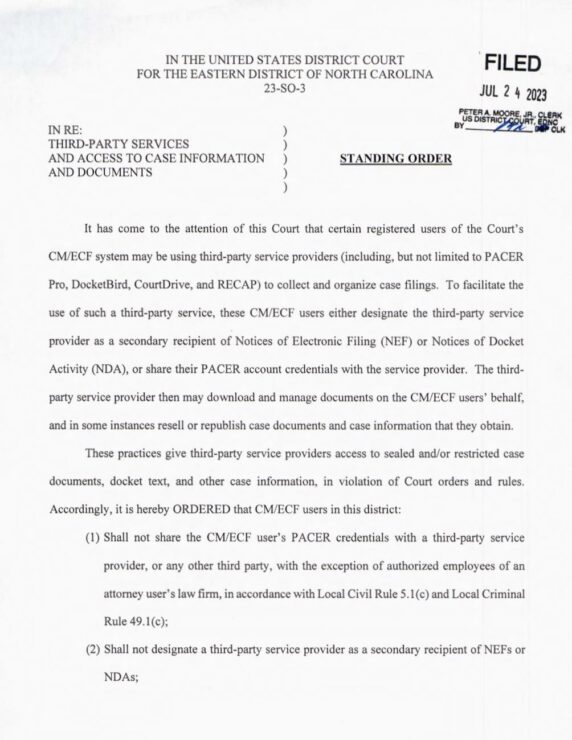
The order specifically mentions PacerPro, DocketBird, CourtDrive and RECAP. The order does not mention the company ECFX. I am in the process of requesting responses to the order from these companies.

Richard E. Meyers II, Chief United States District Judge North Carolina, issued a Standing Order today which orders lawyers to stop using these services. Here is a copy of the order
This survey is intended to  gather feedback on both products and projects which you started or stopped during the past year. I had added additional questions related to the emergence of generative AI.

Please take a few minutes to respond to the survey at this link. The results will be summarized and posted here in late September.

In addition,  Dewey B Strategic blog has partnered with HBR Consulting to create the latest Start/Stop survey.   I will be joining with an Kris Martin from HBR to present and discuss the results of the Start Stop Survey combined with insights from  HBR’s BLISS survey.

This presentation will be featured at HBR’s third annual Legal Information + Knowledge Services Conference (LINKS) on Thursday, September 14, 2023. Proceeds from LINKS ticket sales will cover technology costs for the event and a donation to the American Association of Law Libraries (AALL) George A. Strait Minority Scholarship & Fellowship fund.

In less than six months, two of the remaining independent and reasonably priced legal research providers Fastcase and Casetext have been acquired or are in the process of being acquired.

Fastcase, which itself had acquired the analytics platform Docket Alarm has been absorbed into vLex, an interesting and innovative European start-up, which has been making some inroads into the US legal market over the past decade. Since its launch in 1999, Fastcase had acquired the largest subscriber base in the US legal market.  The combined vLex /Fastcase company will also have the world’s largest law firm subscriber base and resources containing more than one billion legal documents from more than 100 countries.

Casetext, which brought its own Silicon Valley brand of visionary innovation to legal research is in the process of being acquired by Thomson Reuters for the spectacular sum of $650 million.

Mergers are not new to the legal/publishing technology space. Since law librarians have been navigating these mergers for decades, I was inspired to survey, collect and analyze the insights of my librarian and knowledge management colleagues.

From the survey responses, I have extracted both data and anecdotes which can provide some insights and cautionary warnings for both company executives and customers.

The Survey

I gave information professionals the opportunity to provide feedback on legal information mergers in a survey which was open from July 11th to July 18th. Eighty-six law librarians/knowledge professionals responded to an open-ended question asking them to name mergers with successful outcomes. Although the majority were in private firms (84%), there were also responses from academic (10%) and government law librarians (6%).

Librarians have long memories, and I was delighted to be reminded of dozens of deals. Over 40 company and product acquisitions both large and small covering the past 30 years were noted by the respondents. However, the most recent digital resource acquisitions dominated the survey responses. Read the full post on Legal TechHub.

Today LexisNexis is announcing that their soon to be launched AI powered solutions will be integrated into Microsoft 365. The product integrations include– Lexis+®, Lexis ® Connect, Lexis ® Create, and Lexis ® Create Plugin with Microsoft 365 Copilot. Both companies are committed to providing legal professionals with “intelligent, AI-powered tools, enhanced capabilities, and more efficient, guided workflow experiences”  inside the suite of Microsoft products where they currently work: Microsoft Outlook, Word, and Teams.  Back in May Lexis announced two AI initiatives a commercial preview and the AI Insider Program as well as plans for incorporating generative AI into their product. Lexis announced its commitment to launching GPT enabled solutions with the Microsoft Azure Open AI Service which has already been rolled out to customers via Lexis+.

I recall Lexis as having a long history of integrations with Microsoft products. According to Jeff Pfeifer, LexisNexis Chief Product Officer Canada, UK and USA. “The company began working closely with Microsoft in the 1990s when we acquired the Jurisoft product line. These products were among the first legal market tools that delivered bespoke formatting tools integrated with Word. These solutions later evolved to become Lexis for Microsoft Office and later still, Lexis Create. Lexis Create is our first solution built entirely for the Microsoft 365 platform, a key technology enabler for delivery of generative AI in Word, Outlook and Teams. Our customers can expect integration of generative AI capabilities in Lexis Create in Q3 of this year and in Lexis Connect in Q4.”

Jeff Reihl, CTO of LexisNexis Legal & Professional is quoted in the press release “Microsoft and LexisNexis have a long history of collaboration, and we’re excited about how our Microsoft-integrated products will help improve the lives and work product of legal professionals. Lexis Connect, Create and Copilot truly embody our strategy of creating a fully integrated ecosystem, inserting world-class legal data, content and technologies directly into attorney workflows. To enhance this, we’re incorporating professional-grade generative AI capabilities into our current and future products to elevate legal work and help lawyers be more efficient at their jobs.”

LexisNexis Products Integrated with Microsoft include:

  • Lexis+: Azure OpenAI Service has been rolled out to customers via Lexis+.
Continue Reading LexisNexis Announces Integration with Microsoft 365 Copilot/Generative AI Solutions

Today  LexisNexis® Legal & Professional  is announcing the launch of InterAction+™, a new cloud-based legal CRM that  integrates the workflow around law firm contacts into Outlook and leverages the firms existing Lexis subscriptions to deliver business intelligence into the CRM experience. The new interface add new features, including a modern user experience, cloud infrastructure, and exclusive content from LexisNexis® to help lawyers manage relationships and identify opportunities and at-risk clients.

Integration with Lexis Content. If you have spend the past 3 years building custom API’s to link litigation data with InterAction contacts, you might want to sit down. InterAction+ now offers an “out of the box” solution which will deliver business intelligence insights from their Context analytics tool. Context provides analytics on litigation events involving clients or prospects which  provides  data on litigation events involving clients or prospects which can be filter and analyze data by firm, practice area, and jurisdiction..

Continue Reading Lexis Launches InterAction+ with Outlook and Analytics Integrations, New Dashboard and Security Options

NetDocuments, a native cloud Document Management System is jumping into the Generative AI market for Legal with is announcement of ndMAX. The company plans a suite of generative AI-powered products designed to streamline the entire legal workflow based on practice group needs.

According to the press release ndMAX “enables law firms and legal teams to securely and responsibly apply cutting-edge AI to their own documents and data in order to extract business intelligence and generate novel content.”

Continue Reading NetDocuments Announces “Responsible AI” for Legal with ndMAX and PatternBuilderMax

My prior post suggested that librarians are the logical candidates for the emerging role of “Prompt Engineer.” Anthropic which recently released an AI enabled tool called Claude agrees with me and they are searching for a Prompt Engineer/Librarian.

In the job posting, Anthropic describes itself as an “AI safety and research company that’s working to build reliable, interpretable, and steerable AI systems. We want AI to be safe and beneficial for our customers and for society as a whole.” I signed up to test Claude which can answer questions, summarize ingested documents and produce formatted outputs.

They openly admit the challenges: “Given that the field of prompt-engineering is arguably less than 2 years old, this position is a bit hard to hire for!  As a result, we ask that you share with us a specific prompt engineering project on LLMs that you’re proud of in your application!  Ideally this project should show off a complex and clever prompting architecture or a systematic evaluation of an LLM’s behavior. “

Responsibilities:

  • Discover, test, and document best practices for a wide range of tasks relevant to our customers.
  • Build up a library of high quality prompts or prompt chains to accomplish a variety of tasks, with an easy guide to help users search for the one that meets their needs.
  • Build a set of tutorials and interactive tools that teach the art of prompt engineering to our customers.
  • Work with large enterprise customers on their prompting strategies.

You may be a good fit if you:

  • Have 3-5 years of relevant or transferrable experience.
  • Have at least a high level familiarity with the architecture and operation of large language models.
  • Are an excellent communicator, and love teaching technical concepts and creating high quality documentation that helps out others.
  • Are excited to talk to motivated customers and help solve their problems. 
  • Have a creative hacker spirit and love solving puzzles.
  • Have at least basic programming skills and would be comfortable writing small Python programs.
  • Have an organizational mindset and enjoy building teams from the ground up.
  • You think holistically and can proactively identify the needs of an organization.
  • Make ambiguous problems clear and identify core principles that can translate across scenarios.
  • Have a passion for making powerful technology safe and societally beneficial.
  • You anticipate unforeseen risks, model out scenarios, and provide actionable guidance to internal stakeholders.
  • Think creatively about the risks and benefits of new technologies, and think beyond past checklists and playbooks.
  • You stay up-to-date and informed by taking an active interest in emerging research and industry trends.

I especially love this part – you may have imposter syndrome – Apply anyway!

We encourage you to apply even if you do not believe you meet every single qualification. Not all strong candidates will meet every single qualification as listed.  Research shows that people who identify as being from underrepresented groups are more prone to experiencing imposter syndrome and doubting the strength of their candidacy, so we urge you not to exclude yourself prematurely and to submit an application if you’re interested in this work. We think AI systems like the ones we’re building have enormous social and ethical implications. We think this makes representation even more important, and we strive to include a range of diverse perspectives on our team.

And the Salary Ain’t Bad Either

The expected salary range for this position is $250k – $375k USD.

See the job listing and apply for the job at this link.

On July 6th Wolters Kluwer and Above the Law released a survey Generative AI in the Law: Where Could This All Be Headed? The survey queried lawyers and other business professionals in the legal industry to assess the expected impact of Generative AI on the Legal Profession. It seems that every day there is a survey or a webinar offering to answer the big question – can AI replace lawyers and other allied legal business professionals? It is a kind of anticipatory l marketing – lets just plant a flag on “Planet AI.”

The long term impact of Generative AI may well be profound, but today there is no consensus on how soon or how dramatically it will impact the practice of law. The survey respondents suggests a pessimistic future for law librarians and knowledge professionals. I have heard it all before. For the past 20 years the end of law librarians was immanent and yet for those 20 years we have been at the forefront of introducing new technologies that eliminated some traditional work and made room for us to climb the value ladder…. analytics, insights, APIs….New roles in support of Generative AI testing are already obvious.

Librarians Invented Prompt Engineering One of the key challenges to using Generative AI is learning how to construct the right query to generate the best result. Well law libraries are already “prompt” experts. Their skills reach back to the early days of “dot command” platforms that practically required a programming language to extract research results. Prompt Engineering sounds a lot less demanding than the technologies we mastered in the past.

The Chief Query Officer In 2013, I predicted the rise of a role I called “The Chief Query Officer” writing that “In a Big Data world, advantage will be  gained by asking better questions….In a Big Data world, every firm will be striving to be one question ahead of the competition……..And it will need to be the right question!” Librarians have mastered the “art of the Query.”.. step aside…

Key Findings of The Wolters Kluwer ATL Survey:

Continue Reading Another AI Survey– Another Cliché about the End of Librarians — But I See the Rise of The Chief Query Officer!

This coming Sunday I will participating in a panel at the American Association of Law Libraries Meeting and Conference in Boston. “Exploring the Opportunities & Risks of Generative AI” is sponsored by Wolters Kluwer. Ken Crutchfield, of Wolters Kluwer will moderate the panel which includes Vishal Agnihotri , of Alston & Bird and Courtney Toiaivao of Holland & Knight.

When::11:30AM on Sunday July 16th, 2023

Where: Hynes Convention Center Room 208 across from the Exhibit Hall

Here is the Program description:

The panel will explore the opportunities and risks surrounding ChatGPT for legal including current views on Generative AI. Legal professionals must prepare for an eventual future that includes ChatGPT-like products being used within the industry. Librarians and Knowledge Management professionals need to be aware of the potential applications, the potential downsides, and possible safeguards to consider when using these products. The promise of AI includes boosting productivity and automating tasks including the drafting of documents. The panelists will discuss issues and ideas that can help librarians and knowledge management professionals contribute to the conversation within their organizations. The session will help with preparing for the inevitability of AI’s use in law firms and even the practice of law. AI is progressing at an incredibly fast pace, and this panel’s audience will be better prepared for the brave new world of Generative AI in the legal industry.

Thomson Reuters’  deal to purchase  Casetext has driven the legal tech hype cycle to a fever pitch. Don’t get me wrong. I am a big fan of Casetext. I have been an admirer for over a decade. More than once, I have watched them not just beat the market, but redirect the market and invent whole new categories of legal research products. I have spent a lot of time over the past few years musing about innovation,  new product categories and market advantage.

When Casetext created the “brief analysis” tool CARA, it was three years before even one of the largest legal information companies launched a brief analyzer and it was four years before all three,; Thomson Reuters, LexisNexis and Bloomberg Law, had a brief analyzer on the market.

Note: vLex (Fastcase) launched the Vincent “brief checker” in the international market in 2018., two years after the launch of CARA. The above graphic was focused on the U. S. market.

Similarly, with Compose, Casetext introduced “parallel search” and a new category of concept searching was born. Or as Casetext co-founder Pablo Arredondo likes to exclaim “parallel search freed lawyers from the prison of the keyword.” This time The market responded in less than two years. LexisNexis launched “Fact and issue Finder” which leveraged extractive AI technology built on a highly tailored version of Google’s BERT to present insights to researchers.   Westlaw responded with Westlaw Precision built with a large editorial team to help with machine learning. The response time in the market is growing shorter.

Industry Insiders’ Perspectives I have spoken to several legal tech industry insiders and the consensus seems to be that within 6  to 12 months, Thomson Reuters competitors Lexis, Bloomberg Law, and vLex (formerly Fastcase)  are likely to have developed capabilities which can compete with CoCounsel. No one is starting from scratch. According to Ed Walters, Chief Strategy Officer at vLex, “we already have global AI products in the labs. We don’t release vaporware, but these products are coming no matter who owns Casetext.”

Continue Reading Thomson Reuters $650M Bet on Casetext CoCounsel. Did They Buy Market Dominance or Just Time?