Reinventing Reference? Try The Pearl Model

Today I came across a story in Wired A  Place for Burning Questions” describing what may be a new model for the future of research support: Pearl.com . It uses the tag line ” Wisdom when you want it.” At this point they offer the services of only a  handful of specialties and yet they have built a multi- million dollar business. Earlier this year the company  raised a $25 million Series A round of funding, which included investors Charles Schwab (the man himself) and Glynn Capital.

Pearl.com bills itself as  “a revolutionary new way to help solve life’s everyday issues.” The service strikes me as being a cross between a reference desk and Angie’s List. Pearl connects people with questions with “professionals” who can  provide answers. The professionals currently offering their services are doctors, lawyers, mechanics, computer technician, veterinarians, home repair and something called a “life professional.” They have not yet added information professionals,but can that be far off?

Unlike other social network sites that offer crowdsourced  answers, Pearl.com claims it is the only website offering advice from screened, qualified professionals. The service promotes itself as being fast, anonymous and available 24X7. The prices are cheap. According to the Wired story a basic  question costs $15 and a more complex question can cost $80. The average time to get an answer is  10 minutes. Pearl also offers a 100 percent money-back guarantee if you’re not satisfied with your answer.A review of their terms of service, indicates that they are providing “Information” not “advice”.

According to the Wired  story, Pearl.com gets 250,000 questions per month and has earned $100 million in annual revenue, and has had a 123 % revenue growth year over year since 2008.

Sounds Like a Reference Interview to Me

All you have to do is ask your question, set an approximate deadline, and decide if you need a lengthy answer or a concise one and a specialist sets to work analysing your request and writing a response. As Google has given everyone an easy way to perform a quick fact check. the research questions sent to the research  staff in law firms have grown more sophisticated. In light of the complexity of the questions handled by the average law firm reference librarian, their answers should command a premium for a lawyer under a tight deadline.

Is it Time to Outsource Ourselves… To Ourselves?

At the 2011 PLL Summit, Keynote speaker Esther Dyson responding to  the convulsions in the legal marketplace, suggested that librarians might be able to build a more secure professional future as outsourced professionals selling their own professional services back to law firms. Looking at the Pearl model if 3 million questions can generate $100 million in revenue a year – this might be a model worth adapting. Given the ongoing uncertainties of the legal industry… the time may be now.

Today CNN posted a Timeline for Computing Power.  Being a librarian and a blogger on information issues, I collect timelines related to all aspects of information history.  Last week I attended a meeting where someone said that the Internet will double every 11 months. What have we wrought with these computers?

The best thing about the CNNs timeline is the photo of the original Apple Computer which sold for $666.66.

The Original Apple Computer
 A “Computer” Was Originally a Job Title

But I do have a few quibbles with the timeline. It dates the history of computing to only 1946. In fact, the first use of the word “computer” dates to the 1640’s and referred to a human being who performed calculations. These human generated calculations would be compiled in to navigation tables or interest rate tables.

How Did They Overlook Charles Babbage?

My big beef is with the omission of Charles Babbage who developed  the Difference Engine  in 1822.  It was capable of computing several sets of numbers and producing a hard copy of the results. In 1837 Babbage proposed an Analytical Engine, a hand cranked, mechanical digital computer which anticipated virtually every aspect of present day computers. It was almost 100 years until another all purpose computer was conceived. According to James Gleik’s book, The Information, Babbage was inspired by the Jaquard fabric loom,invented in 1804 and which used punched cards to design the fabric patterns. 

A Demonstration of the Difference Engine

Although Baggage never completed building the Difference Engine in his lifetime, a team of engineers using his design notes built an identical engine which was completed in March 2008. It is on display at the Computer History Museum in Mountain View, California.

Reference Librarians Vs The Machine

The CNN timeline ends in 2011 with IBM’s Watson becoming the first non-human winner of Jeopardy. Reference Librarian’s take heart. According the Google’s CTO Craig Silverstein, it will be  about 300 years before Google can understand emotions and non-factual information and replace human reference librarians!  So we have some job security at least for a few more centuries. But coming full circle, if the word computer was derived from the ability to compute algorithms, will the future Artificial Intelligence machine be referred to as a “researcher?” And will some future generation ever be amazed that there were people who once  performed that task, using their own brains?

Competitive Intelligence is hot and the competition among vendors of CI monitoring services keeps getting hotter. Today American Lawyer Media  announced that they had acquired Rivaledge, which currently produces FirmWatch and LateralWatch. ALM becomes the newest entrant into the legal “listening platform” wars.

Your Bottom Line

RivalEdge will be part of ALM Legal Intelligence, the unit of American Lawyer Media  which produces the annual surveys such as the AmLaw 100 and other legal industry rankings and surveys. If you are currently a Legal Intelligence subscriber the RivalEdge products will require a separate subscription.

Is this New?

They claim that they will break new ground by reducing the number of email alerts, newsletters and tweets that lawyers receive. There are already quite a few products that are deployed in law firms which are already tackling this problem including Ozmosys, Info(N)Gen, Attensa, Manzama.  I also doubt that the clipping pioneers Westlaw and Lexis Nexis will stay on the sidelines forever. So the real question is….

Can they Do it Better Than the Established Rivals?

The most intriguing part of the press release is the reference to a proprietary taxonomy and concept map algorithms that RivalEdge has been building the past few years. It will be interesting to see if this innovative platform delivers a truly superior result compared to platforms already on the market.

Can Predictive Trending Be Far Behind?

CC

The truth is that it is getting easier to know “what just happened.” I think the real differentiator in the future will be the ability to detect emerging patters to tell you “what may be about to happen.”  Especially in the area of litigation, bad news can be a predictor of litigation. I was recently reading that Google was able to predict the outbreak of the Flu Season before the Centers for Disease Control in Atlanta and now has a site called Flu Trends. In the same way shouldn’t the monitoring of social media reflect a world of problems which could signal potential litigation arising from a wide swath of issues from investor complaints to product liability. Wouldn’t firms want to follow negative trends involving existing and potential clients?
Make a client pitch in advance of the problem?

I look forward to seeing the the new ALM RivalEdge product offering and reporting back.

When Bloomberg acquired the Bureau of National Affairs in 2011, many legal information professionals wondered if this was simply another takeover that would obliterate the identity, the products and culture of yet another venerated  legal publisher.  Would Bloomberg Law crush the deep and well cultivated relationships that BNA had developed with law firms and law librarians over the years?

When the acquisition was first announced I highlighted the synergies between the two companies in a post entitled Bloomberg Gets BNA’s Intellectual Capital in the Capitol., At the time, I asked whether Bloomberg would be able to retrain the deep pool of human talent and intellectual capital at BNA. I got the answer today. The short answer is “yes.”

Bloomberg has repeatedly affirmed that they knew a good thing when the saw it.  They wasted no time in loading all of BNA content into the Blaw platform which became available to BLaw subscribers at no additional cost. They have maintained the integrity of BNA’s newsletters and research platforms which continue to be available outside of Blaw.

Today, a press release from Bloomberg announced the retirement of Bloomberg Law CEO Larry Thompson, and the elevation of Greg McCaffery to replace him. Since McCaffery, is a 26 year BNA veteran and the most recently the BNA  President and CEO, this   affirms  that BNA  is seen as a valuable collaborator in the evolution of the Bloomberg Law platform.

The Missing Piece: The Business of Law

I was intrigued by Global Product Head Beth Mazzeo’s comment  in the press release that in Greg’s new role he will “focus on the next phase of expansion.”

I contacted Greg and asked him if he could provide any insight into new content and strategy. On the content side  BLaw is planning to  release a Tax and Accounting Center in the fourth quarter. They will also supplement the traditional practice of law platform with new content which focuses on “the business of law.”

The new strategic direction will focus on building portals to support law firm management. There is ample content on both the BNA and the Bloomberg side which can be leveraged and integrated toward this end. Business development tools  could leverage both BNA’s “Convergence” monitoring tool and  Bloomberg’s proprietary news and company data. A Human Resources portal  could leverage BNA’s labor and HR content,  an accounting portal could leverage BNA’s payroll, tax and accounting resources. A Business of Law Center would focus on the needs of firm Executive Committees and C-level leadership. Since firms have an insatiable interest in improving both the effectiveness of their management and their competitive position this seems like both a logical and a potentially winning strategy.

Bloomberg Bought More than Just Content

I asked Greg whether Bloomberg had succeeded in retaining most of the BNA staff following the merger. Greg explained how Bloomberg had focused  on retaining BNA’s human intellectual capital. They have done this  by recognizing that Bloomberg and BNA had two unique cultures. Rather than merge the two organizations into a hybrid culture, they have attempted to preserve the two unique cultures. He described one strategy as “trading their assets back and forth.” In keeping with this, Greg will essentially be leaving BNA and joining the Bloomberg organization. The one area that they have unified is the sales force which supports  the product lines for both organizations. All sales staff have been trained on both the Bloomberg and BNA products so that law firms only need one account executive for all Bloomberg and BNA products. “Amen” to that strategy!

Related Posts:
Welcome to More on Bloomberg Law: BNA Content Debuts on the BLaw Platform
Welcome to Bloomberg Law: No Deals, No Discounts, No Apology
Bloomberg Gets BNA’s Intellectual Capital in the Capitol
Bloomberg Law Takes on the Titans

The ABA Journal is seeking nominations for the 2012 “Blawg 100” which recognizes the best legal blogs.

“Friend-of-the-blawg” briefs are due no later than Friday Sept. 7, 2012.

If you would like to nominate Dewey B Strategic or any other favorite law related  blogs, fill out the form at this link

About Blawg 100 Amici From ABA Journal Editor:

There is no specific criteria that a blawgger can meet to be guaranteed a spot on the Blawg 100. And we think our list would suffer if there were. A blawg’s whole can be greater than the sum of its parts, and a blawg that never fails to post that daily update, has a beautiful design and an unwavering topical focus can very often have less of an impact than another blawg that is less consistent on all fronts.

That said, please keep these criteria in mind when submitting Blawg 100 amici:

That said, please keep these criteria in mind when submitting Blawg 100 amici:

• We’re primarily interested in blawgs in which the author is recognizable as someone working in a legal field or studying law in the vast majority of his or her posts.

• The blawg should be written with an audience of legal professionals or law students—rather than potential clients or potential law students—in mind.

• The majority of the blawg’s content should be unique to the blawg and not cross-posted or cut and pasted from other publications.

• We are not interested in blawgs that more or less exist to promote the author’s products and services.

James Gleick’s 2011 book, The Information: a History, a Theory a Flood documents humanity’s 5 millennia quest to define and organize various galaxies of information.

A Lesson From The 17th Century

cc

In response to an earlier information explosion caused by the proliferation of printed books, 17th-­century writers began compiling  indexes, bibliographies, compendia and encyclopedia to “winnow out the chaff. “
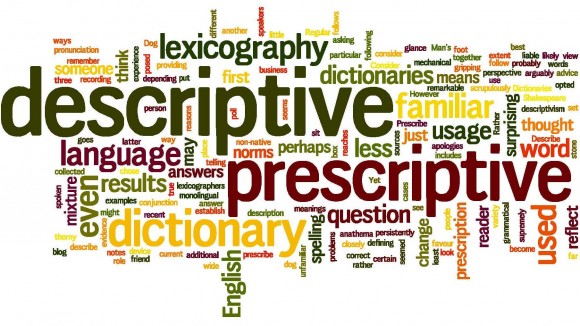
Gleick’s review of the history of English language dictionaries reminded me of a concept I learned in graduate school about the differng linguistic approaches of dictionaries. Some dictionaries, e.g. Webster’s An American Dictionary of the English Language. are “prescriptive:” i.e. they advise on the proper use of a word.  A “descriptive” dictionary such as the Oxford English Dictionary tells you how a word has been used — exhaustively— throughout history— it delivers all recorded usages of a word. It passes no judgements. The definition of the word “information” is an opus in itself— an astonishing 9,400 words long. Or should the definition of this definition be shortened to “TMI?”

The Prescriptive/ Descriptive Dichotomy In KM


cc

As firms increasingly turn to enterprise search as the next “holy grail” for taming the tidal wave of documents surging from their Document Management Systems, it is important to recognize that we may be embarking on a “descriptive” approach to Knowledge Management. We are not passing judgment or making a selection based on quality we are simply allowing lawyers search an ever growing repository. They can retrieve documents based on relevance, they can often filter based on objective “facets” of information. What most systems can’t do without human intervention, is  provide  lawyers with an easy way to locate curated results based on quality.

There seems to be a hope that over time lawyers will provide curation by recommending documents the same way people recommend restaurants and movies on social networking platforms. Are we wise to consider that likely or even desirable, if we consider the reliability of lawyer provided desciptive data in our DMSs?

KM’s Role in Professional Development And Professional Efficiency Needs to be Prescriptive

As firms are seeking both to enhance the efficiency of legal processes and to provide more practical guidance to associates, KM resources should be utilized as a component of the training plan. While British firms have deep legacy of “prescriptive KM,”  using Practice Support Lawyers to craft and filter and promote the use of standard documents, US firms have relied heavily on technology. While technology offers lower headcount and greater efficiencies on producing a KM resource, it may not be optimizing lawyer productivity.

A Hybrid Approach?

A new role for embedded practice librarians may be as KM curators, helping practices define, organize and  tag their best practice templates, checklists and model documents. These curated documents could be appropriately weighted to facilitate retrieval in the KM or enterprise search systems.

The Perfect As the Enemy of the Good

One of the biggest obstacles I have observed in various iterations of KM projects, is the paralysis and indecision that surround what I call the “blessing” of documents and ‘exemplars” representing the “best of firm work product.”  We need to have the courage and persistence to lead and make choices, knowing that we can over time improve the selection process.The important thing is to make a start at taking KM from a “volume proposition” to a “value proposition.”


Jordan Furlong’s keynote address “Climbing the Value Ladder”  at the recent  PLL Summit outlined the critical forces reshaping the legal market. Furlong  concluded his talk with an optimistic array of emerging  roles and responsibilities which obliterate the cliche of “library as administrative cost center.” In my experience it is rare moment when a lawyer/consultant escapes the prison of “librarian conventions”  and demonstrates that he not only understands the analytical skills and substantive knowledge of librarians but can re-imagine these skills in strategic new roles in the 21st century law firm.
Some of these roles are already emerging in firms today, from embedded librarians to Competitive Intelligence Analysts, but Furlong turns many an “ear catching” phrase. The list of new roles suggest new possibilities  not only within law firms, but also new client facing roles.

Niche expert resource: You could also call this a “practice group oracle,” which sounds much better. This person is a kind of permanent attache to a practice or industry group who is fully versed in the law and legal developments in a given subject and who lawyers can contact with topic-specific questions or research requests.

Bespoke CPD designer: Professional development (as distinct from “CLE,” which remains fixated on lectures) is the next natural evolutionary step for law librarians. Assign a librarian or knowledge manager to become a key lawyer’s personal PD coach and guru, interviewing the lawyer about his or her practice, clients, industry, specialties, interests, ambitions, etc., then provide a steady stream of learning and networking opportunities to help advance the lawyer’s goals.

LPM coordinator: Legal project management is all about creating a structure and discipline around legal workflow –designing processes, milestones and collaboration requirements to ensure that a given legal project proceeds on time and on budget to the client’s specified conclusion. Process is knowledge’s first cousin, making the transition natural for law librarians.

Business intelligence director: This also encompasses the similar but distinct category of competitive intelligence; in both cases, it’s a position that strives to tell the law firm what it needs to know about its operating theater, its competitors, its clients, its industry sectors, etc. This can be a case of revealing what the firm doesn’t know that it knows.

External – Services to Clients

Legal knowledge liaison: A practice group oracle who alternatively or additionally is assigned to perform the same knowledge resource and research functions for a key client in the practice or industry group.

Expert application programmer: Based on emerging applications like Neota Logic, which integrates sophisticated legal knowledge management into a logic-driven decision-tree questionnaire, this job involves designing programs that can answer a firm’s most commonly asked legal, regulatory and compliance questions.

AFA coordinator: Every law firm needs to offer alternative fee arrangements in an intelligent and profitable manner, and many are hiring new Directors of Pricing to do so; many successful candidates for these key positions are knowledge managers.

Amazon.law engineer: Based on my column about Amazon.law, the idea is to engineer a firm-specific system that will analyze every data point of client interaction with a firm and, like Amazon, “recommend” certain products, services or knowledge streams for key clients.

Cost Center to Knowledge Engine

The most compelling line of his talk was both a declaration and a challenge. “Law librarians are not running a cost center they are running the knowledge engine of the law firm.” 

The most strategic among us have already shifted focus to strategic knowledge services, but for those who have not, it may soon be too late.


On Sunday,  July 22nd, I participated in the AALL program  on the Next Generation Of Legal Research Databases where co-panelists,  Jean Davis, Emily Marcum, Susan Nevelow Mart and Victoria Szymczak delivered the results of the survey we conducted regarding academic, law firm and government adoption of Lexis Advance, Westlaw Next and Bloomberg Law. A lively discussion was led by Victoria Szymczak which focused on a wide range of issues impacting each constituency. It would be impossible to summarize the entire program, but I have touched on some highlights below.

Law schools are challenged by the variety of platforms they now need to train students. Two years ago they taught only the Lexis.com and Westlaw.com platforms. Now they are challenged with training students on the three new platforms: WestlawNext, Lexis Advance and Bloomnberg Law.

Law Firms are concerned about the variety of pricing schemes available under both the old and new platforms and never ending  challenges of cost recovery.

Government libraries reported that they are being ignored by Bloomberg.Law, although they see a strong interest in the product by judges.

The Publishers Respond The discussion was especially lively because each of the vendors had executives in the audience who were available to respond to questions from the panel or audience members. Brian Knudson , Vice President, Strategic Marketing, Large Law Firms at Thomson Reuters, Bob Hopen , Head of Sales and Customer Experience at Bloomberg Law and Marty Kilmer, VP of Product Platforms and Paul Speca VP of Law Schools represented Lexis Nexis.

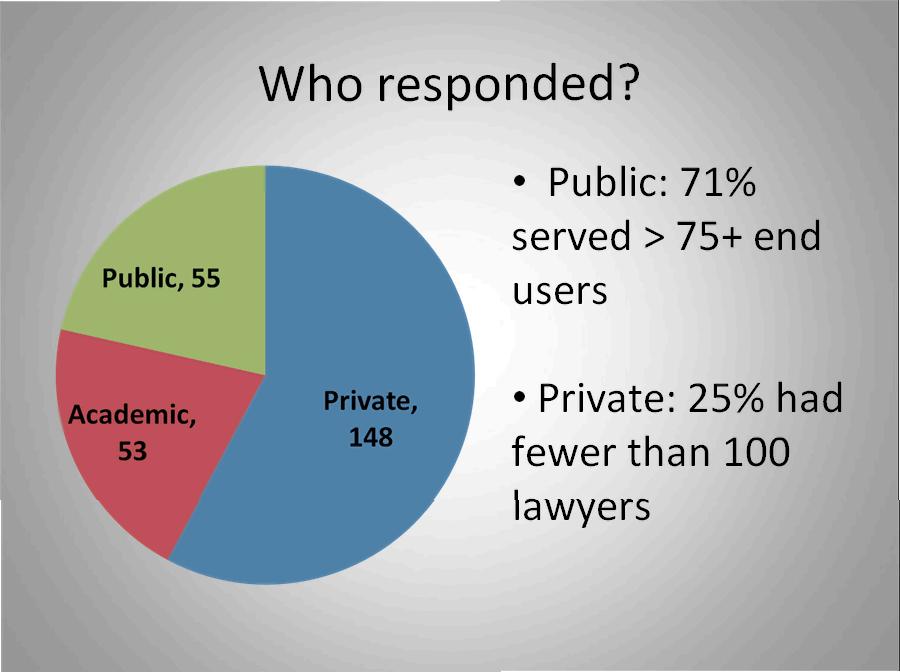
Who Participated In the Survey?

The Good

The chart below shows the two most positive aspects of each service noted in private firm, law school or government libraries.

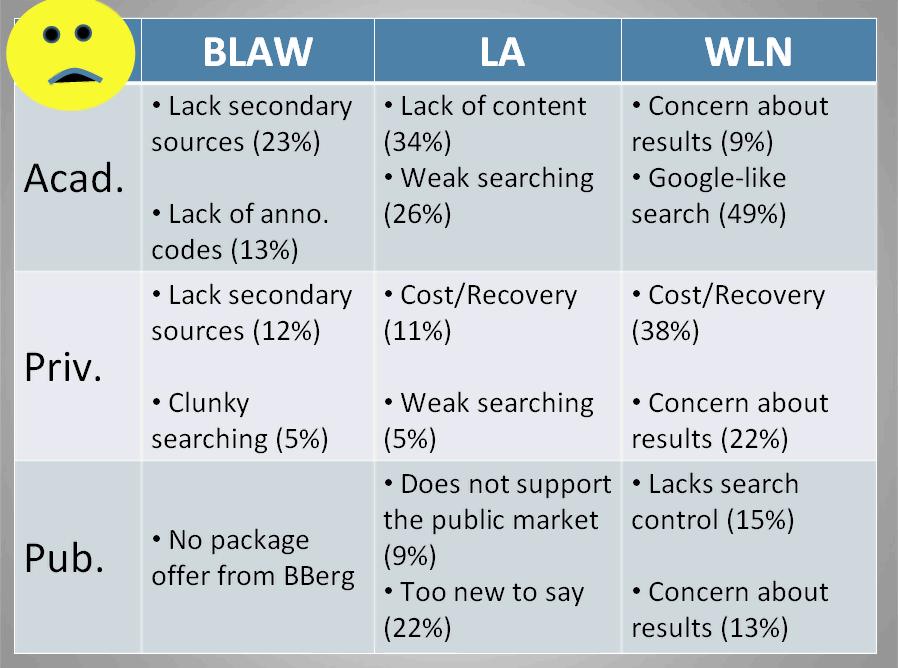
The Bad

The chart below shows the two most negative aspects of each services noted in private firm, law school or government libraries.

The Baffling

One of the more interesting discussions surrounded the mysterious algorithms driving the results of each advanced platform. The “secret sauce” behind each search engine is perhaps the one common trait shared by all the services which makes librarians of every stripe uncomfortable. Librarians who have highly refined expertise in refining and controlling search results are perplexed by the “black box” quality of the  search results.

In one of the most fascinating discussions Jean Davis presented slides showing how the search results varied between vendors but also within the same product when the same search was conducted two weeks later.

The Promising

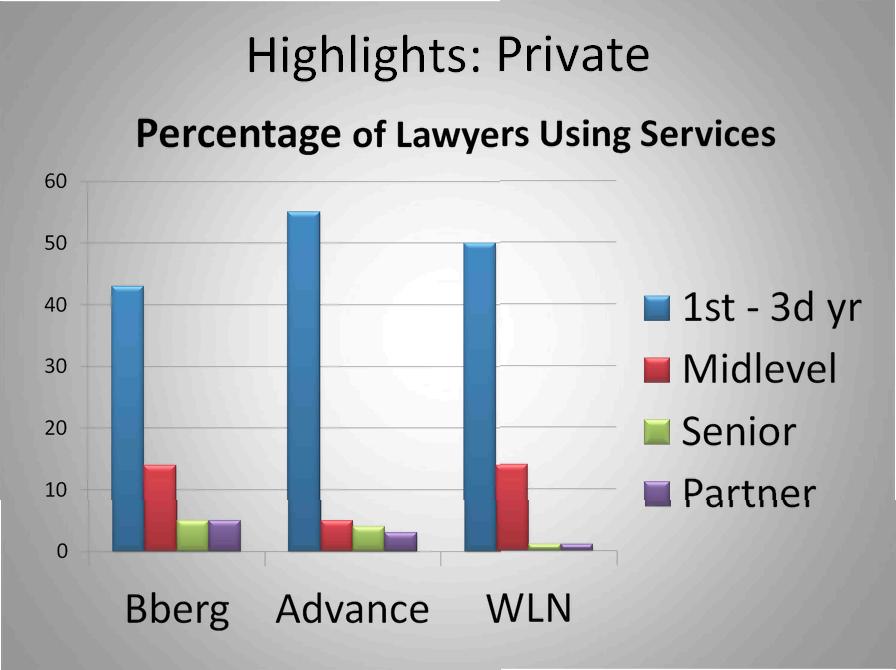
It is somewhat unfair to compare the market penetration of the three products because each product entered the market at a different point over the past two years. Westlaw Next was available in February 2010,  Bloomberg Law had it’s major relaunch in mid-2011 and Lexis Advance was released in early 2012. Those launch dates have had some impact on the results reported in the chart below.

Here are some observations about the Private Firm adoption data: shown below:

  • Younger lawyers ( 1st – 3rd year associates) are embracing the advanced platforms, regardless of whether they were exposed to them in law school.
  • Partners and Senior associates appear to be remaining loyal to Westlaw.com and have not migrated to Westlaw Next. 
  • Lexis Advance is showing a somewhat equal adoption among midlevel, senior associates and partners.
  • Bloomberg Law appears to have the deepest penetration among partners. Presumably this may be due to the easy availability of client and industry data which can be easily retrieved from the Bloomberg “Go bar.”

Works In Progress

As a former research librarian who is nostalgic for the Dialog Boolean search commands, I am somewhat uncomfortable with the mysterious algorithms that drive the advanced platforms.

However, I do recognize the benefits of the more simplified search protocols offered by the new platforms which sweep a broader universe of data and uncover results as a hierarchy enhanced with faceted terms and categories which can be explored and “re-mixed” on the fly.

Lexis Advance, Westlaw Next and Bloomberg Law will continue to evolve and improve. The executives at the meeting left with competitive and market insights which will no doubt spark and new round of  product enhancement as the legal giants “thrust and parry” for market dominance.


Back in December I wrote a post speculating on the possibility of a Wolters Kluwer Thomson Reuters Merger. While no merger has come to pass, a new alliance was just announced.
I have been noticing some positive changes at Wolters Kluwer for the past few months. I have had several conversations with  Bob Lemmond the new Vice President & General Manager, Law & Business.
He seems genuinely interested in understanding customer needs in the very changed legal marketplace. He also assembled the first ever Law Librarian Advisory group. On the product side the new product RB Source is a slick and highly intuitive version of the Securities Act Handbook that I think bodes well for the future. Since RB Source is using a new digital platform. it is an encouraging sign that WK may be preparing to step away from the troubled Intelliconnect platform. So with today’s announcement  that WK and Thomson Reuters are going to collaborate on  current awareness products we may be witnessing the beginning of another major reshuffling of the legal information market.
What’s in it for Thomson Reuters? Perhaps this the long anticipated response to Bloomberg Law’s acquisition of the Bureau of National Affairs in 2011.

Here is what is happening:
  • The new current awareness products on Westlaw will combine news, primary law such as statutes, judicial opinions and regulations, dockets, court wire content and other sources, and will be enhanced with legal analysis from attorney editors.
  • The first two products launched will include Wolters Kluwer’s unique current awareness dailies, Employment Law Daily and IP Law Daily, and secondary source content across a range of practice areas in law and business compliance will be added to WestlawNext.
  • Other new products that provide analysis and insight into key business topics are already being developed and will be rolled out over the next several quarters.
  •  Moving forward, on-point information will be pushed to customers where they are, synthesized into usable formats, with links to deeper sources. 

 Here is the press release:
Thomson Reuters and Wolters Kluwer Law & Business Joining Forces on Current Awareness
The companies have entered into an agreement to offer Wolters Kluwer current awareness products on Westlaw, joint development of new products, bolsters Westlaw offering and extends Wolters Kluwer’s reach

Eagan, MN, (July 18, 2012) –Thomson Reuters and Wolters Kluwer Law & Business will join forces to offer select Wolters Kluwer current awareness content on Thomson Reuters Westlaw online legal research platforms. The exclusive agreement will add Wolters Kluwer’s current awareness products – daily awareness of breaking legal developments which have been analyzed and contextualized by attorney-editors – to the comprehensive legal research databases, news and tools on Westlaw. The two businesses also will collaborate on current awareness product development.

The new current awareness products on Westlaw will combine news, primary law such as statutes, judicial opinions and regulations, dockets, court wire content and other sources, and will be enhanced with legal analysis from attorney editors. The first two products launched will include Wolters Kluwer’s unique current awareness dailies, Employment Law Daily and IP Law Daily, and secondary source content across a range of practice areas in law and business compliance will be added to WestlawNext. Other new products that provide analysis and insight into key business topics are already being developed and will be rolled out over the next several quarters. Moving forward, on-point information will be pushed to customers where they are, synthesized into usable formats, with links to deeper sources.

The two businesses see an opportunity to leverage best-in-class analytical and authoritative Wolters Kluwer Law & Business content; current Westlaw news content, including more than 12,000 databases of news in the Thomson Reuters Newsroom collection and exclusive reporting from Reuters News; and the market-leading primary and analytical content on Westlaw, to bring a new level of market insight to the current awareness marketplace.

According to Leann Blanchfield, vice president of Product Development at Thomson Reuters, current awareness information is a key part of every attorney’s workflow. It helps legal professionals stay up to speed in today’s highly competitive environment, and attorneys also rely on news, analysis and insight to identify clients and create winning pitches. “Wolters Kluwer Law & Business current awareness content is unique and indispensable to busy lawyers who require expert analysis and contextualization of rapidly-changing areas of the law,” said Blanchfield. “Its current awareness products provide original, attorney-authored analysis that puts context around breaking legal developments. They are seen as an essential tool to help busy lawyers stay up-to-date on vital developments in their field. Working together, Thomson Reuters and Wolters Kluwer will create a unique marriage between current awareness and deep research for the legal marketplace.”

“Wolters Kluwer’s current awareness legal dailies are all created by attorneys for attorneys, and are an essential tool for lawyers to put breaking legal news, decisions, and rulemaking in broad context and apply the industry’s leading level of analysis to highly complex and rapidly-changing areas of the law,” said Robert Lemmond, vice president of the Legal Markets Group at Wolters Kluwer. “This collaborative relationship with Thomson Reuters will enable us to deliver breaking news content to the entire family of Westlaw customers, and we are looking forward to working with the Thomson Reuters team to develop new current awareness products for legal professionals that allow them to work more efficiently.”

Lemmond said the sweet spot for the market is the convergence of current awareness and deep primary and analytical content. “We are uniquely positioned to bring together domain expertise with specialized proprietary content, and add the insights of a seasoned team of attorney editors and analysts,” he said.

Blanchfield agreed. “The combination of Wolters Kluwer’s reporting depth and domain expertise, with the breadth of Thomson Reuters news and current awareness capabilities and the insight and content of the Westlaw research service is quite powerful. For customers, it will mean a current awareness offering that promises an entirely new level of insight and foresight. We’re excited to be working together.”

ABOUT WOLTERS KLUWER LAW & BUSINESS

Wolters Kluwer Law & Business is a leading provider of research products and software solutions in key specialty areas for legal and business professionals, as well as casebooks and study aids for law students. Its major product lines include Aspen Publishers, CCH, Kluwer Law International and Loislaw. Its markets include health care organizations, law firms, law schools, corporate counsel and professionals requiring legal and compliance information. Wolters Kluwer Law & Business, a unit of Wolters Kluwer, is based in New York City and Riverwoods, IL.

  ABOUT THOMSON REUTERS

Thomson Reuters is the world’s leading source of intelligent information for businesses and professionals. We combine industry expertise with innovative technology to deliver critical information to leading decision makers in the financial and risk, legal, tax and accounting, intellectual property and science and media markets, powered by the world’s most trusted news organization. With headquarters in New York and major operations in London and Eagan, Minnesota, Thomson Reuters employs approximately 60,000 people and operates in over 100 countries. For more information, go to www.thomsonreuters.com.

CONTACT

Scott Augustin
Thomson Reuters
+1 612 226 5084
scott.augustin@thomsonreuters.com

Amy Wolfcale

Wolters Kluwer Law & Business
212-771-0868
917-576-8767
amy.wolfcale@wolterskluwer.com

Crowded Collaboration c.c.

In a recent Bloomberg interview, I speculated that in the future, law  libraries may look like Apple Stores. My point was that while we may replace law books with desktop virtual libraries, the need for  spaces for  research consultation, collaboration and “just in time learning” will continue.  As I mentioned in an earlier post  on strategic interventions using an iPad, lawyers are facing “customization overload” and  we should be prepared to “just say yes” and offer concierge services which resolve problems and offer solutions enabling lawyers to focus on core client support activities.

What Do Lawyers Need? About 12 years ago in preparation for a library redesign, I surveyed lawyers regarding the new library space. Lawyers wanted 1) clearly designated place where they knew they could find people to help them and 2) a quiet space where they could work… away from their offices… in proximity to other lawyers… although not necessarily talking to them. Note the top requirement was not books but access to people with expertise – research librarians. Today I would describe these design concepts as “crowded collaboration” and “social solitude.”

Examples of these concepts have surfaced recently in press pieces about the transformation of law firm space.

Social Solitude. Yesterday there was an article about WilmerHale’s New Office in the World Trade Center. The architect highlighted the creation of a new “library space” referred to as “The Commons:”

“One example of how the new offices differ from the old: the space traditionally known as the library is called the “Commons.” While it does contain some books, it also has room for lawyers to work remotely with wireless Internet, take a break with a Wii video game system, and sip a latte at the coffee bar.”

OK, I think the Wii bit too cute and uncomfortably reminiscent of the now defunct Foosball rooms that appeared in law firms before the dot.com bust. Since I spent 4 years sneaking my coffee cups into the Fordham Law Library… I can only say “amen” to the library coffee bar.

Sadly there is no mention of research support staff, as if both technology and research were completely intuitive and immune from the need for expert support. Did the Commons design omit the most vital component of the law library – the law librarian? I doubt it… but this was not an important feature in the architect’s eyes. Need I say… “a Wii is no substitute for a research expert.”

Technology Can Be as Frustrating as it Can be Enabling  Let’s face it self service is about shifting work from one group to another. Since lawyers are the primary drivers of revenue we have to carefully assess how the drive to “self service” may be impairing or enabling a lawyer. While research remains primarily an intellectual exercise and not a technological process, there are so many new platforms, passwords and profiles that libraries by any name should be viewed as  spaces for human intervention, collaboration and consultation. These value enhancing qualities should  not be lost in the drive to reduce space. There was recently a story “Self check out on the Wane” about how grocery stores had begun to remove scanners because the technology wasn’t as reliable and intuitive as expected. Customers decided it was simply quicker and preferable to deal with a human being who could instantly resolve any technical problems or address other issues.

Crowded Collaboration I have been wildly fascinated by the crowds in the Apple Store since my first visit. I think that the attraction of the Apple Store is not merely the hip design of the products, but the sheer number of apple employees who are available to direct, consult and troubleshoot. There is also The Genius Bar where you get a real training session and which requires a payment and an appointment.
.
The Social Life of Space In the rush to shrink libraries and reduce law firm real estate spending, planners should be careful not to overlook the social life of space.

The paradox of technology is that it seems to simultaneously escalate both efficiency and complexity. We are constantly driving change into a community of lawyers where there is no universal consensus of what (product technology, platform, interface ) is truly intuitive and which is “not worth the effort.” Many research functions have gotten easier over the past decades. With Google you can always find something. In high stakes litigation you must find “the right thing.” Complex research is not going to be as easy as flipping a light switch. Even simple research tasks are not so easily replicated by technology.

Researchers Can’t be Replaced by Siri. Yesterday a there was an article in the New York TimesThe Initial Romance with Apple’s Siri Goes Sour ” about the voice activated research assistant. The article illustrates the frustrating short comings of this innovative technology.  Author Nick Bilton writes that since last summer “we have had some major communication issues. She frequently misunderstands my questions, Sometimes she is just unavailable. Often, she responds with the same repetitive statement.”

Firms should consider how to balance and accommodate the two types of space, noisy and crowded collaboration space as well as  quiet spaces of social solitude.

In case you missed it — here is a link to the Bloomberg interview where I discuss the future of law libraries.

July 9 (Bloomberg) — Law firms are moving in the direction of having libraries the “size of a phone booth,” as research has moved from a central location to the attorney’s desktop, says DLA Piper’s Director of Research Services and Libraries Jean O’Grady. Libraries are becoming more like the retail hubs of Apple, “a place where people go to collaborate and learn how to do things more efficiently,” she tells Bloomberg Law’s Spencer Mazyck. That means librarians increasingly have to focus on highly specialized research, so law firms can deliver more value to clients, she says.
O’Grady: Law Firm Libraries Becoming Like Apple Stores.