Take Survey  Here

 Last year I participated in the 2011 program at AALL on the new generation of research platforms from Lexis and Westlaw..

A year ago WestlawNext was the only “new generation” product that was fully deployed to subscribers. Lexis Advance was deployed  in trials and Bloomberg Law was regarded as a “wanna be” product. Lexis Advance hit the market in December. Since January, Bloomberg Law has secured contracts with two global law firms, DLA Piper and Jones Day. The competition to gain market dominance continues to intensify and the new generation of research platforms may allow one vendor to aggregate increased market share.

I will be participating in a a follow up panel discussion regarding the adoption of Lexis Advance, Westlaw Next and Bloomberg Law at the AALL annual Meeting in Boston on July 22nd.

Surveys are being distributed to AALL Members in academic, government and private firm sections. These surveys will measure the adoption of new platforms in each type of institution and will elicit feedback on each systems strengths and weaknesses.

Private Firm and Corporate Law Library Survey. Members of the private law firm and corporporate law library community  are invited to respond to the survey  here.

We are requesting that each firm or corporate law library designate on person to respond to the survey. The survey will close on June 8th.

Survey Results will be discussed at the AALL program in July and then reported here after the AALL presentation.
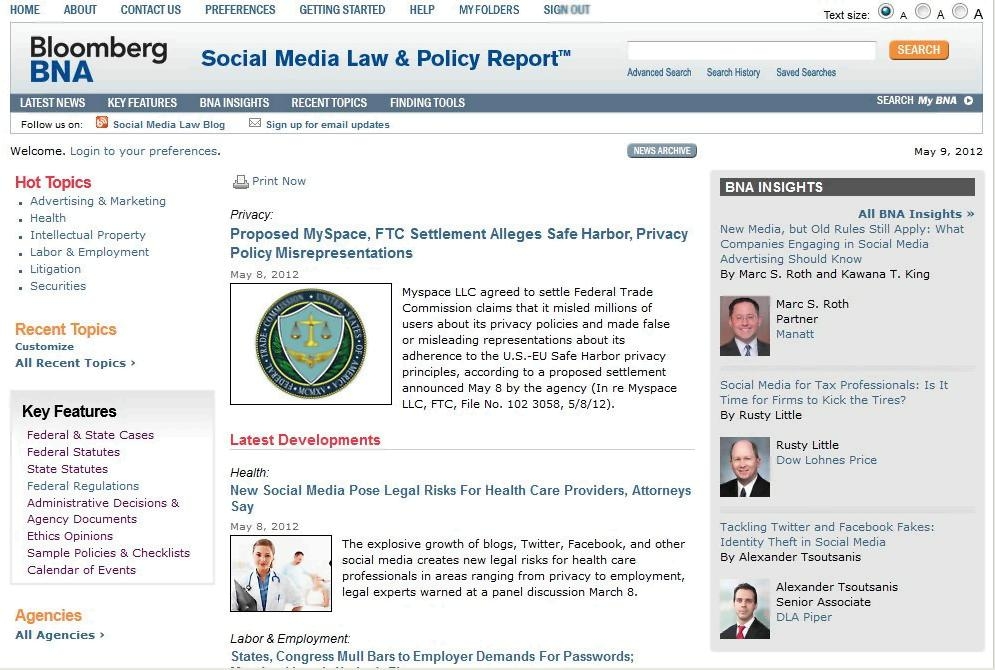
On May 21st Bloomberg BNA will be releasing a new product which focuses on the emerging constellation of issues referred to as “social media law.” The Social Media Law & Policy Report is BNA’s first new “notification product” since 2009. It will cover social media issues emerging in a wide range of legal practice areas  including labor, health, advertising, intellectual property, securities and litigation.

Why Social Media?

Bloomberg BNA’s press release states: “The far-reaching implications of social media disputes and litigation across legal practice areas make it imperative that companies, law firms, and their clients have control over their social media initiatives and understand the potential ramifications as they use these powerful new tools,” said Edwin Jackson, Director of Publishing for Bloomberg BNA’s Legal & Business Publishing Group.’ With social media, we’ve seen time and time again that what you don’t know can hurt you’.”

What’s Different About this Product?

BNA describes the product as a hybrid between the traditional BNA electronic newsletters and the BNA practice centers. Unlike most BNA services, this product will not have a print counterpart and will not be updated on a formal daily or weekly publishing schedule. SMLPR will be a web-only product which is continuously updated. Subscribers can also set up personalized alerts and receive email delivery of all news or custom news updates as they are posted. While some of the materials will appear in other topical reports, the materials selected for inclusion in the SMLPR will all focus on some aspect of social media law.

The Evolving Newsletter Niche

One of my biggest complaints with the major legal publishers is that there are too many “copy cat” products which are only marginally distinguishable from their competitors. I am always asking publishers deliver something new, so I applaud BNA on introducing a product that is delivering new content in a redefined digital “newsletter” plus practice materials.

BNA newsletters were originally developed in a pre-internet world. BNA has a long and distinguished history producing newsletters in very traditional practice areas such as labor, tax, patents. They now have dozens of specialized topical reports. In a pre-internet world, they provided relatively quick access to content that might not otherwise be available for months. They included only documents and commentary that editors determined to be of interest to practitioners in a specialized practice area. BNA was also the first major publisher to deliver their newsletters on a completely digital web enabled platform.

Although speed of access to primary is no longer a problem, SMLPR’s value proposition appears to be the editorial selection and aggregation of the best and most relevant content from across a wide variety of legal disciplines. This focus will allow lawyers to easily monitor legal issues arising from social media. This is an efficiency and productivity play.

Current Awareness Plus Practice Resources

In a move that appears to be targeting the practice support approach of the Practical Law Company (PLC), the “Social Media” platform will move beyond “monitoring new developments and include a variety of practice materials

Sample Policies: BNA will provide access to sample social media polices from top US companies. They currently have policies from Coca Cola, IBM and Best Buy.

Compliance Checklists

Primary Sources: Federal and State Cases, Federal and State Statutes, Federal Regulatory materials including regulations, administrative and agency documents and state ethics opinions

BNA Insights Will include articles written by BNA editorial staff as well as leading practitioners.

Calendar of Events

The Skeptics Response

The skeptics may wonder if such a product is really necessary. The skeptics may remember other highly specialized products and wonder if Social Media is a trendy or ephemeral issue rather than a sustainable and growing body of law that will evolve into a distinct legal discipline introducing new legal principles and standards of its own. Newsletters can suffer both from being too broad and too specific.

Can a Newsletter be too Specialized?

On March 24, 1989, the Exxon Valdez oil tanker struck a reef in Prince William Sound causing one of worst environmental disasters in US history. I received a promotional issue of the Alaska Oil Spill Reporter from an unknown publishing house within a week of the disaster. I joked that the tanker’s infamous Captain Hazelwood was still recovering from his hangover… and yet a newsletter has been born. I had to concede that in the pre-internet world – this narrow specialization did indeed fit a need for access to documents relating to both the environmental issues and the growing litigation. In a pre-internet world, specialty newsletters were often the best source for unpublished primary source documents.

BNA also ventured into a tight niche with the Year 2000 Law Reporter, which focused on the potential liabilities which would arise from programming errors triggered by the Millennium bug. A digital Armageddon was expected to erupt at the stroke of midnight on January 1, 2000 paralyzing everything from traffic lights to global banking exchanges. Not a single catastrophe was reported and the newsletter quietly faded away in the early weeks of the new millennium.

I have long been a reader another inter-disciplinary product, BNA’s Electronic Commerce and Law Report. In my opinion, that product is a good model of how a newsletter can cast a wide net across the legal landscape and weave together an informative array of domestic and international cases, statutes, policies and self- regulatory organization materials. Assuming that the market is ready and the price is right, the social media product with it’s new updating model and practice focus will be worth a trial for practitioners who are trying to track this emerging issues as social media law evolves.

BNA has not yet released pricing information for the Social Media Law & Policy Report.

Wondering Out Loud…

Will the Social Media Law and Policy Report have a Facebook page…And will lawyers “like” it…..

Tonight Above the Law is reporting that “the end is near” for Dewey & Leboeuf and staff departures are scheduled to begin on Friday. It is a story that has become all too familiar, Heller, Brobeck, Howrey, Coudert Brothers… the mysterious alchemy of missteps, hubris and  changed law firm economics. Dewey has the distinction of being the first truly “white shoe” law firm to join this solemn procession.

When Dewey’s esteemed law library Director Gitellle Seer announced her retirement last fall, the firm recruited for her replacement. The position was filled “in house.” One can only assume that former candidates for the position are breathing a collective sigh of relief at their “good fortune” at missing that particular “golden ring.”

When I entered my law firm library career in New York in the early 1980’s. Dewey Ballantine was considered one of the finest “white shoe” firms along with Cravath, Swaine and Moore and Davis, Polk and Wardwell. Wikipedia cites William Safire’s definition of “white shoe” as deriving from white buckskin shoes, long popular among upper-class New Englanders, especially at Ivy League colleges.

Having grown up in Queens and never having seen a grown man in white footwear that didn’t bear a “Keds” label, I assumed that  this was “code” for lawyers who didn’t ride the subway where a “white shoe” wouldn’t last for “a New York minute.”   Tom Wolfe coined a new phrase, “masters of the universe” in  In Bonfire of the Vanities,to describe these powerful legal and financial elites.

Who would ever question the wisdom of these men (and the rare woman) who steered these rarefied partnerships? Who would not jump at the chance to work “below deck” pulling one of the small “staff support” oars on these ships of power and prestige? I was honored to  have a seat aboard the “good ship Shea & Gould”

Since the American Lawyer started the AmLaw 100 in 1986, approximately 10% of the original 100 firms no longer exist. Sadly one of those early casualties was the late, great Shea & Gould. If the best and the brightest law firms have a “one-in-ten” odds of collapse in 25 years, I think it is time to rethink how we  assess and compare  law firms as potential employers during the recruiting process.  It is time to take responsibility for our own “due diligence.”

Mismanagement 101 or New Law Firm Economics

James B Stewart’s weekend New York Times article “Dewey’s Collapse Underscores New Law Firm Realities” reveals an old and now unimaginably charming billing practice which he was privy to as an associate at one of Dewey’s peers. After reviewing the billing reports a  partner prepared a one-sentence bill — in calligraphy— on beautiful stationery which read: ‘For professional services rendered,’ followed by the time period covered and a large number with a dollar sign. (Bold and italics added) Such was the depth of trust between lawyers and clients. It is hard to imagine a more dramatically changed environment than today’s world of AFA’s, outsourcing and “beauty contests.”

In Leverage We Trust

Law firms have long term debts but not necessarily long term assets. Dewey offered unusually lucrative long term contracts to attract lateral partners. They floated bonds. They had lines of credit. Their greatest assets were the lawyers with a book of business and as soon as those started walking out the door the model was doomed to collapse. Law Firm consultant Bruce MacEwen is quoted in the Times story as describing Dewey’s situation as “Mismanagement 101.”

Should Law Firms Have Obligation to Make Financial Disclosures to Staff and Non Partner Attorneys?

Law firms have widely varying cultures and standards regarding the amount of financial information they provide to employees. I have heard of law firms that have completely open internal web applications that allow anyone to view financial data, but most firms strictly limit detailed financial reports to partners and high level staff executives. Many firms offer staff  a PowerPoint presentation including key trends and metrics. To tell the truth, reports about Dewey are suggesting that even partners had less than full disclosure of the financial picture… add to this the stunning inquiry by the Manhattan DA into the activities of the former Chairman Steven Davis.

Law firms have no affirmative obligation to their employees regarding the financial stability or future prospects of the firm. Most employees ride the tides of optimism or anxiety from  one annual “state of the firm” memo to the next. In between, they “read the tea leaves.” They form a personal holographic construct of firm financial health composed of such things as bonus pools, office openings or closures, partner arrivals or departures, stealth layoffs and the size of the allowance for a summer associate lunch. In short, we are a pretty trusting lot.

Even if you are a diligent reader of competitive intelligence on law firms,you can’t always trust was you read. In an unprecedented action the American Lawyer revised downward the 2010 and 2011 Dewey and Leboeuf financials.

Resources for Due Diligence on Law Firms

The American Lawyer can be credited with opening the door to law firm transparency but the problems at Dewey were still well hidden. In light of this it seems prudent that potential law firm employees should make a habit of conducting their own “due diligence” investigation of prospective law firm employers using as many benchmarks as possible. Here are a selected list of resources for conducting your own “due diligence.”

American Lawyer American lawyer rankings and not just the AmLaw 100 should be investigated. The Mid level associate satisfaction survey, the technology survey, the law librarian’s survey and the pro bono survey provide additional views of firm finances, culture and priorities. If you have access to the ALM Intelligence database, you can perform trend analysis and benchmark firms against peers.

Vault Surveys  Vault surveys law firm associates and staff across the country and compiles data and insightful insiders’commentaries. They also produce rankings.

OK so no one has a crystal ball. Dewey and Leboeuf is listed as the 9th Best Law Firm to work for in 2012. Hard as it may be to believe – this seems to disclose that associates were rather sheltered from the storm clouds forming in the boardroom.

Vault’s Verdict: Dewey & LeBoeuf associates are generally happy with their lot. They are perhaps unique in BigLaw in that they have few complaints about the hours and the work-life balance—outside, that is, of what they expected of BigLaw in general—and most report a positive and pleasant firm culture, with excellent associate/partner relations and training.

Dun and Bradstreet provides self reported financials on private companies including law firms. They  provide one especially interesting metric… how quickly they pay their bills.

News and Blogs
Free Google news is good. Specialized sources of law firm news are better, Law 360, American Lawyer regional news sources, ABA news, Bloomberg, Thomson Reuters Legal News are great sources. Above the Law blog – the ultimate source for the serious, the silly and the salacious.

League Tables
Thomson Reuters Financial, Bloomberg and Mergermarket all report league tables which measure and compare a wide spectrum of deal activities by firms.  Dewey & Leboeuf website bragged that their rankings had risen in 2011. However there are many league tables each year and a clear picture requires a mulit-year analysis of all the categories to determine whether a firm had dropped in some league tables. You can generate a  combined trend analysis of their deals over several years.

Litigation Analysis. Bloomberg, West’s Legal Monitor and Lexis Courtlink all have the capability to generate historical and current reports analyzing a firms’ litigation history which provide insights into who they are representing and what issues and jurisdictions they are active in.

Post-script

Vault included this quote from a Dewey associate: “If you told me I could keep this job forever, I’d definitely take it.” Sadly this wish will not come true. This is a tough road for everyone who will have to recalibrate their lives in unforeseeable ways. It is sad to watch institutions die. Law firms — even dead one’s have legacies that do not die when the doors are shut and the creditors sent packing.
Let us reach out to our professional colleagues and offer whatever encouragement and opportunities we can in the days and months ahead.

Congratulations to the Research Genius Award Winner: David Proctor, Director of the Research and Information Center, Ballard Spahr. who submitted the first competed and correct crossword.

Second Place, Lance Odegard, Director National Technology, Thomson Reuters.

Thanks to all participants. The competed crossword and clues are below..

In honor of National Library Week I have developed a legal research trivia crossword. The first person to send a competed copy with correct answers to DeweyBStrategic  (jodc@verizon.net) will be honored as the first DeweyBStrategic  legal research genius.

Back in January 2012, Warren Communications sued US Signal (1 12 cv-00138 U.S.D.C.D.C.) for unauthorized copying of their PDF format newsletter and is seeking damages of $19M. Warren publishes the Communications Daily which focuses on regulation of the communications industry.

Lesson Number 1: It Pays to Have a Librarian

Like the  Lowrys v Legg Mason case  which was filed in 2001, a single subscription was purchased by a non-librarian executive and the issues were alleged to have been systematically copied and redistributed throughout the organization.The Lowry case resulted in a $20M judgement for the plaintiffs. Lowry’s Reports, Inc. v. Legg Mason Inc., et al. 271 F.Supp.2d 737, Civil No. WDQ-01-3898 (D. Md., July 10, 2003). In both cases it appears that the intent from the outset was to purchase the smallest license and engage in a wider than authorized distribution.

I have no sympathy for organizations which demonstrate either institutional disregard for copyright law or institutional negligence in failing to have licenses negotiated by competent professionals.  Librarians play important “risk management” roles because they are  familiar with copyright law and  are experienced at negotiating and scaling licenses based on practice needs and expected workflows of the organization.

Are PDF Newsletters A Kind of “Attractive Nuisance”?

American courts developed the concept of the “attractive nuisance”  which allows injured trespassers to sue landowners. The courts have recognized that certain structures on land such as swimming pools are so inherently attractive to children that their presence is equivalent to an express invitation trespass.The courts have ruled against property owners because they knew the structures were both dangerous and irresistibly alluring and yet the owners failed to secure them from trespass. In other words landowners have a duty to protect trespassers from foreseeable injury.
 Is a Newsletter Publisher Negligent if they Distribute an Unsecured PDF Newletter?

It is not that hard to create a secure newsletter. The technology has been around for years. BNA was the first legal publisher to introduce electronic newsletters about 12 years ago. From the beginning, these newsletters incorporated security by requiring passwords or IP recognition in order to gain access to the full text of individual stories. Most legal publishers have followed suit and incorporate security devices into their publication format. These publisher protect their own intellectual property but also protect their readers from their natural impulse to share.

So I am completely baffled as to why there are newsletter publishers that fail to secure their intellectual content. Publishers who publish newsletters in PDF format not only fail to secure individual stories, they fail to secure the entire issue of a newsletter.

Is It Time To Introduce an Attractive Nuisance Defence in Digital Copyright Law?

I posit that in our porous digital world, a PDF newsletter creates a dangerously alluring and completely foreseeable threat to the subscribing organization and to each recipient. It is like sending a “digital timebomb” because a PDF newsletter once forwarded can not be retrieved and the licence holder becomes liable for all subsequent copying and forwarding that may result from that “one false click,” 

Does an intellectual property owner owe a duty to it’s subscribers to provide more secure products?

One impulsive act – major consequences

In a world of ubiquitous and continuous digital sharing, is the publisher of a newsletter distributed in PDF format creating an intellectual property equivalent of an unfenced swimming pool? Has the publisher created an inherently dangerous, alluring and foreseeable threat to the recipients? It only takes one injudicious and instantaneous impulse to hit “forward” to create an irreversible liability for a law firm.  Once forwarded by any employee,  the subscribing organization is in a position of irreversible financial peril.


Minimizing Risk

For now the entire burden is on the subscriber to prevent unauthorized copying and forwarding of PDF newsletters.

  • The best risk management strategy is to hire and/or empower a librarian versed in copyright, content and licensing negotiations to act as an effective “risk manager.”
  • Negotiate the broadest possible license to cover your firm. Always negotiate in good faith and provide an honest disclosure regarding the number of subscribers.
  • Educate lawyers and staff to understand their responsibilities in copyright compliance.
  • Technology can also be employed to reduce risks. IT  network administrators can create rules to trap and block PDF newsletters from being forwarded.
Photos: Creative Commons

 
The skeptics said it couldn’t be done. The cynics said it wouldn’t be done ( at no additional cost to subscribers.) Only six months after the acquisition of BNA in September 2011, Bloomberg Law has loaded and integrated BNA content into the Blaw platform. And they are not charging their subscribers for the “mother lode” of content that became available virtually over night.
Today’s press release, announced the full integration of  BNA content as well as a major redesign of the Bloomberg Law platform.
“When we first welcomed BNA to the Bloomberg family, we promised this match would create a unique combination of premium content, deep subject matter expertise and world-class technological capabilities,” said Dan Doctoroff, CEO and President of Bloomberg. “Today marks a milestone in which we are delivering on that promise by creating one of the most powerful products in legal research.”

The newly loaded BNA content is fully searchable and provides links  to documents from Bloomberg Law. The BNA classification systems for Labor, Employee Benefits and Intellectual Property are now navigable and add a new dimension of research to the Blaw platform.


BNA Content Added to Bloomberg Law:
The Newsletters. Including the “high ticket” BNA Dailys, The Daily Report for Executives, The Daily Labor Reporter, the Daily Tax Report and US Law Week and over 100 other titles can be routed to any subscriber in “one click.”
The Portfolios.  The Tax Management Portfolios and Corporate Practice Portfolios

Secondary Sources; BNA Treatises, Professional Books,  and manuals

Practice Centers:The Labor, Employee Benefits and Intellectual Property practice centers introduce BNA’s proprietary headnote and classification system into the Bloomberg Law platform. The BNA analytical materials now contain links to Bloomberg’s primary sources such as opinions, dockets, statutes and regulations as well as Bloomberg’s company and market information.


Platform Enhancements Bloomberg has streamlined navigation and access. Deb Sours, a regional Research Services Manager at DLA Piper  who has been using BLaw for over a year loves the new look and feel of the platform that was released today. According to Sours “The new interface provides a cleaner and more concise format for accessing content.”  If you enter a company name into the Blaw “Go bar” you see a menu of search options which  can retrieve information about the company and it’s executives. One click will take you to the caselaw, dockets, SEC filings, company  and executive profiles.

Enhancements to Bloomberg Law’s Interface


The Bloomberg “Go Bar” Displays  sources of company  information

What’s Next? I spoke with Lou Andeozzi, Chairman of Bloomberg Law  today to see if I could get some insights into any upcoming plans for Bloomberg Law. While he disclosed no specific plans for adding new content, he reaffirmed that “Bloomberg Law will follow the model originally set by the Bloomberg terminal. We will continue to add content and functionality which grow the value of Bloomberg Law to lawyers at no additional cost.” For the short term they will be focusing on enhancing the functionality and integration of the Bloomberg and BNA content. Tax Law remains one big practice which is in need of a fully developed practice center. Given the speed of the integration of the first 3 practice centers which were released today, I expect that the market may also be surprised by a speedy release of the Tax Practice Center in the near future.

Bloomberg Law was just named AALL Product of the Year for 2012.
In an interesting competitive juxtaposition, it follows the 2011 Product of the Year award to ThomsonReuter’s for WestlawNext.  After years of development and some misfires, in 2011 Bloomberg Law launched a new platform which against all the odds put it into a competitive position to disrupt the marketplace long dominated by LexisNexis and Westlaw. At the end of the day this fierce competition builds better products for lawyers and helps them better serve their clients.
Congratulations to Bloomberg Law!
Bloomberg CEO, Larry Thompson is quoted below saying that “the law library community the heart and soul of what we do.”
The AALL New Product Award recognizes new commercial information products that enhance or improve existing law library services or procedures or innovative products which improve access to legal information, the legal research process, or procedures for technical processing of library materials. The 2012 New Product Award will be formally presented at the Association’s annual meeting in Boston.

Below is the press release from Bloomberg:

Bloomberg Law has revolutionized the legal research industry by providing a system that integrates comprehensive legal content, company and market information and proprietary news all in one place. Bloomberg Law’s all-inclusive, transparent and predictable pricing means that every user has the same unrestricted, unlimited access to all the content in its databases. In July 2011, Bloomberg Law launched the latest evolution of its web platform, making the system even faster and easier to use.

It is an honor for Bloomberg Law to be recognized by the AALL as the best new product of the year,  said Larry Thompson, Bloomberg Law CEO. The law librarian community is at the heart and soul of what we do. We are committed to continually improving and expanding our product to support their efforts to deliver the best research services and manage costs.

Bloomberg Law’s enhanced platform, introduced in July, provides a redesigned interface for even more intuitive navigation, enriched search capabilities for faster information retrieval, new practice centers offering practice specific resources and enhanced collaboration and workflow features that build on Bloomberg Law’s innovative workspace tools.

About Bloomberg Law

Bloomberg Law is the real-time legal research system that integrates innovative search technology, comprehensive legal content, company and market information, and proprietary news all in one place. This collaborative workspace also includes a suite of new tools for more effective legal analysis and more productive client development. For more information, visit BloombergLaw.com.

About AALL

The American Association of Law Libraries was founded in 1906 to promote and enhance the value of law libraries to the legal and public communities, to foster the profession of law librarianship, and to provide leadership in the field of legal information. Today, with over 5,000 members, the Association represents law librarians and related professionals who are affiliated with a wide range of institutions: law firms; law schools; corporate legal departments; courts; and local, state and federal government agencies.

About Bloomberg

Bloomberg, the global business and financial information and news leader, gives influential decision makers a critical edge by connecting them to a dynamic network of information, people and ideas. The company’s strength  delivering data, news and analytics through innovative technology, quickly and accurately is at the core of the Bloomberg Professional service, which provides real time financial information to more than 310,000 subscribers globally. Bloomberg’s enterprise solutions build on the company”s core strength, leveraging technology to allow customers to access, integrate, distribute and manage data and information across organizations more efficiently and effectively. Through Bloomberg Law, Bloomberg Government, Bloomberg New Energy Finance and Bloomberg BNA, the company provides data, news and analytics to decision makers in industries beyond finance. And Bloomberg News, delivered through the Bloomberg Professional service, television, radio, mobile, the Internet and two magazines, Bloomberg Businessweek and Bloomberg Markets, covers the world with more than 2,300 news and multimedia professionals at 146 bureaus in 72 countries. Headquartered in New York, Bloomberg employs more than 15,000 people in 192 locations around the world.

CONTACT:

Jill Goodkind
+1 212-617-3669
jgoodkind@bloomberg.net

I think I can hear librarians throughout the US breathing a collective sigh of relief:

Today began with the announcement of the acquisition of the Portfolio Media Law360 newsletters by LexisNexis and was followed by reassuring phone calls and communications from Law 360  to its customers.

The Lexis acquisition of Law360 is being described as a strategic acquisition, not a financial one. I assume this means that competitive advantages and not  revenue was the motivation for the deal. Law360 account representatives were reaching out to their customers today to assure them that there would be no immediate changes to Law360.
 The co-founders of Law360, Marius Maland and Magnus Hoglund remain in charge as Co-CEOs.
 The good news (at least for the short term)
• Law360 will remain an independent company
• There will be no staff changes
• Law360 will “own” the relationship with its existing customers
• Law360 subscriptions will not require a subscription to Lexis
• No changes in the look and feel of Law360

I  was also referred to a FAQ from Lexis – Law360  that  addresses various questions about the impact of the acquisition. After reading it closely I noted the tentative nature of most of the answers. There were repeated assurances that there would be no immediate impact, but what about longer term?

A closer reading of the Law360-Lexis Acquisition FAQ  discloses 3 separate references to “existing customers” implying that things may be different for future customers.

The Following Questions and Answers do invite some comment.

Q Would this acquisition make Law360 content exclusive to LexisNexis?

A. Law360 will continue to operate as a stand-alone company. However, as owner of Law360, LexisNexis will be the exclusive provider of Law360 content.

COMMENT: Not clear how they are defining “exclusive provider” or when this will have an impact.

Q. If I’m not currently a LexisNexis subscriber, will I still be able to keep and renew my Law360 subscription?

A. All existing agreements will remain in force.

COMMENT:  The answer only refers to existing agreements and not renewals. So check your contact to see if you have an automatic renewal. If you do not, you may be in for a surprise as renewal time. No direct answer regarding non-Lexis subscribers.

Q. Will LexisNexis honor existing Law360 contracts and obligations?

A. Yes. As a stand-alone entity, Law360 will continue to contract, fulfill, bill, and support its customers directly, and all existing agreements will remain in force.

COMMENT: Silence on the issue of renewals.

Q. Will I be able to log into Law360 through LexisNexis?

A. In the short term, you will continue to access Law360 as you do today. Over time, you will see linkages between Law360 and other LexisNexis products.

COMMENT: Not clear what this will mean. Linkages could mean anything from providing a sprinkling of links to complete absorption of Law360 into LexisNexis.I am glad the Lexis appears to be taking a retrained approach at least for the short term and is not absorbing Law360 completely or putting it behind a Lexis paywall.

The Good News for Law360

Law360 had begun to add cases and dockets to their newsletters. Clearly LexisNexis and Courlink are decades ahead of Law360 in mining and managing the flood of opinions, orders and dockets the flow from the courts. So Law360 will not have to invest in developing this type of enhancement. The Q&A suggests that they will be leveraging Lexis content and this could have a dramatic impact on the expansion and reshaping of Law360 content.
 
So What About ThomsonReuters?

Now that LexixNexis has ALM publications and Law360 and Bloomberg has BNA, one has to wonder what West has up it’s sleeve. Is it possible they will take a pass and let the two competitors dominate the legal news market? I think not. An AmLawDaily story today suggested that West is already developing a legal news product ThomsonReuters News & Insight which features content from Westlaw. This is such a low profile initiative, I never heard of it. But I discovered at the website, that Allison Frankel, veteran legal news writer and editor is writing for West. It is unlikely that a writer such asMs. Frankel would  make such a move if there were no compelling  market strategy to entice her.

Is This a Play for Marketing Market Share?

The FAQ refers to integration of Law360 with other LexisNexis products, I suspect they are not just talking about research content. Since ALM and Law360 products  both focus not only on caselaw, but  on law firm rankings, practice areas  and high profile lawyers, I can’t help but wonder it there isn’t a strategy involving marketing and business development products such as Interaction and Redwood Analytics in the future.

Related Posts: A Lexis-Law360 Deal? the Race for Content Continues.
Lexis Announces Acquisition of Law360

You heard it here first. A press release confirms that Lexis has acquired Portfolio Media the publisher of the Law360 Newsletters. The press release provides no details on how this acquisition will impact either Law360 subscribers or current subscribers to LexisNexis. I analysed several scenarios in my recent post  A Lexis -Law360 Deal: The Race for Content Continues.The text of the press release is reprinted below:

March 20, 2012 — NEW YORK, March 20, 2012 – LexisNexis (www.lexisnexis.com) today announced that it has acquired Portfolio Media, the parent company of Law360® (www.Law360.com), an online provider of speedy and trusted legal news and analysis for business lawyers, primarily in the United States.

“Breaking legal news and analysis are critical for legal professionals as they drive success for their businesses and clients,” said Bob Romeo, CEO of Research and Litigation Solutions at LexisNexis. “Law360 is a key element of our growth strategy because it adds legal news and analysis, a crucial part of an attorney’s workflow and a key entry point to legal research.”

Law360 publishes breaking news and analysis with a particular focus on high-stakes litigation across more than 30 practice areas. This content is distributed through online daily newsletters that are read by well over 100,000 law firm and business professionals ranging from litigators, corporate counsel and transactional attorneys to law librarians and legal administrators.

“We are excited to have our premier legal news and analysis offering join the LexisNexis® family. We see it as a great opportunity to extend our reach, expand our portfolio of content, and create new and innovative ways to deliver it to customers,” said Marius Meland, co-CEO and co-founder of Law360. Headquartered in New York City, Law360 was founded in 2004 by Meland and co-CEO Magnus Hoglund. They will continue to run the company as a stand-alone business, while leveraging the content and analytical resources and distribution of LexisNexis.

Law360 distinguishes itself through the unique combination of speedy delivery of more than 130 original legal news stories daily, the journalistic standards of its experienced editorial team, and its content generation platform that tracks in real-time dockets and regulatory filings – enabling reporters to break major developments in litigation, deal making and legislation before anyone else.

The acquisition of Law360 is part of the continuing LexisNexis commitment to provide critical legal and business content to help customers increase productivity and achieve better outcomes for their organizations and clients.

More information about Law360 is available at: http://www.law360.com/about