I have been invited to give the William A. Gillard Lecture at my alma mater, St. John’s University Division of Library and Information Science.

 “Has the Librarian-ship Sailed? Redefining the Profession in a Post-Google World” will address the dramatic impact of intelligent machines on all professions including librarianship and highlight emerging opportunities for information professionals.

Date:  March 28, 2017
Time: 6 pm
Location:
St. John’s University
D’Angelo Activity Center Room 416A

8000 Utopia Parkway
Queens, NY 11439

(718) 990-6200
dlis@stjohns.edu

Directions and transit options here.

Hope some of my New York colleagues and readers can make it.

I received an official response  from
Ashley Jefferson, Senior Communication Specialist at LexisNexis, regarding my recent post   regarding the lawsuit filed against LexisNexis claiming that the statutory compilation of Landlord Tenant  laws known as the “tanbook” contains material errors and omissions.


 Here is the official statement:


We understand your concern about the legal
publications you use.


While LexisNexis does not comment on pending
litigation, we can tell you that the subject of this litigation (a Matthew
Bender publication known as the “Tanbook”) has no connection with or effect on
the online legal research solutions available from LexisNexis, including Lexis
Advance.


LexisNexis is committed to delivering
high-quality products and services. To that end, we apply multiple-step
editorial processes across our full portfolio, always striving to deliver to
customers the quality legal content they rely on to be successful.


Today Lex Machina is releasing its 4th annual Patent Litigation Year in Review Report and offering a webex to

review the report at 11 am est/ 2pm est. The report analyzes filing trends, key decisions and timing of key events, settlement rates, damages and other key metrics. The report highlights top districts by case filings, top plaintiffs and defendants and law firms representing them. The report also shows top parties willing damages and median award of damages by district courts. The report examines the relationships between finding of infringement and fair use and judgement types ( e.g. default, summary etc.) This year’s report includes two new special sections: 1) a review of the Eastern District of Texas and 2) a party profile of the leading plaintiff.

The most dramatic finding is a 22% decline in patent cases filed in 2016 compared to 2015
 The press release quotes Owen Byrd, chief evangelist and general counsel of Lex Machina, regarding the decline in patent litigation: “While it is too soon to tell whether the decline represents a sea change or a one-year anomaly, we will certainly be keeping a close eye on the filing number in the year to come.”
Here are some key findings:
  • In 2016, 4,537 patent cases were filed — a 22% decline from 2015 (5,819 cases)
  • The Eastern District of Texas continues to lead the nation with 1,662 cases – nearly 37% of all cases filed, yet a 34% decrease over the district’s 2015 total (2,541 cases)
  • This is the fourth year in a row that Judge Gilstrap had the most patent cases of any judge
  • Samsung again leads LG Electronics and Apple as the most-sued patent defendant in 2016 
  • Tech and pharmaceutical companies comprise the top 10, with Amazon, Asus, Actavis and AT&T among the top patent defendants
  • The top 15 parties that filed the most patent lawsuits in 2016 were all patent monetization entities (PMEs) except Whirlpool Corporation (ranked #15)
  • Shipping and Transit (107 cases), Uniloc (87 cases) and Sportbrain Holdings (75 cases) filed more patent suits than the next eight companies combined
  • Compensatory damages continue to be awarded in few cases, around 1.8 % of the terminated cases filed since the year 2000.
  • $3.49b of compensatory damages were awarded in patent cases in 2016
  • The Live Webcast Lex Machina will host a webcast today covering the highlights of the report. To register for the live event, please visit: http://pages.lexmachina.com/Webcast_Patent-Report-2016-21617_LP—Patent-Webcast—Social.html
    Full Copy of Report To request a copy of the full report please register here: http://pages.lexmachina.com/Email_Patent-Report-2016_LP—Social.html

    Today the Courthouse News Service reported that  The law firm Himmelstein McConnell, Gribben  Donahue and Joseph LLP filed a class action lawsuit against Matthew Bender & Company a Member  of Lexis/Nexis Group Inc. in a New York State Supreme Court on February 23rd.

    The complaint alleges  that the  annual publication, the New York Landlord Tenant Law book includes 37 textual omission and 18 inaccuracies. According to the complaint the publication also known as the “tan book” is sold as a “compilation of all the laws and regulations governing landlord tenant matters in New York, providing the text of state statutes and regulations and local laws,” contains serious errors and omissions  which render “it of no value to the attorneys, laypeople or judges who use it.” The omissions as identified in the complaint appear to be very significant– entire paragraphs of text on  issues such as rent control are missing from the Tan book.

    The class action represents everyone who has purchased a “tan book” in the past six years and accuses Matthew Bender of breach of contract, unjust enrichment and engaging in deceptive business practices and seeks, refunds, compensatory damages and an injunction to prevent Matthew Bender from engaging in future deceptive business practices.

    The “tan book”  which costs between $100-120 per volume, is part of a suite of annual desk books also known as color books used by lawyers in New York State.

    I am personally on a quest to reduce purchases of desk books as much as possible. The cost of annual disposable volumes of code mounts up in a large firm. A firm with hundreds of lawyers could spend hundreds of thousands of dollars. Most firms end up purchasing the same content in multiple formats:  online, ebooks, hard back  print statutory compilations and in  annual deskbooks. Paperback codes are at the bottom of the publication “food chain.”

    I am a big advocate for migrating lawyers to digital versions of codes which are inherently more current and accurate since they are updated throughout the year rather then fixed in a print version which is often out of date on the day it is shipped out to purchasers.

    Are There Errors In Other Lexis Publications? Are There Errors in LexisAdvance? The big question is…. are these editorial problems contained to this one particular publication or does it signal a larger systemic issue impacting  other books in the series or other Lexis publications.

    Even more concerning is the prospect that the same errors  might reside in their online services. One would expect publishers to maximize editorial efficiency by maintaining a  “master” version of each statute in digital format which is updated as laws and regulations change and  which can be repurposed in other hard bound, paperback and ebook versions of each code.

    The risks to lawyers in relying on a statute which is missing code sections can not be overstated.

    Lexis Is Not the First and Won’t be the Last to Discover Errors in Publications. However LexisNexis executives need to reach out to their subscribers and provide assurances that they are engaged in a thorough investigation of the extent of the problem  and address how and when they will correct the errors. Last year Thomson Reuters disclosed that they had discovered “non material” caselaw errors in hundreds of cases. They controlled the “bad news” by issuing a press release and posting updates on their website about how they were identifying and correcting the errors. I urge LexisNexis executives to take a similar open approach with their customers in order to provide both the assurances and actions to address any  editorial problems  identified n their digital or print publications.
     

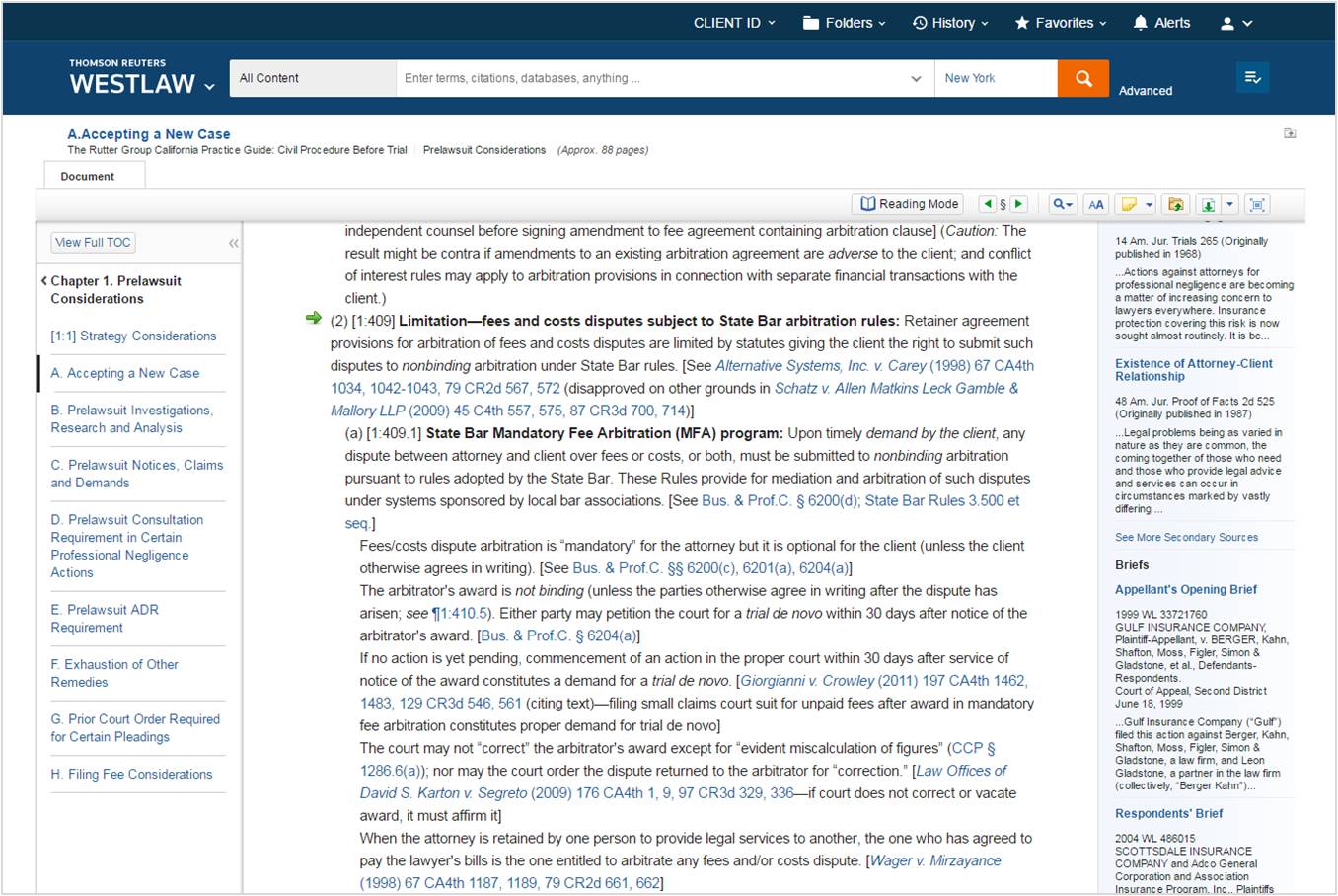
    Treatises offer interactive Table of Contents

    Today Thomson Reuters is announcing the release of re-designed Westlaw Secondary Sources  experience. The marketing materials promise that researchers will “start  stronger and finish faster.” Secondary source content includes more than 4,000 treatises encyclopedia and serials, including titles such as the iconic Wright  and Miller on Federal Practice and Procedure, Corpus Juris Secundum, American Jurisprudence 2d, state practice guides including Rutter  and even Black’s Law Dictionary.
    This is not a new product. It is an upgrade that all Westlaw subscribers will experience when they select secondary sources in Westlaw. This new display format will also appear for users who access treatises using CUIs  “custom user  interfaces.”

    When I first became a reference librarian – I experienced the West treatises in the “bad old days” before caselaw was fully digitized. I noted with frustration that the indices to West treatises were hierarchical – meaning that you could not search directly for the word “rescission” –you had to know that it was a type of contract remedy and you would leaf through the index hoping to stumble across the right subcategory. In other words, you had to know about the subject in order to learn about the subject. The digitization of treatises has enhanced keyword access while reducing precision.  The enhancements offered by the new secondary source filters and navigation tools improve focus and precision of results.  As many partners, professors and law librarians worry that young lawyers  are unfamiliar with the major treatises in each legal subject area – the enhancements of Westlaw secondary sources should  drive up  associates exposure to and use of major treatises. Every legal publisher including Thomson Reuters is focused on enhancements  which support the client demand for lawyer efficiency – getting lawyers to the best insights and relevant content in the fewest clicks!

     Megan Riley   a product developer at Thomson Reuters provided an advance demo for me. According to the  Thomson Reuters press release, secondary sources are the second most heavily used content type on Westlaw following case law .  Riley highlighted the fact  that the new enhancements will free researchers from the constrictions of a linear research path. The goal is to enable users to more quickly identify filter and interact with relevant resources. The impact is that the experience of searching across the entire repository of secondary sources and the search and navigation within individual resources is dramatically improved.
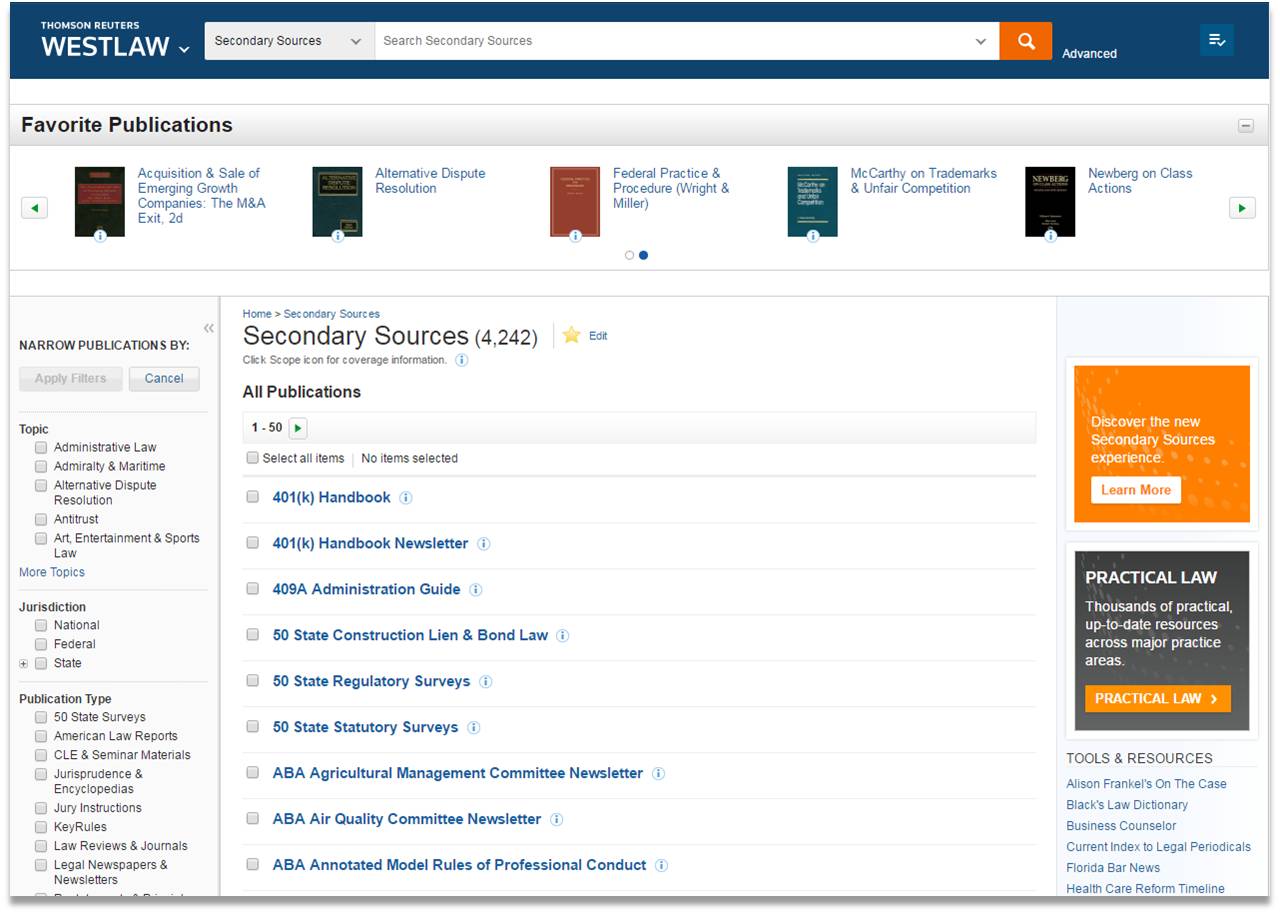
    Favorite Publications Display

    New features include:

    • Streamlined navigation, browsing with enhanced access to contextual materials.
    • Cleaner more intuitive look and feel.
    • Search across all secondary sources with filters which can be combined to enhance precision such as targeting California resources addressing zoning laws.
    • “Reading mode” enables researchers to scroll through multiple documents in a single display. This mode is for reading only– printing is not supported in this mode.
    • Scope screens provide a quick overview of key relevant factors regarding content and updating and include links to related sources.
    • Search results display related documents  as additional options for a researcher to explore.
    • A research trail persists across the top of the page.
    • Favorite publications can be selected and displayed in a bookshelf like format at the top of the screen displaying familiar “book cover” icons.
    • Rutter publications will include pinpoint linking to  enable navigation directly to a referenced citation rather than current process of scrolling.
    Rutter Materials offer Pinpoint Linking
    The US secondary source re-design is the first of a global redesign plan. Redesigns of  WestlawUK and WestlawNext Canada secondary sources will follow. I queried whether this enhancement to secondary sources within Westlaw signaled and change in their ebook strategy. I was told it did not- they remain committee to their Proview ebook platform.
    A Few Humble Suggestions: 
    The new tables of contents feature are a big improvement, but I  have a few suggestions:
    • Add an “expand all” feature rather than having to expand topic by topic.
    • Add an “updated” as of notation  adjacent to titles when searching for a source- this will enable a searcher to quickly determine which of the list is the most current resource and bypassing the need to check individual scope notes after selecting a publication.
    •  Since users remain concerned about client charges, I think it would be a good idea to have a single print charge for viewing any document in chapter rather than triggering a series of charges from reviewing different parts of a chapter.


    The latest issue of Practice Innovations  was the “technology” issue. Each article probes a specific  technological pain point known to every law firm.

    Here are the articles from the current issue:

    Too Much Computer Security? A request for Better Customer Relations by Conrad Jacoby, efficientEDO

    Too Many Passwords by Bobby Kuzma, Systems Engineer, Security Technologies

    Big Law Big Data & Big Foot by Jeffery Brandt, Brandt Professional Services

    The Pen is Dead Long Live the Pen by Don Philmee, Consultant

    Is Virtual Reality Finally  Ready for Business Use? by Joseph Raczinski, Manager Technical Client Management, Thomson Reuters

    Cloud Choices Mature: What Works for the New Legal Business Model by Keith Lipman, President Prosperoware.


    In the past year MLex has launched two “hot topic”
    newsletters: Brexit Market Insight and White House Watch which are positioned
    at the vortex of regulatory uncertainty and designed to helplawyers and corporate leaders mitigate regulatory risk. I interviewed    MLex’s
    founder and CEO Robert McLeod and reported on the evolution of the MLex service
    and its unique approach covering the global landscape of regulatory risk in an earlier post.
     The UK’s referendum
    to exit from the European Union and the election of Donald Trump were both surprising
    election outcomes that have roiled the normally somnolent world of regulatory reporting.
    Brexit Market Insight
    Four months before the majority of British voters approved a
    referendum to exit from the EU, Robert McLeod, began planning a newsletter
    devoted to “Brexit.” Brexit is shorthand
    for British Exit. In a recent interview McLeod recalled that on February 22, 2016
    the Sunday Telegraph reported that Boris
    Johnson, the former Mayor of London, journalist, provocateur had announced his
    support for Brexit. For the first time McLeod considered the possibility that
    the Brexit referendum could succeed. McLeod telephoned his co-Founder and
    Managing Editor, Duncan Lumsden to begin discussing the launch of a new product
    focused on the ramifications of Britain’s possible departure from the European
    Union.   The Brexit
    referendum would be just the first step in a long and uncertain process extending
    over several years. The UK will have to formally invoke “Article 50 of the Lisbon
    Treaty” which will give Britain and the EU two years to agree to the terms of
    the split. Company executives are facing a prolonged period of uncertainty.
    McLeod recognized that business executives and lawyers would
    be desperate of insights and guidance on a host of issues:  What would Brexit mean for their customers
    suppliers, competitors and for individual companies as they plan for the new regulatory
    environment? They began recruiting writers with special expertise in
    identifying the regulatory implications of Brexit for their bureaus in London,
    Paris, Berlin and Brussels. On June 23, 2016
    Britons voted in favor of leaving the EUThe Brexit product which launched in mid- 2016 is updated three or four times a
    day. The digital newsletter has been profiling the key Brexit players.  McLeod recognized that business leaders need
    to understand who will be influencing and negotiating the new regulatory
    framework. What are their political beliefs? What are their economic beliefs?
    Where did they go to school? What speeches they have given? What positions they
    have taken?  According to McLeod there
    are 900 separate regulations that could possibly be renegotiated …everything from
    fisheries to footwear could be impacted. To date, Brexit Market Insights has been the fastest growing publication in the MLex
    portfolio.

    White House Watch
    Free Until May
    The day after Donald Trump won the US Presidency, McLeod
    began pulling resources from around MLex  to help him launch a news service to cover the
    regulatory upheaval promised by Donald Trump during his campaign.  McLeod is still recruiting journalists with
    specialized White House experience. Following the Brexit formula, they plan to
    focus of regulatory issues of interest to corporate leaders including, trade,
    tax, labor, environment and energy.  McLeod observed that President Trump has up-ended
    the traditional role of lobbyists and industry associations by engaging
    directly with company CEOs. MLex editors plans to profile all political
    appointees in order to better anticipate their regulatory agenda. They had
    already created profiles of judges on Trump’s Supreme Court nominee list.
    White House News Without the Politics. McLeod hopes to offer
    pure legal analysis without a political point of view. If he can pull that off –
    he will deserve a Pulitzer Prize – and perhaps a new category of Prize!
    MLex has eyes and ears around the globe –with news bureaus in
    20 major cities.  The White House Watch will continue to respond to the global interest in
    following the regulatory and legislative impact of the Trump administration.
    McLeod personally reads the coverage of the Trump administration in 5 major international
    newspapers and recognized that it is a challenge to sort out the truth. He
    believes that MLex could lead the market in offering White House news
    unblemished by hyperbole and partisan rhetoric.
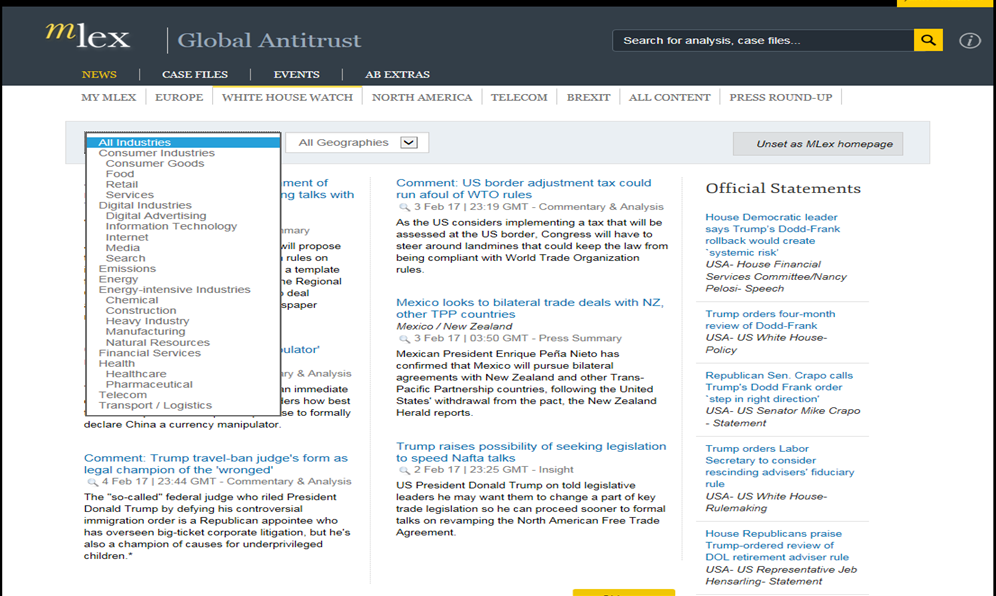
     The White House Watch will be free until May. The newsletter can be filtered by regulatory issue in order to easily locate topics of interest. Lawyers can
    feel free to distribute stories to their clients.REMINDER: Start/Stop Poll Closes Friday February 17th. Take the survey here.

    In July 2015 LexisNexis acquired MLex, a newsletter service specializing in international
    legal analysis of regulatory risk. In recent years MLex has cracked the US market as a “must read” for antitrust lawyers. MLex editors employ an
    investigative approach combined with in-depth forensic examination of issues by reporters, lawyers and industry experts located in 15 bureaus around the world.
    In the last eight months they have launched two new products emerging from vortexes of regulatory uncertainty: Brexit and the election of Donald Trump. These two newsletters will be examined in part two of this post.

     The market for specialty news.
    I recently interviewed MLex founder and CEO, Robert McLeod. MLex has ridden a wave of demand for deep specialized news. McLeod discussed MLex’s rise in the context of recent dislocations in the news industry. The Pew Center has documented the decline of the traditional newspapers.
     McLeod witnessed the transformation from inside the traditional news industry where he has deep roots as a professional journalist. He started as writer with
    Bloomberg in 1993 when Bloomberg had only 17 reporters in Europe. McLeod focused on antitrust and merger control in Paris, covered energy and investment banking in London and was promoted to bureau chief in Belgium. McLeod traces his idea for MLex back to 2004. As Internet browsers began eroding the market share of traditional newspapers, the owners of news outlets responded by cutting the most highly compensated reporters – the ones who covered the most complex regulatory and business issues. Newspapers began seeking business and regulatory content from news agencies like Bloomberg and Reuters. There was one catch. Newspaper editors wanted  “copy” but they wanted “watered down” versions for general news readers. McLeod recognized that there was still a market for very sophisticated business coverage or as he likes to say …“smart copy.”
    Since broadband has leveled the playing field. Startups like MLex had a unique opportunity to complete with big news organizations. McLeod left Bloomberg in 2005 to launch MLex.
    MLex – “11 Years to Overnight Success” 
    McLeod filed his first MLex story on July 7, 2005. He recalls celebrating when the first reader clicked on the story. He watched the traffic grow steadily. He found four US law firms who agreed to subscribe for the first year.   MLex was not an easy sell.  Forty five firms said they were not interested… they already had a source for all the antitrust news they needed.  McLeod was confident that he could deliver a product that provided deeper analysis and more compelling content than his competitors.
    Over the past decade MLex has branched out into coverage of: financial services, anti-bribery, compliance, data privacy, globalization and convergence of regulatory risk. McLeod offered an outline which highlights the acceleration of global regulation.
    McLeod’s Outline of Regulatory Acceleration:
    • ·
      It took 120 Years for antitrust regulation to
      spread around the world from US.
    • ·
      It took 40 years for anti bribery to spread around
      the world from the US.
    • ·
      It took only 12 years for data privacy and
      security regulation to go global.


    McLeod expects the next big regulatory issue to go global in less than 10 years. All of these regulations expose companies to serious risks running the gamut from huge fines to jail time for executives. Many of the regulatory regimes are converging and companies which are exposed on one issue may discover
    risk exposure on other issues. This convergence will increase the risk of
    litigation. According to McLeod  “Companies which operate multiple jurisdictions have to update their compliance materials every three months.  The job of the
    global GC is to keep the CEO out of prison.”
    Today MLex has 85 reporters in 15 bureaus located in key political and financial centers around the globe including Washington DC, New York, Sao Paulo, Beijing, Jakarta and Geneva. Subscribers represent more than 800 law firms and corporations around the globe.
    New Issues in the Pipeline.
    McLeod anticipates that tax and intellectual property will be next areas to experience a surge in global regulation. McLeod also sees opportunity arising from being part of LexisNexis. LexisNexis has a deeper bench of technologists and programmers who can help them add enhancements to the product. McLeod would like to see new visualization features such as regulatory “heatmaps.” They plan to offer lawyers the ability develop custom newsletters on discrete issues that will automatically update.  One use case would be shareable pages on specific issues related to a deal.
    While library budgets remain tight, specialty news sources for practice groups remain one of the few areas where spending is increasing. Specialty news addresses every lawyers need to feel smarter than their client,  while also responding to every GC’s demand that outside counsel follow the business issues facing their industry. Specialty newsletters like MLex are positioned in a market sweet spot where they can simultaneously reduce information anxiety and enhance opportunity.
    Up Next: Part Two– MLex Tackles Brexit and The Trump White House
    The fourth annual Start/Stop survey of products and projects will be closing on Friday February 17th.
    Share your wisdom with your colleagues by taking the survey HERE
      
    You
    the readers have provided the insights and trends which have made the
    “Start Stop Survey” one of the most popular blog posts of each year. . Here are links to the  2013 , 2014 and 2015  product  and process  results.
     
    Let
    the cheers and raspberries roar. Share your insights into the hope and
    the hype of legal information and legal technology market. Did your firm
    hire a “robot lawyer”? Did your team develop an in-house app? Are you
    driving analytics into the practice of law?

     We routinely assess new products, new processes, new roles,  new organizational options, new expectations.  Let’s help each other decide what’s worth doing. Let’s leap boldly into the future together. Share your insights. What were your victories, false starts or  plain old bad choices. Share your hot tips,  short cuts,  projects and best practices.


    Make Room For Value.
    The speed with which old processes and assumptions become obsolete is
    accelerating. We can only deliver more value by eliminating or
    streamlining the routine, the redundant and the unexamined. 
    Invest in the Future. Since law firm budgets remain flat, the best  way find the budget for innovative new products, is to eliminate redundant products and low value products.

    The Wisdom of Colleagues. In the spirit of collecting the wisdom of colleagues please let us know what processes and projects you  started
    or stopped in 2016 or will start or stop in 2017. Which products  will
    be tossed and what have you selected as the “must have” new product for
    2017?

    Anonymity Results
    will be aggregated and there will be no attribution to any individual
    person or organization without the express written consent of the
    respondent.
    The Poll: Please take the brief 9 question survey here.
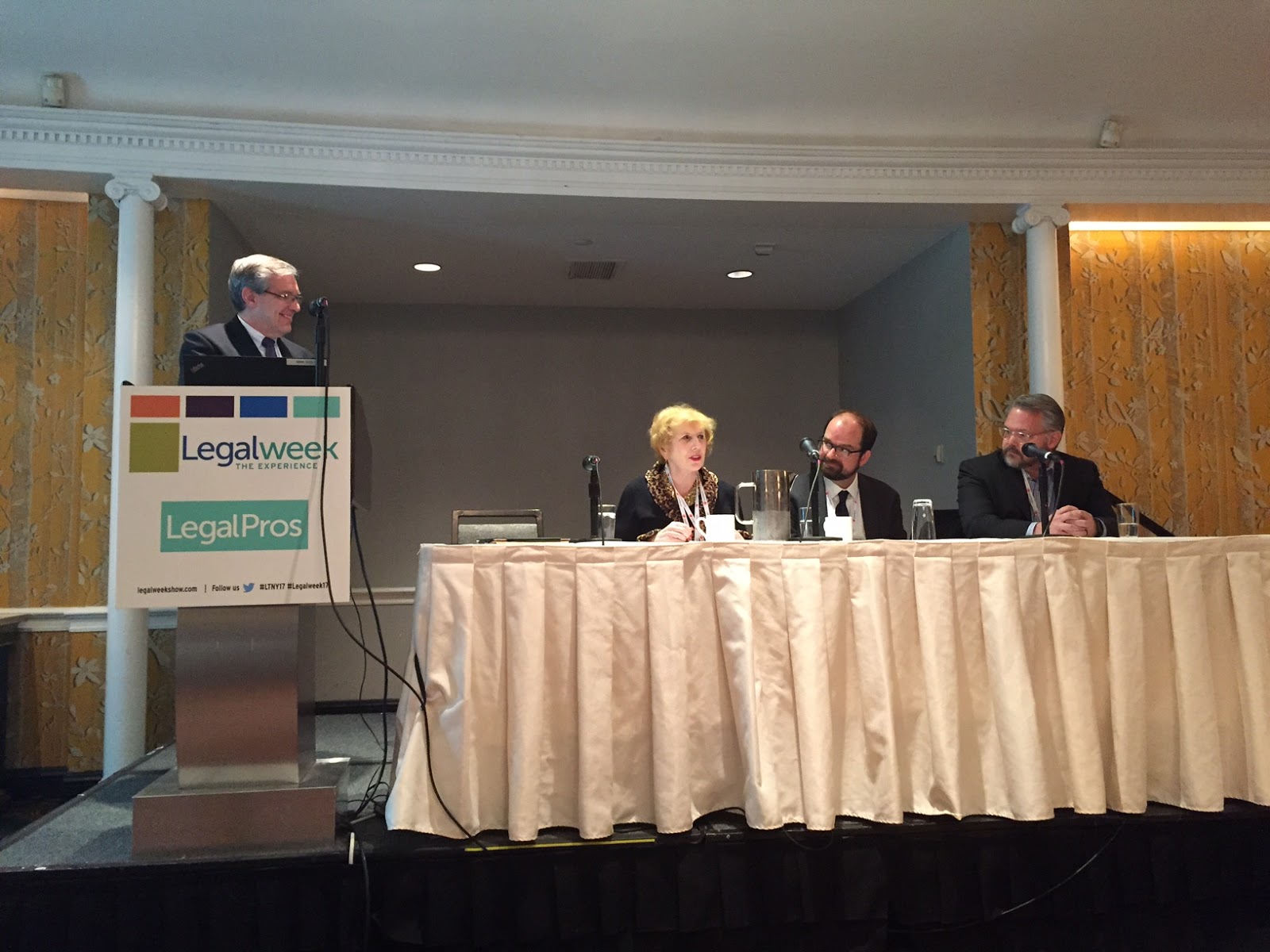
    Steve Martin, Jean O’Grady, Scott Baily, Greg Lambert
     

    On February 1st, the first panel of the new Legal Pros track at Legal Week– 
    New Ways for Law Librarians & Knowledge Managers to Become Indispensable
    brought in a standing room only crowd.

    Steve Martin, a Principle and head of legal design practice at Gensler provided an overview of the transformation of law firm libraries from rooms full of stacks into innovation and collaborarion hubs. A Gensler survey of library users had identified new roles for information professionals. At the top of the list was digital curator, change agent, connector and innovator. All of these issues emerged throughout the panel discussion.

    From this framework — I joined my co-panelists, Scott Bailey, Global Director Research Services, Squire Patton Boggs  and Greg Lambert, President-Elect, AALL, Chief Knowledge Services Officer, Jackson Walker in a discussion about the challenges  and opportunities facting information professionals in  21st century law firms.

    I highlighted the importance of business skills including budget analysis, scenario planning and analytics for knowledge services leaders. Since lawyers are not always open to innovation– there are times when it makes more sense to act first and get permission later–  acting when   a unique opportunity presents itself.

    Scott Baily highlighted the importance of outreach and  deep engagement with practice groups to identify knowledge gaps where information professionals can create new solutions. New opportunities can arise from embedding researchers in practice groups where they can advise on the development of new workflow best practices.

    Greg Lambert focused on interdepartmental collaboration opportunities. Most administrative functions have knowledge needs and information professionals can help develop workflow solutions .There are also opportunities to assume responsibility for a wide portfolio of knowledge related serviced including, conflicts, pricing, business development, competitive intelligence, intranet management, and client portal development.

    We all agreed that lawyers simply can’t keep up with all of the changes in knowledge products and technologies and that  the role of the information “connector” has never been more important. Information professionals will play and important role in assessing and deploying emerging Augmented Intelligence, analytics and workflow enhancement products.

    It was clear from the audience questions that not every law firm and corporate legal department has invested in hiring strategic knowledge leaders – so the panel provided a great platform for educating the wider legal community on the transformative roles information professionals can play in giving lawyers an information edge.


    1)    New efficiencies within the department

    ·       
    JOG – What skill do you
    wish you had learned before you became a Knowledge Services Leader/ Library
    Director?

    ·       
    SB-Many studies regarding
    innovation have suggested that the way to create indispensable services is to
    be inventive and develop something new. How has your firm effectively
    recognized (or not recognized) your attempts at innovation? Is failure an
    essential part of the process?
     
     ·        
    SB-What innovative services
    does your department offer that expand your value and insight and impact?

    ·       
    JOG – Have you ever gone
    out on a limb to introduce innovation (opting for  forgiveness rather than
    permission)?


    2)    Unique partnerships within firm and
    outside

    ·       
    GL – What non-traditional
    opportunities are available within the firm to the leaders of Knowledge
    Services?

    ·       
    SB-What are the points of
    resistance toward establishing an effective internal awareness campaign of what
    you and your team can do?

    ·       
    JOG – What have been your
    most successful alliances/collaborations to initiate change?


    3)    Effectiveness of information services

    ·       
    GL – How are you leveraging
    the technologies your firm already possesses in new ways that expand the role
    of KM or Libraries?

    ·        
     JOG – What new technologies are you watching closely with
    an eye future innovative opportunities?