Scott Mozarsky


Greg McCaffery, BloombergBNA, CEO and Scott Mozarsky President
of the BloombergBNA legal division discuss Bloomberg BNA strategy, AI,
predictive technologies, gatekeepers, advisory boards and BNA platform
migration plans. Contrary to recent rumors McCaffrey emphasized that customers
will be able to continue purchasing BloombergBNA vertical products after the
content is migrated to the Bloomberg Law platform.

Following the departure of Bloomberg Law President, David
Perla, I interviewed Greg McCaffery and Scott Mozarsky on some “hot topics” in
legal tech and legal publishing.

McCaffery kicked of the discussion by acknowledging David
Perla’s  important contributions during
his two and a half years at BloombergLaw. 
McCaffery described BloombergBNA as being in “heavy execution mode” and
underscored how Mozarsky’s  background is
perfect for continuing the development strategy begun under David Perla. Perla’s
legacy includes the development of the Bloomberg Law Corporate Transactions and
most recently the Litigation Analytics product.  McCaffery is confident that Mozarsky’s
background developing Bloomberg’s cross-platform capabilities is perfect for
continuing the strategy. Mozarksy joined Bloomberg three years ago after
practicing law in  private law firms and as
inside counsel. His cross-platform portfolio included: the Convergence
aggregation and publishing platform, CLE, media marketing, law firm event
support and Big Law Business—one of
my favorite daily reads. His focus has been on helping law firms leverage
Bloomberg Law resources to differentiate themselves.

JOG: Will this leadership change have any immediate impact
on your strategy?

GM: Our Strategy will continue to focus on combining
Bloomberg’s business news and analytics with BloombergBNA’s content expertise. We
expect to grow by double digits with a strategy of displacing other products. We
are having great success displacing niche providers in law firms.

JOG: What are Mozarsky’s top priorities?

SM: My first priority is to spend as much time as possible
with customers since customer feedback is critical to innovation. I also plan
to spend time with our employees. BloombergBNA has recently infused a lot of
new talent into the organization and I want to understand their talents so we
can continue to drive innovation through collaboration.

JOG: Is there anything in the pipeline that you can tell me
about?

SM:  We will continue to build out analytics. The goal is
to be in the legal market what the Bloomberg terminal is in the financial
market.

JOG: Do you have plans to eliminate the BNA Practice Library
platforms?

GM: We will be  migrating the content from the legacy BNA  platforms onto Bloomberg Law.  This content includes the Labor Law Resource
Center and the IP Law Resource Center. 

JOG: Will customers be able to purchase individual practice
libraries after the content is migrated onto the Bloomberg Law platform?

GM: “Yes. No one will be forced to purchase Bloomberg Law in
order to get topical content. There will be new functionality on the Bloomberg
Law platform. Customers can set up alerts and will have access to a full citator
as well as other enhanced Bloomberg Law functionality.

JOG: Is there any content that will not be available to topical
library subscribers?

GM: “Yes. Dockets, Bloomberg News and the Business Development
Center will remain exclusive offerings on the full Bloomberg Law platform.”

JOG: What is your view of the recent “gatekeeper”
controversy? Do you think of librarians and information professionals as “gatekeepers?”

SM: “I have a different perspective. I think that the very
large majority of librarians that I have dealt with are extremely strategic and
knowledgeable. A large majority of the innovation that we have undertaken  as an organization is driven by ideas we get from librarians in law
firms.”

JOG: Bloomberg BNA is the only major publisher that does not
have an advisory board composed of librarians and information professionals .  Would you consider having one?

GM: We have asked librarians to act as advisors in the past.
 We had one day summit in New York in 2014
. We put fifteen librarians around  a table and came away with wonderful new product ideas.”

SM: I think that being able to test ideas and get feedback
from customers is extremely important. I like the idea of having an advisory
board of librarians who can provide regular feedback from a variety of perspectives.
We will definitely consider doing that.

JOG; Are you looking at predictive technology?

SM:  Bloomberg has very large data sets and the technology
to look at patterns and trends.  We expect Litigation Analytics to be used as a  predictive tool. We will continue to leverage  the predictive technologies which have been developed
on the business side of Bloomberg to enhance the BloombergBNA  products.

JOG: Where do you think Artificial Intelligence fits in your
strategy?

SM: AI is both a challenge and an opportunity, but it needs
to be focused on real needs that will benefit the market.

GM: There is an AI team at Bloomberg. AI already being used
to create stories for Bloomberg business news. It has been in use for several
years. In the early days  you could tell
when stories were written by a machine, but the technology has improved
dramatically. Bloomberg lists the source of those stories as ‘Automated News,’  and those stories are being written by
algorithms.

JOG:  You indicated
that your goal is to have BloombergLaw  be positioned in law firms,  the same way Bloomberg
Business terminal is positioned in financial services firms. Can you elaborate?

GM: The business terminal is a workflow tool that supports
many constituencies in a financial serviced firm. We are developing
BloombergLaw to be a multi-faceted workflow platform offering the best content
and functionality across the spectrum of roles in law firms  whether the user is an associate, partner, business
development  or research team member.

AALL  has released  a digital White Paper:  Defining ROI: Law  Library Best Practices.
The white paper provides practical advice on measuring and defining value in  private law firm, academic and government funded law libraries. 

The
role of the legal information professional has never been more critical to
the institutions they support, yet it has never been more at risk. Success
of both lawyers and law firms ride on access to the right mix of precedent
and predictive insights. Information
professionals act as ”Connectors” digital cartographers who help law
students, judges and lawyers surface and synthesize both precedents and
predictive indicators….. Today information is so ubiquitous
and information professionals deliver it so seamlessly that the complexity
of balancing the budgets, the workflows, the technologies, the formats,
the user preferences is often invisible to our organizations.  Librarians
must track and evaluate a flood of emerging technologies and select and
configure tools which change workflow and research methods while supporting the
existing infrastructure. More than ever before librarians need the right tools
and methods for monitoring the pulse of their constituencies while carefully
selecting and managing complex changes in platforms, learning styles, client
expectations and budget constraints.

The
AALL “White Paper” was written to encourage all  AALL members
take on the “value challenge.”  This project is a journey not a
destination. Law librarianship cannot expect to survive as a profession if
members do not engage in honest reassessments of the typos of professional
skills they need to learn and the platforms and services they
provide. They must embrace the need to continuously reassess and recalibrate
services to  optimize  value at the highest strategic level – all
while maintaining an eye on the bottom line. Measuring value across each
environment will not be easy, but it is a task we undertake. Contributors
include thought leaders from across the AALL spectrum, who have mined their own
experience and
Chapters cover issues adapted to each type of library environement addressing key issues such as:   
·        
Creating effective
self-assessments and user surveys 
·        
Modeling value
metrics and methodologies 
·        
Identifying
new opportunities
·        
Communication skills
and methods for effectively impacting the pain
points of    stakeholders.  

Contributors include thought leaders from across the AALL spectrum who have mined their own experience to share their  methods and metrics of success.  Authors include: Roger V Skalbeck, University of Richmond Law School. Joan S. Howland,  University of Minnesota Law School; Martin Korn,  Sheppard Mullin; Coleen Cable, Orrick; Steve Lastres, Debevoise; Jean Wenger, Cook County Law Library;Katherine M Lowry, Baker Hostetler; Mark E. Estes, Alemeda County Law Library  and Kevin Iredell, Greentarget.

The publication  was edited AALL  members Holly M. Riccio, director of knowledge management, Nossaman LLP; Jean P. O’Grady, director of research and knowledge services, DLA Piper; and Gregory R. Lambert, chief knowledge officer, Jackson Walker LLP.

Fastcase, a provider of next-generation legal research,  provided support for production of the white paper.  Ed Walters CEO of Fastcase is quoted in the press release “It’s not enough that the guidance of library professionals is ‘invaluable’—we have to quantify and demonstrate that value. Our team at Fastcase is proud to support this pioneering report that measures the real  returns on investing in libraries and library professionals.”

AALL  has Released the Executive Board Member Election Results:
VICE PRESIDENT / PRESIDENT-ELECT
(JULY 2017 – JULY 2018)
Femi Cadmus
Edward Cornell Law Librarian, Associate Dean for Library Services,
& Professor of Practice 
Cornell University Law Library
Ithaca, NY
 SECRETARY
(July 2017 – July 2020)
Luis Acosta
Law Library of Congress
Chief, Foreign, Comparative, and International Law Division II
Washington, DC
BOARD MEMBERS
(July 2017 – July 2020)
Beth Adelman
Director, Charles B. Sears Law Library,
Vice Dean for Legal Information Services
The University at Buffalo State University of New York
Buffalo, NY
Jean P. O’Grady
Director of Research & Knowledge Services
DLA Piper
Washington, DC
Congratulations to  all the new Executive Board members. I am honored to be a member of the incoming Board.
I am hearing from multiple sources that David Perla has resigned as President of the BloombergBNA legal division.  According to Bob Amrbrogi’s website Law Sites  Perla is being replaced by Scott Mazorsky who will report to Greg McCaffery, the BloombergBNA CEO.
( I hate when Bob scoops me!).

Perla brought a lot of energy to BloombergBNA. Under his watch Bloomberg BNA added some of their most innovative products including the Corporate Transactions Center which provides advanced drafting analysis of corporate deals. In the past month, BloombergBNA released  litigation analytics which is the first market entrant to take on the dominant Lex Machina in that space.

Perla stoked controversy over the summer with his Above the Law post on “gatekeepers” in law firms, which was viewed by many including this writer as insulting, information professionals– who have in fact been both BloombergBNA’s strongest allies and critics– helping it grow and evolve its offerings.

I liked David and his energy and insights will be missed. I suspect we will soon see David emerge in another innovative leadership role in the legal market.

Speaking of comic, librarian stereotypes…  while I was writing my prior post on the AALL rebranding… I watched the rebroadcast on HBO of Tracy Ullman’s new BBC show “Tracey Ullman’s Show,”  which featured a tap dancing, operatic, production number complete with book dumpsters, shushing librarians and sleeping library patrons….

Trick or Treat?

Today the American Association of Law Libraries announced the adoption of a new logo that combines the organization’s acronym with a new tagline “your legal knowledge network.”

According to the  press release “AALL’s new brand supports its strategic goals to foster knowledge, community, and leadership.” “Today, legal information services and the role of the law librarian reach far beyond research and collection
development,” said AALL President Ronald E. Wheeler Jr. “Our members—whose diverse roles include knowledge
management, competitive intelligence, business development, and project management—are essential experts who
deliver business-critical insights at law firms, law schools, and government institutions.”
AALL’s new brand is the culmination of almost two years of work that included extensive research,  multiple
opportunities for member input, and thoughtful consideration of the history of the legal information profession, as
well as its rapid evolution over the last decade

Earlier this year the organization’s Board triggered a vigorous and sometimes heated debate among members when a new name  “The Association for Legal Information” (ALI) was proposed. The name change was voted down by a majority of the membership. The new logo and brand are a fair compromise by maintaining the original acronym while embracing a broader  and more proactive professional role with the tagline: “Your legal knowledge network.”

 The new logo nods to the past with blue as the dominant color;
conveys collaboration with the linked letters, “AALL”; and suggests a future focus with the orange forward slash. The
new tagline, “Your Legal Knowledge Network,” positions AALL as the resource for legal information professionals to
gain invaluable professional support, as the go-to source for employers to find legal problem solvers, and as an
information hub for accessing legal information that is every citizen’s right.”
The new tagline and logo underscores the expanding and strategic roles played by information professionals across law firms, law schools and in court and government agencies  and downplays the “l” word with it’s pop culture parade of demeaning librarian stereotypes.
Today Bloomberg announced the launch of a new analytics
product that transforms data on more than 3 .5 million companies, 7,000 law
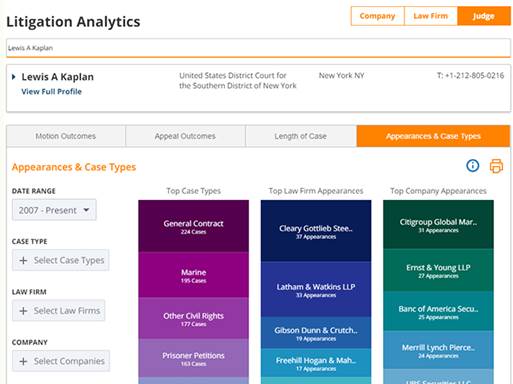
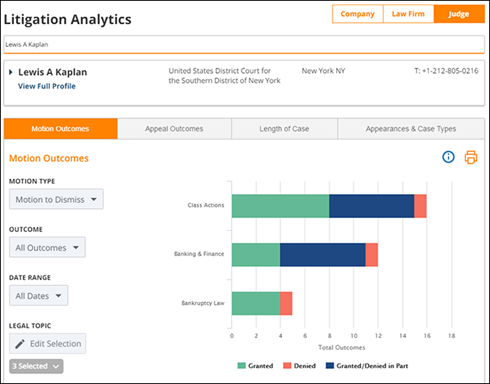
firms and all active federal judges into actionable insights. The product is positioned as strategic planning tool for litigators by analyzing   past patterns of judges behavior such as motion grants/denials and time to trial.

Coverage:*

  • Motion Outcomes and Appeals Outcomes include the full time period that a judge has been on the bench.
  • Length of Time and Appearance/Case Types are docket based analytics covering back to 2007.
  • Company search and Law Firm search are docket based analytics covering cases back to 2007. 

Here are some sample reports:

Law Firm  Appearances by Case Type


Average Time to Trial


Motion Outcomes

 The Competition. From it’s earliest days in the legal market Bloomberg Law has offered a topnotch docket tool and that docket tool provides the raw data which Bloomberg feeds into their analytics engine.There are  several products which offer judicial analytics including Ravel Law and PacerPro and Lex Machina . Lex Machina is the product which can be most closely compared to Bloomberg Law’s new offering. Lex Machina came into the market with a product focused on IP litigation. The rationale for Lex Machina’s acquisition by Lexis Nexis was the opportunity to expand the Lex Machina offerings by loading the Lexis archive of docket data. In July, they launched a securities litigation product.  I have not yet had a demo of the Bloomberg Law Litigation Analytics product so I can’t compare how their interactive features and reports compare with Lex Machina’s.


Bloomberg Advantages. The one obvious advantage that Bloomberg will have out of the gate – is that they appear to be offering analytics on all types of federal litigation. Lex Machina intends to expand their coverage beyond IP and securities over the coming year – but for now Bloomberg Law appears to be the only product  offering the insights into practice areas such as labor law, contract disputes and civil rights which are not yet covered by Lex Machina.

A second advantage is that in keeping with Bloomberg Law “all in” contract approach, every Bloomberg Law subscriber automatically gets access to all new content and features. Lex Machina is not integrated into Lexis and must be purchased under a separate license. Thomson Reuters also offers litigation analytics on a separate platform the Intelligence Center, which cannot be accessed from Westlaw and which requires a separate subscription.

In this hyper-competitive legal market, building products such as Litigation Analytics which feed law firms insatiable  appetite for competitive insights is smart marketing strategy.

* Correction of original post regarding coverage dates.
________________________

Here is the press release:
New Bloomberg Law Litigation Analytics Solution
Provides Insights into Judicial Behavior
hdfcInnovative Resource Helps to Shape Litigation Strategy,
Drive Business Development Efforts
 Arlington,
VA.
(October
18, 2016)
— Imagine if attorneys could counsel their clients on how long
judges typically take to resolve cases, how they rule on dispositive motions,
and how often they are overturned on appeal. Insight to those important
questions, along with a host of other predictive analytics invaluable to trial
lawyers, litigation managers and business-generating rainmakers, are now
available on Bloomberg Law.
 Today,
Bloomberg Law announced the launch of Litigation Analytics, which draws
on both comprehensive court opinions (both published and unpublished) and
docket information in Bloomberg Law’s vast databases to help inform litigation
strategies and understand potential impacts of judges and courts, revealing
insights like:
 Judge
Jack Weinstein in the Eastern District of New York has been almost four times
more likely to deny a motion to dismiss in full than Judge Jesse Furman in the
Southern District of New York.  The disparity is particularly noticeable
when it comes to corporate law cases, where Judge Weinstein has been five times
more likely to deny a motion to dismiss in full.  
Judge
Leonard Stark in the District of Delaware had – to an extraordinary degree –
the busiest bench of the judges we sampled over the past five years: the top
three firms appearing before him appeared a total of 1050 times.
 “Bloomberg
Law Litigation Analytics
allows attorneys to devise informed litigation
strategies and anticipate outcomes to a degree we could simply not approach
before,” said Cassandra Collins, partner in the Business Litigation practice at
Hunton & Williams LLP. “The depth of intelligence that can be gleaned from
this product is going to make it a go-to resource not only for litigators, but
also law firm business developers, marketers, and law librarians.”
                                                                                                                                          
With the
introduction of Litigation Analytics, Bloomberg Law becomes the first
and only full-service legal research and business intelligence platform to
include this type of solution, together with access to a comprehensive case law
and dockets collection. In addition to providing insights about federal judges,
Litigation Analytics includes extensive information on the litigation
activities of companies (more than 70,000 public and 3.5 million private
companies), as well as the law firms that represent them.
 This
universe of data allows law firms and corporations to make more informed
decisions on critical strategic issues such as where to file or remove a case,
whether or not to settle, whether or not to pursue an action in the first
place, and even which law firm to retain or consider—all of which are likely to
be influenced by the success rate of cases before particular judges and the
length of time that judges take to make decisions.
Corporate
legal departments and law firms will also find Litigation Analytics
instrumental in gaining intelligence on their competitors and industry peers,
as well as each other. Thus, a general counsel can instantly discover how many
product liability cases a specific law firm has litigated in California to
determine which law firm might best represent a company, while a partner can
find out which firms a client prospect is using for environmental cases in New
York.
“Our
mission at Bloomberg Law is to create technology that enhances our clients’
legal practices, and there’s no better example of that mission in action than
this new solution,” said David Perla, President of Bloomberg Law and Bloomberg
BNA Legal, who called Litigation Analytics the most comprehensive
product of its kind. “Unlike other analytical tools on the market, Litigation
Analytics
covers all federal district courts and case types, all practice
areas, leverages both case law and dockets, and is available without additional
cost to existing Bloomberg Law subscribers.”
For more
information on the valuable insights Bloomberg Law Litigation Analytics
can provide, please view a Technology Snapshot at http://www.bna.com/litigationsnapshot.
To learn
more about Bloomberg Law Litigation Analytics, register at http://about.bna.com/litigation-analytics for a
product overview webinar on Tuesday, November 1.
About
Bloomberg BNA
Bloomberg
BNA provides legal, tax and compliance professionals with critical information,
practical guidance and workflow solutions. We leverage leading technology and
a global network of experts to deliver a unique combination of news and
authoritative analysis, comprehensive research solutions, innovative practice
tools, and proprietary business data and analytics. Bloomberg BNA is
wholly-owned by Bloomberg L.P., the global business, financial information and
news leader. For more information, visit www.bna.com.
About
Bloomberg Law
Bloomberg
Law helps legal professionals provide world-class counsel with access to actionable
legal intelligence in a business context. Bloomberg Law delivers a unique
combination of practical guidance, comprehensive primary and secondary source
material, trusted content from Bloomberg BNA, news, time-saving practice tools,
market data and business intelligence. For more information, visit www.bna.com/bloomberglaw.
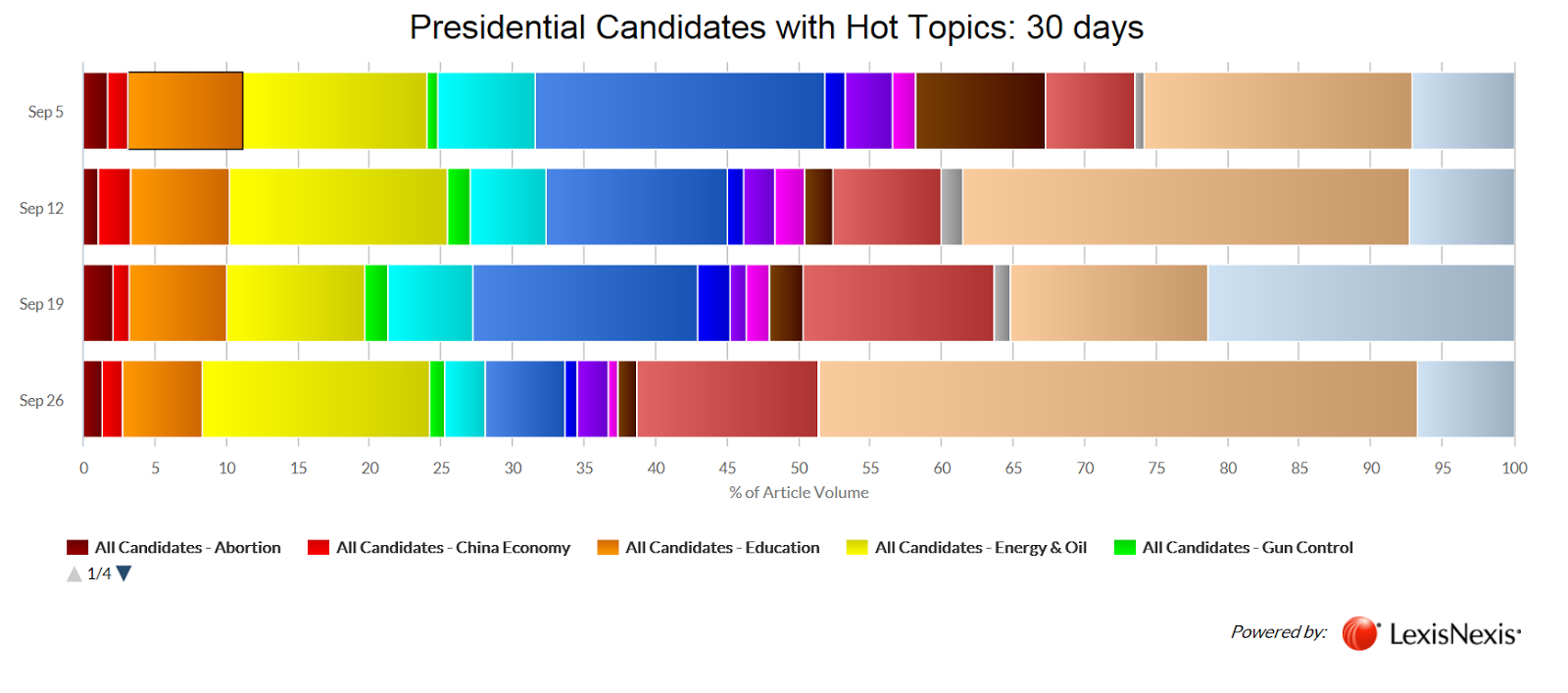
Just in case you are not tuning out any mention of the 2016 Presidential Election– I recently learned that LexisNexis has posted  an interactive 2016 Presidential Election News  Tracker Page. The page shows coverage trends  for Donald Trump and Hillary Clinton,  and  the Vice Presidential Candidates Mike Pence and Tim Kaine. It also charts, share of voice, and provides word cloud of  campaign hashtag topics. Users can interact with the charts and drill down to read stories.

The Campaign  Page is showcasing some of the new data visualization capabilities which LexisNexis offers in it’s NewsDesk curation product.  Charts are generated from an analysis of print, broadcast and web coverage of candidates. Interactive charts enable users to dig into  “share of voice” and geographic coverage of each candidate.

 The topic tracker illustrated below,  shows how much discussion is devoted to hot topics such as gun control or education over the most recent 30 days.

 
There is also a free Presidential Campaign Tracker App which is downloadable from iTunes.

Lawyers Need to Interact With Information in New Ways. Perhaps the most important aspect of this microsite is that it invites users to interact with information in ways that have not been possible in the “Boolean” online research world. It is important for lawyers to get comfortable with interactive analytics products that this is a public website that provides a no cost introduction to the new world of interactive data and visualization.


Dewey B Strategic and I were recently honored with a “Legal Rebels” Profile and podcast on the ABA Journal website “Dewey B Strategic’s Jean O’Grady  Leads Lawyers Through the Tech Maze.”

Here is an excerpt:

Most people see librarians as the quiet personification of technical obsolescence. Jean O’Grady is out to change that.

Far from sitting in a dusty room full of outdated books and CD-ROMs and telling visitors to keep quiet, the senior director of research and knowledge at DLA Piper in Washington, D.C., is at the forefront of pushing the legal industry toward embracing technology as a means of enhancing the practice of law. Through her acclaimed blog, Dewey B Strategic (which has been selected for the ABA Journal Blawg 100 every year since 2012), as well as through numerous public appearances and interviews, O’Grady informs lawyers about what the current legal tech landscape looks like and what kinds of innovative tools are at their disposal…

“While the blog is named for someone from the past, O’Grady is focused squarely on the future. “I think we are about to see a spectacular growth in innovation,” she says. “Analytics will allow lawyers to ask completely new questions like ‘What will happen?’ instead of just ‘What happened?’ Lawyers will have to speed up their adoption and embrace of analytics.”” Read the full article here.


Yesterday LexisNexis announced their intent to acquire Intelligize — one of those start up gems that came late to the SEC research party and became the “belle of the ball.”  Well really, it was  completely different kind of SEC research product that  not only provided deep faceted searching of documents, but introduced powerful algorithms which produce unique insights into SEC comment letters, no action letters and standard  corporate filings.  Today I had the opportunity to discuss the Lexis- Intelligize deal with Jeff Pfeifer, Lexis VP of Product Management and Todd Hicks, CEO of Intelligize.

Intelligize and Securities Mosaic? Do Customers Need Both? In 2013 Lexis bought another “boutique” securities product  with a loyal following called Securities Mosaic. It is hard to see why Lexis would retain both Securities Mosaic and Intelligize, especially when one of them, Intelligize is driven by  more sophisticated technology. Here is a clue. Securities Mosciac will move into the Intelligize organization where both products will be managed by Todd Hicks the current CEO of Intelligize. In today’s call, Hicks indicated that they plan to take time and conduct  “a thoughtful assessment of the  product roadmaps for each product” before determining if the products should be merged or remain separate.  For the remainder of 2016, both products will operate separately within LexisNexis North American Research Solutions organization. In January the two product teams will come together within LexisNexis under the leadership of Todd Hicks.

Intelligize and Lex Machina for Securitiesthe Bigger Data Play?  Less than a year ago LexisNexis purchased Lex Machina  a litigation analytics product.  It seems unlikely that it is a mere coincidence that the first non-IP module for Lex Machina  was focused on securities law and it launched only six weeks ago.  The more interesting alignment of Lexis products may be the convergence of these two securities data sets powered by algorithms and data: Lex Machina for securities litigation  and Intelligize for securities transactions.  Could  a marriage of Intelligize and Lex Machina for Securities Litigation create a whole new breed of legal intelligence platform? Imagine a product that identifies the documents and clauses that are most vulnerable to litigation. Imagine a product that analyses SEC filings and predicts events such as shareholder activism, takeover targets and lawsuits!

Lexis Content Acquisition Strategy. For the past few years LexisNexis  has been collecting legal content gems – Law360, Lex Machina, MLex. Instead of integrating them into the massive LexisNexis organization, each company has remained a stand alone operation retaining their entrepreneurial culture, their key talent and their client relationships. Core Lexis content is being leveraged to enhance the offering of the smaller companies. At some point it would make sense for  – Lexis to start aligning some of the content synergies between the acquired gems. Are they ready to to that?


Why Lexis and Intelligize Agreed to the Deal?
According to Jeff Pfeifer, Lexis VP of Product Management, Lexis has been focused on developing solutions that provide deeper insights using machine learning and analytics. That is…. insights which can’t be achieved with traditional text searching. Pfeifer anticipates that Intelligize content will be used to enhance existing Lexis products such as Lexis Practice Advisor and Lexis for Microsoft Office. Pfeifer also described how Lexis Search Advantage  and Intelligize could be combined to enhance internal firm document  research using “clause level analysis.” This feature  would enable firms to analyze their own deal documents and compare documents and clauses with peer data sets. This functionality would have an application both in drafting and deal strategy.

According to  Todd Hicks, Intelligize had other suitors, but chose Lexis because of the company’s commitment to letting Intelligize remain a stand alone company while making Lexis content and technology available for product enhancements. Hicks anticipates that as a Lexis subsidiary they  can accelerate  the product enhancement pipeline. Hicks indicated that product enhancements are likely to focus on improving drafting tools, expanding regulatory products. Since Intelligize recently  launched an exempt offerings module, Hicks indicated that they would explore creating an international exempt offerings module which would include offerings from non-US stock exchanges.

Like many of my colleagues, I feel a twinge of sadness as I watch the arc of another small startup move from  scrappy innovator to hot property for acquisition. At least we can look back at how Lexis has handled, Securities Mosaic,  MLex, Law360 and Lex Machina — to see that those companies and products have retained their identities while expanding content and functionality under the Lexis umbrella.