Today American Lawyer posted an article about what the author described as a “growing trend in law library outsourcing.”  Nuance doesn’t grab headlines, and this article
raises more questions than it answers.  A  few key clarifications are in order.  Are law firms throwing away institutional intelligence instead of just tossing the books? Will they pay a high price later for a short term savings?

1. Outsourcing is not new – I suspect that 100% of ALM 200 firms engage in some level of outsourcing, looseleaf filing, cataloging,  document retrieval and repetitive technical processes are the processes which are most commonly outsourced. Functions involving deep, specialized knowledge and  high levels of expertise are not.

2. Outsourcing is not unique to law libraries – many large law firms have outsourced lower level repetitive work  from many different departments including HR, IT, conflicts, marketing, accounting.  The key metrics which determine whether to outsource a job are: the complexity of the work, a short learning curve, high repetition, low decision making authority. Outsourced positions anticipate high turnover  with low impact on service in order to maintain savings.

3. Most importantly… What exactly do they mean by “law library?” Are any two people  in the article talking about the same thing
when they refer to” law libraries.”?
Is Your Law Library a Time Capsule? 30 years ago most law libraries operated according to a fairly standard template focused mostly on maintaining print resources,
overseeing book circulation, routing  newsletters and magazines. Research support  was generally confined to “ready reference fact checking.”
Since 1986 the spectrum of  services offered by information professionals has exploded as they have taken the lead introducing firms to online research, the internet, Knowledge Management, analytics, competitive intelligence, project management and listening platforms. Sadly there are firms and law librarians who have perpetuated the “time capsule version of a 1986  law library.” Clearly law firms who have failed to hire strategic knowledge leaders will find the savings offered by an outsourced solution very attractive– but this doesn’t mean that the lawyers will be
getting what they need to compete in the 21st century knowledge economy.
Is Your Law Library an Intelligence “Force Multiplier?” Most ALM 200 firms are well down the road to eliminating print, automating operations and outsourcing or eliminating repetitive low
level work. Any firm that has not begun these transformations is way behind the curve. Before law firms jump on the outsourcing band wagon leaders and partners
should do some “soul searching” and consider  what kind strategic information support they currently offer to their lawyers and what kind of
intelligence they want to integrate into  their business and legal work processes to compete in the 21st century.
I have observed at least 3 different tiers of legal information support in ALM 200 law firms and there are probably more.  But for purposes of assessing the value of “outsourcing” to an organization you
need to define the central idea of the “law library.” What kind of support does your firm offer now and what kind of support do you need to maintain a competitive edge?
Low tier.  A basic library. Supports the management of print and electronic resources. Provides reactive, basic legal research.
Middle Tier. Research and Intelligence Center.
Provides proactive legal and business intelligence and complex legal  and business research services,  in-depth research analytics. Oversees the organization wide content acquisition  strategy informing  management and business decisions. Offers  a wide range of services including KM, competitive intelligence, practice aligned support, practice  portals and key client portals. Director/CKO assures that information polices mitigate ethical risks.
Top Tier. Strategic Knowledge Services .
Director or CKO oversees integration of workflow and resources  functions including research services, conflicts, dockets, records, intranet, competitive intelligence, knowledge management. investigates emerging technologies, AI, machine learning, process improvement and advises firm on  development of
integrated desktop workflow solutions.
Open Questions?

 It is not at all clear how an outsider, even if given a “Director” title with no “seat at the management table” can help a law firm build out their 21st century knowledge enabled desktops and
workflows.  Information professionals are in demand across a wide spectrum of jobs in the emerging fields of competitive intelligence, pricing, process improvement and data analytics, so positions in marginalized “library” operations are unlikely to offer an attractive career option for innovative information professionals. Who will want to take these jobs?

Let‘s be frank  there are law firms which have tolerated law libraries staffed by “book tenders” which are rightly at risk for drastic measures such as 100% outsourcing… and then there are firms who had the foresight to hire professional knowledge strategists who have spent the past decade transforming law libraries into strategic intelligence units that are driving competitive insights and analytics through all legal and business processes. It is one thing to throw out the books and another to throw out the information professionals who act as “force multipliers” in assuring that the firm always knows more and looks smarter than their clients or the competition.

SEE ALSO Greg Lambert’s response to the American Lawyer article on 3 Geeks and a Law : Law firm libraries can not simply be a service: they need to be a strategic partner.
 

On Thursday May 29th, at noon est., the ABA, Law Practice Management, Knowledge Strategy Interest Group is offering the 5th in a series of free webinars. Register here

Checklists in the practice of law are not merely “to do lists. The best checklists for improving efficiency in legal practice are more like roadmaps which provide nuanced and experience guidance. This webinar will discuss law to draft effective roadmaps for lawyers at all skill levels.

Discussion will cover:

  • Examples pf roadmaps that work in large and small practices
  • How roadmaps can enhance efficiency in staffing matters.
  • Roadmaps vs standardize forms: Why roadmaps are superior and provide greater flexibility and minimize risk.
  • Substance vs process: How are do substantive and procedural roadmaps differ? Why do  you need both?
  • How to get start drafting effective roadmaps?
  • Using roadmaps to kick start a firmwide efficiency programs.


Faculty

Jack Bostelman ( moderator)
President KM/JD Consulting LLC and Chait of ABA Knowleldge Stratetgy Interest Group

Thomas H. Kennedy
Partner, Golabl Head of Knowledge Strategy. Skadden, Arps, Slate, Meagher & Flom LLP, New York

Daniel J Siegel
Managing Partner, Law office of Daniel J Siegel, LLC and Co- Author, Checklists for Lawyers (American Bar Association 2014

Today
Wolters Kluwer Law and Business is announcing the release of  “Cheetah for Tax.” Ben Snipes
the Product Line Director for Tax provided me with a preview of the new
platform. The Cheetah Tax Product has a clean intuitive look and  offers a
boatload of new functionality.  The U.S. tax code has been the rigid
backbone of all prior tax products. That backbone is this there, Cheetah also
offers flexible alternative approaches to research. Cheetah offers a high level
personalization as well as a variety of options for search, navigation and
display.
Today’s press release quotes Dean Sonderegger, Vice President & GM, Legal
Markets Group:  “With Cheetah we built a platform that is specifically
designed to support the attorney workflow and we will continue to add new
capabilities and practice areas to this platform to help a new generation of
attorneys re-envision the way they work.”
The Code Rules CCH
has held a firm grip on Tax research for over 150 years. When CCH launched
their original tax product in 1913, it was considered rather revolutionary,
offering weekly news of  regulatory updates (by mail.)  For most of
that time the Internal Revenue Code was the central organizing principle of all tax
research. Wolters Kluwer/CHH has been chasing the right technology for decades.
They migrated from the multi-volume print  Standard Federal Tax Reporter,
to cd-rom, to online dial-up , to web based (and much maligned) Intelliconnect and now Cheetah for
Tax.
Cheetah
for Tax
 is the second product to launch on the Cheetah platform.  The
Securities law product was released in 2015. Cheetah is not a revision of
Intelliconnect—It is a whole new platform. The Cheetah team took the 7.5
million tax documents from Intelliconnect and de-duped,  re-coded and enriched
each document with meta data. A major goal was to move beyond the book paradigm
and allow lawyers to cluster  all related content, no matter where it was
originally published.
Although
tax lawyers can continue or organize their research around tax code sections,
in Cheetah they have many more options. Topic, Entity type (LLC, partnerships,
nonprofits etc.), jurisdiction, subject can be selected for inclusion on a
personalized “home page” or used as filters.
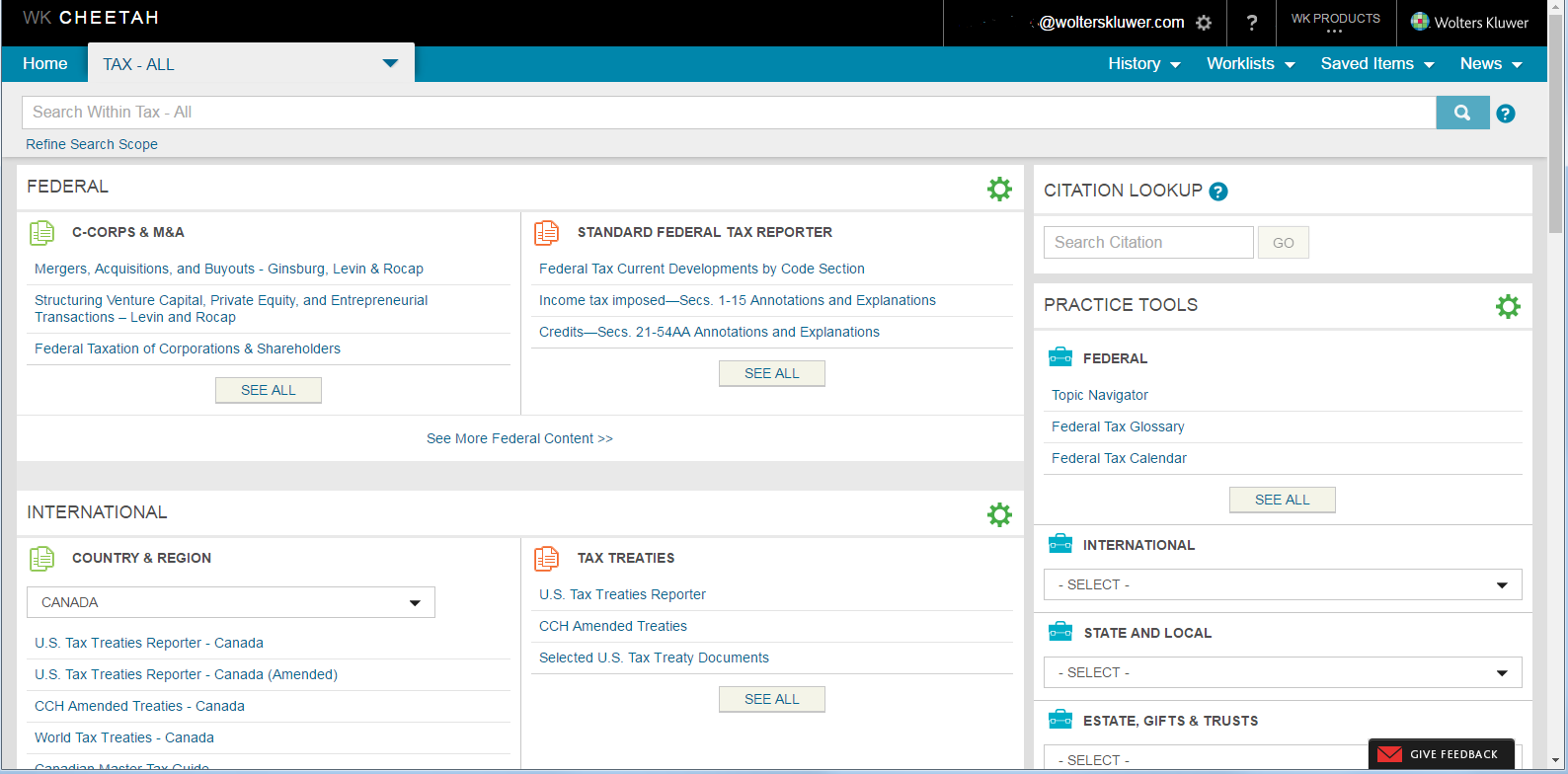
The Cheetah Home Page – Before Personalization
Cool
Tools:
Cheetah is loaded with new functionality:

  • ·        
    There
    is prominent citation search box in the right corner.
  • ·        
    Content
    includes, primary law, analysis, legislative history  and news.
  • ·        
    All
    of the Smartcharts have been migrated.
  •       
    All
    of a subscribers content can be accessed from home page.
  • ·        
    Customize
    the page to see only what you want. Select code sections, topics and
    jurisdictions of importance to you.What you use will be there in one click.
  • ·        
    All
    the quick reference tools are in the same location on each page.
  • ·        
    Red
    envelope – give feedback. Send your recommendations directly to Editor Ben Snipes.
  • ·        
    Seach across all subscribed content:
    federal, international and state and local.
  • ·        
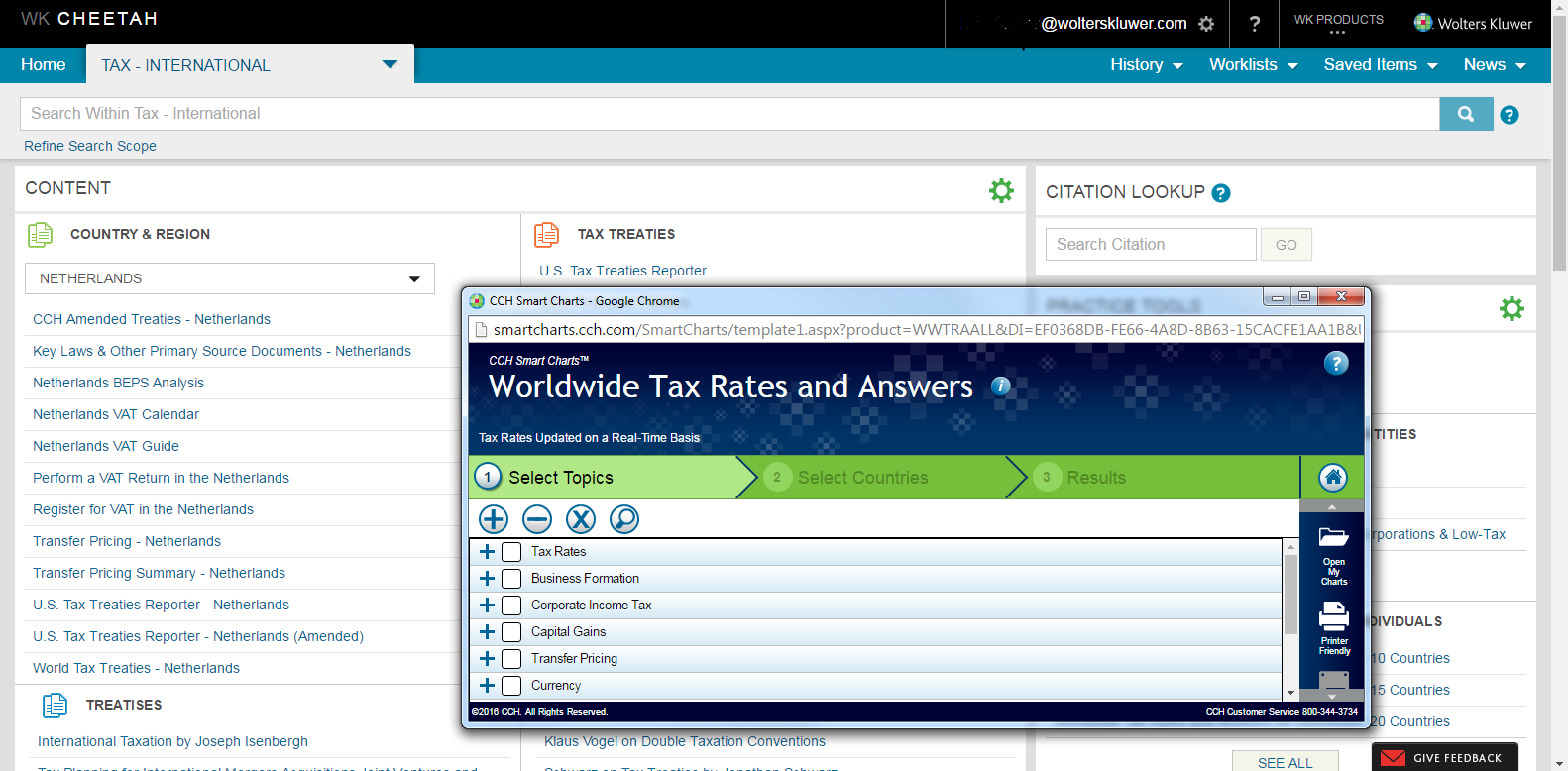
    International
    content covers 270 jurisdictions which can be both searched and compared by
    country using “smart charts.”.
  • ·        
    Entity
    type search allows a lawyer to focus on tax impact on an LLC, partnership a
    corporation, nonprofit?
  • ·        
    “Content
    flags” Tell you clearly what kind of content you are looking at e.g. a statute, a
    temporary regulation, a treatise. This feature assures that a new lawyer always understands
    what kind of document they are reviewing. It clearly shows which documents have
    the force of law and which are interpretive.
  • ·        
    A-Z
    lists are coming so lawyers can navigate to a specific titles.
International Smartcharts

Existing
Subscribers
:
All Intelliconnect subscribers will have the option to migrate to Cheetah or
remain on the Intelliconnect platform. They will see all the same CCH and Aspen
content which was availableto them  on Intelliconnect.
Will
Cheetah entice the majority of print Standard Federal Tax Reporter subscribers to
give up their books?  Since Cheetah  will offer both the code
structure and  topical research, they  will now be clearly in direct
competition with  RIA Checkpoint from Thomson Reuters which offers a
topical approach to tax research. Will more tax lawyers be willing to go will a single online source since Cheetah offers both topical and code views?
Wolters
Kluwer along with their competitors, Thomson Reuters, LexisNexis and
BloombergBNA are in a fierce competition to control practitioners desktops by
offering not only content but workflow enhancements.The winners are the lawyers who can count on the continuing development of faster, better and more integrated desktop tools like Cheetah.
More information at: Cheetah For Tax Law

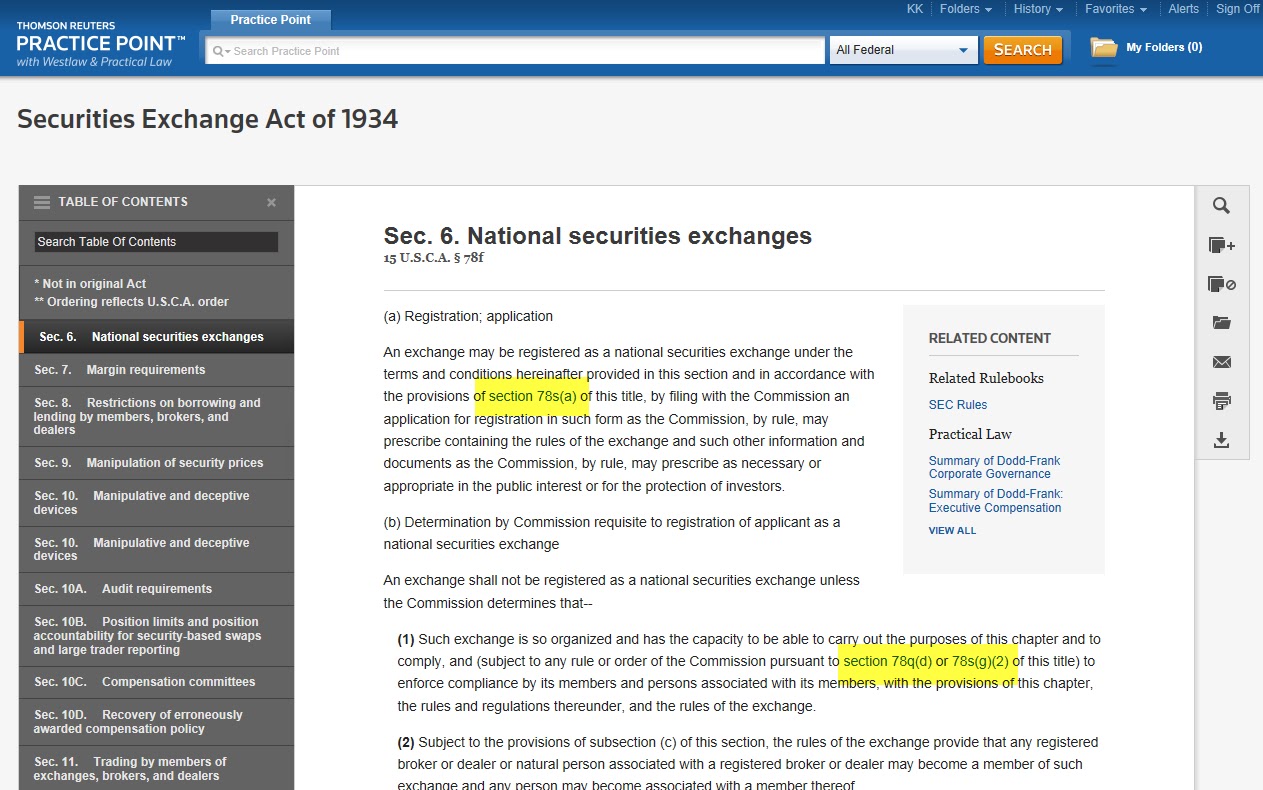
Frankly I was surprised and somewhat baffled when Thomson Reuters announced the
release of Practice Point several months ago. At first glance it seemed to be a
slimmed down version of Practical Law. Why two
different products? Where does it fit on a lawyer’s desktop?  How does it relate to Westlaw?

I spent some time talking to Craig Vaughn, the  product’s Strategy Manager  and Mindy Sciarini, Senior strategy associate  and exploring Practice Point on my own.  According to Vaughn, Practice Point is designed to provide transactional lawyers with “trusted answers in one place.”

Over the past few years I have written several posts noting that all the major
legal publishers ( TR, LexisNexis, Bloomberg BNA  and Wolters Kluwer) were evolving from providing ”
pure content” to offering content woven with process. Research products were sprouting workflow tools. Practice Point is not an outgrowth of Westlaw. The original West Publishing Company  which created the National Reporter System  for legal research had a slogan  “forever associated with the practice of law.”
Westlaw, their online product, could have had a corollary slogan: “forever associated
with the practice of litigation.” 
Therein lay the problem for Thomson Reuters. Westlaw had
been built around caselaw and no matter how much corporate content they added,
corporate lawyers viewed Westlaw as a caselaw research system built around the needs and workflows of litigators. Even though Westlaw
was loaded with corporate treatises, commentary, forms, corporate profiles and
business information, there was no easy way for transactional lawyers to locate
and retrieve  useful practice resources buried in the terabytes of Westlaw data.Westlaw executives have been puzzling over this challenge for more than a decade.

After Thomson Corporation (TR’s predecessor company)
purchased Global Securities Information in 2005, I recall Thomson executives suggesting that GSI content would be used develop a new product focused on the needs of
transactional lawyers. They rebranded GSI as Westlaw Business which launched at the dawn of the great recession. The product  faced a shrinking market and client dismay at higher prices for the same SEC focused content.  (I will forego a retelling of the  complete Westlaw Business
saga.)

Then in 2013 Thomson Reuters acquired Practical Law Company, a UK based “know how” product which  is bursting with transactional practice expertise, clauses, checklists and commentary.  Practical Law offers an exhaustive topical approach with encyclopedic depth.  Practice Advisor, by contrast, is selective and organized around workflow.  Practical Law contains transactional workflow tools. Practice Point was built to BE  a transactional workflow tool.

It has taken them a while, but  Thomson Reuters has finally succeeded in creating product tailored to the workflows and content needs of transactional and business lawyers. As if to underscore the complete break with Westlaw – Practice Point contains no caselaw!

Leveraging Thomson Reuters Assets

Practice Point was designed to leverage content from across the wide
landscape of Westlaw assets including: statutes, news,  company information, market trends, regulatory
materials, treatises and SEC filings. Practice Point is not simply a curated
version of Practical Law it is a curated version of all Thomson Reuters assets which can  help a  transactional practitioner.  Practice Point organizes 2,000 tasks across multiple practice areas and in-house
counsel projects.  Practice Point attorney – editors curated each  task, form, statute, comment etc. from millions of resources across
Thomson Reuters repositories. The platform uses a menu structure by practice area and
task to enable lawyers to quickly pinpoint what they need to do. Although menus are the primary form of access,
the product is also  searchable using the
traditional West search algorithm.

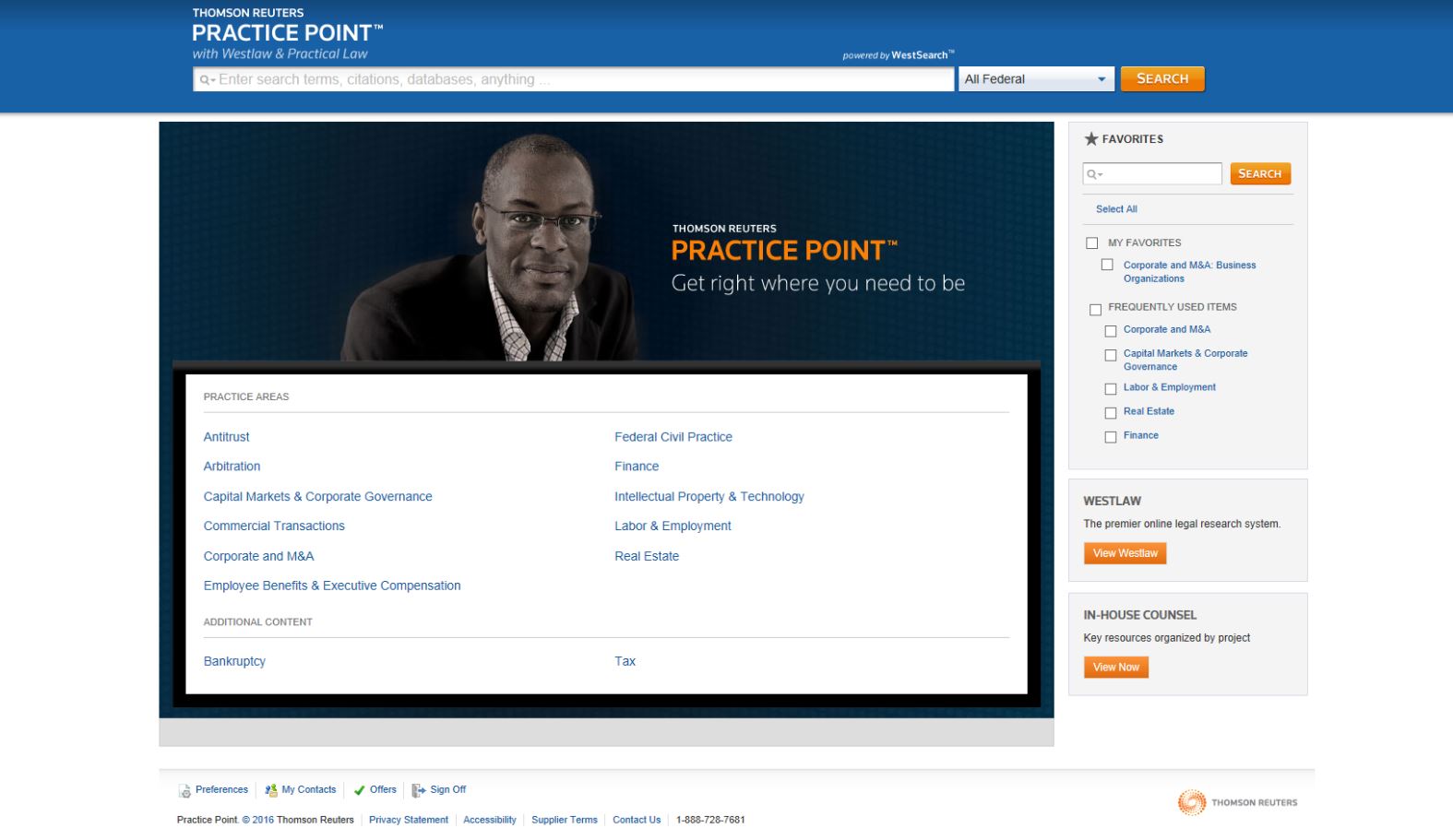
Practice areas include: antitrust arbitration capital markets and corporate governance, commercial transactions, corporate M&A, employee benefits and executive compensation, federal civil practice, finance, IP and technology, labor and employment, and real estate. There is also an section on In-House Counsel tasks e.g. launching a product.
Organization
One of the main goals was to offer a product which mirrored attorney workflow. Tasks are structured around the way attorneys
approach problems. The menu driven structure allows lawyers to select
subtopics within a workflow. For example, if an attorney is looking to
structure a business organization they can read background materials, review
checklists, drafting material, templates, commentary, forms and secondary
sources. I do have one criticism. Some of the standard forms did not display well. Since they have curated forms which originally appeared in treatises… the forms look like, well… pages of treatises. I hope TR invests in making these forms interactive and visually appealing to a digital user.

Curated
The attorney editors for Practice Point have curated and selected what they regard as “the best of the best”  from Practical Law and Westlaw. Practical Law includes over 2,500 practice notes, 4,000 standard documents. Westlaw includes half a million forms and over 5,000 secondary sources.Only the most highly targeted and
relevant materials related to specific lawyer tasks and workflows have been incorporated into Practice Point.

Looking at the Corporate M & A page, your can navigate by task type ( Private equity fund, Private M&A, Public M&A  or Browse by content type, (merger agreements, laws, forms, treatises). The center panel contrains daily practice news and Reuters News. The right column includes, What’s market, the business law center ( public filings), company search, foreign country Q&A and  corporate related CLE.

Special Features
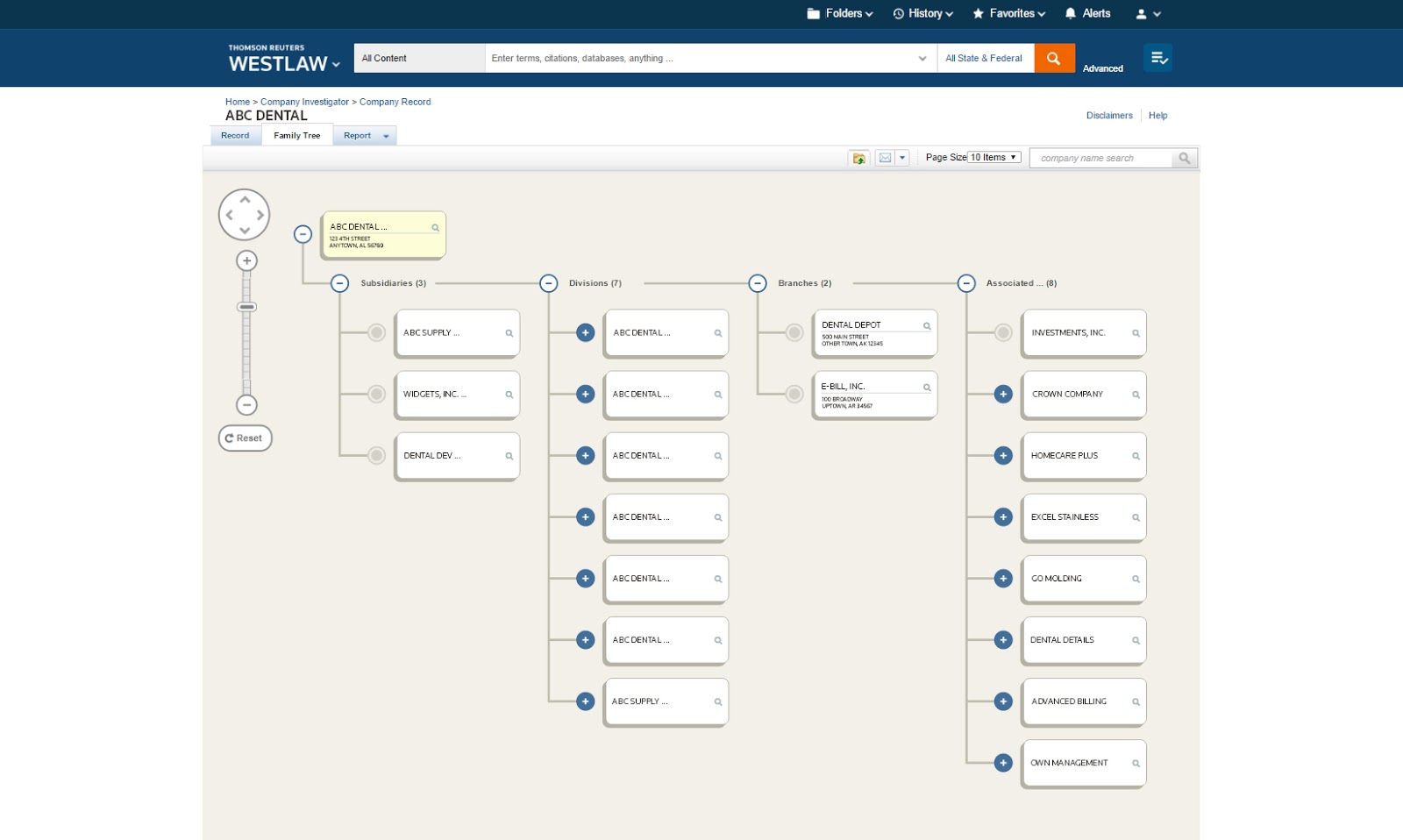
The Company Investigator from Westlaw
which provides an interactive company  family tree.

The”Rulebook Shelf”.
Relevant rulebooks enable a lawyer to quickly retrieve laws and regulations
relevant to the task at hand. The rulebooks provide a “browse-able” book like
experience.

What’s market – Offers custom graphics on the fly  including charts, graphs and tables  which show frequency of  key deal terms.

Business Law Center – access public filings from Westlaw Business

State and Country Q & A – check state and foreign country laws and requirements.

Drafting Assistant – the Thomson Reuters drafting tool will be integrated in the near future.

Where’s the market?

Thomson Reuters would like to dominate the transactional lawyers desktop the way Westlaw has dominated litigation for decades… But they are not the first to market  in the transactional workflow space.
Practice Point is playing to the process improvement, Lean Six Sigma movement. Firms which are still assessing the cost of building their own practice workflow desktop may find that purchasing Practice Point is a more cost effective and reliable option. Law firm workflow improvement initiatives often depend on a few key staff and can come to an abrupt halt when priorities shift or a key staff member departs. Efficiency is not a luxury in the legal market… it is regarded as “table stakes.” So the market is ripe for solutions like Practice Point.

Existing Practical Law subscribers will not be happy about the prospect of  paying a separate subscription for  Practice Point. TR is bound to face some interesting challenges and discussions when they make this pitch. Those of us who have been begging for digital “rulebooks” will be especially annoyed to find that these primary law assets are available on Practice Point but not the more robust Practical Law platform.

Practice Point will be a much easier sell for  firms which are struggling to create “home brewed” workflow tools  and firms which have not yet invested in Practical Law  or its  competitors (Lexis Practice Practice Advisor and BloombergBNA’s BloombergLaw: Corporate Transactions).

When Thomson Reuters acquired Practical Law, I speculated that the acquisition would not make sense if  “PLC is to be an island within an ocean of TR content.”  I immediately saw opportunities in aligning PLC with the Westlaw
Business and  Dealproof (now called Transactional Drafting  Assistant). Well I was wrong. Practical Law was not the convergence point for all of the TR assets…  the convergence point is Practice Point.

Project management, Lean Six Sigma, efficiency and workflow optimization are among the hottest buzzwords in law firm management as law firms compete to show clients that they are both smart and lean. If you are confused about where to start, this  upcoming  American Bar Association webinar promises to offer some answers.

The ABA, Law Practice Management, Knowledge Strategy Group is continuing it’s “Practice Smarter” Series next week with a webinar: “How to (Re) Start a Practice Efficiency Program.”
They have lined up an impressive panel which includes KM “Superstar” Meredith Williams, Chief Knowledge Management Officer at Baker Donelson, in Memphis and Steven G Hastings, Co-Practice Group Leader of Commercial Lending Group (and Knowledge Management and Technology Partner. at Chapman and Cutler in Chicago. Jack Bostelman, a KM consultant and former Partner at Sullivan and Cromwell will moderate the panel.

The program will address critical issues to be considered in projects designed to  optimize lawyer workflow including how to conduct a  needs assessment such  and how to prioritize of projects.

When: April 28, 2016 – 12:00 EST

Register for the webinar here

Prior Practice Smarter Webinars can be viewed here

Here is the full ABA announcement:

Free ABA Webinar

April 28, 12:00
Noon, Eastern (30 mins.)

These free 30-minute webinars show
how to practice more efficiently and deliver better value, while
improving your financial performance. Our programs feature practical
takeaways for individual lawyers, law firms and practice groups.
Click here to access past webinars.

RESERVE YOUR SPOT TODAY

 
April 28, 2016 – 12:00 Noon,
Eastern (30 minutes)
You’ve heard
lots of ideas for practice improvement and efficiency projects. Maybe
your firm’s past efforts have faltered and need a restart. Maybe you
haven’t tried yet. In either case, which projects should you start
with? And how do you get them started?
This program
explains:
·        
How to conduct a quick
needs assessment to learn what efficiency improvements are most needed
·        
Why the input should be
sought from the practitioners themselves
·        
How to prioritize among competing project ideas
·        
Why the recommended approach
also leads to an improved success rate in implementation
Faculty
Jack
Bostelman
 
(moderator)

President of KM/JD Consulting LLC and Chair of ABA Knowledge
Strategy Interest Group. Former partner of Sullivan & Cromwell LLP.
 San Francisco
Steven
G. Hastings


Co-Practice Group Leader of the Commercial Lending Group (and Knowledge
Management and Technology Partner), Chapman and Cutler LLP. Chicago
Meredith
L. Williams


Chief Knowledge Management Officer, Baker, Donelson, Bearman, Caldwell
& Berkowitz, PC. Memphis
Copyright © 2016 Knowledge Strategy
Interest Group, Law Practice Division, American Bar Association, All
rights reserved.
 
You are receiving this email because you opted in when registering for
one of our webinars or subscribed on our website. 

Our mailing address
is:
 

Knowledge Strategy Interest Group, Law
Practice Division, American Bar Association
Attn: Joshua Poje, Director
321 N. Clark Street
Chicago, IL  50564-7598

Want to change how you receive these emails?
You can update your preferences or unsubscribe from this list 

Email Marketing Powered by MailChimp

AALL announced the slate for the 2017-18 Executive Board. The slate includes four nominees from AmLaw100 firms, 3 academic candidates and one candidate from the Law Library of Congress.  I am honored to be among the nominees. A pretty impressive slate if I do say so myself.  I have reprinted the AALL announcement below. Congratulations to my fellow nominees.

Here is the AALL announcement:

Candidates
Announced for Executive Board Election
 
The 2016 AALL
Nominations Committee presents the following slate of candidates for the AALL
Executive Board
. Members will vote for one candidate to
serve as president­-elect, one candidate to serve as secretary, and two
candidates to serve as Executive Board members. The election will be held September
30 to October 31
, and successful candidates will begin
their terms of office in July 2017. 
 
Vice
President/President-Elect
Kathleen
(Katie) Brown

Associate Dean for Library Services
Charlotte School of Law
Charlotte, NC
Femi
Cadmus

Edward Cornell Law Librarian &
Associate Dean for Library Services
Cornell University Law Library
Ithaca, NY
Secretary
Luis
Acosta

Law Library of Congress
Chief, Foreign,
Comparative, and International Law Division II
Washington, DC
Scott
D. Bailey
Global
Director of Research Services
Squire
Patton Boggs LLP
Washington,
DC
Board
Members
Beth
Adelman
Director
of the Law Library &
Vice Dean for Legal Information Services
The
University at Buffalo
State
University of New York
Buffalo,
NY
Katherine
M. Lowry, JD
Director
of Practice Services
Baker
Hostetler LLP
Cincinnati,
OH
Catherine
M. Monte

Chief Knowledge Officer
Fox Rothschild LLP
Philadelphia, PA
Jean
P. O’Grady
Director
of Research & Knowledge Services
DLA
Piper
Washington,
DC
 
Come “Meet the Candidates”
during an informal session at the 2016 AALL Annual Meeting
& Conference
in Chicago on Monday, July 18, from 8:30­
a.m.-9:30 a.m., in the exhibit hall at the AALL Member Services Pavilion.
In early August, biographies and statements of all Executive Board
candidates will be posted on AALLNET. As provided in the AALL Bylaws,
Section VI 2c, a member may also be nominated for any office by
submitting to the secretary, not later than 30 days after
the date of this notice, a nominating petition signed by two percent of
the members and the nominee’s written acceptance.
Congratulations
to all of our candidates!


Late last year, Thomson Reuters re-branded themselves as “The Answer Company.” Well they better be ready with some really good answers because they are about face a barrage of incoming questions.

What Happened? After Thomson Reuters upgraded their PDF image conversion process in November 2014, a very small percentage (.05%) of the total cases loaded between November 2014 and March 2016  contained errors. According to Thomson Reuters executive, this software problem caused sections of text to be omitted or sections of text appeared out of order.


Was the Meaning or Holding of Cases Changed by These Omissions?
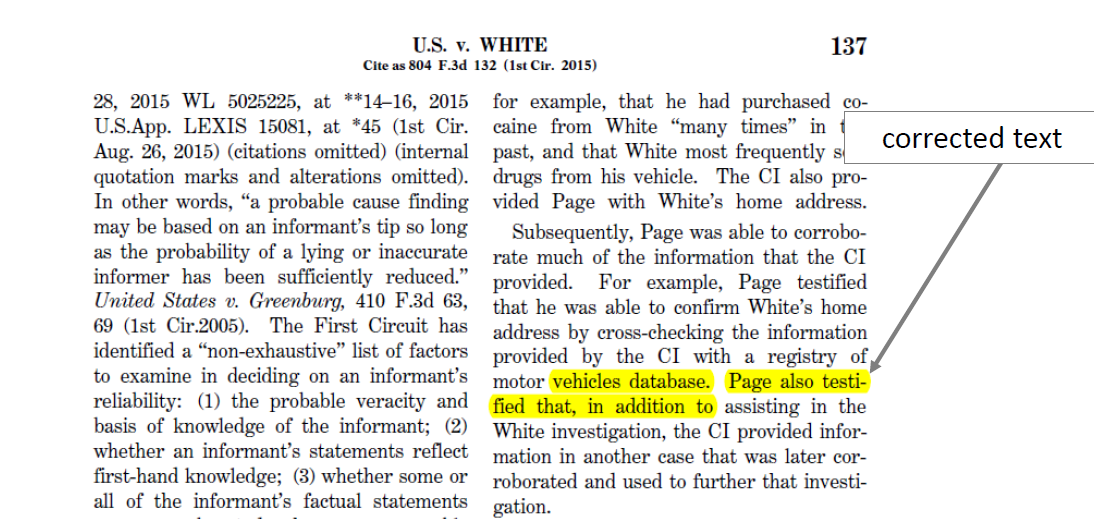
Thomson Reuters executives are sending out emails and letters today assuring customers that the editorial team has reviewed all errors/omissions and they are confident that the errors were not material to the meaning or holding of the impacted cases. Here is an example of a case with corrected content highlighted.


Corrected opinion


Which Products Were Impacted?

  • Westlaw
  • Federal Reporter 3rd
  • Federal Supplement 3rd
  • Federal Rules Decisions  3rd
  • Federal Appendix
  • A few specialty reporters ( Bankruptcy Reporter, Merit Systems Protection Board Reporter)
  • State reporters for Ohio, South Carolina and North Carolina
  • Regional Reporters: Atlantic 3rd, North Eastern 3rd, North Western 2nd, Pacific 3rd, South Eastern 2nd, South Western 3rd, Southern 3rd 

ThomsonReuters states in its letter to customers (reprinted below)  that only one-half of 1% of cases  loaded in those 17 months were impacted and the vast majority of those cases were unreported federal cases. Here is the breakdown: 480 reported federal cases;  110 state cases mostly in 3 states Ohio, North Carolina and South Carolina. In addition, approximately 1,500 unreported federal cases were impacted. At least the US Supreme Court opinions are not included as a possible source of errors.

The Fix All cases on Westlaw have been corrected. Customers who still subscribe to print reporters will receive replacement copies at no charge. Thomson Reuters will also work will customers to mitigate administrative impact.

Change in processes: Conducting an extensive retrospective review and reviewing all of their processes going forward.

Transparency
All subscribers will be receiving a communication directly from Westlaw.  Westlaw will be posting  a list of citations for cases impacted  today. The an image of all text of all of the cases impacted with the errors/omissions highlighted will be posted at this website by next week:
http://thomsonreuters.com/cases

Errors in Legal Publishing … Not a New Issue
Law librarians and legal information professionals know that this is not the first time that errors have slipped on to a page or into a database. All major legal publishers have issued corrections from time to time. Lawyers and information professionals have encountered errors in citators, major treatises,cases, statutes and annotations and customers often play a role in helping publishers maintain editorial accuracy. Loosleaf services weren’t just sending law libraries new cases -they were also sending corrections in the new supplement  envelopes. My first job as a circulation librarian at Pace University Law School, one of my responsibilities involved maintaining the loose-leaf updates and pocket-parts. It was not uncommon to receive paste-in pages that were glued over bad pages in treatises. Technology has reduced the number of errors in legal publishing but no technology is foolproof.

If There is a Silver Lining to this tale…The good thing about living in a digital world is that once the online errors are identified – all customers get the fix almost in real time as it is identified.

Thomson Reuters will take some heat – as they should. But I do applaud their willingness to actually load the errors on public website so customers can confirm for themselves whether they regard the errors/omissions as material instead of asking them to trust the Thomson Reuters editors. It will be interesting to see how the marketplace responds.
_________________________________________
Here is the text of the letter going to Thomson Reuters customers:

To our customers:
As part of our commitment to transparency, I wanted to alert you to some errors related to publishing cases in Westlaw® and our print volumes that we have now corrected.
In March, Thomson Reuters became aware that small portions of text were missing in a number of new cases posted to Westlaw due to the introduction of an upgrade to our PDF conversion process in November 2014. We immediately conducted an investigation, which revealed that approximately one-half of one percent (0.5%) of total decisions added to our collection during this period were affected by these issues. We have now corrected those cases on Westlaw and we will be shipping replacement print volumes to all affected customers as soon as possible. We will work closely with those customers to minimize any disruption.

Our analysis of the cases found that none of these issues resulted in any change to the meaning of the law. To provide clarity, we are posting examples of the issues, as well as a listing of all corrected cases, here. We will post all affected cases with corrections highlighted within the text.
Additional details and answers to common questions can be found here. If you have questions, please contact your sales representative or Thomson Reuters Customer Service at 1-800-249-9378.
We are very aware of our crucial role in supporting the U.S. legal system, and there is nothing more important to us than delivering the best possible solutions and customer service to you. Please accept our apologies for our errors. We are very sorry for the inconvenience.
Sincerely,

Andy Martens signature

Andy Martens
Global Head of Product & Editorial


Bloomberg Law and the Legal Marketing Association have just issued a joint report on the state of marketing  in the legal profession. The report “Are We There Yet:  Revealing the Latest Trends in Legal Marketing and Business Development is available at this link.

The report focuses on the evolving and expanding roles of marketing and business development professionals, budgets and new business challenges. The study which was  conducted in April 2016 included responses from 286 lawyers and business development professionals.

The definition of Business Development is very expansive and identifies 9 different types of activities including expected activities such as marketing, event management, pr as well as new activities such as pricing and attorney coaching. It also include Knowledge Management and Practice/Process Improvement which are often developed and maintained outside Marketing and BD departments.

  • 67% of respondents say firms are increasing their focus on business development
  • Marketing and Business development staffs are increase
  • The primary reason for increasing focus on business development are increase internal pressure to generate revenue.
  • Only 8% of law firm have Chief Pricing Officers.
  •  45% of law firm respondents have Chief Marketing Officers.
  • 40% report having difficulty getting lawyers to “buy in” to marketing.
  • Lack of time is the largest problem facing marketing/BD staffs.
  • Attorneys regard “lead development” tools as the most important technology that is not meeting their needs.

The report ranks the top 10 new responsibilities of marketing departments: social media, Process improvement, Business planning, attorney coaching, content marketing, Relationship management, competitive intelligence, direct business development and managing client teams.

My only complaint with the report is that the technology tools section uses categories of tools which are rather vague.  “Business intelligence”  tools could be referring to anything in  a  wide and varied landscape of software.  It would have been helpful for them to either describe the functions or name some of the products in the category.

Last month LexisNexis 
announced a new release of Lexis Advance which offered customers enhanced news
services and legislative insights. Legislative Outlook offers predictive
analytics and data visualization for proposed legislation.  Legislative
Outlook will be available  at no charge to subscribers through November
30, 2016, except where a gratis subscription is precluded by law (e.g. Federal
Government). 
 
Jeff Pfeifer Vice President of
Product Management for North American  described Lexis Advance as  “offering
lawyers powerful analytics solutions to deliver insights behind the raw data.”
 
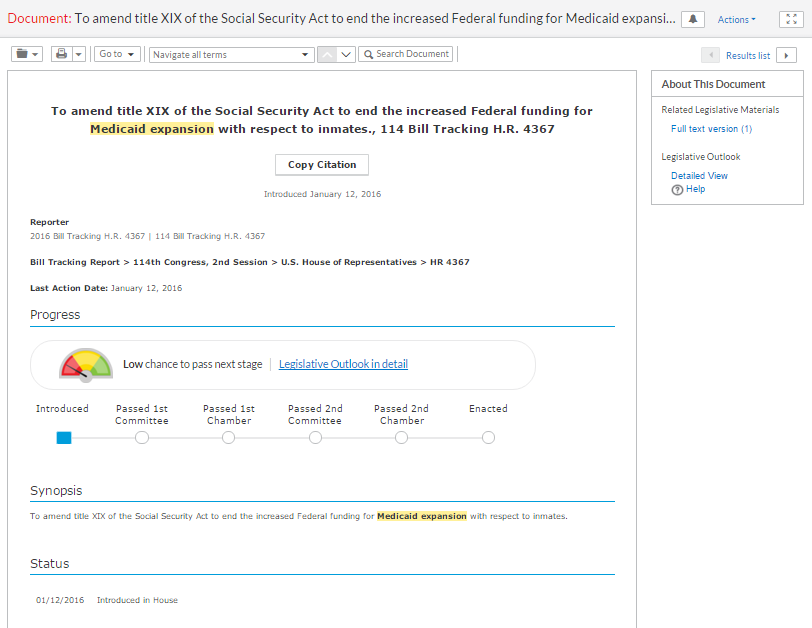
Legislative Outlook Gauge
appears with the text of a bill and bill tracking documents.  A special
Lexis  algorithm analyzes historic and current legislative patterns, key
probability indicators ( e.g. who is the sponsor)  in order to forecast
probable outcome. The algorithms assessment is displayed using an icon which
looks like a an automobile gas gauge signaling the likelihood of passage.
Legislative Outlook
 
Legislative Progress Bar provides
a visual representation of the status of a bill.
 
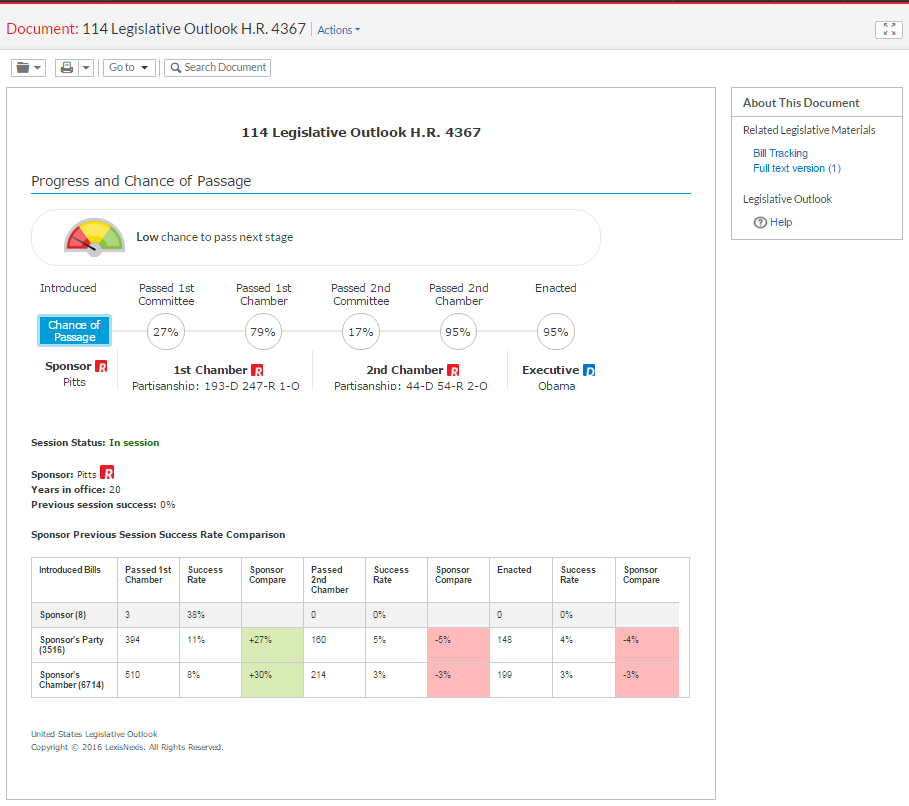
The Legislative Outlook in
Detail
document analyzes each phase of the legislative process and provides a
detailed overview of the bill including political details, sponsor detail and
forecast factors.
 News Enhancements in Lexis
Advance –
LexisNexis which has always boasted a superb news offering  has
finally migrated this deep archive to Lexis Advance. The collection includes
news sources dating back 60 years to the 196p’s. Lexis has been building an
archive of exclusive content from premier news outlets and specialty legal and
business publishers through a series of alliance and acquisitions. Exclusive
sources include The Washington Post, The New York Times, Wall Street Journal
and the American lawyer Media publications. One of my favorite new features is
an obscure source called the Wenn Archive which includes photographs dating
back to the 1960’s.
 Additional Developments include:
               
Explore Content feature is a bridge between Lexis.com and Lexis Advance
               
Back of the Book Indices from their Matthew Bender treatises.
               
Document Segments –  users can speed research and narrow results by using
over 60  new document segments.
               
Lexis Practice Advisor: Forms Index – allows users to locate forms by practice
and form type and key work. There is also an alphabetical index of all forms.
               
Lexis Advance Mobile App  has been updated and includes the full news archive.
IPad users have more delivery options
 One Search Does Not Fit All
Search has come a long way  in the past 50 years. Early Lexis required a researcher to execute a series of specific “commands” to perform every action and search required Boolean operators used in a specific syntax. I am grateful that those days are gone, but the rush to develop the perfect search engine has often ignored the power of facts and descriptors.
 There are some who
believe that one algorithm is good enough for all research across all types of
content. I am in the opposing camp. I am in the hybrid camp. I want strong
algorithm that can be fine-tuned with the use of segments  and facets.
 All of the major legal research providers offer “natural language”
algorithms. Thomson Reuters  Westlaw Next, BloombergBNA and Wolters Kluwer
Cheetah all rely primarily on algorithms to meet the demands
of  “google generation”  users. Yet they all supplement their algorithms by allowing
“power searchers” to custom focus their search using fields, descriptors and facets of
various kinds. I applaud Lexis  for taking bulking up their segments with 60 new facets to support the
sophisticated research needs of information professionals.


The March issue of Thomson Reuters Practice Innovations is out. The focus of this issue is “Managing in a Changing Legal Environment. The full issue can be viewed here.

I co-authored Innovation in Serving Those with Modest Means with Sheldon Krantz, the Executive Director of the DC Affordable Law Firm. DCALF  which opened in the fall,  was created by a unique collaboration between 2 Amlaw 100 law firms (DLA Piper and Arent Fox) and Georgetown University Law Center.

How Being Happier Contributed to Career Success: An Interview with Dr. Emma Seppala, Dr. Sepalla is the author of “The Happiness Track” which explores the science of happiness.

Investing in Your High Potentials: Coaching Circles by Jane  DiRenzo Pigott
Focuses on innovative strategies for retaining high performing associates.

Performance Reviews are Getting a Makeover in Many Large Companies


Chief Content Conductor: The New Role for Legal Marketers by Adam L. Stock
Explores the new roles for marketing in content productions.

In Pursuit of Organic Growth Conducting an Effective Go-to-Market Analysis By Marcie Borgal Shunk Provides a step by step formula for developing a marketing strategy.