On February 23rd  I spoke at
the Ark Conference on  Best Practices and Management Strategies for Law Firm Libraries and Information
Centers
which was held
at the SUNY Global Center in Manhattan.

Ron Friedmann of Fireman and Company and I co-presented “Developing
a Library Best Practices Framework :The Key Principles of Process
Analysis.”
 I  also delivered the conference wrap-up session
” Has the Librarian Ship
Sailed?: Inventing Your
 Future in a Post
 Library World.”
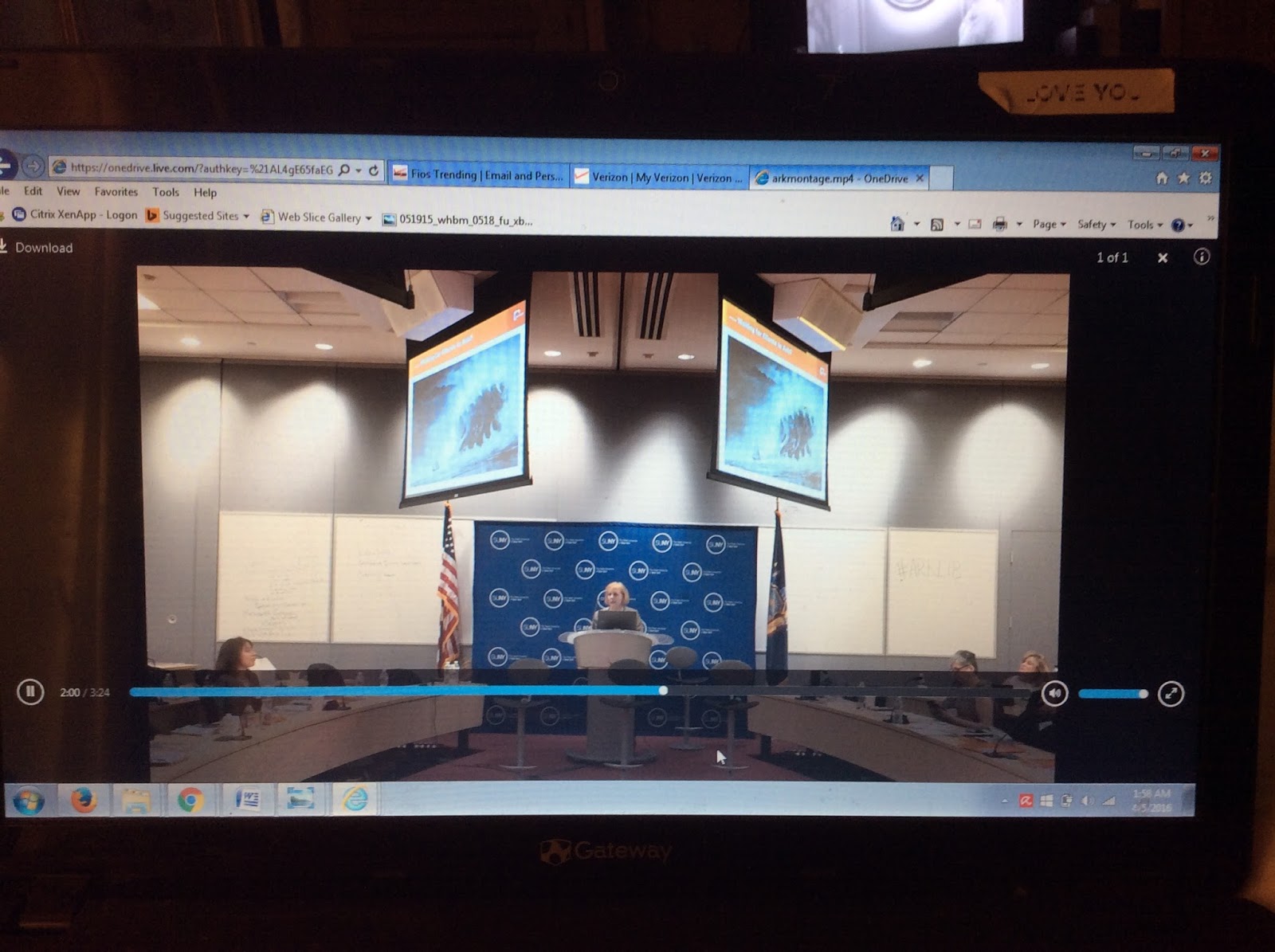
Ark has released a video montage of the conference including comments from
myself, Ron Friedmann and Tom Duggan. It is also a bit of a “Where’s Waldo” of
the legal information community.

The Video Montage See the
video and spot your friends and colleagues in the audience here.
Program topics included innovation, reinvention, process
improvement, new service delivery models and CI, analytics and big data
delivered by a veritable  “who’s who” of the legal information
community.

Speakers included John Alber, Practical
Futurist, 
Katherine Lowry,
Director of Practice Services, Baker
& Hostetler LLP, 
Michelle
Bramley, Global Head of Knowledge/Dispute
Resolution, Freshfields
Bruckhaus Deringer (UK), 
Cynthia L. Brown JD,
Director Research Services, Littler
Mendelson P.C.
Colleen Fitzgerald Cable, Director of Information Services,
Orrick, Herrington
& Sutcliffe LLP
Rachelle Rennagel, Director of Research and Information
Services, White
& Case LLP
Steven A. Lastres, Director of Knowledge Management
Services, Debevoise
& Plimpton LLP
Anne Stemlar, Managing Director, Research & Knowledge
Management, Goodwin
Procter LLP
Shaunna Mireau, CSSBB, Director of Knowledge Management and
Process Improvement, Field Law and Adam Ziegler, Manager
– Special Projects, Library Innovation Lab, Harvard Law School Library
Information industry participants included: Phil Rosenthal,
President, Fastcase, Nancy
Furman Paul, Commercial Product Manager, Bloomberg Law Business Solutions, Bloomberg BNA, 
Daniel Lewis, Co-founder & CEO, Ravel Law

Westlaw Adds 6 New Features: “Westlaw Answers,”
Research Recommendations, Snapshots, and  Folder Enhancements… At No Charge to
Subscribers!

There has been great anticipation surrounding the recent
announcement that Thomson Reuters was entering into an alliance with IBM to use
their Watson technology.  Westlaw’s new features especially “Westlaw
Answers” caused me to assume that this must be a progeny of their Watson
collaboration—but I was wrong. Westlaw has just built a number of powerful new
features for workflow, analysis and collaboration using their existing algorithms and technology.  Westlaw doesn’t
seem to be promoting this as AI but the results are pretty darn close to what I have see from AI platforms. Since
Westlaw will not charge for “Westlaw Answers,” they may have finally developed the
long awaited antidote to associate angst about incurring charges on Westlaw. If
Westlaw has an answer to the associate’s question – the answer will be delivered
automatically without incurring any special charges.  Let me be the first
to shout “Hallelujah!”

All of the new features  released this week are available to all Westlaw
subscribers and do not incur any charges or supplemental agreement. Hooray!

Westlaw Answers  – I would describe this as the
first pass at the “robot lawyer.” You put in a question. Westlaw provides an
answer.  


Westlaw Answers

Here are the caveats:

  •                
    It cannot provide answers to every legal issue.
  •                 Answers are limited to what West considers to be “black letter law.”
  •                 The answers are designed to address issues in individual states.
  •                 Typical questions involve:
      • Identifying legal elements of…
      • Statute of limitations for…
      • Judicially defined legal terms
    •                   Lawyers should still Keycite their results to validate that there are no recent adverse  treatments.
    • What about federal answers? Although the product was built to provide state law answers it can also provide federal law answers by circuit on topics which fit in to the “black letter law” criteria.


      How does it work?
      Westlaw Answers is powered by a combination of algorithms
      developed for the most commonly asked questions. Attorney editors have reviewed
      and validated answers.

      “Westlaw Answers” starts working when you type your query.
      Relevant questions  are suggested as   “ type ahead” text. The
      answer appears above the traditional search results.    
       

       Research Recommendations – This new feature  can
      be turned on and off with a “ Click”.  TR describes this feature as
      working like an expert researcher and applies Westlaw’s editorial enhancements
      (keynote, topics, synopses, keycite etc.)  to supplement search results.
      It automatically identifies legal issues during the research session and
      suggests  additional documents and key numbers which are relevant to the
      search session.  It analyses the entire research session and not just the
      latest query.  The research recommendations appear in a box above the
      research results and are designated with a  “pair of glasses” icon. The
      recommendations and can also be viewed in the researchers “search history.”

      Snapshots

      When you are conducting legal research the result is
      enhanced with relevant “snapshots” which pulls information from specialized
      Westlaw databases.  Snapshots can be provided for:

      •                 Legal professionals (attorneys, judges & experts)  extracts data from Profiler
      •                 Companies extracts data from Company Investigator
      •                 Popular Names of Statutes provides codification and Public Law numbers from
        Popular Name tables.

       Caveat
                     
      Only one snapshot will appear at a time. ( I assume this will be expanded since
      clearly many searches could trigger multiple snapshots)

      Judges Snapshot in Right column

       Folder Analysis

      For several years Westlaw has allowed researchers to save
      and share their research results using online “folders.”  Now Westlaw
      offers the ability to analyze the folder’s contents and  identify the issues in the cases
      and suggest additional relevant cases. A graphical view provides a visual display which allows a
      researcher to navigate documents based on each issue.

       The folder analysis is triggered when a lawyer opens their
      folder.

      Folder Analysis

      Research Reports

       This is another new “folders feature” which allows
      lawyers to create a report which summarizes the research with in the folder.
      The summary includes all documents and all  personal or shared notes
      associated with each document.

      Shared Notes

      Another “folders feature” which allows lawyers to share notes
      with colleagues.

       Pricing All of these enhancement are available to all
      subscribers. These features will be “no standard cost” events in transactional pricing. (In hourly pricing mode- time online will be charged.)  Opening documents
      which are suggested by the enhancements will trigger normal document charges,
      but there are no charges for primary law documents. Clicking link in snapshots
      is a chargeable event for companies and people but not for statutes.

      Product  Integration and Augmented Intelligence

      Westlaw’s latest round of enhancements show TR’s commitment
      to integrating all of their resources from across TR platforms more seamlessly. It also shows how close
      Westlaw’s algorithms come to delivering an AI product  with Westlaw
      Answers. One has to wonder what will the “Post Watson” version  of Westlaw
      will deliver? All of the new features respond to the market demand for tools which support efficiency and collaboration. In January Thomson Reuters rebranded itself as “the answer company,” today they delivered their first feature which offers the elegant simplicity of a question and answer pair. Not a full blown AI system but an impressive foreshadowing of the future of legal research.

      As a long term observer of Westlaw, I am
      really impressed that they are finally releasing features without enraging
      their subscribers with the prospect of new charges, excluded content or
      contract addendum. Is this influence of BloombergBNA’s entry into the legal
      market with their  “everything’s included” contract model? Does it reflect
      a new pricing  philosophy from  Susan Taylor Martin, President, Thomson Reuters Legal?
      Whatever the cause – this new approach will be applauded in the legal
      information community.

       In December, I offered readers the opportunity to respond to a survey on products and processes that they started or stopped using in 2015 or planned to stop or start in 2016. Readers were also asked to describe products or features they are waiting for vendors to invent.

      What s the best NEW PRODUCT you became aware of in 2015?

      Once again  the responses to the question “What was the best new product that you became aware of in 2015?”  evoked a wide variety of responses. Just to clarify this, readers are invited to recommend products they became aware of or used in 2015– although products may have been developed and released before 2015.Ravel Law Judge Analytics and Wolters Kluwer’s Cheetah platform were voted by readers as  the best new products of 2015.
      I have described Ravel’s Judge Analytics as providing lawyers with a judges precedential behavior analysis. The product pinpoints the precedents which a judge cites when ruling on various issues and motions. I described Ravel’s Judge Analytics features in Ravels Judges Analytics: Precedential Behavior  Analysis Made Easy

      Wolters Kluwer took great pains to reinvent the platform for it’s regulatory practice offerings with the launch of their Cheetah Platform. I previously reviewed their development efforts in two earlier posts.  Can Wolters Kluwer Get Its Groove Back. Can Cheetah Outrun the Market. and Wolters Kluwer Finally Launches Cheetah Research Platform: Usability, Workflow and Context Drive New Design.  At
      this writing only the Securities Law product is available on Cheetah.
      The market is ready and waiting for Wolters Kluwer to migrate the rest
      of their products to Cheetah.

      The overarching theme for 2015 was competitive intelligence and business development. Many of the products highlighted by users are use to enhance business development opportunities. Many of these products leverage analytics to provide deep insights. The competitive pressures in the legal market seeking practice efficiencies and actionable insights for business intelligence and client related matters make it ripe and receptive to these new offerings.

      One of the things I really enjoy about conducting this
      survey is that I always learn about products that I haven’t yet encountered.
      This year was no disappointment.


      Other products on the best new  products list:


      New
      Features/Functions

      Wolters Kluwer came out on top in the new features category as well. Wolters Kluwer Browser Plug-in  was voted the  best new feature.  The plug-in allows lawyers to simultaneously search  the web and Wolters Kluwer content. Now here’s the irony…the Wolters Kluwer plug in works with WK’s old Intelliconnect platform, not the new Cheetah platform which was just voted at the best new product in the Start Stop Survey.

      It is surprising that  although bother RelEx and Thomson Reuters have continued to add features to  in LexisAdvance and WestlawNext – no specific features of these products were identified by survey respondents. But maybe that is the point of these advance platforms – “functions” are less important in “intelligent” search platforms.  Possibly… but they are still adding content which could have been recognized as valuable.


      Other functions/features highlighted by readers:
      • Fastcase semantic cloud
      • Cheetah’s entity search
      • Bloomberg’s docket analysis tools.
      • Pacer Pro’s “free looks.”
      • Political Pro’s addition of the Congressional Directory.
      • Publication Alerts in Lexis AdvanceA-Z search in lib-guides.
      • Addition of ABA and Lexis treatises to the New York law Institutes’ eBook library.
       PRODUCTS STOPPED

      Lexis and Westlaw – Sole Source Trend Emerges. The most surprising trend which emerged in the Responses suggests
      that a number of firms are pursuing a “sole online legal research provider strategy.” The Lexis and Westlaw were tied at the top of the
      cancellation list and it was a wash. An equal number of respondents indicated that they were cancelling each service.

      The Runner- Up Loser is Print. Print was the category of resource which was frequently mentioned although there was no particular product or publisher being targeted. There was an across the board recognition that print is being cancelled aggressively. The other theme I recognize is that “products” are not forever. Law firm budgets are flat and vendors can not assume that they are safe from scrutiny after their are installed in a law firm. The only way to bring in newer more innovative products is to retire products which are not delivering ROI. Thanks to the installation of monitoring products such as Onelog, Research Monitor and Topaz, information professionals have powerful tools for identifying the winners and losers on their firms desktops.

      Other products which were cancelled:

      • Loislaw
      • Lexis eBooks
      • Innography
      • Lotus Notes
      • Intelliconnect modules
      • Westlaw Business
      • Lex Machina
      • Courtlink
      • Bloomberg Law


      WHAT PRODUCTS SHOULD BE DEVELOPED?
      All” is the operative work here. People are exhausted from moving from product to product. The market is crying out for comprehensive “one stop” solutions targeting specific functions. Here are some of the products suggested by readers:
      • A better patent research product which includes ALL patent data.
      • ROI data for all content products.
      • “Nirvana” search – a technology that can search across ALL online resources
      • Easy to use research workflow software.
      • Regulatory risk analyzer.
      • Analytics for non patent litigation. ( Since Lexis purchased Lex Machina – this is the one suggestion on this list which I know is currently in development.)
      • A product that searches across the courts of all 50 state court dockets.
       Thanks To Readers and Respondents.Thank you to everyone who participated in this year’s survey. As always I love to learn from the “wisdom of colleagues.” Take notes on what you see at the best and the worst of 2016… I plan to be back with a new survey in December.


      For the third year, I have offered readers the opportunity to contribute to the “Dewey B Strategic Start/Stop Poll.” Although it is a very informal and unscientific poll, prior annual polls have been among  the post popular Dewey B Strategic posts each year. Thanks to everyone who responded to this year’s poll. I will be reporting the results in two parts. Today I am reporting on processes and on Monday I will be reporting on which new products are making the grade and which products may be starting a slide into oblivion.We are once again being offered a chance to learn from the “Wisdom of Colleagues.”

      START. The initiatives that were most often cited as priorities in  2015 and 2016 are: workflow process improvements including centralization specifically research tracking and virtual teams,  formal project planning, embracing analytics products. Knowledge access projects include knowledge management initiatives, enhanced mobile access to digital resources (Research Hub), enhanced practice portals, intranet redesign, product monitoring (Onelog or Research Monitor) and curated news (Manzama).

      Additional organizational initiatives started in 2015:

      • Using SharePoint to manage vendor contracts using the end date feature to track renewals
      • Subscribing to e-books from Aspen.
      • Teaching lawyers process rather than products.
      • Reducing spending on deskbooks by ending automatic distribution and replacing it with “opt in” only distribution.
      • Outside counsel guidelines review.
      • Use data-driven analytics for outcome prediction.
      • Streamline approval workflows by adopting real-time chat.
      • New 
      Additional organizational initiatives to be started in 2016:
      • Create a research knowledge repository.
      • Automate alerts and and email routing using Manzama, and EOS.
      • Introduce enterprise messaging such as Yammer or Slack to reduce email communications.
      • Enabling mobile access to digital resources with research hub.
      • Total review of everything we do to determine priorities.

      STOP A new trend this year is digital hygiene.  People are looking at ways to eliminate emails, attachments, home grown databases, newsletters, digital archives. Print is still under fire. All manner of print is being tossed, books newsletters, loose-leafs, paper files and periodicals. The challenge of completely eliminating the routing of print newsletters was noted repeatedly— even when a digital version is available – legal information professionals still struggle with lawyer attachment to print. One respondent was giving up on custom curation of newsletters. although that remains a growing trend in many law firms.

      • Stop filing loose-leaf services completely–just replace the books periodically.
      • Moving away from SharePoint.
      • Giving up on an unsuccessful custom newsletter curation project.
      On Monday I will report on the top products and features highlighted by readers who responded to the  Start Stop Survey. Thanks again to all participants in the 2015-16 Start-Stop Survey.
      For my entire career it has been a sore point that the post of Librarian of Congress has been occupied by poets, scholars, historians… but never filled by a professional librarian. Until now the position has been a lifetime appointment. The previous  Librarian of Congress was James Billlington who resigned in September  of 2015. Mr. Billington was appointed by Ronald Reagan  in 1987…. before email was invented…. so his 39 year tenure was the equivalent of 3 geologic eras in technology time. The position has been changed to a ten year appointment, which I assume is to assure that the leader will be equipped to deal with the emerging technological challenges of future decades.Finally the role of the Librarian of Congress is being recognized  as a  position requiring  both  management expertise and  a vision which embraces both technology and culture.

      The Library of Congress was established in 1800 and was the first national cultural institution. It is not only the worlds largest library, but it is a leader in digitization initiatives from preserving fragile archives to providing online access to laws and regulations of the world.

      Yesterday President Obama nominated Dr. Carla Hayden as the 14th Librarian of Congress. Dr. Hayden has a long history leading public library systems in the US. She has been the CEO of the Enoch Pratt Free Library in Baltimore since 1993.
      Under Dr. Hayen’s leadership,  Pratt Library has been a powerful cultural force offering programs “to provide
      equal access to information and services that empower, enrich, and enhance
      the quality of life” of the residents of Baltimore.


      The American Association of Law Libraries issued a press release in support of Dr. Hayden’s nomination:
      “AALL
      congratulates Dr. Carla D. Hayden on her nomination to be the next Librarian of Congress.
      We are confident that her background as a librarian and demonstrated commitment
      to preserving the public trust will be a great asset to the institution. We
      look forward
      to working closely with Dr. Hayden as the next leader of the ‘nation’s library,’ and
      urge the Senate to act quickly to approve her nomination,” said AALL President Keith
      Ann Stiverson. “We also extend our gratitude to Acting Librarian of Congress David
      S. Mao, dedicated AALL member, for his commitment and service to the Library during this time of
      transition.”
      Congratulations to Dr. Hayden.


      Today Ravel Law announced the addition  of new features and extended judges analytics to cover opinions of appellate judges in 5 states.  I described Ravel’s core functionality in an earlier post Ravel Law: Legal Research Radically Reimagined. I also wrote a post when  Ravel  launched its  Judicial Analytics  product in April
      2015. The initial launch offered analytics for federal judges.

      Fierce competition marks all aspects of the legal market. Ravel provides an innovative caselaw research platform powered by natural language professing, machine learning and data science which could provide a  competitive edge in litigation. Ravel’s Judges Analytics product provides attorneys with custom analysis  and incites into how individual judges rule on specific issues. It also helps lawyers to  identify the specific language which judges find persuasive when ruling on an issue.

      New Features and Content Include:

      • Judges Analytics added for New York, California, Delaware, Illinois and Florida
      • More granular analysis of a judges rulings on specific issues
      • Redesigned interface
      • New “Drag and Drop” functionality for sharing results
      • Improved speed
      The New Ravel Judges Analytics Interface

      What’s Next?
      I asked Ravel’s President Daniel Lewis what additional content is in the pipeline.  Currently Ravel’s state law coverage includes state appellate opinions dating back to 1950.  Several months ago Ravel announced a collaboration with Harvard Law School to scan the entire archive of caselaw in the Harvard Law Library. Earlier this year Ravel competed the load of California cases from the Harvard collection. The California caselaw archive now extends back to 1850. Lewis indicated that the New York archive is currently being scanned and is scheduled for release in March. The Massachusetts archive is the next in line for release.


      On February 17, 2011 I launched Dewey B Strategic with a post entitled “Vendor Sourcing: Thinking the unthinkable as a strategic alternative to outsourcing.” It is hard for me to believe that 5 years have passed. I may not have had any readers that day, except for the generosity of Greg Lambert of Three Geeks and a Law Blog  who was kind enough  to write a post. Dewey B Strategic Blog Comes Out Swinging…

      Why another blog? Well the truth is that most of the bloggers in the legal information and legal technology  space were men. Ironic since the majority of law librarians and legal information professionals are women. I wanted at least one female voice to join the chorus of opinion and professional jousting. Plus I was known to have some opinions after 30 years working law firms and observing the legal information industry. Still… producing a blog requires a thick skin, persistence and for me  swapping sleep time for writing time.


      Knowledge As Strategy My particular interest was  highlighting the important role that information professionals play in helping law firms manage information risks and developing effective knowledge strategies. The turmoil in the legal market underscored the importance of helping legal information professionals  focus on identifying and  aligning with the core priorities of the organizations they served.

      The Legal Information Market I had watched the digital information industry evolve since its earliest days. I used Lexis when it contained only 2 libraries – Ohio and Federal. I used Westlaw when it included headnotes but no opinions…. I accessed Dialog, New York Times, Infobank, Orbit, VuText, Legi-slate and Dow Jones Online using  300 baud dial-up modems. There were also the parade of products on cd-rom, ebooks, websites….

      We are moving from the revolution sparked by the availability  of machine readable content to an age of analytics and augmented intelligence. I feel like a kid in a candy store watching a new wave of products that offer context, visualization and  interactive  dashboards serving up custom answers on the fly, and talking machines that can answer questions… the stuff of science fiction when I began my career.

      Many Thanks To Go Around Although I had a vision for how I wanted the blog to look I had no technical expertise and a turned to younger, geekier colleagues for advice and design expertise. So thanks go  to Sean Rebstock, Stacy Pangilinan, Julie Pabarja who all helped build Dewey  pages and establish the social media feeds. Ron Friedmann of Strategic Legal Technology, tutored me on blog etiquette. Poor Jason Wilson  tried to make me a master of the Tweet – but alas….

      Special Thanks to my  harshest critics -To  Jeff  Brandt of Pinhawk Legal Technology News and colleague Deb Sours who  have been my  most persistent critics and “sharp eyed”  proofreaders – my eternal thanks.  They have both saved me from more than a few colossal whoppers.

      Outlasting Dewey & LeBoeuf – within the first few hours of my launch, I received a concerned call from a colleague at Dewey & Leboeuf who feared that my blog would be mistaken as a Dewey & LeBoeuf publication. I was urged to change the name of my blog. After consulting an attorney – I added the sidebar which explained that my Dewey was Melville. Who knew that “Dewey the blog” would outlive” Dewey the law firm!”


      Blawg 100  Dewey B Strategic has been listed in the ABA Magazine Blawg 100 in 2012, 2013, 2014 and 2015. Many thanks to those  readers who nominated Dewey and special thanks to  Molly McDonald and the ABA Magazine staff who read gazillions of blog posts every year in the Blawg nomination process.

      Legal publishers big and small. Thank you for continuing to innovate and evolve and giving me a steady stream of products to assess. Profound thanks to Westlaw and Lexis for having simplified your pricing systems in the past five years.  While I can’t take credit for the change, my post “The Myth and the Madness of Cost Effective Legal Research Training”  advocated simplified pricing  methods but also stoked a great debate. Thanks for BloombergBNA for shaking up the legal information market. Thanks to Wolters Kluwer for letting the “cat out of the bag” with the release of Cheetah.


      The Entrepreneurs: Fastcase, Ravel, Intelligize, Knowledge Mosaic, Kira, Lex Machina,
      Law360 , Modio Legal,  PacerPro to name a few. Exciting to trace the history of ideas evolving into products which are changing the practice of law. To the entrepreneurs who I haven’t spoken to yet- you are on my list…I’ll get to you…

      It has been an honor and a privilege to know that people continue to open  and forward and tweet the early morning email from Dewey B Strategic. Now let’s see if I can find inspiration for 5 more years of blog posts!

      Image result for no

      The American Association of Law Libraries Board (and myself by proxy) received a harsh rebuke from the AALL membership when the rebranding vote results were announced today.   I wasn’t surprised that  the name  “Association for Legal Information” was rejected. I was stunned that it was  voted down by a  huge majority. I expected a close vote. Boy was I wrong.

      According to an announcement by AALL 59.1% of the members cast ballots. 81.9 %  (1998 members) voted against the new name. 19.89 % (498 members) voted in favor of the  new name.

      I wasn’t actually all that crazy about the “Association for legal information,”  but it was infinitely better than sticking with AALL, and I didn’t have a better name to suggest. As far as I can tell neither did anyone else. Many people suggested that they might have voted for the change if the word “professional” were added to the end. The Association for Legal Information grew on me and I think the change would have had a revitalizing impact on the association. What went wrong?

      • Was it a failure in the process of “socializing” the proposed change?
      • Should there have been a town hall devoted to live discussions of the name change at the annual meeting?
      • Was it the absence of the word “professional” in the name?
      • Was it the prospect of “outsiders” non-librarians becoming members?
      • Will there be another vote on another name or will it take another 100 years to get to a reassessment of the name?

      It is a curious outcome considering the overwhelming evidence that the number of law libraries and consequently the number of law librarians will continue to shrink. Reminds me a bit of the Shakers Sect that died out because absolute adherence to their core beliefs destined them for absolute extinction.

      Will A Great Migration Follow? Frankly, I know that many private firm colleagues  did not vote because they regard AALL as irrelevant to their careers. Other former librarians who have transformed themselves into digital pioneers have  already  chosen membership in  ILTA  over AALL. The vote could accelerate an exodus that had already begun.

      The Private Law Librarians and Information Professionals Name Change
      When I was Chair of the Private Law Libraries Special Interest Section in 2014 I proposed changing the name of the SIS. Instead of going directly to a vote, we floated a series of “trial balloons.” We conducted several straw polls in advance of the final vote to get a sense of what kind of change the members were open to. The goal of the Board was to at the very least eliminate the absurdity of having the SIS named for a place- the library.  It became clear that members could stomach  adding a reference to information professionals but they were unwilling to eliminate all reference to libraries or librarians. My successor Cheryl Neimeier continued the process and successfully initiated the vote in which the members agreed to change the name to “Private Law Librarians and Information Professionals.” It didn’t go far enough for me, but at least the members were willing to acknowledge  and  welcome colleagues who were no longer working as librarians or working in libraries, but who had moved into  non traditional rolls in areas such as  competitive intelligence or knowledge management.
       
      I Have an MLS But I am Not a Librarian
      I haven’t been employed in a traditional librarian role for at least 20 years. I respect that many of my AALL colleagues do work in libraries and may well work in traditional libraries for the next 20 years. On the private law firm side of AALL many law firms have already eliminated their print libraries and many more will go digital in the next 5 years. I am baffled at the unwillingness of my AALL colleagues to enlarge the association tent to embrace the needs of colleagues who are out on the forefront of change… members who have moved into “non librarian” roles outside a library environment but who continue to play a vital role in enhancing access to knowledge.

      A colleague who specialized in technical services once commented to me that “catalogers” were the only “real” librarians and reference librarians were imposters – they were a much later addition to the profession and didn’t qualify as true librarians. If that is true that the first discipline of librarianship was cataloging — imagine how research librarians would feel if they had to join “The American Catalogers Association”  An uncomfortable fit at best. 

      Today members of The American Association of Law Libraries will have their final chance to vote on the proposal to change the organization’s name to the Association for Legal Information. The name change has triggered an emotional debate on both sides of the issue.
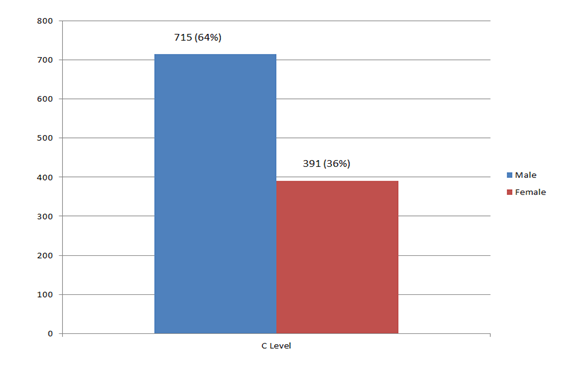
      C-level positions in Law Firms by Gender

      Upward Mobility In a “Feminized” Profession
      There has been one “elephant in the room” that has been largely ignored in the professional discussion boards, so I will raise it now. AALL is an organization composed of 75% women. Should we not even consider the possibility that maintaining a professional identity  which is aligned with an historically female profession, may limit professional opportunity and have a negative impact on members incomes?

      While I value my professional training as a librarian, I believe that ongoing association with a historically female profession will limit professional opportunities available to the next generation of information professionals. It is well
      

      documented in scholarly literature that “feminized” professions are consciously or unconsciously  associated with subservience– not with power and leadership. 

      Demographics as Destiny AALL has never acknowledged how this demographic fact may be influence the opportunities and career trajectories available to its members. The ABA which represents lawyers (an historically male profession)  encourages lively and open discussion of the impact of gender in the legal profession. It is no secret that female attorneys are under-represented in partnership ranks of Amlaw 200 firms. Why should we think that  as law librarians we would be immune from similar obstacles to for upward mobility?  Why don’t we take this opportunity to remove one of the obstacles by voting to change the name of the association?

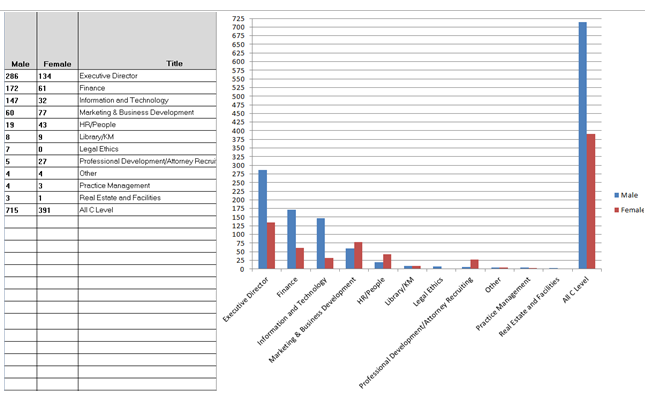
      Upward mobility for female administrators in law firms is largely unexamined. The data is not easy to find. Leadership Directories produces a “Yellow Book” of Law  Firm Leadership   and database that includes C-level staffing data which I analyzed to produce the charts in this post.*
      • C-level Leadership in Law firms is predominantly male (64% ) to (36%) female.
      • The positions most likely to be included in the C-Suite are historically and  predominantly male (Operations, IT, Finance).
      • Chief Knowledge/Library/Research Officers represent fewer that 1% of C level positions in law firms  ( And many of these C-level positions are held by non-librarians.)
      C-level positions in Law firms by Gender

      When I entered the law librarian community in New York in the 1980’s there was a cynical rubric which stated that an MLS degree was the only degree that you could combine with a JD which would make your salary go down. There I was with a JD and an MLS shaking my head in disbelief. Please don’t let this be true – 30 years later I believe that it is.

      I was present at the creation of a  digital legal research revolution. Law Librarians were often the only online research experts to unlock the mysteries residing in the dedicated Lexis and WL terminals. We were the ONLY people practicing the magic of competitive intelligence and curated news using the complex and primitive “dial-up” systems such as Dialog and Orbit where hidden universes of scientific, medical, business and trade data were buried. We could write our own ticket – we held the keys to the information kingdom- our futures were assured…. or not….


      Progress to the C-level Since the mid 1980s

      In the early 1980’s law firms did not have IT or Marketing staff… and yet in 30 years these professionals were hired and  soon leapfrogged over information professionals into the C- Suite. Knowledge is certainly no less important than technology or marketing. In fact it could be argued that knowledge is more essential and core to the practice of law than either of these other disciplines.
      Clevel positions began to appear in law firms in the 1990s.

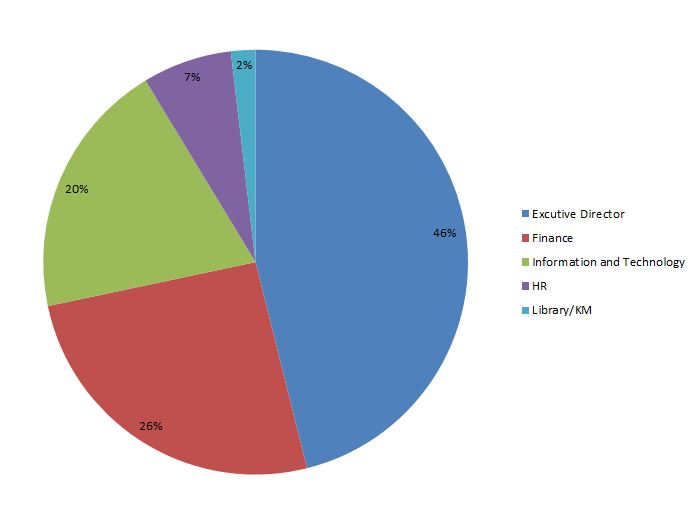
      Librarian Representation in The CSuite. The chart above compares 5 positions ( executive director/administrator, IT, HR, Finance and Libraries/KM)  that existed in the 1980’s ( before firms started designating C-level staff) . It illustrates that of the 5 positions the librarians/knowledge managers have the lowest representation in the C-Suite (2% of C-Suite positions), followed by Human Resources Professionals ( at 7%.) Is it a coincidence that the two groups with the lowest representation in the C-Suite are predominantly female? By contrast the 3 positions which are predominantly male have the highest proportion of C-Suite positions (91% of the C-level positions in this analysis).

      Time is Short Fast forward to this decade – law firms are hurtling full throttle toward alternative staffing models and embrace of augmented intelligence tools. Time is short, if information professionals can contribute to this future (and I believe that law firms will be better off if we do) we must pivot quickly and find our footing 21st century roles …  We need a professional organization focused on the digital future, not the bound to the hardcopy past.

      Professional Identity: Does it Open Doors or Close Doors?
      Taking a purely pragmatic position -I urge members to vote in favor of changing the name of AALL to the Association for Legal Information. It is a name which will open up  new opportunities to its members. The  bottom line is that there is shrinking need  in law firms for traditional librarians performing traditional library management work.  In a twitter world – time is short, attention spans are shorter. Opt for a message of the future.

      * I downloaded the data in April 2015.
      Related blogposts:
      I have seem a LOT of product tie-ins in my day, but Kira is the first legal technology product I have ever come across to develop a child’s “board book” as a marketing tool. Not only did Noah Waisberg found a tech startup but he authored a kids book on AI:”Robbie the Robot Learns to Read.”

      It is a slick way to give a prospective client a tutorial on machine learning during  storytime with their kids. I confess it provided an explanation even I could understand:

      “(Robbie) built vast language models
      Including word patterns, order, position
      He worked day and night
      being literate was his mission
      Robbie learned , after studying heaps
      that you can know a  word from the company it keeps.”

      Machine Learning and AI

      Artificial Intelligence comes in two flavors. Either you figure out all the rules in advance and program the computer to follow the rules or your program the computer with algorithms which can discern the based rules when given a limited amount of data. Kira is a machine learning system..

      “Up All Night” — Another Frustrated Lawyer Start Up
       I recently spoke with Noel Waisberg the
      co-founder of Kira. I asked Waisberg how he had come to develop Kira
      technology. Like many 21st-century legal entrepreneurs, Waisberg spent
      time in the “big law” trenches performing “due diligence” work the old-fashioned way. He was an
      M&A lawyer at Weil Gotschal. He spent  years performing and supervising contract
      review  as part of standard  Merger & Acquisition due diligence. Like
      many of his peer innovators he came to believe “there had to be a better way.”
      Due diligence contract review was time consuming and could represent 80% of the
      bill for an M&A transaction.  More
      importantly, he believed that the combination of stress, high stakes, tight
      deadlines and boring and repetitive work was a formula for human error. He also
      observed that due diligence involves a lot of repetitive common tasks which
      made it perfect for machine learning.
      The company was founded in January 2011 when Waisberg began collaborating with co-founder Alex Hudek  a PhD technologist. The product was originally called the Diligence Engine because
      they were focused on large scale due diligence projects.They began examining the due diligence process which
      often involves the review of thousands of document — including many poor quality scanned documents. They started with
      the assumption that machine learning was the approach best suited to dealing
      with massive volumes of unfamiliar content. It took them six months to develop
      the first version of their software. At that point the software could find “governing law” but it couldn’t identify ” change of control” clauses.
       Waisberg spent
      a year reading documents and identifying clauses.  He read every contract he could get his hands on, no matter
      how badly it was drafted, no matter how specialized its focus. His goal was
      for the system to understand both the content and the context of each clause. He believes he may
      have been the only person to ever read many of these contracts. He read
      everything from grain supply contracts to aluminum distribution contracts. But
      after a year, the system was still not learning! In mid-2013 they had a “lightbulb”
      moment. The quality of the review jumped from mediocre to reasonably accurate.
      Today Waisberg  reports that law firm
      subscribers confirm that Kira offers equal or better accuracy than the work
      done by experienced reviewers. They boast that the system can learn to analyze
      a large document set after reviewing about 10 sample documents.
       How it works
      Kira searches and analyzes text in contracts. It can  review and extract relevant provisions from
      contracts in any format. The software can handle nonstandard forms and
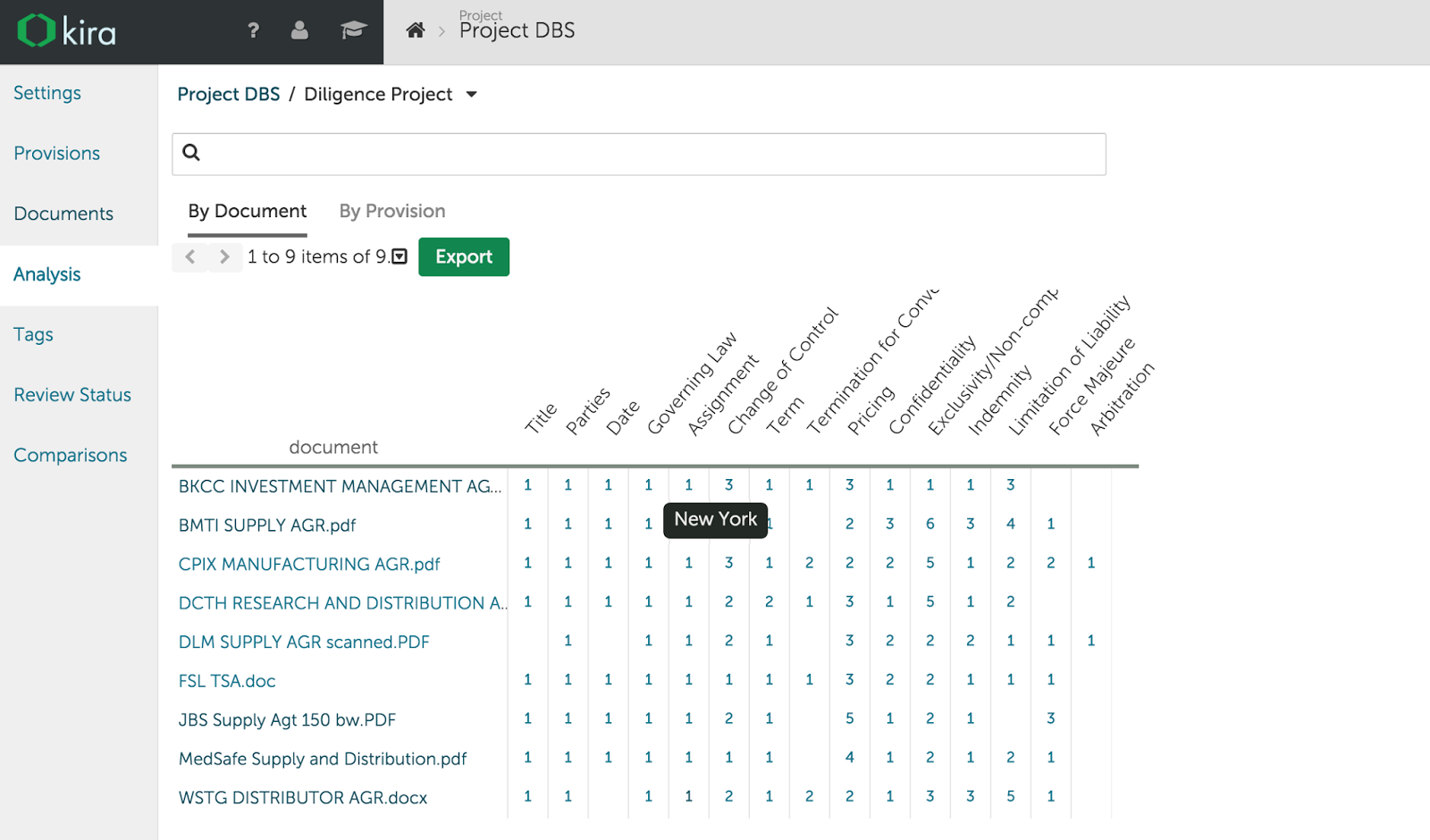
      provisions and generates summaries of each document. The product includes a workflow platform and allows
      lawyers to assign responsibility and track progress in the review of documents.
      Kira Workflow
      ROI Data
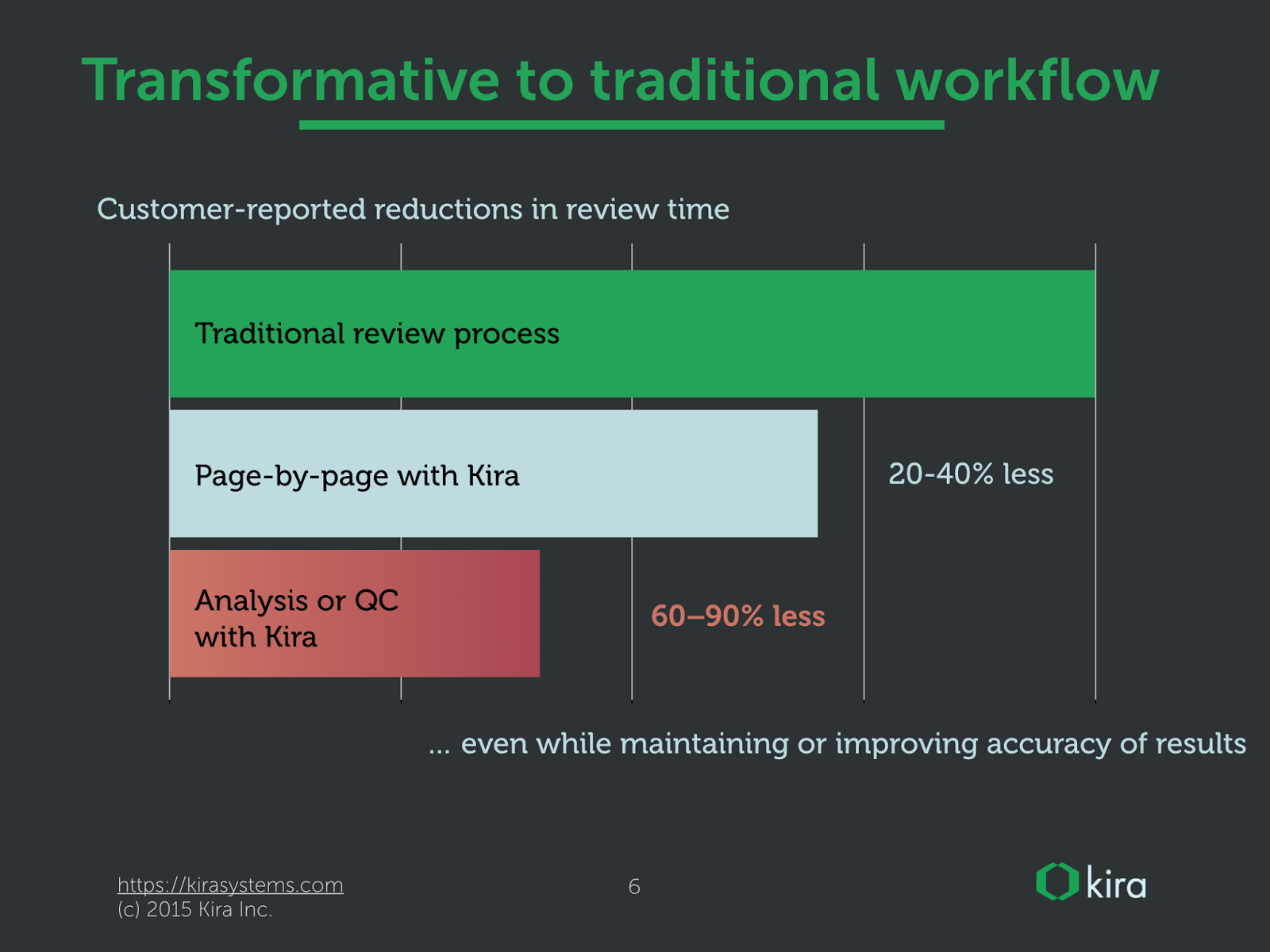
      One of the things I’ve always asked vendors to provide
      is some metric which describes the time savings or efficiencies delivered by
      the product. Although Kira is new to the market they have already created
      marketing materials which quantify the efficiencies delivered through use of
      the product.
      Kira’s ROI 
      From Diligence Engine to Kira

      The big change is that Kira’s executives began recognizing that
      the diligence engine could also assist other kinds of document review. The company
      began to add features at the request of customers. They soon realized that
      they needed to rebrand product because the name was restricting their appeal in
      the marketplace. When he decided to rebrand Noah (who we know  does not shy reading large
      volumes of data) began reading dictionaries in search of the perfect name. He  read an Iriquois dictionary, a Sumarian dictionary and finally found the new conmpany name in a  Sanskrit dictionary. ”  Kira” means “ray of light.”
      Expanding Suite of Offerings.
      Today Kira is used 
      for contract obligation management, contract obligation, contracting management, cost recovery, compliance, knowledge management and other use cases
      where visibility into contract provisions is critical.
      Several Amlaw 100 firms are already using their product and they are in late stage discussions with several more.And obviously Waisberg and Hoduk are hoping that more law firms “see the light.”