Bloomberg
BNA has released a new app for iPhones and Android phones designed to provide
Bloomberg Law subscribers with timely, personalized content. The app is
available to Bloomberg Law subscribers at no additional charge from the App
Store and Google Play.
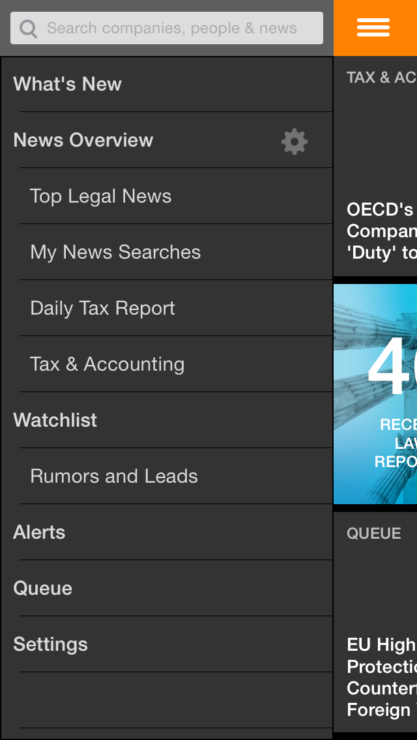
Unlike
other legal apps, this Blaw app doesn’t attempt to support the legal research
process. It is designed to do a few things really well. And these few things are
of particular interest to a commuting
lawyer or a lawyer with a few minutes in between meetings. Read a news feed on
a client, scan the latest corporate rumors, check out a company profile for an
upcoming meeting. Look up  bio of a judge
a attorney and executive. Scan the BNA Newsletter headlines and read stories of
interest.  According to  Joe Breda, Executive Vice President, Product, at Bloomberg BNA“ This new app brings not only an added mobility to their service,
but was designed to specifically deliver actionable, personalized content,
seamlessly from the app to desktop and back again.”  The “value add” of this app is the promise of bringing productivity to “down time” by overcoming frustration points such as  lost  network connections or
time in a reception area.

 One of
the features which I think is particularly useful is the automatic synching between a
lawyer’s document queue in Bloomberg Law and the app. Any document that a lawyer
has added to their reading queue when using BLaw will automatically synch to the app and will be
available for review even when a phone is in “airplane mode” or loses its
network connection

The new
Bloomberg Law app allows users to:

·        
View
news and analysis targeted to their interests

·        
Follow
news, litigation, and market performance of clients, prospects, and other
companies on their Watchlist

·        
Read BNA
Law Reports and get email notifications

·        
Receive
the latest Bloomberg Law alerts for legal and news searches

·        
Access
legal documents and news articles within their reading Queue – online or
offline – and maximize workflow efficiency with documents seamlessly synched
between desktop and mobile app

·        
Easily
track dockets, opinions or bills in their interest areas

·        
Share
legal documents and news with other Bloomberg Law subscribers
 

Bloomberg
Law, Bloomberg BNA’s flagship legal and business intelligence, news, and
research platform, is designed for leading legal professionals who are focused
on delivering superior client service. By integrating news, company and
financial data with exceptional analysis, primary and secondary legal research,
and business development tools, Bloomberg Law delivers an advantage to legal
professionals handling the most complex legal matters.


About
Bloomberg BNA

Bloomberg
BNA, a wholly owned subsidiary of Bloomberg, is a leading source of legal,
regulatory, and business information for professionals. Its network of more
than 2,500 reporters, correspondents, and leading practitioners delivers expert
analysis, news, practice tools, and guidance – the information that matters
most to professionals. Bloomberg BNA’s authoritative coverage spans a full
range of legal practice areas, including tax & accounting, labor &
employment, intellectual property, banking & securities, employee benefits,
health care, privacy & data security, human resources, and environment, health
& safety.
 The latest issue of Thomson Reuters Practice Innovations focuses on  a range of IT related issues.

Bring
your own (BYO)
Everything:
How BYO is Transforming Technology in the Workplace

By
Don Philmlee ,Legal
Technology Consultant, Washington,
DC

Internal
Lawyer Mobility-
Thoughts on Reducing Risk and Adding Value

By
Elaine M.Egan, Manager of Information Center, Sheaman & Sterling LLP, New
York, NY and

William
P. Scarbrough
, Chief Operating Officer, Bodman PLC, Detroit, MI

 By
Conrad J. Jacoby. Cofounder,
Seventh Smural
and Adjunct Professor,
Georgetown University, Washington,
DC


Decentralized
IT Management:
We’re All In “IT” Together

 By
Lynn Watson, Director,
Information Resource
Technologies, Hogan
Lovells US LLP., Washington,
DC


Using Social Networks as a Catalyst for Building Relationships

 By
John Corey President
and founding Partner,
Greentarget, Chicago,
IL

Gamification In Law Firms? Game On!

By
Ronda Fisch. Director of Research
& Library Systems, Reed Smith
LLP. Pittsburgh, PA: Robert Klan, KM
Senior Web Coordinator, Reed
Smith LLP, Pittsburgh, PA;And
Johann Widjaja, Practice Innovation
Analyst, Reed Smith LLP, Philadelphia,
PA

 I am tempted to declare  2014 as the year of the dumpster and the iPhone.

The most overwhelming trend articulated by respondents to my January 3rd poll is the embrace of all things “Apple:” iPhones, iPads, minis, Macs. Theme number 2:  Paper is out. Respondents are ditching all manner of paper resources, reporters, transfer binders, archives, paper invoices, loose-leaf services, back issues of journals, books, files, CFRs, archival copies.
The two trends may be related. As light weight portable, personalized smart devices proliferate in law firms, and as publishers have responded with apps and platforms for streaming updates, it is becoming easier to abandon reliance on print. The one technology which was conspicuous by its absence is eBooks.
On the process and performance side, professionals are moving closer to the stakeholders, working in practice groups and for clients. New projects are “value added” initiatives to help lawyers work smarter or retain new business. Efficiency initiatives include centralization, reducing administrative work, and streamlining workflows.
The responses on the introduction and cancellation of various products highlights the ongoing engagement of information professionals in the analysis of ROI for existing products  and the continuous assessment of new products to meet emerging practice needs. In the “new normal” of law firms economics – there is  a “zero sum” budget process — an old product must go for a new product to get in.
The responses below are derived from an informal online poll I conducted from January 3 through January 15th 2014.
New Initiatives:


·        Competitive Intelligence Moved to Library


·        Establishing “roaming librarian program” using iPads


·        Participating in RFPs


·        News aggregations platform


·        Embedding research staff in practice groups


·        Working directly with clients


·        Creating a wiki or a blog


·        Knowledge management initiative


·        Moving document storage to the cloud


·        Implementing research workflow tool


·        Creating workflow for digital license renewal tracking and ROI


·        Centralized billing


·        Barcoding the collection


·        Creating practice guides for practice group pages


·        Add web discovery to OPAC


·        Saving all research in a filesite folder


New Products


Software


·        MS Lync


·        iPass


·        Asana – Project management software


Research Products


·        Intelligize


·        TLO


·        BloombergBNA


·        RBSource


·        WeslawNext


·        Knowledge Mosaic


·        Manzama


·        PLC (now called Practical Law PL)


·        Asana – Project management software
Free resources


·        Feedly


·        Lawfirmsearchengine.com


STOPPING

The End of Print

Respondents are ditching all manner of paper resources, reporters, transfer binders, archives, invoice files,loose-leaf services, back issues of journals, books, files, CFRs. To the extent the people are retaining print they are engaged in streamlining processes relating to the handling of print.
Processes Stopped


·        Binding law reviews


·        Original cataloging


·        Stamping books with library name


·        Recovering for online research


·        Delegating invoice processing to a clerk


·        Don’t automatically give both Lexis and WL passwords to attorneys


·        Distributing deskbooks


·        Routing print periodicals


Technology Abandoned


·        Blackberries
Products Cancelled


·        Move to sole provider cancelling either Westlaw or Lexis


·        Intelligize


·        Loislaw


·        Intelliconnect


·        Westlaw Business


Thanks to everyone who responded to the survey!

The PLL Summit is still going strong. It  has grown from an experiment born of the financial crisis  and the “new normal” in law firms which was hammering law firms into  a “must attend” program for private firm librarians and information professionals who want to stay on the “cutting edge” of issues impacting their firms. The Summit is held in conjunction with the AALL Annual Meeting in San Antonio Tx on July 14, 2014.

This year’s Summit is Co-Charied by Marcia Burris, Sr. Manager, Library Services at Ogletree Deakins and Cheryl Niemeier, Director of Library Services at Bose & McKinney.

This year’s topic “The Voice of the
Client”  will explore  ways librarians can help their firms deliver legal
services more efficiently and add value through client-facing initiatives. As in the past, Summit V will include moring sessions which provide  “high level strategic perspective” including a panel of in house counsel. The afternoon will offer a selection of more practical topics inviting attendee participation.

Cheryl Neimeier Posted the Top Ten Reasons For attending the Summit:

10. Escape the
office for several days and spend time in popular San Antonio, Texas


9. Attend the
destined-to-be amazing Bloomberg BNA Welcome Reception on Friday evening


8. Funds an issue?
No worries – grants are available to attend the Summit! Stay tuned to the
Summit blog for more information


7. Networking,
networking, networking!


6. Opportunity to
attend two out of three interactive and sure to be practical afternoon programs


5. Learn more
about the importance of research competencies


4. Explore
practical means of adding value to and what your role can be in the firms
client facing initiatives


3. Delve into the concept
of EQ (Emotional Quotient) as it relates to our interactions with our client
base


2. Hear from an
amazing lineup of well-known and influential keynote, panel, and session
speakers


And the number 1
reason….


You will leave
energized and armed with key takeaways on how to help your firms deliver legal
services more efficiently and add value through client-facing initiatives in
fresh and innovative ways!

The Logistics:
Register here
Keep up to date at the Summit blog.

As always we thank the support of AALL leadership including Executive Director Kate Hagan and AALL President Steve Anderson.

Special thanks to : Bloomberg Law/Bloomberg BNA, Thomson Reuters, Wolters Kluwer Law & Business LexisNexis, and Fastcase  for their generous sponsorship of PLL Summit V.

Thomson Reuters recently released  the long awaited Westlaw Analytics tool that
will ultimately   now available to any subscriber law
firm of  30+ attorneys.  In several weeks they will
be releasing a new eLibrary platform which enables  subscribers to create and control
“non-billable zones.” One product should enable firms to improve cost recovery
and the other will help firms abandon or limit cost recovery for any  WestlawNext content they designate. This
“odd couple” of developments 
are in fact complimentary and both are 
powerful tools for helping firms align 
with “the new normal.” One provides “big data” insights
into  utilization of a major cost center,
the other  provides a platform for
expanding unfettered access to  custom
digital libraries… while also accelerating the migration of firms away from hardcopy
books. 
replace the Quickview reporting product. Westlaw Analytics
is

Drumroll Please! Introducing Westlaw Analytics  The Release of  Westlaw Analytics merits a drumroll if not
fireworks. Westlaw Analytics is light years beyond the old workhorse Quickview
which  could  generate a 
file of billable and non-billable usage by client, by use, by date. and
the retail, discounted or custom defined rates. 
But Quickview  was short on
actionable details or customizable and actionable insights. Non only is Westlaw
Analytics more flexible and customizable than Quickview, but it provides
powerful graphical views of the firms research activities. 

The Top 6 Things That Just Got Easier 

1.INVESTIGATING RESEARCH ACTIVITIES If you have ever fielded
the ” most dreaded call from a partner” asking  “How did an associate rack up that
bill?”  Westlaw Analytics will finally
enable a Library Director  to answer that
question. WA allows you to identify the user, content accessed, search queries,
documents printed  time spent and provide
a meaningful explanation.


Billing Investigation

2. PROACTIVELY MANAGE USE – You can  now set up triggers which will alert you when
costs by user or client exceed a custom defined threshold. 


Trend Analysis
3. TRAINING Identify the 
associates who need training before they ruin their careers by  accidentally racking up indefensible changes.
Conduct an intervention on a bad researcher so they don’t become truly terrible
researcher. 

4. PRACTICE GROUP AND OFFICE ANALYTICS Ever wonder which
offices and practice group are the heaviest users. Where is the heaviest use of
excluded content?. Identify offices or practices that are underutilizing the
system. Now you can easily run  reports
showing the trends by office and practice group.

5. ALERT THE STAKEHOLDERS – Billing partners or practice
group managers can receive alerts advising them of the cost of  research 
to date on a client or for a practice group. 

6. REQUIRE INFORMATION BEFORE EACH SESSION. There are lots
of new features that can be used to customize the collection of data about
lawyers and clients before any research is conducted. You can designated
certain number as nob-chargeable, you can associate lawyers with practice
groups. You can control the info lawyers have to give in order to log into
Westlaw.


 There is One
Caveat
  Currently, research session costs
are  computed in either retail rates or
custom defined rates. Firms that use variable or fixed discounts to compute the
client costs will have to wait for that functionality. However  in the meantime they can  take the retail cost and compute the discount
on your own.

 According to Kris Gunderson ,Director, Business Operations
& Integration. “We have had great feedback from our beta users, and I am
very pleased with the foundation that is built and the possibilities this
provides in the future, particularly as we continue to integrate our reporting
experience with  accounting  systems such as Elite.”  

Even with the  limitation outlined above, this product is light years beyond the old Quickview platform and offers a “big data” view of a sprawling universe of client charges,  price points and user  behaviour. Everyone who has to manage and explain Westlaw spending is
about to look a lot smarter. Embrace the “big data!”

Welcome to the Non-Billable Zone

 One of the most positive developments to follow  the introduction of  ”Flat fee billing” in the 1990’s  was the creation of  CUIs “custom user interfaces.” The first CUI
was the simple “find and print” 
function. CUI’s were often IP authenticated to allow lawyers to have
unlimited access to certain kinds of content without charging a client. An IP authenticated “Find
and print”  CUI  function allows a user to retrieve any
document using  any citation recognized
by Westlaw (cases, statutes, regs, law reviews, etc) . Over the years, customer
defined CUIs were developed for a variety of subsets of data, digital
treatises, dockets, SEC filings. Different law firms had different philosophies
regarding the type of content should be provided without a “chargeback” to
a client or what kind of CUI would serve their needs.


IT’S A SUNK COST — USE IT! While many firms have signed
flat fee contracts, they often fail to embrace the logical extension of the
contract– it’s a sunk cost and a fixed cost  so the more you use it the higher your ROI. Flat fee contacts provide an opportunity to create benefits for
clients and the firm. Yet firms have often failed to develop a clear strategy to maximize the benefit of these contracts. They continue encouraging lawyers to avoid online research and to use it only after less effiicient strategies have failed.Since a lawyers time is not free there is a cost for encouraging inefficiency that is often overlooked.

Years ago after signing a “flat fee”
contract at an  Amlaw 100 firm, colleague  Ron Friedmann and I conducted a study to
determine which was cheaper: printing cases from Westlaw or using
paralegals to pull the reporters and
copy the cases? The study determined that printing cases from Westlaw  was hands down a cost saver for both the
client and the firm. Exploiting the flat fee contract can result
in the reduction of spending on treatises, codes and reporters. Eliminating
print also which results in reduction of the cost of space and staff time for
processing materials  ( check in, cataloging ,circulating, shelving).

 Embracing the Future In Historical context, the original West Publishing Company
(now owned by Thomson Reuters)  fumbled
their entry into the digital world by trying to protect print revenue. The
original Westlaw  included  only the headnotes describing the points of
law and not the full text of the opinions. You had to go to the print reporter
to read the case. This ambivalence allowed Lexis then owned by industrial giant
Mead Paper Company  to clobber West the
reigning king of legal publishing. It is clear that Thomson Reuters sees the
changing  landscape in the legal market and is making no pretense of protecting print. They are moving from content to process and are
clearly encouraging subscribers to migrate from print to digital by
facilitating the creation of custom eLibraries. Promoting enhanced functionality in eLibraries may also signal a step back from more investment in the Proview eBook platform.

Enter eLibraries Next Month Westlaw Will be giving the administrators of  every WestlawNext account the ability to
create and manage their own “non-billable” zones. And the tools are easy to
use! Here’s what the eLibrary widgets will offer: 
 
·       
The law firm will control the creation,  editing and management of  the eLibrary experience.

·       
They require no significant technical investment

·       
Users get the enhanced experience provided by
WestlawNext, including Global Search, Foldering, Highlighting and Notes

·       
Access can be linked to firm intranet or portal
environment as with traditional eLibraries.

·       
New functionality allows users to toggle
directly to eLibrary pages within any Westlaw session.

·       
Usage of eLibraries can be tied back to
individual users to enhance analytics.

·       
UI coloring and messaging clearly signal when
they are entering or leaving an eLibrary or non-billable zone. No surprises!

·       
Firms make their own decision on using  client/matter to associate with usage.

·       
Admins may share pages with entire firm or
subsets of users (such as practice groups).

·       
Firms can create an unlimited discreet pages.

·       
Pages may include key functions or tools, such
as KeyCite or Find.

 What does this mean for WL? What does this mean for
Customers?

A year ago TR announced that they were  no longer in the content business. Then then they acquired the Practical Law Company workflow platform. They kicked off this year with the announcement that they had appointed the first
female President of TR Legal, Susan Taylor Martin. A recent  Law Technology News interview  contains this quote from Martin commenting on the disrupted legal market: “There’s
tremendous opportunity, but to see that, you’ve got to give up an attachment to
something that’s been very good to you in the past,” That something may just be
the print publications.

While there is much disagreement about both the substance and policy behind the Affordable Care Act,  it can be universally stipulated that it is a complex law  which promises an increasingly complex implementation.  The law itself is about 1,000 pages long and to date  the implementing  federal regulations are reported to number in excess of 20,000 pages which impact over 700 sections  of the Code of Federal Regulations. Health and Human Services Secretary, Kathleen Sibelius testified to a House Committee  in December 2013  that she didn’t know how many pages of regulations there are. According to a recent report in Politico “Some of the most important actions ahead may be impossible to predict until after the initial open-enrollment period ends on March 31st.”

 But that’s not the whole story!

The ACA also dovetails with the substantial body of Social Security, Medicaid and Medicare law and regulation. Then there are the state laws and regulations related to the implementation of the ACA insurance exchanges. Add to this brew, the shifting time lines and the recent cascade of postponements and exceptions. 

 What is a lawyer to do? Wolters Kluwer is betting that they have developed the answer. 

Today Wolters Kluwer is releasing the Health Reform KnowlEDGE Center. The product is designed for legal, health care, compliance and human resource professionals. The  ACA law and regs have been developing since the law was passed in March 2010. It was not until the Supreme Court rendered the opinion in The National Federation of Independent Business v Sibelius   in June 2012  that   a crescendo of need began to build in the legal world clamoring for reliable practice guidance on the ACA.

The Supreme Court Opinion signaled to law firms and businesses that it really was time to get ready for ACA. Health Care Practice groups and teams were formed, but they all faced a common need to find  current reliable sources of laws, regulations and commentary. Since the ACA cuts a swath across so many traditional practice groups, the WK product was built to support lawyers practicing health, benefits, tax , labor or insurance law. The promotional materials for the KnowlEDGE Center promise a reliable source for quick answers to complex questions.

The Health Law KnowlEdge Center Dashboard

Wolters
Kluwer developed the KnowlEDGE Center to provide  is a single source
solution for multiple market segments: law firms, in house counsel, corporate compliance offices,  health care providers and insurance
companies. 

 “This [product] answers a key need for one source of reliable information about implementation of the ACA,” said Nicole Stone, director of the Health Reform KnowlEDGE™ Center.  “Our single solution enables users to survey the transforming health reform landscape in its entirety and then gain detailed insights into every area and every new development important to them. Recognizing the importance of this evolving area we plan to continue investing heavily in health reform resources and will introduce an enhanced alert system in March 2014.”
The KnowlEDGE Center Includes Several Especially Interesting and Innovative Components

1. Topical Navigators Provide “Point of View”  Research Topical Navigators  allow users to  research issues from what I think of as their “point of view” depending on whether they are representing an insurance company, a beneficiary  or  an employer.   You are allowed to select your context and navigate into the issues as they impact that market segment. Smart Chart technology will compare the impact of ACA on various issues and provide links to primary authority.
Health Reform Topical Navigator

2.  Tracker / Calendar – This feature will insert deadlines into a lawyers Outlook calendar and send alerts when there are changes to deadlines. Dates can be sorted by law, regulation or deadline.
Law and Regulatory Calendar/Tracker

3.Smart Charts – WK takes the innovative  technology of their smartcharts and applies it to specific ACA issues,  exchanges, contraception etc. Smart Charts – Allow you to compare the law and regs across states.

Smart Charts Compare Laws Across Jurisdictions

4. Health Reform Law Look Up

The ACA amended over 500 provisions of The Social Security Act which is the backbone of the Medicaid and Medicare programs. The Health Reform Lookup feature identifies all of the amended provisions of the Social Security Act and the 18 other Federal Laws impacted by the ACA. It also tracks changes to the ACA since it was first passed.

Health Reform Law Look Up

4. Collaboration.  Users can Download content to spreadsheets, documents or email and  share information  with colleagues and clients  on a non-systematic basis. (Mass distribution requires a separate license). This feature is not new for WK  but it is so important I just have to keep saluting WK for their “Sanity in licensing” feature which they introduced with the launch of their Daily  Reporting Suite. Yes, in the ordinary course of business, lawyers need to share licensed information with colleagues and clients. They shouldn’t have to stop to renegotiate a license before they hit “send”!

 The Health Reform KnowlEDGE Center  – Additional Features

In addition to the “killer apps” outlined above, the KnowlEDGE Center “dashboard” is chocked full of useful content and features:
  • Quicklinks include  newsletters, expert analysis, laws and regs,law & health blog.
  • The alert center delivers custom alerts on a daily or weekly basis. Provides links to primary sources and expert analysis.
  • Direct links to the Medicare and Medicaid guidance
  • Direct links to ERISA and IRC
  • Coverage of all grants, demonstration projects and government programs found in the ACA
  • Practical Know how and checklists
  • The regulatory alert center tracks change to custom filtered results
  •  Other resources: include links to federal agencies and other related websites CMS, HHS, IRS, FDA, state  Insurance exchanges,
  • Top Stories 
  • Regulatory Alerts 
  • Agency documents (CMS Letters, GAO reports, IRS documents etc.
  • Primary sources: laws, regulations, caselaw, administrative decisions
  • Fun Features: Fact of the Day, Poll of the Week, twitter
  • Mobility the center has apps for iPhone, ipad, Droid and BB – latest news  can be filtered by topic or jurisdiction

NOT GOOGLE. Legal information professionals are routinely challenged to explain the ongoing need for purchasing research products from commercial publishers in a post-Google world. The ACA is the poster child  of laws which illustrate the limits of Google as an effective legal research tool for  lawyers because they have ethical obligations to avoid malpractice. Of course the market has changed and there is resistance to paying for terabytes of  “plain vanilla” primary source law  which lacks editorial enhancements or  is linked using semantic technologies and intelligence. 

All the major legal publishers, LexisNexis, BloombergBNA and Thomson Reuters – Westlaw are shifting from content to process, from search to context, and weaving process and analysis into their platforms. Wolters Kluwer reports that they developed the KnowlEdge Center in 4 months by marshaling the technologists and editorial teams across all the product units which are touched by the ACA: insurance, labor, benefits, tax. The other major legal publishers have collected the ACA primary laws, regs and collateral materials but as of today Wolters Kluwer has claimed a significant lead in the ACA practice space with the release of the Health Law KnowlEDGE Center.


According to Bob Lemmond, President and CEO of Wolters Kluwer Law &
Business “The Health Reform KnowlEDGE™ Center is one example of our many
customer-engaged innovations. Wolters Kluwer Law & Business is
taking our deep domain expertise and effectively combining it with
customer insights and technical excellence to devise solutions that
tackle today’s legal and regulatory challenges in both the business and
practice of law.”

Rumors
of Wolters Kluwer’s demise in the legal market are premature. The KnowlEDGE
Center combined with the upcoming release  of the“Cheetah ” platform  which I wrote about in December,
suggest that WK may indeed be “getting its Groove back.”

Related Posts:


Can Wolters Kluwer Get Its Groove Back? Can Cheetah Outrun the Market?
Wolters Kluwer Launches Daily Reporting Suite Built for Collaboration and Copyright Complaince

On January 1st Anne Ellis a former Chair of the Private Law Libraries, SIS and the first Director of Librarian Relations at Thomson Reuters retired after a long and distinguished career as a professional leader. I thought it would be interesting to get Anne’s thoughts on her career and the challenges facing law librarianship.Tell
me about your career prior to going to Thomson Reuters?

I
earned my MLS in 1975 from the University of South Florida. My first job was in
public libraries. In 1984 I got my first law firm position as a reference
librarian and later as the Director of the Library at Carlton Fields in Tampa.
After ten years at Carlton Fields, my family relocated to Denver and I took a
reference librarian position at Holme Roberts working for Mark Estes. Then I
got the opportunity to be the Library Director at Holland and Hart. I became
PLL Chair in 1997 and was recruited by Andy Prozes at Thomson Reuters to start
the Librarian Relations Program for Thomson Reuters.


What
made you leave a traditional career path and pursue the opportunity at Thomson
Reuters?


I
had the opportunity to meet many of the TR executives by being on the Westlaw
Private Firm Advisory Board. Brian Hall, the first CEO of Thomson after the
acquisition of West Publishing, wanted to build a librarian relations team to
show the company’s continuing support of law librarians and challenge the one
that Lexis had had in place for several years. It was a very exciting
opportunity to build the organization from the ground up.


Service
as the PLL chair also made me recognize that there were important ways to
support the librarian profession from the vendor side.I regard my move to TR as
the greatest opportunity of my career.


As
the first Director of Librarian Relations, what was your greatest challenge?


Law
firms and corporations are very different environments. Law firms are like a
little community. It was a big transition to get used to being in a huge
organization. I relocated to Minnesota and worked in the corporate
Headquarters. That move helped me understand the various business units in the
organization. Being agile was the most important quality for succeeding in my
position.


What
do you regard as your greatest accomplishment?


Developing
the librarian relations team and then helping that team develop wonderful
educational offerings for law librarians.


Would
you encourage other librarians to work for legal publishers?


I
think it is a great career path. It requires a specific skill set. You need to
be able to build relationships both inside the publishing organization and with
practitioners in law firm, law school, and government environments.


What
skills should the next generation of librarians and Knowledge professionals
possess?


They
need to learn how the technology behind legal online products work. It is no
longer enough to be able to use the technology. We also need to know more about
how the technology is built. The technology that is behind the information
resource is as important as the content needed by legal practitioners.


Do
you have any thoughts on the passing of Dwight Opperman?


He
was no longer at Thomson when I went to work there, but I had met him as a
member of the Advisory Boards. He remained completely beloved by the people at
Thomson Reuters and would visit the offices from time to time. I respect the
fact that he built a superior company in West Publishing and expanded it from
print to the addition of online resources such as Westlaw. The acquisition by
Thomson continued that expansion and led to huge investments in research and
development which resulted in the transition of Westlaw from a software
platform to Westaw.com
and now WestlawNext.


 What are your plans?


I
am already retired and am enjoying having time to go to “the Y” for
exercise, volunteer work, and having more time with my family. I also am
enjoying taking a break from extensive business travel. I am pleased with these
changes, but would consider taking on challenging opportunities if they arise.
I will continue to proudly call myself a law librarian.
Law Library Association of Maryland is sponsoring “All Access” the first access to justice program  for law librarians. According to Kate Martin of the Circuit Court of Montgomery County Law Library  the program will be  especially valuable for private law librarians by showing them a way to use A2J to raise their profile within their firms and support their firm’s pro bono efforts. A2J will also offers a way to give back to the community.

Martin stated that “A2J” seemed a natural fit for our LLAM biannual Legal Research Institute, which won the AALL award last year for its innovative programming.”


 She also points out that there hasn’t been a symposium on A2J organized by and for librarians. There will be several tracks on A2J basics, practical hands-on advice and current issues in A2J. The venue at the University of Baltimore is brand-new and beautiful, convenient to the Baltimore train station, and less than two hours from Philadelphia and DC. The organizers are in the process of developing a webpage with all pertinent information regarding the conference. National A2J speakers are coming from Alaska, Montana, Minnesota, Utah and Atlanta. 


Registration for this one-day event is $65. Registration has been kept low to encourage as many people as possible to attend.  They are also offering for registration fee grants to wider the attendee base further Registration includes breakfast, lunch and a wine reception as well as all programming and hand-outs. So far we’ve gotten sponsorship from AALL, West, Bloomberg/BNA, and Lexis; Fastcase, LLSDC and GPLLA.

 The Day The institute will be a day-long symposium on access to justice. Leading off with a colloquium of national thought leaders, the conference continues with concurrent programs on basic and advanced A2J issues.
The closing event will be a stakeholder fair, where attendees can meet informally with workers in the forefront providing A2J services.
They have already lined up national A2J speakers such as Judy Meadows, Joan Bellistri and Sarah Mauldin.
Topics Include:
  • How to raise your profile working on law firm pro bono issues, aid to prisoners
  • A2J basics, social worker on expectations of SRLs, resources for A2J, Minnesota’s database for pro bono attorneys
  • Ed Modell on the ombudsman position in the MD courts, how trends in courtroom tech will
  • affect A2J, new ways legal clinics are working at law schools, how to work with SLRs – what they expect
  • MD incubator programs, the People’s Law Library and how it helps SLRs, how public libraries can assist SLRs
Access to justice is a core value of law librarians — and it is becoming more critical as professional legal assistance becomes more expensive and beyond the reach of even average, middle-class Americans. Law libraries are being inundated with these self-represented litigants and this trend will only continue to grow.
The State of Maryland is developing strategies that lead the nation in service to the self-represented litigant. A state-wide A2J commission works with the courts and has joined national leaders to in developing better A2J policies and practices. The state law library has developed an innovative website, the People’s Law Library, to explain court procedures to the layman. County courthouse libraries are working to give free legal advice though Lawyer in the Library sessions. Baltimore law schools are offering novel legal clinics to inner-city areas.

For more information contact:
Kate Martin

Law Librarian
Circuit Court for Montgomery County
50 Maryland Avenue, Room 326
Rockville, Maryland 20850
Phone: 240-777-9121, Fax: 240-777-9126
Email: kmartin@mcccourt.com
.


On
January 1st the Bloomberg Law’s executives and sales team relocated from the
Bloomberg Headquarters on Lexington Avenue in NYC to the BNA Headquarters in
Arlington Virginia.. Does  it signify a
shift in power, a shift in strategy, a shift in culture or all three? I met with BloombergBNA
CEO Greg McCaffery to discuss the implications of the relocation and
BloombergBNA’s plans for the future.

Bloomberg
and BNA are a fascinating “odd couple” in the legal publishing world.  Bloomberg Law is brash, edgy and data driven.
BNA is  bow ties and bifocals with a long
history of legal and regulatory reporting and analysis.  No doubt facets of each culture are
co mingling to create a new organization. Elements of  Bloomberg ambiance have been introduced at the BNA
offices. Like the Bloomberg Mothership in NY they have  an  all
day  “pantry” with coffee,
snacks, fruit, yogurt. They have begun renovating the office space and building glass walled conference rooms to be more open
like the New York office. 

Greg
McCaffery became the CEO of Bloomberg BNA in September 2012. After 16 months at Bloomberg
headquarters in New York, he’s proud to be bringing BLAW back to the BNA
headquarters. McCaffery joined BNA in 1986 as a reporter on the staff of BNA’s
Chemical Regulation Reporter He covered polymer regulation at the EPA and then
moved over to the labor and employment side of BNA. He later became editor and manager
on Daily Labor Report, before moving into product development, and finally to
the business side or the organization. Greg brings a unique understanding of
both Bloomberg and BNA to the role – with a career at BNA of more than 26
years.

Is this
change a reorganization or a relocation?

McCaffrey: It’s a relocation. It made strong sense to concentrate the
organization around its center in the DC area, and also to move our sales and
client engagement staff into the communities they serve all around the country.
The creative synergies being realized from having our BLAW staff physically
sitting with BBNA’s content experts are massive. 

Why are these changes happening now?

McCafferry: 
Bloomberg took its time to  learn BNA. There is a lot of respect of the BNA culture  and the integration went smoothly. The joining of Bloomberg Law and Bloomberg BNA into a
single subsidiary, announced in July, is now complete. This complex transition
has been seamless for clients. Access to Blaw and BBNA products have not
changed. Bloomberg Law is the “flagship” product. You can continue to
subscribe directly to BNA products, but a single Bloomberg Law subscription
includes access to all BNA content

How will these changes impact Bloomberg Law
and BNA customers?

      McCaffery: We expect Customer Service to
be even better. We are following the BNA model – sales account executives are
regionally based to provide even more specialized customer service. Account
executives have been fully trained and can help clients with all products– BLAW
and BBNA.

       Some specific benefits will be:

  • ·    All invoices for Bloomberg Law and Bloomberg
    BNA will now come from BBNA – and clients can have their invoices consolidated
    if they choose. 
  •      The
    Bloomberg Law Helpdesk will remain staffed 24/7 with knowledgeable and
    experienced legal professionals – including attorneys and law librarians. 
  • ·     Whether
    you call the Bloomberg Law Help Desk or Bloomberg BNA Customer Service – the
    experienced staff will put you directly in touch with the appropriate
    representative.

How will the
integration of the two cultures drive Innovation and product improvement?

McCaffery: ·BNA
had this incredible depth of expertise and Bloomberg has the technology, data
and analytics that few if any companies can rival.·The
combination makes BBNA an incredibly powerful market force – not just more
efficient, but more insightful. BBNA will be better positioned in both the
vertical/niche information markets where it has excelled for decades, as well
as the legal research and business intelligence space, which Bloomberg Law has
helped to reinvent. We are bringing the Bloomberg strengths in data and
R&D into BBNA, where, when meshed with editorial skill and knowledge,
true innovation is possible.· We are introducing advanced and search tools that allow practitioners to do more than pull up a verdict or
settlement but to easily see related news and cases or apply sophisticated
filters.

··Powerful new Resource
Centers with integrated analytics on top of deep knowledge

Bloomberg’s data enhancements to BNA resources can be seen in the BBNA
Resource Centers.
The  Labor and Employment Law Resource
Center  now has an Arbitration Award
Navigator ·The Navigator allows practitioners to conduct complex filtered
searches on  a  repository 
of arbitration data extracted from 20,000 arbitration awards.  Lawyers
can  assess trends, evaluate arbitrators,
and view fact patterns in awards to develop an optimal strategy for an upcoming
arbitration. ·12 different variables including case name,
arbitrator, topic, union, employer, industry, classification outline number,
and more, to allow users to filter and sort an expansive and growing collection
of more than 20,000 arbitration awards

McCaffery
described a new focus on customizable, real time information that allows a
practitioner to be “the first to know.” 
This is  real time awareness is combined with advanced analytical tools. that will help a lawyer spot emerging trends which will impact clients and potential clients.
In
the coming months BBNA will be introducing “big data” solutions integrating
analytics on top of a deep well of legazationl analysis and business data. The ultimate goal will be to provide trending and predictive analysis. 
As I have been saying for years,  since everyone now knows “what just happened”, the next competitive edge will come from knowing “what is about to happen.” I predict that Bloomberg BNA will not be alone in pursuit of the ultimate predictive product for the law firm market.
T
Although Bloomberg Law offers some very innovative features which weave legal and business information together, lawyers and librarians have been slow to embrace the product. The realignment of the organization in the BNA editorial headquarters may lend some “gravitas” and legal street cred to the Bloomlberg Law brand.

Related: Bloomberg Law Gets BNA’s Intellectual Capital in the Capitol.
Bloomberg Law Rebrands: BBNA Let the Mashups Begin
Greg McCaffrey Named Bloomberg Law CEO: Headed Toward the Business of Law


 In August  2013 LexisNexis announced that they had entered into a joint
venture with Internet Brands (the owner of Cars.com) to develop
“marketing solutions” using the Martindale.com platform. Although
Internet Brands is taking the lead in managing the joint venture there
is no mention of Martindale on their website. Since LexisNexis owns InterAction,  the leading “contact management” product which is used in many law firms – it is puzzling why some effort was not made to integrate Martindale with InterAction and other LN sources containing rich actionable client data such as Courtlink dockets.

Blogger Kevin O’Keefe
recently posed the question “Does Martindale Hubbell, as we knew it still exist?
“The answer is clearly “no,” and O’Keefe wonders aloud whether the
Martindale brand divorced from the legacy of Martindale Hubbell has any
real meaning.  The announcement of the joint venture was followed by
the layoff of most of the Martindale staff. These were the people who used to
curate the surveys and data collected to evaluate whether lawyers and firms qualified for
the for the “gold standard” AV rating. So what is left of the legacy?

A Reference Shelf Superstar. There was a time when Martindale Hubbell was probably the most heavily used reference book in the law library. It was not only the easiest way to locate lawyers and law firms, but it was chocked full of  other useful information. It contained summaries of the laws of all 50 states and for  hundreds of foreign countries. Need to see a sample notary form for South Dakota? Check Martindale Hubbell. Need to know the statute of limitations for breach of contract in Alabama? Check Martindale Hubbell. Need to learn about IPO requirements in Italy? Check Martindale Hubbell. Need to see the full Hague Convention on International Service of Process? You got it – check Martindale Hubbell.

The History. The Martinale Directory was created  by James B Martindale in 1868. His goal was to furnish lawyers, bankers, merchants and real estate agents with the address of one reliable lawyer, banker, real estate office etc. in every city in the United States. In 1930 the company  purchased the rights to the Hubbell’s Legal Directory which contained a digest of law for every state. The company was purchased by Reed International (LexisNexis)  in 1990. An interesting summary of the Martindale Hubbell peer review Rating system appeared in the journal Diversity and the Bar. Over the years the 2 volume set exploded into a 26 volume set containing over 1 million lawyers. It was also distributed on cd-rom, the web and on Lexis.

The Ransom Note. As I contemplated writing a blogpost, I realized that the best testament to the critical place of MH was hanging on the wall across from my desk. First you must imagine a world in which there is no World Wide Web, no Google –  your desktop is not connected to a freely available ocean of facts. On May 5, 1987 I  sent out a memo to all the lawyers at Shea & Gould pleading for the return of  the New York Martindale Hubbell volumes. This was a fairly regular occurrence. There was no firmwide email system. The style of the memo makes we wonder if it was — yikes! — typed on a typewriter.

The memo: “Once again both copies of the New York Martindale Hubbell are missing. Please contact the Library immediately if you know where these volumes are located.” When I returned from lunch I found a ransom note on my desk. (Reproduced below) I was secretly delighted at the outbreak of pure fun mid-day.

The
ransom note reads: “They’re being held for ransom. If we don’t receive
$1 billion in small unmarked bills by one pm today, both volumes will
be executed. We mean business!”

I showed it to litigation partner, Martin
Shelton  who laughed and responded 
“If you find out who wasted time doing this, I’m going to fire them.” Then I showed it to firm’s
chief prankster and corporate partner, Arnold S. Jacobs of “Rule 10b-5 fame,”
who said “Find out who did it, I want to give them a raise.” 

My
best recollection is that I later discovered that it was done by two associates, a litigator and  a corporate associate. I believe they were both named “David.” If only I had
a 1987 copy of Martindale Hubbell, I might be able to figure it out!

I later framed the ransom note and to this day it hangs in my office as a reminder of a lost
world. It is like an ancient map inscribed with exotic legends… “here be dragons.”  I imagine a
white gloved appraiser on Antiques Roadshow …” What you have
here is an original example of late 20th century large, law  firm
associate folk art. It is virtually priceless.”

Late 20th c. law firm associate folk art .