Fastcase  which made it’s name as a low cost alternative to Lexis and Westlaw with an innovative search engine including  graphical timelines for analyzing caselaw has announced a move into the growing legal process improvement and  workflow arena.

www.fastcase.comToday LexisNexis and Fastcase announced that the Collier TopForm & File product will now be provided exclusively by Fastcase and will be known simply as “TopForm.”

In an interview Ed Walters, CEO of Fastcase stated that after Fastcase reengineers the product he expects it to become the leading bankruptcy efiling product which can be scaled to  law firms of any size. The current cd-rom platform has limited the product’s appeal to solo lawyers and small bankruptcy practices. Walters expects the cloud based product to be available by April 2014.  Fastcase President Phil Rosenthal is quoted in the press release: “Integrating the editorial expertise of LexisNexis and one of the industry’s best filing and form systems with Fastcase ‘s technology and online database will provide every TopForm subscriber with more access and helpful tools than ever before.”

According to the press release:

“LexisNexis will continue editorial updates to the service through 2017, with Fastcase focusing on product development, especially a Web version of the TopForm software tightly integrated with Fastcase’s legal research service. The combination will produce the most authoritative, powerful bankruptcy software on the market”

In an interview, Ed Walters, Fastcase, CEO, stated  ” We’ve
been interested for some time in expanding into e-filing, document automation,
and practice management, so this is a great entrée into all three. ”

Key Features

  • Prepare and File Electronically
    Prepare and file schedules and forms electronically through a simple e-filing interface. Easily download new and revised forms. Prepare the Proof of Claim form as well as post-petition motions, orders and notices. Also expand your ability to take on new types of filings with comprehensive, up-to-date Chapter 13 plans.
  • In-Depth Form Interview Questions
    Form data entry interview questions with contextual guidance assist you every step of the way so you can finish your form faster and more accurately.
  • Click-Through Data Entry
    Experience simple click-through data entry, maximized full-screen viewing, easy access to master address list including common creditors and other key contacts, and related document/certificate attachment. Automatically populate credit report data. Customize personal and jurisdictional preferences and standard firm information. Capture and add key dates or case status throughout the entire case management process.
  • Review Forms While You Work on Them
    Easily review forms with a question-and-answer summary for each form, preview the form with your answers and spell-check the information you’ve entered directly from the data entry interview.
  • New Form Alerts
    Be alerted as soon as federal and local form updates are available to be confident you’re using the most up-to-date information, and help ensure that your filing is accepted.
  • Due Diligence Resources, Current Exemption and ECF Compliance
    Help verify that your client’s position is vetted by leveraging due diligence data and reports. Access the latest exemption laws for all jurisdictions and maintain full compliance with all current versions of CM/ECF used by the courts.
  • The LexisNexis Question?

    I get why Fastcase wants this product. I don’t get why LexisNexis is letting it go. After all, LexisNexis is also in the productivity space.  I have to assume that this is happening because Lexis has a new  “Practice Advisor” bankruptcy product in  the wings. 

    Here is a link to the Press Release.

    Thanks to everyone who voted for Dewey B Strategic in the recent  ABA Blawg 100 poll.     It is a special honor given the quality of the other nominated blogs. It has been a wonderful experience to be part of the lively “fraternity” of legal bloggers.The winners were announced in the January issue  of ABA Journal. Congratulations to the  other winners in each category. as well as  all the members of the Blawg 100.


     The Poll: Please take the brief (10 question)  Start/Stop 2013/2014 PollI am a big believer in new beginnings.  The dawn of  a New Year always provides a good excuse to hit the “pause button” and reassess my trajectory both personally and professionally. I started 2014  with a good omen – being bumped up to first class on my first flight of the year. I will add it to my “good luck” inventory of the year – a list which I consult in those inevitable  moments of psychic whiplash.

    Knowing When to Stop. I am a big fan of Jim Collins author of the business classic “Good to Great.”He counsels that deciding what to STOP doing is as important as deciding what projects we START. It is so easy to continue doing things – because we have always done them. Managing change is not easy. You may take some heat… it’s part of the job.

    Decades ago I took one bold leap into the future. I decided to stop sending law reviews to the bindery. It was after the most current  issues of law reviews were on Lexis and Westlaw but before the full archives and images appeared in HeinOnline. I could no longer in good conscience spend the firm’s money and staff time on this legacy ritual that was creating gilded buckram volumes destined for the dumpster within a few years. OK I can hear the snickers – what’s the big deal? Well I was at a rather …”scholarly/nerdy” law firm at the time – lawyers even wanted us to bind their private sets of law reviews from their alma mater… so my decision did raise some eyebrows. I was later reviled for suggesting that we should stop delivering the daily newspapers to every lawyers office (redundant,  inefficient, not green.)

    I was  pilloried for suggesting that the associates no longer looked at Shepard’s in print – a notion which I tested  by putting rubber bands around all the volumes – to prove that this work had all moved online. But to the partners Shepard’s Citator volumes were so iconic practicing law without these books was unthinkable. So we also have the unenviable task of building consensus around our changes. Luckily the “Great Recession” has had a remarkable impact on making lawyers more amenable to change, especially if you can show them the dollar signs. But there is no question you need to choose your battles, prepare carefully and assess the impact on lawyers – your clients when you introduce change.

    Make Room For Value.  The speed with which old processes and assumptions become obsolete is accelerating. We can only deliver more value by eliminating or streamlining the routine, the redundant and the unexamined.

    The Wisdom of Colleagues. In the spirit of collecting the wisdom of colleagues, I thought it would be interesting to do a poll on what we started or stopped in 2013 and on what we plan to start or stop in 2014. What products did we stop using? what new ones will we adopt in 2014?

    The Poll: Please take the brief (10 question)  Start/Stop 2013/2014 Poll

    The Survey will remain open until January 15th and I will report on the results. Thanks in advance to all participants.

    Also of note: Greg Lambert and I were on the same theme today.  He has an even more aggressive take on what to STOP in his post  Building Innovative Law Library by Subtracting Essential Services.


    I have compiled a list of the most popular Dewey B Strategic  posts of 2013. Several themes run through the year. Innovation and reinvention are driving both law firms and legal publishing. There is a “David and Goliath” theme with new legal publishers challenging the dominant players — this theme emerges as well for law firms in the ALM surveys and Bruce MacEwen’s PLL Summit speech. Big Data, efficiency,

    consolidation are everywhere. Legal information professionals are rising to the challenge of reinventing and expanding their roles from “library centric management” to more strategic advocacy and advisory roles… driving the flow of knowledge  through all aspects of  the business and practice of law.

    Most Popular: I have to confess with some astonishment that the runaway hit  in 2013 was a light hearted post which I wrote out of curiosity about an ATM machine for recycling old phones which I had heard about on a trip to California. The post ” An Encounter with an ecoATM: It’s Not Easy Being Green.” is now the answer people get on “Ask.com” when they inquire about the ecoATM. I think its a great concept and I assume they have smoothed out some of the kinks I encountered a year ago.

    Personal Favorite: My personal favorite was a “flash back” piece which I hoped would provide some historical context to the current “lean in” success strategy for female professionals.  “Before Women Could Lean-In, The Good Girls Had to Revolt.”

    Here is the popular list in chronological order.
    Happy New Year! — Jean O’Grady
    Back in May I spoke on a panel with Sara Glassmeyer, at the Canadian Law Library Association meeting in Montreal. Then in December we were paired up again as ABA Magazine Blawg 100 nominees. Being a co-panelist on a program called “Thriving on Chaos: The Future of l Law Libraries” with the queen of the Punk librarians made me feel well…. old. I brought checklists and charts and I hope some useful insights. Sara brought down the house when she illustrated the challenge to reforming  legal education as combining elements of :” The Hindenburg” “The Titanic” and a “herd of cats.”

    At the time, our pairing reminded me of a “mash up” of Bing Crosby,  1930s crooner and David Bowie 1970s glam rocker on a holiday special.  So here is to mash ups, Punk librarians and Holiday Cheer!

    Merry Christmas, Happy Holidays and A Wonderful New Year to All!

    After years of development Wolters Kluwer is preparing to release the secret platform that has been referred to internally as Project Cheetah at the AALL conference in July. Wolters Kluwer recently offered to “lift the veil” so I could get a look at Project Cheetah. Will Cheetah be just another hyped up launch of a marginally new product? Will it be a “head scratcher” like IntelliConnect?  Can Cheetah find a home in the wild world of legal research? Can Cheetah outrun the competition? Read on.


    The Bottom Line

    Cheetah is NOT an IntelliConnect makeover. Bob Lemmond, President and CEO of Wolters Kluwer Law & Business  describes it as “a complete reimagining of WK content.”  The real question is not “have they come up with a better product?” which I believe they have. The big question is “have they come up with a better product in time to grab some additional market share from shrinking pool of law firm budgets?”  Like law firms, legal publishers are facing a world in which most revenue growth will come from stealing market share from the competition. Clients hate cost recovery more than ever. BloombergLaw the “Wunderkind” of 2009 which was expected to upend the legal research market, appears to be stalled in a holding pattern.

    I imagine that Wolters Kluwer selected the Cheetah name to refer to the lightening speed of its retrieval engine. But Cheetah also suggests the speed with which Wolters Kluwer  must displace competitors.

    Context Is Everything.
     

    Wolters Kluwer bought Commerce Clearing House in 1995. CCH began as a tax law research and compliance product in 1913 at the birth of the modern US federal tax system. In order to keep up with the frequent and massive changes in tax law and regulation CCH developed a system for coding and updating their publications. For almost a century CCH products dominated tax and other highly regulated practice areas including securities, banking, trade, energy, government contracts. Their gold tooled, black binders where workhorse mini libraries where a practitioner could navigate through codes, regulations, commentary and collateral regulatory materials. The editors invented exotic marvels of specialty research including  indices, finding lists and conversion tables. It may be that the books were so iconic to loyal practitioners that the editors and corporate leaders had trouble thinking “outside the book” at the dawn of the digital age.

    Wolters Kluwer (CCH ) dominated the topical legal publishing market at a time when information printed on paper inserts and delivered weekly via the postal service was considered breathtakingly current.

    In the early 1990s I bought what was then the “cutting edge” of research technology: the CCH tax service consisting of 10 CD-ROMs in a networked tower. This was a clunky but serviceable solution which was later replaced by the CCH Research Network. The CCH Research Network was basically an online version of the CD-ROM, and the CD-ROM was a really a digital version of the books. The working assumption appears to have been – “we got it right with the books – we’ll just keep pouring the old content into the latest digital wineskin.”  In 2009 CCH tried to reinvent user experience with the introduction of a platform called IntelliConnect. It is now widely maligned as one of the most disappointing product revamps in legal publishing. It was criticized as a disorienting platform, full of duplicate content, and overly complicated to search. In fairness, many specialists who learned the IntelliConnect system will defend it. It was never a system for a casual user. And as we all know, people become power users after spending time as a casual user. IntelliConnect just seemed to aggravate most people.

    The one indisputable breakthrough function offered by  IntelliConnect which no publisher has yet to match is a feature called Smartcharts. This innovation allows lawyers to generate 50 state surveys of a topic in seconds. This feature will be retained in Cheetah.

    Customer First
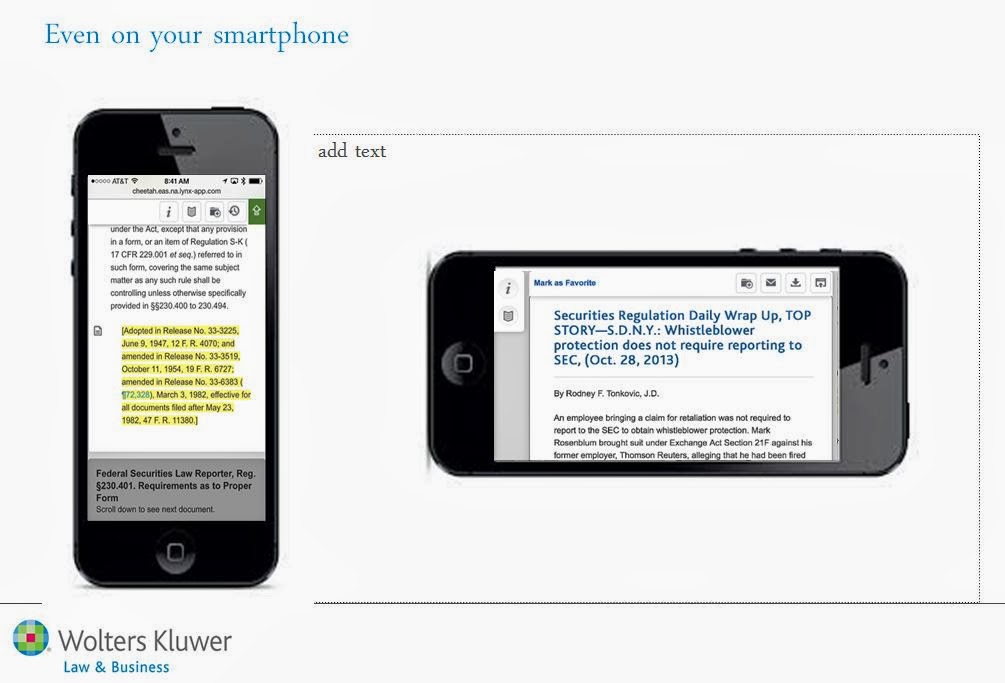
    I outlined the recent transformation of Wolters Kluwer toward a more customer centric organization in a prior post about Robert Lemmond who was appointed President and CEO of Wolters Kluwer Law & Business earlier this year.  Lemmond describes Cheetah as being the product  of “our ‘Customer First’ development process [which] has resulted in a seamless integration throughout the user’s workflow, whether at a desktop, or on the go with a smartphone or tablet.”


    Thinking Outside the Hype Cycle

    Wolters Kluwer demonstrated its commitment to reinvention when it recruited some IT “star power:”   Andrew Little and Alfred Kahn to lead the development of Cheetah. If you are an IT groupie you would know that Andy Little is credited with developing the concept of “the hype cycle” which defines the stages of technology adoption.

    Andy came to Wolters Kluwer from the Gartner Group where he was Vice President of the Strategic Technology Group. While at Gartner, Andy was instrumental in the realization of many solutions that have become synonymous with the IT Industry. In addition to the “Hype Cycle” he helped develop “The Total Cost of Ownership (TCO),” ” Magic Quadrant” and the “Market Clock” research methodologies. He also created an innovative technology suite to produce many of the self-assessment tools in use by Gartner clients today.

    Another key player in Cheetah is Alfred Kahn, who heads the customer experience organization to ensure that the customers’ voice is part of all WK development practices. Alfred and his team devised a persona-based development process, meeting with and observing hundreds of research professionals, attorneys, and associates to understand their work flow needs, requirements, and preferences. Alfred’s work helped create RBSource a recently developed digital version of the Securities Act Handbook.
     

    Thinking Outside the Code


    Cheetah is the first digital product from Wolters Kluwer Law & Business  which is not built on top of a statutory and regulatory code structure. The linkages between codes, regs, commentary and cases are still there, but these are not the backbone of the user experience. A user can still navigate through a table of contents for a code, but they also have dozens of other options for navigating and combining and filtering research results based on what they, the user need to do.
     

    How Did they Do It?


    The Cheetah team basically disassembled, purged, reorganized and enhanced the over 25 million documents in WK’s  various legal products. They removed all the duplicates which appeared in various CCH publications. They gave each document a persistent URL. This means you can now catalog digital versions CCH  titles and documents or add URLs to your portals and they won’t go bad! No more linkrot in your catalogs or portals. All content was enriched and enhanced with new taxonomies and ontologies and documents were coded using 40 meta data features. All research can be related and rendered in the context needed by the researcher in the course of their workflow.

    The Dashboard
    Cheetah will offer a customizable dashboard which is divided into three sections. The left column is for personalized content: favorites, current awareness, saved searchers, the center column is topically organized with practice specific content; the right column contains productivity tools such as Smartcharts.

    Cutting to the Chase: Cheetah Offers A Long List of Enhanced Features

    • Each statute has a table of contents which can be expanded to allow navigation of the document
    • Unlimited scrolling provides continuous reading experience
    • When a user annotates a document, Cheetah will post the citation to the document
    • Content collection – users design their personal library shelf of materials  from all collections
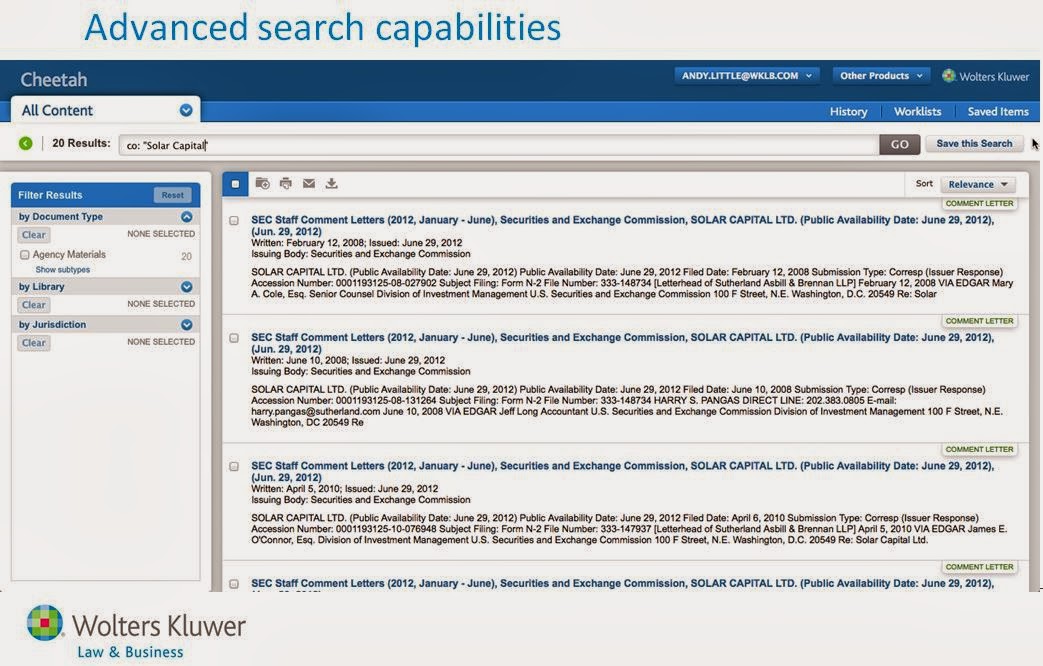
    • A type ahead feature suggests words and phrases as you type.
    • The system recognizes citations automatically
    • Enhanced reading experience document review offers lightening fast continuous scrolling of documents
    • 40 new meta data items for search, filter and display
    • Each statute and regulation includes a “point in time” amendment history
    • Each users research history is saved for 2 years
    • A Worklist collaboration tool allows lawyers to share documents and notes related to project or matter
    • Every document has a persistent url  meaning no duplicate documents, no dead links
    • Users will have an identical user experience on every device, PC, tablet or smartphone.Responsive design renders an interface scaled to any device.

    Rollout Securities will be the first practice area released in the Cheetah platform followed by tax and then other practice area content sets. There is no fixed conversion date for existing customers. According to Lemmond ” As part of our customer driven strategy we are consulting with our customers not just on product enhancements but also on migration strategies to help ensure seamless transfer between the platforms. Given our commitment to “Customer First,” it is our commitment to make this transition as successful as possible and with as little disruption.”
     

    Can Cheetah Outrun The Market?

    I assume that anyone reading my blog needs no introduction to the history of the online research cost recovery frameworks created by Lexis and Westlaw  which have survived for three decades. Bloomberg Law elbowed into Lexis/ Westlaw turf in 2009 with a disruptive new model which attempted to create a “research Utopia” as an alternative to the complex cost recovery systems which had driven the revenue of Lexis and Westlaw while driving billing partners, associates and librarians mad!  Bloomberg offered an all inclusive contract that was built to be a utility that would remain open all day on the desktop, and for which there should be no client charges or cost recovery. Bloomberg may have underestimated the impact of the recession. The market liked the content  and the concept but largely resisted the price tag.

    Can Bloomberg’s Plateau Be an Opportunity for Wolters Kluwer?

    OK, Wolters Kluwer doesn’t offer as much content as BloombergLaw. They don’t have the business data trove but they do have solid legal practice centers and have taken direct aim at the legendary BNA newsletter market by introducing their suite of afternoon topical dailies. Whatever Wolters Kluwer is charging for their practice libraries on Cheetah it will be a fraction of what the SuperSystems (Lexis, Westlaw and Blaw) charge. Law firms are still looking for ways to cut their spending.  Law firms still want to get out of the online cost recovery mess.Cheetah offers a  flexible, feature rich new research platform. Can Wolters Kluwer position Cheetah’s high performance platform to actually steal the market share that had been in BloombergBNA’s crosshairs? Can Cheetah lure users from Lexis and Westlaw with a promise of high functionality and relatively low annual cost which can be supported without charging clients for cost recovery? It looks like Cheetah is positioned to give them a  “run for their money.”

    Earlier this year I wrote a post  which noted the paucity of female executives in legal publishing. Wolters Kluwer was the only major  publisher to have not only a female CEO, Nancy McKinstry but many female leaders of its publishing units.Today Thomson Reuters announced the appointment of Susan Taylor Martin as the new President of Thomson Reuters Legal. I applaud the promotion of a new female executive to a top leadership
    role in legal publishing.

    Ms. Taylor Martin is currently managing director of Thomson Reuters Legal in the UK and Ireland. She joined the company in 1993 and has held a variety of leadership roles within a number of businesses, including global head of Corporate Strategy at Reuters and president of Reuters Media.
    Now For the Questions

    It is impossible to second-guess the internal decisions of an organization. Yet I find it somewhat hard to fathom why less than a year after outgoing president Mike Suchsland,   made the bold pronouncement that TR Legal was no longer in the content business, he is well,  out!  He didn’t just announce a new direction, it was accompanied by two new cloud based and process centric platforms, Concourse for In House Counsel and Firm Central for small law firms.

    Will Ms Martin remain in the UK or will she relocate to the TR Legal  headquarters in Egan Minnesota? Does her selection suggest a shift away from a US focus? Is the US market regarded as so mature that TR will focus on the development of non-US legal products?

    I tried to reach TR to get clarification and have not heard back, so for tonight we are left with the questions.

    Congratulations to Ms. Martin as well as to  Basil Moftah who has been appointed president of Intellectual Property & Science; Gonzalo Lissarrague who has been appointed president of Global Growth & Operations (GGO).

    Related Posts:
    Thomson Reuters  Legal Announces New Strategic Direction: Content no Longer King, Shift to Client Centric Platforms

    Nancy McKinstry;CEO Of Wolters Kluwer on Leadership Strategies  and The Importance of Law Librarians in the New Information Environment

    e

    Biographical:
    http://powerlistfoundation.org.uk/about-us/trustees/item/39-susan-taylor-martin


    The American Association of Law Libraries has launched an online information center dedicated to promoting its new  Principles and Standards for Legal Research Competency within the legal profession. One of the most important aspects of  “the principles” is that they are a strong antidote to the increasing risk of malpractice which arises from the “everything on the Internet myth.”  There is no question that certain types of ” fact checking” research have gotten simpler with the aid of tools like Google. But the absolute volume of unstructured data, as well as terabytes of Internet dreck (material of questionable provenance and quality)  increases the risk of both wasted time and finding “the wrong thing.”

    In the practice of law there is a world of difference between finding “something” on the Internet and finding “the right thing.”  Locating a legal precedent is not the end of the research process, it is the beginning  of a series of  collateral inquires. This may involve determining if a case was overruled, if  a statute invalidated, or  that a regulation is about to expire or come into effect. Information literacy has never been more important to the practice of law.

    According to a press release from AALL.”The standards were developed to improve legal research methods,. AALL’s online information center
    provides access to the principles and standards; implementation and best
    practice ideas; and information on upcoming programs. The Information Center is organized into 3 areas, Outreach, What’s New and Action Center.
    Crossing the Bar
    Academic, Government and Firm librarians have been advocating for law schools to enhance and expand legal research classes  for decades. In the  mid – 1980s, I was told that law schools would not take legal research classes seriously until the state bar examiners incorporated research concepts into the bar exam..
    According to the AALL information center, The National Conference of Bar Examiners completed a job analysis of  the workload of newly minted lawyers ( in practice less that three years.)  For ninety-eight percent of the lawyers surveyed , electronic research is one of the most important and frequent activities they perform.  The NCBE is considering adding new assessments  which will cover skills where are not currently being measured on the bar examination, including legal research.AALL’s Principles, Standards and Competencies provides a thorough framework which details the intellectual and practical complexity on effective legal research.

    I applaud this initiative which demonstrates the continuing importance of librarians and knowledge professionals in enhancing lawyer competences and building the  digital literacy skills which are a cornerstone of  the competent practice of law.
    Update Dec. 11, 2013: This post was awarded the Technolawyer BIg Law Pick of the week:

    Yesterday I reported on the ALM  General Counsel Survey. Today I looked at the data from the Amlaw 200 Law Firm Leadership Survey.  There is only a partial correlation  between two surveys.

    Like corporate GCs, law firm leaders are overwhelmingly optimistic about their firms prospects for 2014 while being fairly pessimistic
    about the pace of economic  recovery in the US. Law firm leaders are deeply pessimistic about prospects for a near term
    European economic recovery. Instead of writing a summary of the reports,  I reviewed the ALM charts and culled a  list of “what’s hot”  and “what’s not.”

    • New office locations:   Hot (DC) Not (Silicon
      Valley)
    • Practice areas:  Hot (Litigation) Not (
      Bankruptcy)
    • Revenue drivers:   Hot (government regulations)
      Not ( Dealflow)
    • Staffing trends:    Hot (small incoming associate classes)      Not (associate layoffs)
    • Partner trends:    Hot ( de-equitizing partners) Not ( mandatory
      retirements)
    • Law Firm Finance:   Hot (Capital calls) Not (3rd party debt)

    • Growth strategies:   Hot ( US mergers) Not (
      European expansion)
    • Lateral partner hires:   Hot (Litigation) Not (
      Energy)
    • Client feedback:   Hot (establishing a feedback
      program) Not (actually getting client feedback)
    • Fee Arrangements:   Hot ( discounting hourly rates) Not (alternative fees)
    • Alternative staffing:   Hot ( secondments) Not
      (shared staffing)
    • Succession planning:  Hot (making a succession
      plan) Not ( executing a succession plan)
    Some of the items on this list highlight a disconnect between planning and execution (client feedback programs). Although the majority of firms have a succession plan – 90% of firm leaders have been in place for more than 10 years, so succession is not happening. Failing to establish policies (mandatory retirement)  may have negative repercussions. Would establishing a mandatory  retirement age, diminish the need for undertaking the humiliating process of de-equitizing partners?
     

    ALM Legal Intelligence  released a report  this week “Corporate Counsel: Agenda 2014”. Many of the themes are familiar: controlling costs, driving efficiency, alternative fee arrangements. But I can’t recall any recent reports that repeatedly point to “the government” as a major source of anxiety for in-house counsel.
    How The government is impacting In house counsel
    •   The slow recovery of the economy.
    •   The fear of political stalemate.
    •   An expanding minefield of new regulations creates new risks of compliance failures
    •       New laws and regulations create new risks of liability.
    •   GCs must not only know the new laws and regulations, they have to figure out how to adopt company-wide procedures to assure compliance. 
    What they want from outside counsel

    “Responsiveness”of outside counsel jumped significantly since the last survey. 80% of GCs ranked this as the top quality GCs want from outside counsel.

    Surprising findings
    • 90% of respondents expect their budgets to stay the same or increase in 2014
    • Supporting company growth and providing exceptional service to company leaders continue to be the top two concerns, of GCs.
    • Half of the respondents expect their company’s financial health to improve significantly in 2014 but only 1/3 think the US economy will improve.
    • 90% expect their legal budgets to increase or stay the same.
    • Many CGs are examining technology to improve efficiency, enhance compliance and reduce risk.
    • They would rather hire lawyers and staff rather than outsource to LPOs.
    • Most plan to move all transactional work in-house. Complex litigation will continue to be sent to outside counsel.
    • 56% of GCs plan to request alternative fee arrangements.

    How to annoy your client

    Total cost of outside legal work and the uncertainty of legal costs rank high in the list of irritants.

    Outside counsel who provide legal solutions that don’t consider the business objectives are undermining their relationships with their clients.

    Common Ground with Outside Counsel
    • GCs looking for technological solutions
    • GCs plan to implement project and workflow management.
    • GCs want to be positioned as strategic business partners in their organizations just as outside counsel want to be strategic business partners to the GCs.
    Although most GC’s think that their companies will have a strong 2014, they are not confident that the overall economy will improve. They continue to scrutinize costs and to look for opportunities to enhance productivity and reduce outside counsel spending. Despite all of the financial scrutiny, personal relationships with individual lawyers remains an important factor in the retention of outside counsel.