This morning I attended a  presentation at Bloomberg HQ given by Bruce  “growth is dead” MacEwen. He has so many unique insights I definitely recommend reading his book to absorb them all. He showed some amazing slides on the  configuration of the legal industry before  and after the  2007 crash.

 One interesting “aside,”  focused on the corrosive effect of “profits per partner.” The PPP ranking was created the American Lawyer and is a  metric which is particularly susceptible to manipulation. Yet it has become the vehicle for not only measuring success, but also a key driver of rampant lateral poaching, which in turn has contributed to the cratering of many firms.

One  partner in the audience only half tongue in cheek suggested that it was time to move up the alphabet and perhaps a legal publisher name starting with a “B” should create a new  and more reliable competitive metric for   measuring the success of law firms.

The Bloomberg BusinessWeek issue of May 12th sported a cover “What do you do with 176,000 lawyers lying at the bottom of the ocean?” Howrey’s Bankruptcy and Big Law’s Small Future. 

The article focuses on the collapse of Howrey, but predicts continuing disarray in the legal market. And oh by the way, the Bureau of Labor Statistics predicts that  by 2020 the US economy will create 73,600 lawyer positions and law schools will graduate 24,000 new lawyers a year. This they suggest will result in  176,000 excess lawyers. But is not the real problem that law school are grooming lawyers for the 20th Century Law firm instead of the 21st century law firm?

 Bloomberg Law TV Interviewed Richard Susskind on May 2nd:  With Radical Changes Law Firms Can Beat the Recession.  Last week Lee Paccia interviewed legal “futurist” Richard Susskind who had  a completely different take. Here are some surprising “take aways” Outsourcing is Temporary and  Technology is the Future. We don’t have an oversupply of lawyers we have an undersupply of legal knowledge engineers!

Why Now? There is a further irony that Bloomberg has chosen to enter the legal information market at a time of such wrenching displacement in the legal market… unless Bloomberg has calculated to enter the breach and take advantage of the disruption.

 News You Can Use! For those of us who toil at the intersection of copyright and human behavior, any publisher who keeps making it easier to legitimize the natural impulse of lawyers to embrace every venue for highlighting their accomplishments and share news and insights with their clients gets my endorsement. Last July Wolters Kluwer launched a new series of daily newsletters, The Wolters Kluwer Daily Reporting Suite which allows subscribers to forward stories to clients and colleagues. Today Wolters Kluwer is expanding their policy by granting a license allowing law firms to post Daily Alert stories which mention the firm or individual lawyers on the firm’s website and to include reprints of these stories in promotional materials 7 days after the initial publication. I once again applaud Wolters Kluwer for respecting the integrity of their subscribers enough to allow the reuse of these stories. This is a great business strategy which in marketing terms, creates “stickiness” between the publisher and it’s subscribers. It creates enormous good will by supporting the marketing and business development needs of firms.


And they also released 2 New Newsletters in the Wolters Kluwer Daily Reporting Suite

Today’s release expands suite of current awareness products which are focused on the “hottest”  and most complex practices. The Daily Reporting Suite now includes: Antitrust, Securities Regulation, Health Law, Employment Law and Intellectual Property, Banking and Finance and Products Liability.

The Press release quotes WK Legal Market Leader Robert Lemmond:

“The response to our Daily Reporting
Suite has been extremely positive and we are pleased to be expanding the topics
to include the key areas of product liability, insurance and banking and
finance. Legal professionals consistently tell us they need a reliable news
source to keep them fully briefed on breaking legal news, court decisions, and
legislative and regulatory developments that impact every aspect of their
practice.  At Wolters Kluwer, our team of
attorney-editors have enabled us to expand our Daily Reporting Suite and continue
to make the critical challenge of staying up-to-date with relevant cases,
statutory changes and new rulemakings a much faster and
more streamlined process.”

The Content.  These daily news services will deliver breaking news from both the federal and state level, the latest rulemaking and updates on litigation as well as a complete summary of the daily legal news. legislative and regulatory activity and highlights of state agency enforcement activity.Access to all links to cases, state laws and regulations,and other primary source documents.


Banking and Finance will cover all of the hot issues of interest:


Bank Secrecy Act , Volker Rule,Capital and Basel Accords, UDAAP,Consumer Financial Protection Bureau ,Truth in Lending, Dodd Frank Act,  Securities and Derivatives Enforcement Actions, Equal Credit Opportunity, RESPA, Fair Credit Reporting, Identity Theft, Mergers and Acquisitions, The Federal Reserve Board


Products Liability Law Coverage includes:

  •  Full summaries of products liability decisions issued by federal and state supreme, appellate, and district courts, including the presiding judges and names of the attorneys representing the parties
  • Consumer Product Safety Commission and National Highway Traffic Safety Administration regulatory and administrative developments, product recalls, agency enforcement activities, and more
  • Access to all links to cases, Federal Register Issuances and other primary documents
  • Federal consumer product safety legislative activity

Products Liability Law Daily Topics include:

Design, manufacturing and warning defects, Defenses to liability, Damages, Expert Evidence, Preemption, Consumer product and motor vehicle recalls, CPSC settlement agreements, Product testing and certification, Motor vehicle exemptions and Import rules
 

Mobility Rules The products will be delivered via email, RSS feed, and mobile apps for iPad, iPhone, Blackberry, and Android.

Here are the standard Daily Report features: 

  • Daily email summaries written by knowledgeable attorneys and industry experts with links to the full text of any new cases, regulatory or statutory developments, and breaking news 
  • Seamless access to information from ANY mobile device without being prompted for logins/passwords. Other legal news services require logins creating unnecessary time delays.  
  • The ability to customize content by topical area and jurisdiction so users can view the content that is the most relevant to them 
  • Built-in copyright permissions that permit legal professionals to instantly share information with clients or colleagues without having to download or reassemble information. 
  • Time-saving mobile apps with customizable home page, ability to filter by topic/jurisdiction, note-taking capabilities, favorites folders and email functionality 
  • A searchable archive on Wolters Kluwer’s proprietary online content delivery platform, IntelliConnect.
In the Pipeline  Wolters Kluwer is also planning to release a daily insurance product in June.
 

Wolters Kluwer continues its assault on the  topical legal “newsletter” niche which has been  dominated by Bloomberg BNA and Law 360. However WK seems to have an edge in customization of both content and delivery. They are remain  ahead of the entire market in advancing policies which allow lawyers to legally “socialize” their content and maximize it’s marketing value for the law firm… which is no small benefit in this fiercely competitive legal  market. Time will tell if these distinctions and the quality of the WK proprietary analysis translate into market share.


Related Stories:

Wolters Kluwer Launching Daily Reporting Suite: Built for Collaboration and Copyright


American Lawyer Media Legal Intelligence Released their report “2013 Alternative Fee Arrangements at Legal Departments and Law Firms”

There is nothing simple about AFAs. There isn’t even a simple definition of what it means and in reviewing the inconsistent responses of law firms and legal departments, I couldn’t help but wonder how many of the respondents were using the same definition. My favorite part of the report is the addendum that lists and explains the wide variety of AFA agreements as defined by the Association of Corporate Counsel,  The list  include: Blended rates, capped fees, contingency fees, defense contingency, flat fee, flat fee with shared savings, holdback, partial contingency or success fee and phased fee. The only thing each variant has in common is they are not “the standard hourly rates.”

A careful reading of the report shows that the real drivers of the AFA movement are not the GC’s but the corporate executives and often the procurement departments who have been charged with rationalizing  and reducing legal spending using the same tools they use for the procurement of office equipment.  And yet both in house and law firms responses indicate  that the effectiveness of AFAs need to be determined on a case by case basis.

Legal Project Management Is Critical To Success

The most significant take away is that right now many firms are treating AFAa as a loss leader with the expectation that it will bring in more work from the counsel. But if firms don’t have the discipline and the tools for managing  their own efficiencies  it is likely doomed to failure. So the real question is whether firms will invest in the development of real LPM specialists who have sufficient authority to establish best practices which become the firm’s standard procedures.

Other key findings include:

  •  More than half of the Law Departments and Law Firms surveyed said their volume of AFA’s had increased from 2012
  •  Over 60% of Legal Departments said that Law Firms were cooperating more with AFA’s then when they took  the survey in 2011. 
  • AFAs are used predominantly by large companies with more than 10,000 employees (44% of respondents )
  • 59 % of law firm respondents said that AFA’s make up between 11 and 25% of all firm billings 
  • Several GCs articulated the goal of lowering lawyer rates by $100 an hour. 
  • Law Firms are not at all confident that AFAs are profitable. 
  • Most firms view AFA’s a the price of admission. A loss leader which they hope will result in growing the relationship. 
  • More firms are hiring pricing specialists. 
  • Half of the respondents have participated in” reverse auctions” in 2012 
  • Litigation is the activity which is most often targeted by legal departments for AFAs. 
  • Only 4% of law firms responded that AFAs were more profitable than the billable hour. 
  • 34% of respondents report that they lost money on AFAs. 

The Up Side of AFAs. Alternative career paths. Maybe law firms should start recruiting law grads with project management skills. Certainly there is a pool of second career candidates who in a prior life worked in as IT project managers. Take an unemployed law grad off the street and invest in a new kind of associate who can help build the workflow disciplines of the future. If that doesn’t work look around the law firm for other staff such as librarians and knowledge managers who have skill sets ideally suited to Legal Project Management.

The Dark Side of AFAs. Several weeks ago law.com published a story Orrick’s Next Act which contained the following comment: “some partners worried that the firm’s embrace of alternative fee arrangements gave the impression that it was moving down market.” So herein lies the cognitive disconnect. Large Law firms see themselves as Neiman Marcus but now have to market themselves  as if they are Walmart. Bruce MacEwen, of  Adam Smith Esq.  has pointed to the risk of “suicide pricing” which leaves firms  blindly competing for business without the tools for analysing profitability. What law firm really wants to win this “race to the bottom?”
 

NY Times Mar. 20, 1969

Several weeks ago I wrote a post about the lawsuit brought by the researchers at Newsweek who in 1970 figured out that they had been hired into a “female ghetto” of research, which was valued less than the “male” role of reporting . It was also a position from which they could not be promoted. When I read “Good Girls Revolt” by Lynn Povich I was not thinking… “this is ancient history.” I was thinking that there is an echo of this story in the “glass ceiling” facing of law librarians in 21st century law firms.We have not revolted, but we live with earnest and unrequited hope that our invitation to the C-suite must be in the mail. We keep thinking that we have to change our titles, our brand, our message, ( and this all may be true ) but I now suspect the problem runs much deeper and is almost impossible to document except by considering  the history of the profession, the statistics and observing the outcome. So let’s look at the evidence.
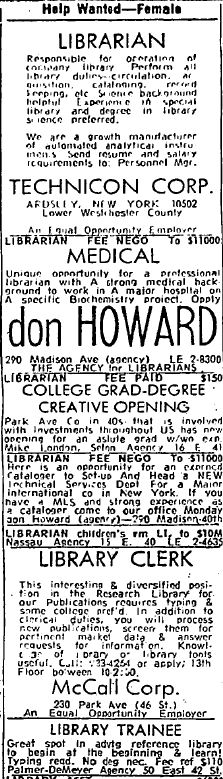
Help Wanted-Female. When I was in college, jobs in the New York Times classified section, were divided into male and female. No surprise –the job of “librarian” was listed in the Times under “help wanted female.” I have often told young colleagues about this, and they have reacted with head-shaking disbelief. The segregated ads are gone but I suspect that to this day, that our profession suffers the consequences of unconscious bias. Yes, yes, I know we have male colleagues, but overall they are a minority in the profession, and they also suffer the consequences of the gender baggage our profession still carries, so let’s call the problem by its right name and start dealing with it.

Bring on the Cartoons. As if gender were not enough of a problem, there is the relentless stereotyping of librarians. Name one other profession for which there is such a universally accepted and cartoonish image. We can all recite it: hair in a bun, sensible shoes, glasses, drab clothing, humorless, prudish, and forever “shushing.” Who would invite this character into the C-Suite! Earlier this year Lego released a “librarian” Lego that is remarkably similar to the 19th century stereotype.But “updated” with the word “shush” printed on her coffee cup. These are not empowering images and yet they are a cultural fixture. I don’t think a month passes in which  I don’t encounter the  “bunhead librarian” in an advertisement, in a movie or  in an news story. This is the professional equivalent of a minstrel show character, that persists when all ethnic and racial stereotypes have been banished. Maybe you are thinking I should just “lighten up.” but consider the possibility that stereotypes create real professional consequences.
The Music Doesn’t Sound Good if You are Wearing Lipstick.  If you think I am over-reacting, just consider the impact of stereotypes on female classical musicians. Several months ago, I came across this in a
book by Malcolm Gladwell.” Blink, the Power of Thinking Without Thinking”, which concludes with a chapter “Listening with Your Eyes.” It describes the difficulty which classically trained female musicians faced getting hired by orchestras. Conductors almost universally thought women were unsuitable for orchestras because their hands were too small, their lips were the wrong shape, their lungs couldn’t hold enough air…..you get the picture. No one thought they were being unfair to women. When women showed up for auditions, they just didn’t sound as good as the men. Then something happened. The mostly male musicians began to unionize in an effort to counteract favoritism and unfairness of conductors who sometimes  only hired candidates who they knew or favored graduates from certain schools. One of the reforms that was instituted was called the “blind audition,” in which the musicians audition behind a screen. The conductor can only hear the music and makes judgments based on the quality of the music alone. Guess what, following the introduction of “blind” auditions, the number of women in symphony orchestras began to increase. In 1970 only 5% of the musicians were women. The number had increased to 25% in 1997 when a study was conducted by Claudia Goldin of Harvard and Cecelia Rouse of Princeton. ( Orchestrating impartiality: the impact of blind audition of female musicians.)”

What Else Could Explain the Low Numbers of Librarians in the C-Suite? Law librarians are among the most highly credentialed administrative staff in law firms. Most have at least one Masters Degree. They often have  2 advanced degrees,  a Master’s Degree plus a JD, MBA or PhD. Law librarians have been in law firms longer than any other “non-lawyer” professional. Their positions date back to at least 1930. Information Technology folks arrived in the 1970’s and Marketing folks in the 1980’s and Professional Development folks in the 1990s. We had a 40 year lead and yet we have fallen behind in opportunities for professional advancement. The numbers of  Finance, IT, Marketing and Professional Development Human Resources professionals in the “C Suite” far exceeds the number of librarians. No one can convince me that implementing the right information strategy is less critical than having the right technology, marketing, recruiting or lawyer training strategy.

 At the first PLL Summit in 2010, 3 Geeks and a Law blogger, Greg Lambert raised some uncomfortable issues.. He pointed out that in the past 20 years librarians were continually at the forefront of introducing new initiatives and technologies. These innovations include providing firms with the first link to the Internet and introducing  knowledge management (which by the way librarians invented in about 2000 BC), competitive intelligence and formal professional development programming. But instead of having their roles elevated, a strange thing happened… someone else was hired to lead each new initiative. Worst of all  the people hired into these new roles were then elevated to the C-Level. The persistence of the pattern is too dramatic to be ignored. I am open to other explanations, but right now unconscious stereotyping and gender bias get my vote.

And now… I can’t help but wonder if during all these years when I was talking strategy and risk anyslyis, my words were drowned out by sound of a cartoon “shushing” in the Executive Director’s and Partner’s heads.

Leaning Up for the Next Generation. This is a subject no one wants to discuss. I can’t  recall ever seeing an AALL program that addressed the issue of gender bias faced by our profession. The ABA and every law firm is trying to increase advancement opportunities for women  lawyers to reach partnership. So why, as a profession that is about 80% female are we afraid to name the problem and begin to look for a solution. I want the next generation of  information professionals to have a a shot at a seat in the C-Suite, but the first step toward recovery is admitting you even have a problem… and then call the problem by it’s right name.

______________________________


Special thanks to Jamie Furillo for assistance with archival research.
Welcome to National Library Week. I thought I would start out with a celebration of law books which I found my deep archive of “law librariana.” This is a segment of a longer video which I believe was produced by those great “fans of librarians”  Craig and Bill from West Publishing … decades ago. I can no longer even guess the date…  But this book segment is priceless and timeless! Thanks to Thomson Reuters as the heirs of the West Publishing legacy!

When Law Books Ruled!

According to a report in BloombergBNA Electronic Commerce and Law  Report the American Law Institute is about to begin untangling the morass of conflicting state and federal privacy laws. The goal of the new project is to  write the “black letter”  principles of privacy law  which will ultimately be published as, “The Restatement Third, Information Privacy Principles.”

The ALI website describes the purpose of the project as follows:

“Information privacy law, concerning the collection, use, and disclosure of personal information, is currently an assortment of laws and regulations that differ from jurisdiction to jurisdiction. This new project aims to bring clarity to American information privacy law by restating and fleshing out a set of Fair Information Practice Principles that will bring greater order and consistency to privacy law and provide guidance to courts and legislatures.”

The Reporters  The American Law Institute has tapped two well-known privacy law specialists to lead the project Prof. Paul M. Schwartz, of the University of California Berkeley School of Law, Berkeley, Calif., and Prof. Daniel Solove of the George Washington University Law School, Washington, D.C., have been designated the project “reporters.” Consultive Group currently includes 20 lawyers from the government, law firms and law schools. The full committee will include 35 to 40 lawyers who are experts in the field of information privacy.

According to the  BNA  story Schwartz described  the project as being “designed to bring clarity to a body of common law that has become a bewildering array of conflicting and overwhelming rules differing from state-to-state and the federal government.” Schwartz said that he and Solove will attempt to draft a volume that “is concrete enough to be explanatory but with abstract enough [principles] that we’d be good for ten to 15 years.”

What’s A Restatement? Restatements of the law are addressed to courts and others who apply existing law. They are intended to present clear formulations of common law and its development in statutes. They are meant to reflect the law as it presently stands or might plausibly be stated by a court. It will operate to produce agreement on the fundamental principles of the common law, give precision to use of legal terms, and make the law more uniform throughout the country.

The ALI also drafts Model Codes. Model or uniform codes or statutes and other statutory proposals are addressed mainly to legislatures, with a view toward legislative enactment. Statutory formulations assume the stance of prescribing the law as it shall be.Principles may be addressed to courts, legislatures, or governmental agencies. They assume the stance of expressing the law as it should be, which may or may not reflect the law as it is..

The Drafting Process. A restatement  is developed in a series of drafts prepared by the Reporter and reviewed by the project’s Advisers and Members Consultative Group, the Council, and the ALI membership. Preliminary Drafts and Council Drafts are available only to project participants and to the Council. Tentative Drafts, Discussion Drafts, and Proposed Final Drafts are publicly available. Once approved, Tentative Drafts and Proposed Final Drafts represent the most current statement of the American Law Institutes’s position on the subject and may be cited in opinions or briefs until the official text is published.

Additional background on the history of the restatements and the drafting process are detailed  in the Style Manual which is available on the ALI website.
The Style Manual: A Handbook for reporters and those who review their work..

The American Association of Law Libraries  PLL Summit, now in its fourth year,
continues as a vehicle for examining the impact and opportunities presented by
change in the law firm environment.  The Summit will be held on July 13th in Seattle in conjunction with the AALL annual conference.Last year, we looked at changes in the business and practice of
law and envisioned what those changes mean for the future. Joan Axelroth and I  are Co-Chairs of the program.  This year’s Summit, “SOS,Shaping Our Success” we
explore how to take charge, shaping ourselves as well as the services we
provide to meet these new world demands.  


Bruce MacEwen

Keynote Adam Smith Esq. This year’s Summit with kickoff with a keynote
address graciously sponsored by Thompson Reuters
Bruce MacEwen, more popularly known as Adam Smith, Esq., grabbed the attention
of law firm leaders in 2012 with his “Growth is Dead” series, which was
recently published as a book entitled  “Growth Is Dead: Now What?: Law firms on the brink.”


Morning Panel The keynote is followed by a panel
discussion addressing librarian roles:  how do we identify, adopt and
promote the roles that add value to our organizations?   


David Lat

Lunch,
sponsored by Wolters Kluwer Law & Business, will provide time for
networking and insights into the legal market from the very special and no
doubt humorous and iconoclastic perspective of David Lat, Managing Editor, Above The Law.


Afternoon Sessions. In the afternoon, interactive break-out sessions will
investigate the practical aspects of social media, the art of branding and the user
experience.  The sessions will be repeated twice so that each participant
can benefit from two out of the three programs.

Register for the Summit here.

Thanks to the Summit sponsors:


Jean O’Grady and Nancy McKinstry
Two days after writing the “glass ceiling” story about “good girls revolting” at Newsweek in 1970, I had the opportunity and good fortune to have lunch with the CEO of Wolters Kluwer. I am embarrassed to admit that until recently, I had not been aware that the CEO of any major publishing company was a woman. Nancy McKinstry has been Chief Executive Officer and Chairman of the Executive Board at Wolters Kluwer since September 1, 2003, and Member of the Executive Board since June 1, 2001. Her current responsibilities include:  Corporate Strategy, Division Performance, Business Development, Global Shared Services, Technology, Legal Affairs, Communications, Human Resources, and Sustainability..Forbes named her one of the “100 Most Powerful Women.” Ms. McKinstry is an American, with an MBA from Columbia University who leads a global company based in the Netherlands.

With all of her accomplishments she was stunned that after holding an important  press conference on corporate strategy, one newspaper reported that  they thought she was dressed like a “KLM stewardess.”   Women do face special challenges in achieving and retaining corporate leadership roles…and being taken seriously. According to a Harvard Business Review  article, Women CEOs: Why so few? only 1..5% of CEO’s in top performing companies are women.

The Vacuum: Women Legal Publishing Executives. In 3 decades of meetings with legal publishing executives, I silently wondered why I was always escorted through hallways full of professional women, then seated in a boardroom full of male executives. Don’t get me wrong, I love men! I don’t want to question anyone’s achievement. I just need to wonder “out loud” why the numbers remain so skewed. Now that I am on roll, I will also wonder “out load,” why legal publishers court librarians for their expertise on legal content and product development strategy, but then recruit talented librarians who are steered into “glass ceilinged ” roles in “librarian relations.” I am not aware of anyone who entered the executive ranks from one of these positions. Nonetheless, the executive suites in legal publishing are changing.

There are finally some high level women executives appearing in legal publishing. Notably, Karin Lieber is VP Sales, Strategic Accounts at LexisNexis, Allison Guidette, is Managing Director Large Law Firm Segment at Thomson Reuters. Beth Mazzeo, is Chief Operating Officer at Bloomberg. But, Wolters Kluwer really has the edge here. In addition to McKinstry at the helm of the mothership, another woman Stacey Caywood is CEO their Legal and Regulatory business unit. Wolters Kluwer is the only legal publisher with women CEO’s heading both the parent company and legal publishing divisions.

The McKinstry Strategy for Women in Professional Publishing
In our recent conversation, Nancy McKinstry made it abundantly clear that she is very proud of the progress women have made at Wolters Kluwer since she took the helm. A March 8, 2013 article in Forbes “C-Suite Sees More Female Leaders Reaching the Top.” describes McKinstry’s hands on approach to making sure women are rising to the top at Wolters Kluwer.. When she started as CEO in 2003, only 20% of top leadership posts at Wolters Kluwer were held by women, ten years later it is 33%. McKinstry believes it is easier to recruit top female talent because candidates see women leading different parts of the company. In her words.” Diversity helps, it is a self-fulfilling prophecy.”

Team Work Talent McKinstry believes that the secret of success lies in building strong teams – especially in a knowledge-intensive company like Wolters Kluwer. She also believes that women are especially talented in managing teams and thrive in collaborative environments.. Good teamwork, both inside the company, and working with customers, is the only way to ensure high-quality, innovative products.

Flexibility A post on the website  HeadHoncha also cites Wolters Kluwer’s ‘Work from Anywhere” program as supporting women’s career development.. The program allows people to work three days from home and two in the office, but not in a regular work-space. This has reduced the company’s real estate footprint as well as introducing flexible working.

Job Swaps McKinstry also introduced job swaps to help stimulate international experience. This is particularly helpful for employees “earlier in their tenure.” It provides the experience of working in a different country for several month without having to endure the upheaval of a major relocation.

Talent Management.Wolters Kluwer has a talent management program which identifies high potential executives and, says McKinstry, “We specifically work on programs to provide them with the right experience to ensure they’re developing the kind of leadership skills that they would need to get to the top of the organization.”

The Proof is in the Org Chart McKinstry is proud, not only of the statistics, but of the fact that many of the company’s key businesses are run by women. “In some companies, women tend to take on functional roles but at Wolters Kluwer, women have responsibility for a P &;L. Profit &Loss reflects the utmost level of leadership and accountability for a specific business or division.. P&L responsibilities include “revenue” generation (products, sales, marketing), as well as the related “expense” management (operations, technology, editorial). She provides women with the kind of experience and track record they would need if they are to have any shot at being the CEO of a company or to sit as a non-executive director of a multi-national.

Some of the female executives who rose under McKinstry’s tenure include:Guilietta Lemmi the CEO of Italy; Sasha Chang the CEO of China; Karen Abramson, President and CEO, CCH Tax and Accounting; Cathy Wolfe, CEO of Medical Research. and Stacey Caywood, CEO of Legal and Regulatory who “runs one of the largest divisions in the company.”

McKinstry sums it up: “Getting diversity into the marrow of a company isn’t rocket science. It needs persistent focus at every level of the organization led from the top.”

A Word About Law Librarians I asked McKinstry to comment on the role and contributions of librarians.

“The world of information has exploded.  As a result, Wolters Kluwer sees the role of legal librarian–the ultimate expert in content– as crucial, now more than ever. Particularly as the legal profession migrates rapidly to mobile and digital platforms, the information marketplace is more fragmented than at any time and attorneys need a highly strategic librarian to ensure their seamless access to ‘gold standard’ information sources like Wolters Kluwer in order to make the right recommendations to their clients.

As the legal industry has undergone significant transformation, the role of the librarian has only increased in importance, acting as a critical resource for legal professionals as they focus on increasing productivity. When librarians apply their specialized knowledge management skills to the specific needs of their firm (its unique processes, culture, and practice groups), law firms and attorneys are more successful, productive, and efficient. At Wolters Kluwer Law and Business, law librarians are our partners in finding new ways to help attorneys be more productive and get the mobile and digital content they know is right—both primary law and legal analysis—whenever and wherever they need it.”

A Reason For Optimism Law Library Directors have always had the critical executive “Profit and Loss Responsibility” at the departmental level. Those skills have been honed even more by the challenges of increasing access, manging costs and mitigating risks related to information in an era of exploding content, multiplying platforms and reduced budgets. C-Suite anyone?


“The new normal” in law firms demands a relentless focus on efficiency. Even complex transactional work offers opportunities for process improvement. Lexis is expanding the offerings of Practice Advisor and taking aim at market share now held by Practical Law Company (PLC) a UK company which was recently purchased by Thomson Reuters.Lexis Practice Advisor is a separate application from the LexisNexis research service, but it draws on some of the prime intellectual content behind the paywall to provide practical guidance on transactions. It also leverages Lexis Advance functionality including the search algorithm, filters, alerts and folders.

New Modules Today Lexis is announcing the addition of two modules: Mergers & Acquisitions (with Market Tracker), and Securities & Capital Markets. Prior modules include: Business & Commercial, Financial Restructuring & Bankruptcy, California, Corporate Counsel

According to Lexis executives, they set out to develop an easy intuitive product which optimizes workflow and mitigates key pain points of the transactional practitioner:: simplify the routine processes, reduce the learning curve, jump start the drafting process.

The Practice Advisor provides, Step by step guidance, how-to, checklists, model documents. Commentary is written by experienced practitioners who are both internal and external authorities.

“Crowdsourced” Content. Like PLC Lexis has hired experienced practitioners to develop the content. Here comes the crowd. Unlike PLC they have hired practitioners at Amlaw 100 firms to write the practice materials.”The meet our authors” section discloses who is providing editorial content. This is the first workflow tool I can think of which combines commentary  from both internal and external experts.

Lexis Practice Advisor – Mergers & Acquisitions with Lexis Market Tracker

The Lexis Practice Advisor Mergers & Acquisitions module covers the key areas of M&A transactions such as Public Company M&A, Private Asset Acquisitions, Private Stock Acquisitions and Private Mergers. It addresses the core activities of an M&A attorney – from structuring and planning a deal, handling preliminary agreements and conducting due diligence, to drafting and negotiating the main purchase or merger agreement, signing and closing. Built and managed by a team that includes experienced former Am Law 100 M&A attorneys, the Mergers & Acquisitions module also features content contributions from lawyers at Amlaw 100 firms. The advisor includes a variety of forms including: standard templates, annotated forms and negotiated forms. The forms are interactive and allow lawyers to add terms which are applied throughout the draft which can then be saved in Word.

Lexis Market Tracker

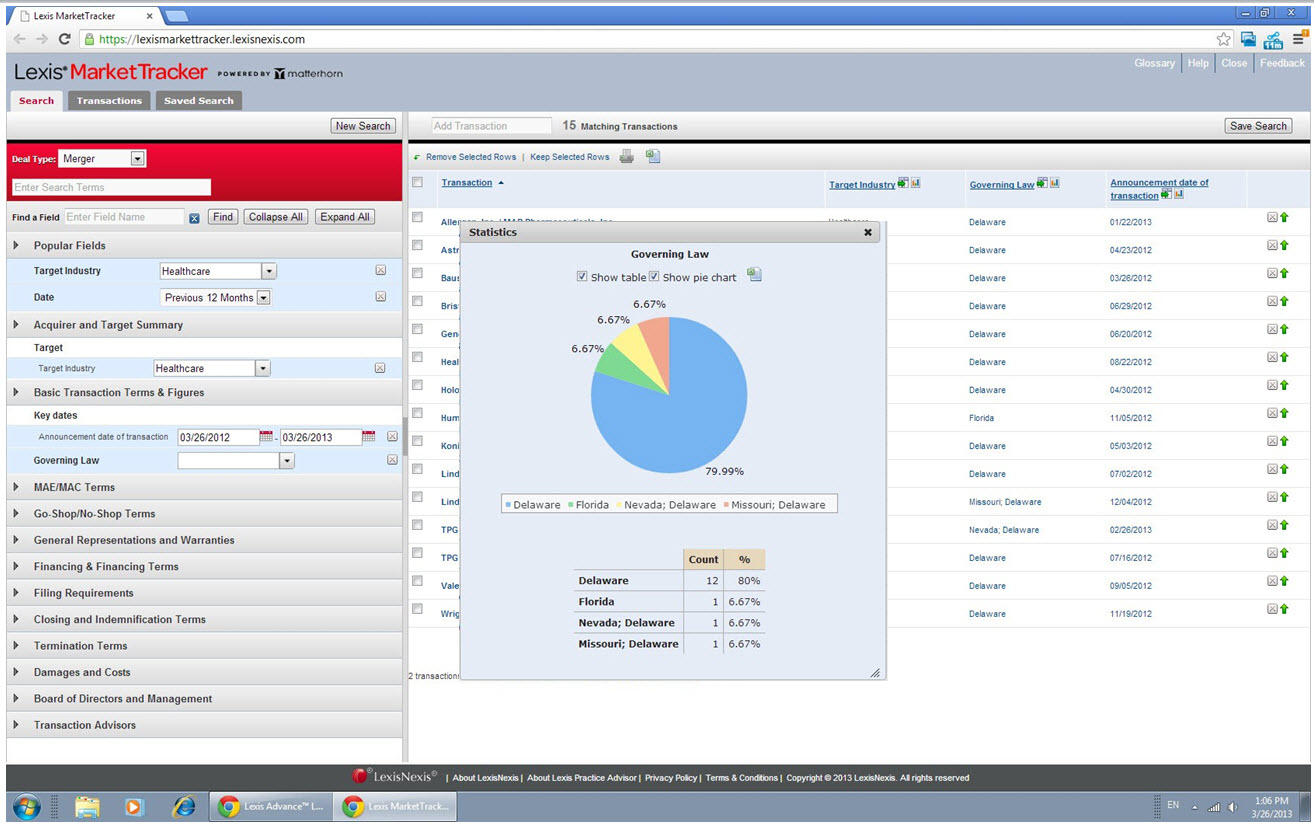
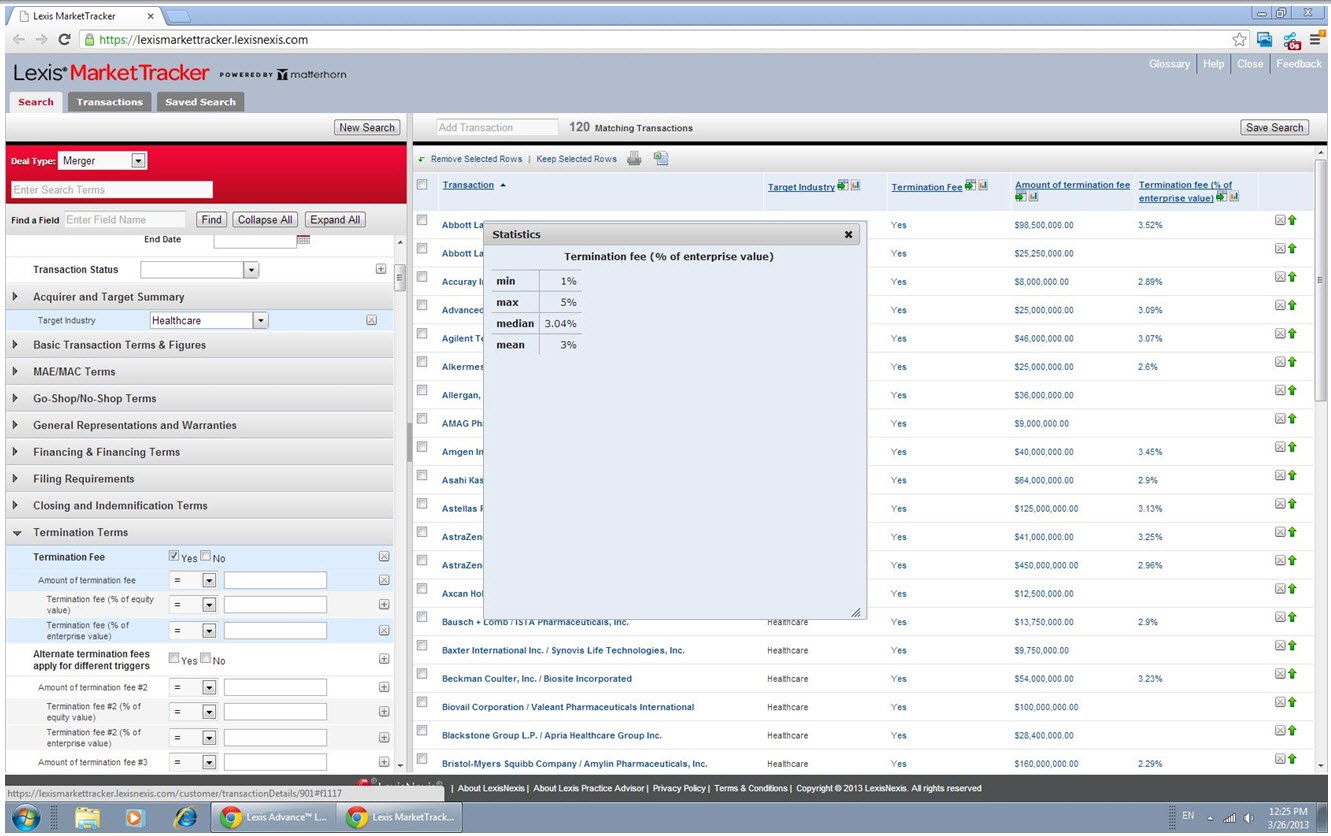
Lexis Market Tracker tool,  offers real-time insight in the M&A market with granular searching of  over 1,000 recent deals using over 900 deal points. Lawyers can search, compare and analyze relevant deals, negotiated terms, structures and provisions, enabling them to accelerate and optimize their deal negotiations and executions. It allows lawyers to analyze deals by law firm or deal terms. The filtering features allow lawyers to save hours of time in identifying and comparing deal terms conforming to specific criteria. The deal results can be downloaded into a spreadsheet. Searching by law firm  name allows a lawyer to see what terms opposing counsel has agreed to in a similar deal. One of the more advanced features shown below, illustrates how the report can compute analytics “on the fly” showing metrics for termination fees in Health Care  industry deals.

Termination fees in Health Care Industry

Lexis Practice Advisor – Securities & Capital Markets

The Lexis Practice Advisor Securities & Capital Markets module addresses the primary elements of securities transactions, including Private Offerings, IPOs, Rule 144A/Reg. S Debt Offerings and Follow-on Offerings and key filings, such as Proxy Statements and Periodic Reports. Featuring contributions from lawyers at preeminent law firms. The module offers legal analysis, cases, codes and SEC administrative materials, such as no-action letters, as well as compliance and disclosure interpretations and releases for key federal securities law topics. It also includes 50-state coverage for important issues under Blue Sky Law.

Up Next Additional releases this year will include Real Estate and Intellectual Property. They can be purchased as an annual all-inclusive subscription .Modules are available as stand-alone products or in conjunction with other LexisNexis subscriptions.

The March  issue of Thomson Reuters Practice Innovations is out. Articles focus on legal project management in various contexts, Litigation, Knowledge Management, Research, Process Improvement.
Here are links to the articles:
Process Improvement and Legal Work Product by Silvia Coulter, LawVision Group
Distressed Litigation and Legal Project Management by James Buckley and Aileen Levanton, Qlex  Consulting Inc.
Organizational Project Management in Law Firms By Don Philmlee, Legal Technology Consultant
Intersection of Knowledge Management and Legal Project Management by Lisa Kellar Gianakos Pillbury Winthrop Shaw Pitman


Have it Your Way Unique Approaches to Legal Project Management By Sharon Melt Abrahams, Foley and Lardner


Research Services Management: Strategic Sense by  Linda Will, Thomson and Knight

About Practice Innovations