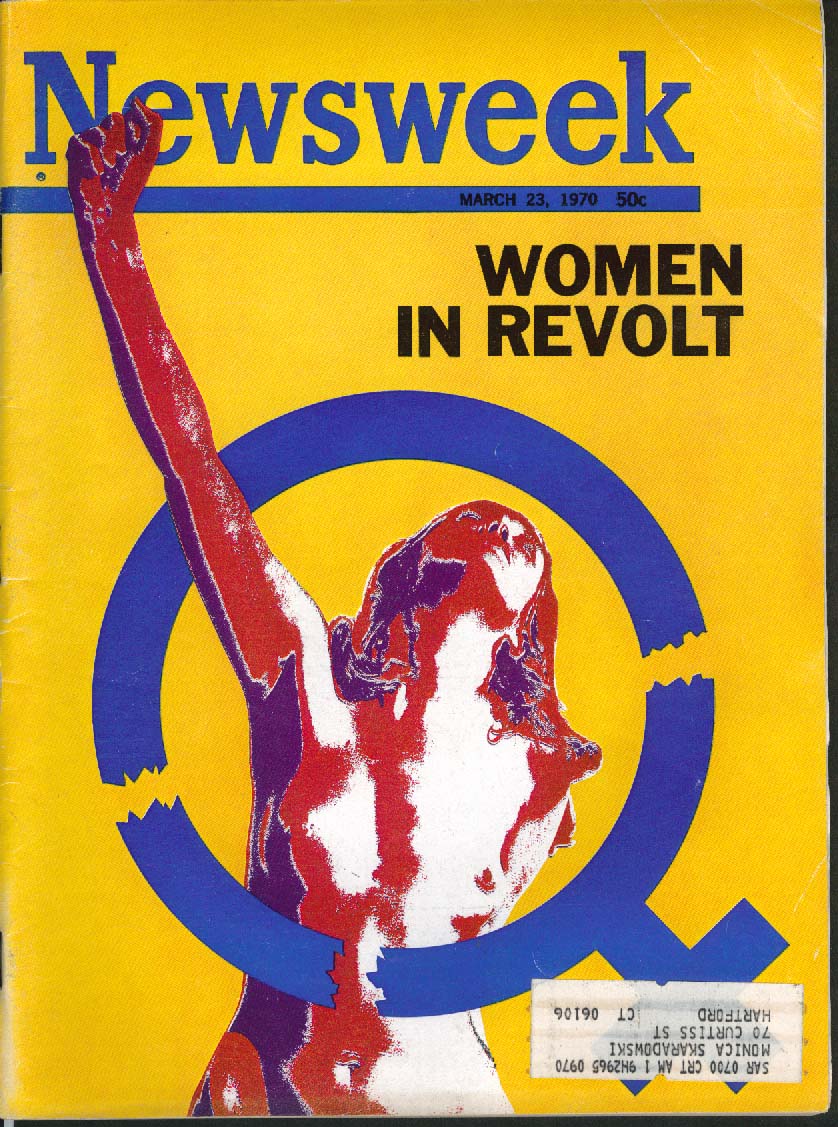
Newsweek  Cover March 23, 1970
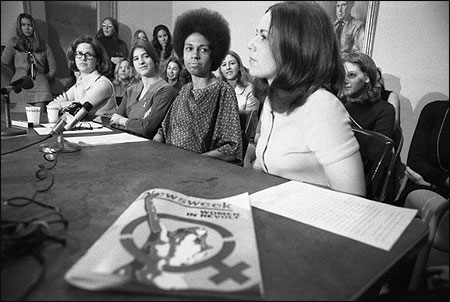
On March 16, 1970 Newsweek ran a cover story “Women in Revolt” about the nascent women’s movement. To the editors, it was a distant and exotic fringe movement. That same day 46  female Newsweek researchers  and their lawyer Eleanor Holmes Norton held a press conference announcing that they were filing an EEOC lawsuit against Newsweek.  This was the first female class action lawsuit. It charged Newsweek with discrimination in hiring and promotions. Newsweek had effectively constructed a female ghetto: the “research department,” full of female graduates of prestigious schools who could clip, fact check and research, but not analyse, write or report, and never ever rise to editor. Newsweek had developed a segregated system of journalism that divided research, reporting, writing, and editing roles solely on the basis of gender.

Primary Sources. I tried to track down the original complaint or any primary sources associated with the suit. According to a  librarian at the EEOC reading room, the case did not go to trial, a Memorandum of Understanding was signed between the 46 women and Newsweek on August 26, 1970 resolving the complaint. The complaint is considered “private” and is unavailable to the public.
Luckily, one of the litigants, Lynn Povich, tells the story of the revolt in her 2012 book, The Good Girls Revolt: How the Women of Newsweek Sued Their Bosses and Changed the Workplace.
Setting the Stage It was the “swinging 60’s” Mod Squad and Laugh-In were on TV, The Beatles were still together,  the  Viet Nam War would last 5 more years…being a researcher at Newsweek was considered a “pretty good job for a girl….” It didn’t even require typing. But… it also provided no career path. These top tier college grads were slotted into a dead end track at the magazine. Since it’s founding, Newsweek’s editorial staff included “girls’ known as “checkers” who researched and verified facts. Years later the term was upgraded to “researcher,”  but in fact, the male writers and editors referred to  them as “Dollies.” But being called a “Dollie” was nothing compared to the overt sexual commentary that was permissible at  Newsweek (and most  workplaces) at the time. In 1970, there was no name for this kind of behavior – it appears to have not even been mentioned as a factor in the lawsuit. The notion of the “hostile work environment” was decades in the future.


Norton and the Newsweek researchers
Photo © Bettman/Corbis.

What Problem? We Don’t See a Problem. The all male editorial hierarchy at the magazine were completely flummoxed when they heard about the lawsuit. After all,  they supported the  civil rights movement!  The problem was invisible to them! They had not hired radical feminists. The researchers were  women  who wore hats and white gloves to church. They were  women of their time and culture who had stumbled into a societal breach between  the old and new worlds.They had the courage to do something they had not been raised to do. They asked “why not me?” Not all of the researchers wanted to be writers or editors. Some of the women simply wanted their research activities to be given equal status to  the traditionally male roles, such as reporting. They also  agreed that the women  who wanted upward mobility should have the path cleared for them.

The male leadership could not understand that they were doing anything wrong. Even after they settled  with the researchers, there were no material changes in the mobility of women into the writing and editorial ranks. The women had to sue a second time in order  to force the editors to begin to offer reporting, writing and editorial opportunities to the researchers.

Which Side Am I Supposed To Be On?” Katherine Graham the Publisher and owner of the  Washington Post Company  and Newsweek, when told of the lawsuit – inquired,'”Which side am I supposed to be on?” Well, she was even more conflicted than that.  In 1969 Graham had been interviewed by Women’s Wear Daily and made this statement: “I think a man would be better at the job I’m in than a woman.” In fairness, Graham was thrust into the position after the death of her husband who had succeeded her father in “the family business.”  She was the only woman to be in such a high position at a publishing company, she had no female role models and had difficulty being taken seriously by many of her male colleagues and employees.

Lean In 2013. Sheryl Sandberg’s book. Leaning In: Women Work and the Will to Lead: challenges us to wonder why  women outpace men in educational  achievements, but are still under  represented in the C suite and on corporate boards. Yet I hear an echo of Katherine Graham’s insecurity and ambivalence in Sandberg’s words almost half a century later:”I still face situations that I fear are beyond my qualifications, I still have days when I feel like a fraud.”*

Which leads one to wonder, what does this all mean for legal information professionals?

__________________________
*I recommend reading Deborah Tannen’s “You just don’t understand me: Men and Women in Conversation,” I read it about 20 years ago, but I am pretty sure she addresses gender differences in dealing with insecurity, and expressions thereof…

Note: Jamie Furillo provided research assistance, dare I say “fact checking” this article!



20,000 pages of health care regulations


Just when  we all thought libraries were shrinking, along comes the new health care law . The Patient Protection and Affordable Care Act of 2010 clocks in at over 2,000 pages. I have always wondered about the ratio between the length of a statute and the volume of regulations it’s implementation will generate. Well we may have the beginnings of a metric. Yesterday I came across a photo of the health care regulations which have been generated by the Affordable Care Act  to date. As of March 13th, the new health care law has generated 20,000 pages of regulations.So the working ratio at this point is that 10 pages of regulations are generated  for every one page of law. 
Could this result in major reshifts of libraries as we try to make room for  the additional volumes of CFR?


 Could These Regs be Tipping Point for eBooks?
Since the IRS will be enforcing compliance with the Patient Protection and Affordable Care Act, I am trying to envision now many volumes will be added to the already massive IRS code and regs which is compiled into a 9 volume set by one major publisher.  Will publishers be issuing the new  tax code  and regulation’s sending the books with wheeled brief case?  Or —will the sheer weight of the tax laws and regulations accelerate the adoption of eBooks by the legal profession.?
Lexis Quietly Acquires a Collection for Oxford University Press

This past week Lexis quietly acquired the a collection of  55 titles  from Oxford University Press US Law Division.  Now before you get too excited here’s the bummer – the collection does not include one of my personal favorites, the Oxford Dictionary of American Legal Quotations by Yale Law Librarian, Fred R Shapiro. ( I was assured this was not completely “off the table for the future.)The  Oxford titles include publications primarily in the Intellectual Property area. Another 30 publications  covering IP, Corporate, Environmental and Insurance Law will be added over. the next two years. These publications will become part of the LexisNexis portfolio of legal products. LexisNexis will develop e-book and online versions of this content – which  to date has only been available in print format.
 I spoke with  Steve Errick, VP & MD LexisNexis Legal & Professional; Errick described this acquisition as part of a  strategy to enhance Lexis analytical content offerings and to make them available in a variety of formats including, online and ebook offerings.

Errick noted that LexisNexis sells their e-books directly on their own web site, via Overdrive Lending solution and through Amazon. Since Lexis introduced e-books and print titles for sale on Amazon, over 40% of their sales through Amazon is e-book sales. Law student texts, practice titles in Criminal Law, Family Law and Property Law are among the leading categories sold through Amazon.

 What’s The Strategy?

Errick described this acquisition as part of a  strategy build authoritative commentary and analysis to  to be integrated with Practice Advisor . Practice Advisor is in head to head competition with Thomson Reuters which recently acquired Practical Law Company. Both companies are making major plays in the lawyer productivity space. Both PLC and Practice Advisor are designed to help lawyers enhance efficiency ie reduce the amount of time billed for drafting documents.These products provide templates, workflows, commentary and checklists.The addition of high quality analytical materials will be a key component in the development of this product.

Errick saw the opportunity  with  Oxford as mutually beneficial because the company didn’t have a great strategy for the legal marketplace. The Oxford titles will compliment the existing Matthew Bender treatise collection which Lexis Nexis will be intergrating into the Practice Advisor platform.

Karin Lieber,Sales, Strategic Accounts at LexisNexis – describes the search for content as an almost  archeological  effort. They are searching for “jewels of content which they need to put in the right setting.” IIf they can’t acquire all the content they need, they will devlop new content in-house to fill any gaps.

By Contrast Thomson Reuters….

It was only two month ago that Thomson Reuters announced they  shifting their focus away from  being a content provider to being a solutions provider. This was followed up in February with an announcement that they had  sold Foundation Press. Foundation was  the premier casebook publisher  of books with the distinctive navy blue buckram covers with gold tooled lettering which curved the spines of many a law student for generations. In early February Thomson Reuters has completed the sale of our Law School Publishing business to Eureka Growth Capital.

The Race For Content Diverges
So while LexisNexis and ThomsonReuters have some divergent approaches to the acqusition and retention of content, I can easily predict this will not be the last acquistion of 2013.

Not the official logo 🙂
Joan Axelroth and I will be Co-Chairing the PLL Summit in Seattle on July 13th. You can register at this link.
The Top 10 Value Propositions for Attending the AALL PLL-SIS Summit IV
SOS: Shaping Our Success – July 13, 2013


AALL Annual Meeting Seattle, WA


The Private Law Libraries Summit, now in its fourth year, continues as a vehicle for examining the impact and opportunities presented by change. Last year, we looked at changes in the business and practice of law and envisioned what those changes mean for the future. This year, we explore how to take charge, shaping ourselves as well as the services we provide to meet these new world demands. In the morning, a keynote address designed to get our creative juices flowing will be followed by a panel discussion addressing librarian roles: how do we identify, adopt and promote the roles that add value to our organizations? How do we brand ourselves as the owners of more than books and online contracts? In the afternoon, interactive breakout sessions will investigate the practical aspects of social media, the art of selling and the user experience. Participants will be better able to shape their success by defining the roles and developing the services that add value to our organizations.

Now on to the top 10 value propositions for attending….

10. Escape the brutal July heat and spend time in “cool” and beautiful Seattle, Washington.

9. Attend the destined-to-be amazing Bloomberg/BNA Welcome Reception on Friday evening.

8. Grants are available to attend the Summit! Stay tuned to the Summit blog for more information.

7. Networking, networking, networking!

6. Opportunity to attend two out of three interactive afternoon workshops/programs.

5. Get practical advice on leveraging social media to enhance your role and services.

4. Get useful tips on increasing yourresource utilization and library traffic by enhancing user experience.

3. Uncover awesome techniques for selling management on your latest ideas for enhancing library services.

2. Hear from an amazing lineup of well-known and influential keynote, luncheon and educational program speakers.

And the number 1 reason….

You will leave armed with tips on how to take charge and shape your success as a provider of information that meets the new world demands you are facing in fresh and innovative ways!

Visit the PLL Summit Blog to get more information, or apply for a grant to attend the Summit. Click here to register for the conference. Please note that it is a pre-conference of AALL and you must check the appropriate box on the annual meeting form to register for the Summit.

In order to provide access to a wide audience, we have secured a venue that can accommodate up to 300 attendees. We encourage members to register early so they can be a part of this invaluable one-day conference.

If you have additional questions please contact the co-chairs, Joan Axelroth jaxelroth@axelroth.com
or Jean O’Grady jean.ogrady@dlapiper.com..

Thank-you to our generous sponsors: Bloomberg Law/Bloomberg BNA, Thomson Reuters, Wolters Kluwer Law & Business, and LexisNexis.

Everyone is building their brand these days. Writing  articles for publication is a common form of marketing outreach which demonstrates the special expertise of the lawyer and firm. It  can put the lawyer and firm name in front of existing and potential clients  who read trade or specialized legal publications. In order to maximize the residual benefits authorship, it is important to carefully review the publisher’s standard contract. It might be logical to assume that  the lawyer and firm retain rights to the publication, but  it ain’t necessarily so.

Getting Less Than You Didn’t Bargain For
It is not uncommon for lawyers to write articles and expect no monetary compensation from the publisher. They benefit from the opportunity to showcase their expertise or special insights on an emerging legal issue. It is perhaps an overreach for a publisher to claim rights beyond the initial publication, but that doesn’t mean they won’t do it. The lawyer may accidentally give away all future opportunity to reuse the publication for personal or firm benefit. To state the obvious you must…

Read the Fine Print

Recently I have encountered two different specialty newsletter publishers who had approached lawyers  and solicited articles for publication in  their commercial trade publications. I discovered that in both instances, the publishers standard contract required the lawyer to transfer ownership of the article to the publisher.

The appalling implications of this are that the firm either has to ask for permission and possibly pay a royalty to make routine future use of the publication. This means::

  • You can’t publish it on the practice group page of the intranet
  • You can’t publish it on the firm’s external website 
  • You can’t distribute it internally to your colleagues 
  • You can’t forward it to your clients 
  • You can’t reprint it for in house educational materials 
  • You can’t reprint it for a client seminar 
  • You can’t reprint it as a marketing handout
In short — the attorney and firm might find themselves creating intellectual capital and then for a lack of due diligence, end up paying a third party for the right to reuse the publication for the most routine marketing and educational opportunities.

Just Ask


It is important to negotiate the terms of ownership or the licensing terms to assure that the attorney and or the firm retain the right make all future marketing and educational uses of the publication. Many small publishers don’t have an in-house counsel and can not afford to hire counsel to renegotiate custom terms.  If the publisher will not renegotiate the standard terms, they may agree to an addendum or side letter  prepared by the author which amends the standard terms. Ideally the contract should restore ownership to the author and  modify any license to assure unencumbered use of the publication for marketing and educational purposes. If the publisher won’t negotiate it may be best to explore other publishing options..

 The Negotiator
As libraries have grown more digital, professional librarians have developed a high degree of expertise negotiating content licenses and can be an excellent resource in reviewing licenses for publications and negotiations with publishers. If you have such in house talent, don’t be afraid to tap your resident negotiator.
When I first heard about Intelligize, I have to confess. I rolled my eyes and groaned at the thought of yet another securities  research product. What in the world could be new in the over populated territory of securities research products? But the rumors were persistent, that  this product did something new. Intelligize could save a lawyer hours of research time. I took a look and blimey… There was something new in securities research!

Painful Research as the Mother of Invention

Gurinder Sangha
Intelligize is the brainchild of Gurinder Sangha a former corporate associate at Shearman & Sterling and White & Case. In 2007 he left the practice of corporate law, retreated into his apartment and began developing a ” better way to conduct securities research”. He wanted to apply what he calls the “Apple approach” to legal research. He defines the “Apple approach” as creating a complex product with a simple intuitive interface which requires no training manual.
The traditional approach to research starts with a broad  search of all documents which is then narrowed with a series of sub-searches. Sangha decided to turn the process on its head. He developed a search engine with the ability to search by deconstructing documents. Start with the best document  and then expand your search by finding more documents or clauses like the original document or clause..
Sangha had a great idea, but as we all know,  building the technology for a start-up  requires some angels for funding.

Every Start up Needs an Angel

The first potential investor Sangha attempted to contact was Phil Brown, the founder and former CEO of Global Securities Information (GSI). GSI, one of the grand daddies of the securities research business, started in the pre online world of the early 80’s.The technology involved a telephone, a photocopier and a chair in reading room at the Securities and Exchange Commission Office in downtown DC. Brown grew GSI into one of the most successful and respected SEC research providers. He sold the company to Thomson Reuters in July 2005. They re branded product as Westlaw Business, a  company which remains a competitor to Intelligize. Since Brown was under a non-compete agreement, he was unable to discuss Sanga’s venture until  his non-compete expired.

Before GSI was sold, Brown wanted to tackle SEC comment letter research.  but  Brown  admits he could not figure out how to link the series of communications in comment letter chains of correspondence. The challenge wasn’t just linking the relationship between the letters, but identifying and matching the question and answer pairs through a series of letters. Nonetheless. Brown had unknowingly contributed to the creation of one of the key components of the Intelligize product. In 2004, GSI made the FIOA request which led to the public release of the entire SEC comment letter archive. The documents were now available to all, but still difficult to research.. A lawyer who conducted a keyword search of comment letters, might have to review hundreds of letters including many irrelevant documents before reconstructing the thread of communications in which the SEC responded to the issue of interest to the lawyer.

When Phil’s non-compete expired, he agreed to meet with Sangha but he was initially extremely skeptical that Intelligize had anything new to offer. By the end of the meeting Phil was convinced and ready to invest.

The First “Killer App:” The Precedent Analyzer

From his own experience as a “big law ” associate, Sangha knew that one of the most challenging securities research tasks facing a corporate associate was reviewing precedents of specific clauses within SEC filings. If for example, you wanted to research precedents for a particular risk factor, you would have to flip through each registration statement one at a time to locate and read that risk before moving on to the next document. As a result, it was very challenging to quickly analyze and synthesize multiple precedents. Sangha’s technology broke apart SEC filings down to the clause level. For the first time a lawyer could easily review the same clause form multiple flings simultaneously on one screen.

The Intelligize Products. Since the release of the precedent analyzer in 2009, Sangha has added 7 more products which apply his search technology to new data sets and provide new and improved workflows for analysing SEC research documents. Here is a brief summary of the Intelligize products released since 2009

Comment Checker Next  Sangha  tackled the SEC staff review process. Preparation for the staff review normally involves locating and organizing coherent threads of inquiries and responses from SEC Staff in comment letters. Sangha’s technology blew apart the documents and identified the threads of issues through chains of correspondence. For the first time a lawyer could easily identify the question and answer pairs that threaded thorough a long chain of correspondence. Comment Checker pulls together all publicly disclosed SEC comments and responses including over 1.2 million  comments from more than 5,000 public companies. It is the only tool that provides the entire chain of communication between the SEC and a company for each comment (including follow-up comments/responses) on one screen. Released in 2009.

Precedent Analyzer The most efficient tool in the marketplace for analyzing multiple SEC fillings and isolating what’s market, what’s new and what’s changing (e.g. the program can simultaneously analyze the Competition risk factor from 10 different companies and show what’s been updated). Released in 2009.

SEC Checker pulls together all publicly disclosed SEC filings and related documents. Using our patent-pending processes, we’ve organized, reformatted, and indexed all of this information – enabling you to search, filter, compare, copy, and assemble content for internal or client review. Allows you to compare year over year changes. Automatically links to all underlying filings which are incorporated by reference. As far as I know – this is the only product that automatically links to documents “incorporated by reference” in SEC filings.

No Action Letter Database Full-text searchable database of No Action Letters and SEC responses  which lets you research Reconsideration Requests and Shareholder Proposals. Released in 2011.

Memos Database The largest and only fully-text searchable  database of law firm and accounting firms memos in the marketplace. It includes over 150,000 memos written by over 100 law firms. Released in 2011.

Rule 144/Reg S Database Over 10,000 hard-to-find Rule 144A and Regulation S offering documents. Released in 2011.

M&A Researcher. Helps you easily analyze M&A deal terms from over 10,000 transactions (e.g., you can easily pull up all “Go-Shop” language where Wachtell is the target’s counsel). They plan to add documents going back 10 years. Released in 2012.

Agreement Checker The only product that can run searches within specific clauses and sub-clauses for any type of contract (e.g., you can research the notice periods within each termination clause in all public license agreements to see what’s standard). It blasts apart documents and allows law firms to identify their own standard clauses or review clauses prepared by other law firms. To support this product, they have created a taxonomy allowing lawyers to navigate form to the appropriate clause or language. Takes a more granular approach to analyzing documents. Released in 2012

Tapping the Librarian Brain Trust

Sangha worked closely with early adopter firms such as Skadden, Latham and DLA Piper. Those firms provided valuable feedback for enhancing products. In particular, he regards  law librarians as a special  product development “brain trust” who  he credits as the source of major enhancements in content and functionality.

Now More Than Ever

Sangha’s immersion in SEC research has provided him with some interesting insights. According to Sangha, recent changes in SEC regulations, have resulted in an explosion in the size of SEC filings. According to Sangha’s analysis of public filings, all 3 major filings (10Ks, 10Qs and Proxy Statements) have doubled in length in the past 10 years. Proxy Statements in particular are becoming the primary form for disclosure of major issues. Since the SEC has increased penalties, Intelligize can be positioned as a tool for helping clients mitigate increasing risk exposure. This  issue is detailed in a recent Intelligize “white paper” on risk. .And of course  Gurinda is pleased to point out that Intelligize’s powerful search engine can help lawyers analyze and compare this ever growing database of filings.

The Business Model

Sangha plans on growing revenue by  creating value. That value includes adding new products, content and functionality, rather than focusing on steep price increases to meet revenue targets. I can already  hear law firm librarians cheering!
_______________________________________________________________
The Last Independents Standing: This is the first in an occasional series on legal information companies which are not owned by one of the major legal publishers.


On Friday, Judge Rakoff tossed out the  lawsuit brought by intellectual property lawyer Edward White last year against Lexis and Westlaw, according to a story in Thomson Reuters News and Insight. White claimed that Lexis and Westlaw had violated copyright law by including  his copyrighted legal documents in their online services.( Edward White v. West Publishing Corp, U.S. District Court for the Southern District of New York, No. 12-1340.) 

 In a brief ruling, U.S. District Judge Jed Rakoff dismissed White’s lawsuit against Thomson Reuters Corp, which owns Westlaw and Reed Elsevier Plc, which owns LexisNexis. Rakoff said that his reasoning for dismissing the lawsuit would be laid out in a subsequent opinion.

The lawsuit was initially filed in 2012 by White and Kenneth Elan, a solo practitioner based in New York.

According to the complaint, both companies had engaged in “wholesale unlawful copying of attorneys’ copyrighted work, bundled those works into searchable databases, and sold access to those works in the form of digitized text and images for huge profits.”
The lawsuit  had  originally sought class action status on behalf of two groups of lawyers: those who registered their documents with the U.S. Copyright Office and those who did not.

Last  May, Rakoff dismissed Elan from the lawsuit and struck the proposed subclass of lawyers who had not copyrighted their legal filings.White then filed an amended complaint,  which dropped the class certification request and sought an unspecified amount of damages based on the inclusion of his copyrighted legal briefs in Westlaw’s “Litigator” and LexisNexis’s “Briefs, Pleadings and Motions” databases.

A Victory for Fair Use and Common Sense. Westlaw and Lexis in a rare showing of unity, both claimed their actions were protected by the “fair use” exception in US Copyright Law. They also argued that their use of the documents was “transformative,” because they had enhanced the documents by making them searchable.

 As I pointed out in my blog post on this litigation last year, the very fabric of legal research is  so interwoven with precedents that a holding for the plaintiff in the suit could have dire consequences:

“Call me a cynic but aren’t a huge chunk of the legal opinions written in this country essentially “derivative works” based on other peoples arguments and analysis? Don’t judges (or their clerks) take whole paragraphs from briefs and drop them into opinions? Don’t lawyer’s draft briefs by selecting text from judicial opinions and legal memoranda?

Is the whole system of common law precedent to be pulled from Lexis and Westlaw and put through a textual analysis to see who had the first “original expression” of various issues?”

A logical extension of a ruling for the plaintiff would be the removal or restriction of access to lawyers briefs on Pacer, Google and other open web sources.

Happily fair use and common sense have prevailed.

Related Post:
Class action copyright suite filed against Lexis and Westlaw

Several weeks ago I posted a survey soliciting information on whether law firms highlight information on their non-lawyer staff contributions on the firms public website. All firms are  facing increased competitive scrutiny and are often asked to demonstrate how the firm is using innovative approaches to client support and staffing. It would seem  logical for firms to use their external websites to promote such initiatives and innovations to clients. I know of many firms which have undertaken fairly dramatic and innovative initiatives which support the firm’s value proposition., but in general, law  firms are not leveraging the PR benefits of such innovations.

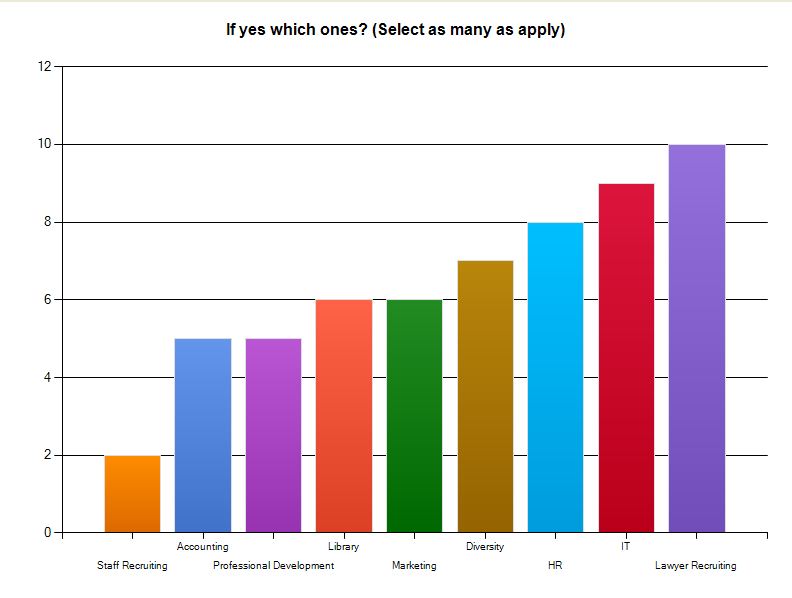
Describing services. Here are the services in rank order which are most commonly recognized on the firm website and provide some description of the value of the services.

1. Recruiting
2. IT
3. Human Resources
4. Diversity
5. Marketing/Library  (Tied)
6. Professional Development
7.Accounting
8. Staff Recruiting

It is obvious that clients choose firms for the expertise of  their lawyers not for their staff. However, in the current competitive environment, it might make sense for firms to highlight they ways they are leveraging people, process and technology as a differentiator.

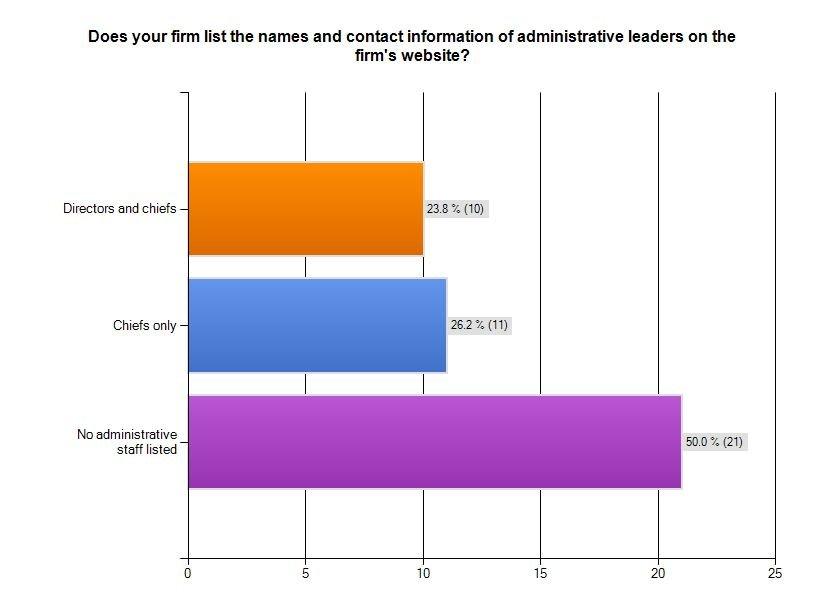
Contact Information Only about 1/3 of the respondents indicated that their firm provided basic contact information for their Directors or Chiefs.

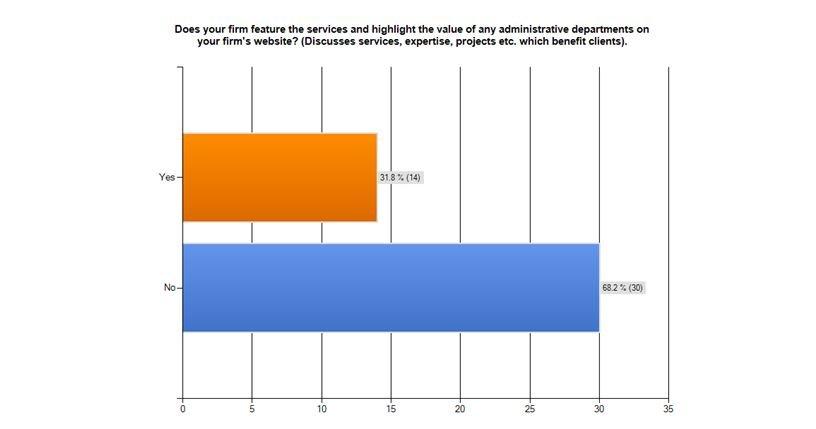
Feature Services. About 1/3 feature services provided by at least one administrative department.
Featured Services: Which services are featured on the firm’s website?

The January issue of Practice Innovations is out. Here is a list of the new articles:

Making Attorneys Champions of Data and Information Usage, Andrew M. Baker, Director or Legal Technology, Seyfarth, Shaw,LLP

You Can’t Manage What You Can’t Measure: A Sneak Peak at Westlaw Analytics, Brian Knudson, Vice President, Strategic Marketing, Thomson Reuters

Essential Technology for the Minimalist Lawyer, Conrad Jacoby, Senior Attorney, Winston & Strawn

Voice Activated Computing: Does it Really Work?, Don Philmlee, Legal Technology Consultant

Security in an Era of Mobile Devices and Cloud Computing Bobby Kuzma, President, Central Florida Technology Solutions.

At the Crossroads of Lawyering and Technology: Ethics Lynn Watkins, Deputy CKO, Hogan Lovells, LLP

Link to full PDF