American Lawyer Media’s Legal Week kicks off January 31st – February 2nd at the New York Hilton Mid-Town. In keeping with the Legal Week mission of providing programming more legal communities, they have added a track for Legal Pros which focuses on topics of interest to law librarians and legal
information professionals.

I will be speaking on the panel which kicks off the two day Legal Pro track.  The session, New ways for Law Librarians and Knowledge Managers to Become Indispensable also includes, Scott Baily, Global Director of Research at Squire Patton Boggs and Greg Lambert, CKO, Jackson Walker LLP. The panel will be moderated by Steve Marin, Principal, Gensler.

Other Programs include Business Intelligence & Analytics Tools for Legal Pros with a who’s who of legal tech start-ups. Josh Becker, CEO Lex Machina, Daniel Lewis, CEO of Ravel Law, Phil Rosenthal. President, Fastcase,Inc. and Michael Sander. Founder, Docket Alarm, Inc. Tools of the Trade: Negotiation Skills featuring Natalia Berdzeni. Exec. VP Chase Cost Management, Robyn Rebollo, VP, Chase Cost Management. Doing More With Less: Coping with Staff Reductions and M&As, Kimberly Council, Reference Librarian, Sullivan & Cromwell.  Marketing and Promoting Knowledge Management and the Law Library. Christine George, Faculty & Scholarly Services Librarian, Benjamin N. Cardozo School of Law, Yeshiva University.   Working With Vendors: Software and Soft Skills. Ifeoma Anekwe. VP, Project Manager, Legal Discovery Management, JP Morgan Chase & Co.,  Moderator: Mark Schwartz, Director Content Management, Law Library Management Inc.


Program information and registration here.

 

I just received the message below from  Jake Heller, CEO of  Casetext.   Casetext is  now offering free access to their premium tools to any lawyer involved in civil rights litigation.
 Casetext offers access to caselaw and crowdsourced annotations. I had previously reviewed CARA in a post “Citation Fingerprints, Celestial Footnotes and Opinion Sourcing : Casetext Launches CARA.”

The key features of CARA are:

  • Suggested Cases – identifies cases not included in your document, which should be reviewed for relevance before finalizing a brief.  A concise summary includes a citation and the case holding derived from judicial “explanatory parentheticals.” There is a direct link to the full text of the opinion on Casetext. If a lawyer is analyzing an opponen’ts brief – this feature could identify vulnerabilities.
  •  Most Cited Passage– identifies the most cited text from other opinions.
  • Insights –  provides links related law firm memos discussing the case. 
Dear Jean
The courts will soon set important and long-lasting precedents defining crucial
rights and liberties.  I believe that Casetext’s missions of making the
law freely accessible, and getting the best tools in the hands of the best
lawyers, are going to be critical in these cases.
This is why Casetext is offering free access to our full suite of premium
tools, including CARA, for litigators fighting for civil rights and civil
liberties.  If you are an attorney working on a civil rights case, request
free access
here.  
If you are fighting to defend our rights, our liberties, and the Constitution,
we hope CARA helps you in your litigation. You can learn more about how CARA
empowers litigators here.
Thank you,
Jake Heller
CEO & Founder

I asked Casetext CEO, Jake Heller to explain provide some further insights into today’s announcement. Here is Heller’s response: “This is an important time for the legal profession. We at Casetext believe ALL clients deserve the best representation, and that includes access to the best information and the best research tools. Most of our customers are of course in private practice — from the largest law firms to solo practitioners — but we want to give extended access to public interest lawyers as an acknowledgment of the fundamental issues before the courts today and in the coming months.”

P.S. If you are interested in CARA but not a civil rights litigator, you can
sign up for a free trial here or respond to this email for more information.

LexMachina is a system  exploding with data.
But Data doesn’t equal insights until you combine elements into a query. Data
analysis is pretty new to legal research and Lex Machina is on a mission to
keep making it easier for lawyers to extract powerful insights with minimum –
as in “no” training. It also enables lawyers to ask completely new questions.
The Lex
Machina system includes hundreds of data elements which can be combined in
thousands of permutations. Their modules currently cover, Patent, Trademark, Copyright, Antitrust,ITC and Securities Litigation.  
Today Lex
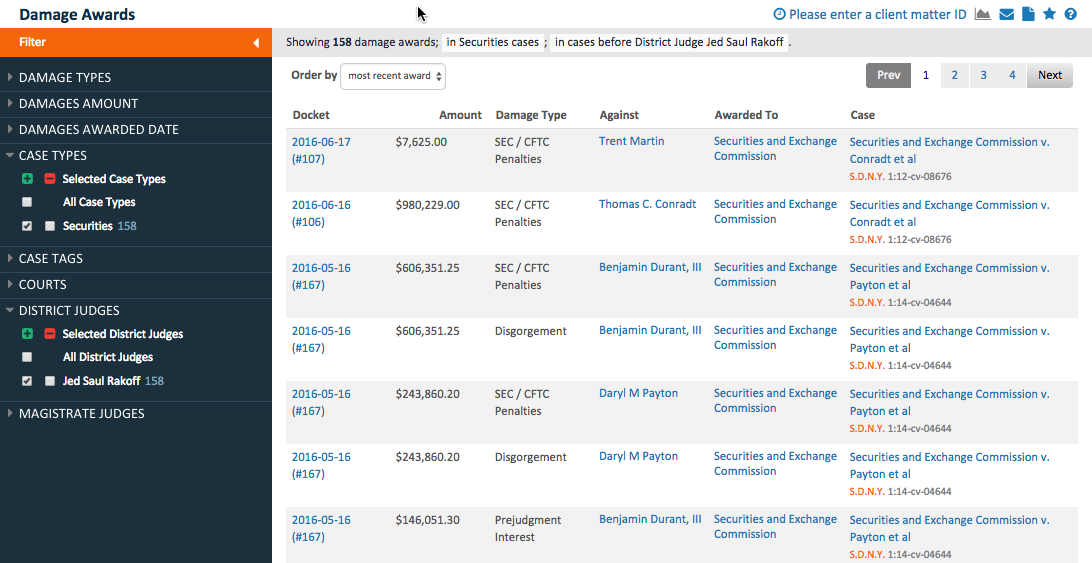
Machina is releasing two important new apps: The Damages Explorer and the
Parties Comparator which provide instant insights to litigators. Attorneys
can use both apps to quickly model different strategic approaches – using
information from the Lex Machina database  that previously would have taken weeks to compile using a team of researchers.
Damages Explorer delivers the first-of-its-kind ability to
expose,  compare and analyze individual
damages awarded. The app  can analyze
damages awarded by judge,  court, and  type of
damages. Sample reports include:
·
attorneys’ fees
in a specific district
·
infringement
damages awarded by a particular judge
According to the
press release Lex Machina has the only complete record of damages awards in
patent, copyright, trademark, securities, and antitrust cases since 2009. 

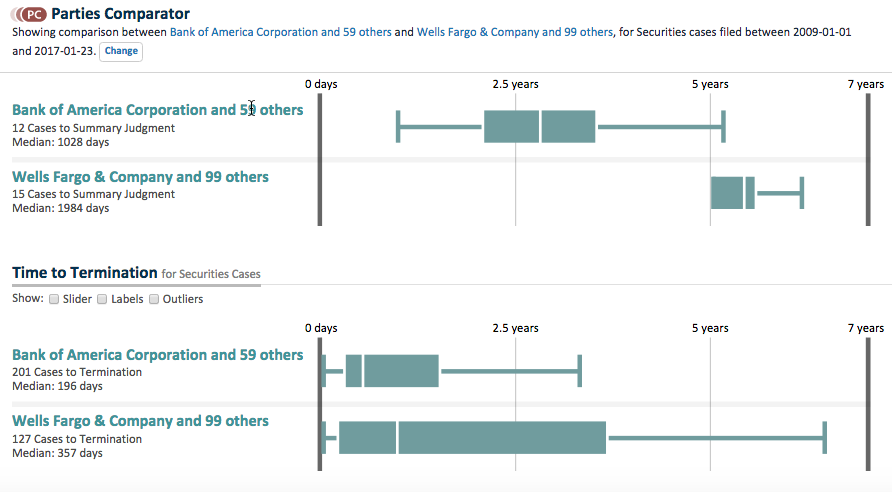
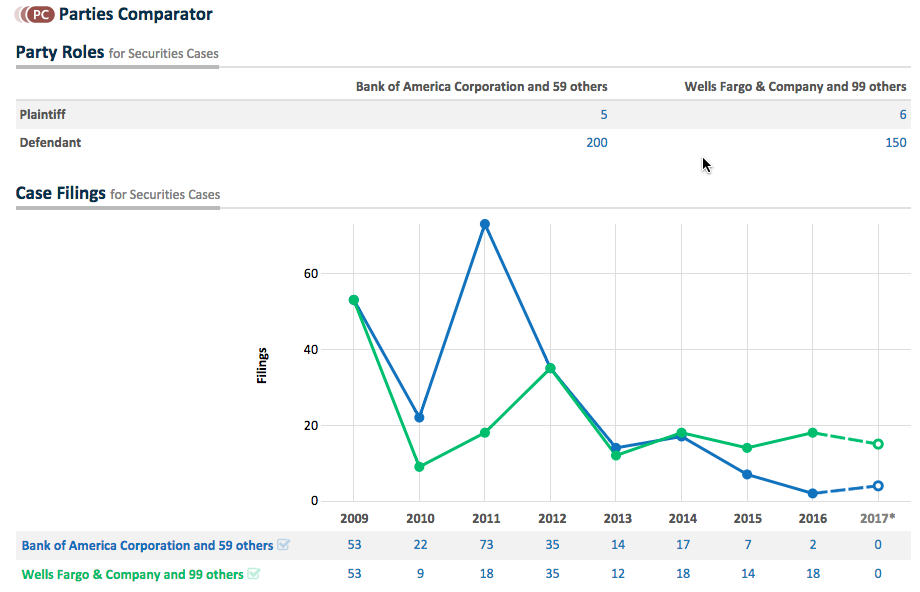
Parties Comparator enables  lawyers to compare parties  across multiple criteria, such as litigation
volume, performance, and outcomes. For each party being compared, the
application shows damages, remedies, findings won or lost and case timing
milestones.
Compare Litigation Timing By Party
Compare Case Filings by Party
The press release
highlights the value of this  app as
enabling GCs  to perform peer
benchmarking and for law firms to gain deeper insights into  clients and  to improve legal strategies.
From the PressRelease:
“Today, attorneys
need data-driven insights to make sound legal and business decisions. Our new Damages Explorer and Parties Comparator, deliver unprecedented
information within seconds instead of days or weeks,” said Josh Becker, Lex
Machina’s CEO. “Being able to easily explore the damages awarded in similar
cases, enables attorneys to gauge whether to pursue or settle a case before
setting foot in a courtroom. Similarly, the ability to analyze how opposing
parties or similar companies have fared in court can give attorneys valuable
strategic insights, instant decisioning capabilities, and a distinct
competitive advantage.”
The Lex Machina Suite of Apps. Lex
Machina’s previously released  Legal
Analytics Apps
(Early Case Assessor,
Motion Kickstarter, and Patent Portfolio Evaluator) and Comparator
Apps
(Courts and Judges Comparator and Law Firms Comparator).

In several prior posts I have reported on how legal publishers are preparing to cover the legislative and regulatory impact of the Trump Administration. Scott Roberts,  VP and General Manager of Law 360 Lexis Legal News provided the following summary written by the Law360 editors highlighting  the Trump Administration issues to be featured in  upcoming Law360 newsletters:
 Law360 Prepares:
The impact of a Trump presidency on the legal industry is likely to be significant and immediate. He has been clear about his desire to roll back and in some cases completely revamp a slew of regulations, which will likely lead to a serious uptick in legal work as companies work to understand the new rules and head towards implementation and compliance. 

As for specifics, Law360 will be closely watching these areas for immediate impact:

Supreme Court nomination: The most memorable impact on the legal community of a Trump presidency is expected to be the configuration of the Supreme Court. With at least one guaranteed Supreme Court justice pick and possibly others to follow over the next 4 (if not 8) years, President Trump could fundamentally alter the makeup of the Court for decades to come. His picks are expected to be conservative and business friendly.
President Trump has indicated that he will announce his SCOTUS pick within a a few weeks following inauguration. Law360 will cover his pick from a number of angles, ranging from the nominee’s likelihood of winning confirmation to the new justice’s likely impact on the court’s ideological makeup.
Repealing & Replacing the Affordable Care Act: President Trump has vowed to completely overhaul Obamacare, if not do away with it completely. Law360 will be covering the actual process of repealing and replacing the bill on Capitol Hill — and perhaps even more interesting for our readers, we’ll cover how the attorneys for health insurers, doctors, hospitals and all the other people and businesses impacted by the legislation are handling the changes and bracing for the aftermath. 

Immigration: This is another area that President Trump had signaled to impact from Day 1 and we’ll be watching closely to see how this is approached. In particular, it’s expect that President Trump will rescind immigration-related executive orders made by former President Obama. The Deferred Action for Childhood Arrivals program — which protects adults who were brought illegally to the US when they were children — is one that President Trump could jettison right off the bat. 

International Trade: President Trump pledged to renegotiate or exit a host of trade agreements, perhaps most notably NAFTA, during his campaign. He’s also threatened to impose hefty tariffs on companies that move manufacturing jobs overseas. 
EPA & Climate Change: It’s also expected that President Trump will likely move to defang the EPA and possibly exit or somehow alter the Paris Agreement on climate change. Environmental issues tend to be highly litigious and many anticipate lawsuits to follow if such efforts are pursued by the Trump administration.
While almost no area is “off limits” to potential scrutiny by the incoming Trump administration, Law360 expects these key topics to be the first reforms targeted following [last] Friday’s transition of power.

Every law firm has a hidden history.  Did you know that
the landmark gay rights case Lawrence v. Texas 539 U.S. 558 (2003) was litigated by Jenner &
Block’s and Lambda’s Legal Board Co-Chair Paul M. Smith? 

In
a world of tweets and blogs one  new legal publisher Twelve Tables Press is launching a rather
contrarian  project by publishing books  (yes I mean  – paper
pages sewn together between two covers )  which tell the story of how
leading firms and their members became  legends and influenced the development of the
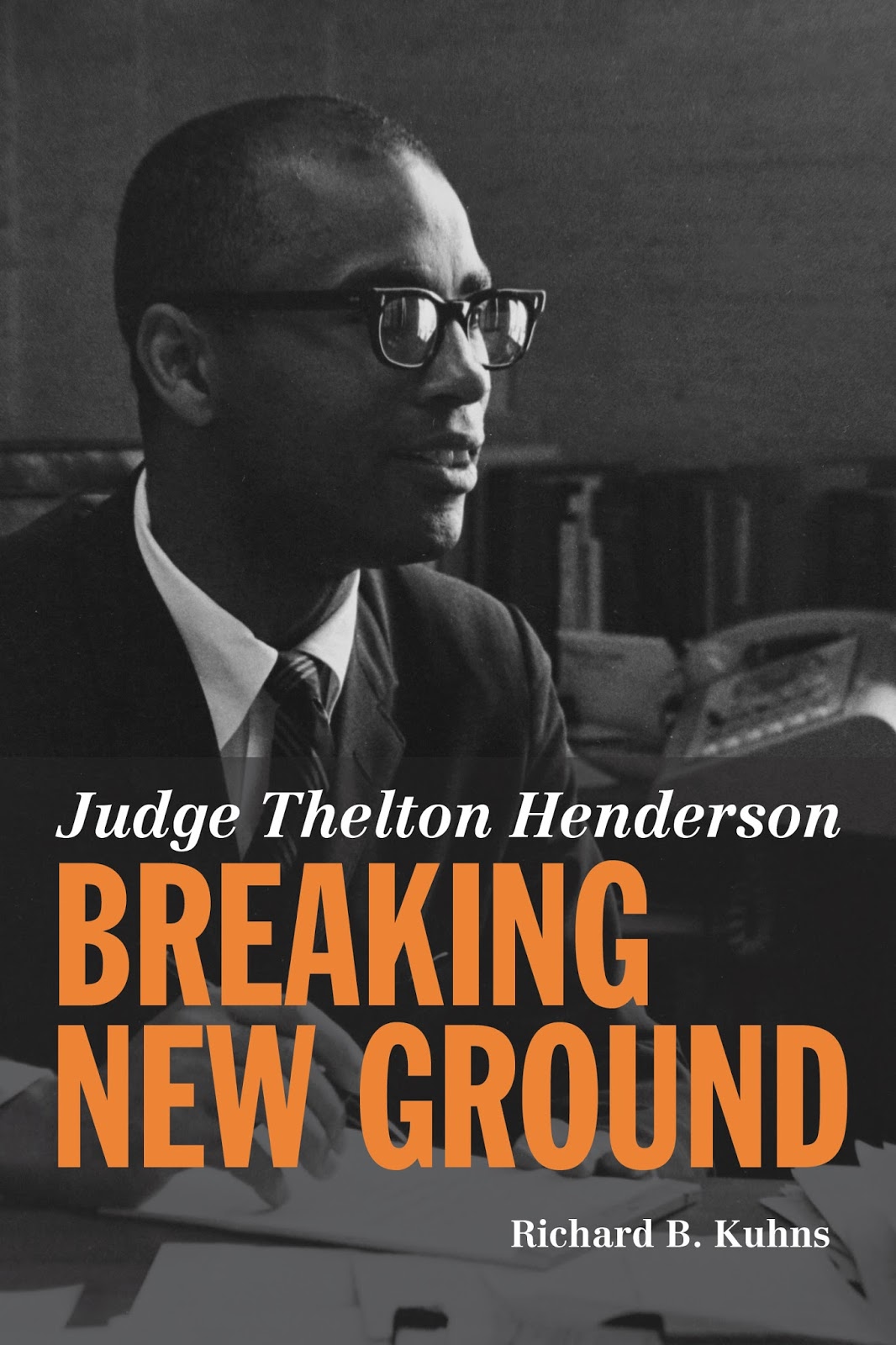
 law and the legal profession.  This series will be similar to their  Leaders in Law, which features leading
Judges and Attorneys. The first book of that series Breaking New Ground  focuses on a civil rights
lawyer, educator and jurist: Senior District Judge Thelton E. Henderson, of the
Northern District of California. Steve Errick’s Twelve Tables Press is preparing
to  develop a new series called Law
Firms & Legends
.

Law Firms & Legends  is a hardcover  and e-book series which
will focus on the top 100 ALM law firms and capture the stories of the founders
and leaders of each firm. Every law firm will  be able to recount the
unique role that the firm has played in shaping US law, social and political
history. According to  Errick the mission of Twelve  Tables Press is
to “showcase the compelling stories, the will and fight of individual lawyers,
law firms and judges bringing positive attention to the craft of lawyering and
the lawyers who have made a difference in United States legal
jurisprudence.”  The Twelve Tables imprint refers to the 12 bronze
tablets on which the earliest Roman codes were inscribed.

Beyond The Marketing Profile. Each
law  firm will have the opportunity to tell  eight  to
 twelve in-depth stories on the history of their firm. These stories will be
published in a single volume e-book and hard cover expected to be 200 to
350 pages each. Each title is designed to appeal to students and lawyers,
 legal history fans and legal scholars, and of course to firms showcasing
their history to clients. The series is positioned to have a wide appeal
 because each volume will highlight the thought leaders and
practitioners  in America’s most prestigious law firms and will tell an important
story about the evolution of legal practice in the US.  The series will be
marketed to all law libraries, colleges, law firm libraries, Amazon and other
book distribution platforms and partnerships.
 

Legal Publishing Pro Steven Errick,  the publisher of the series has an extraordinarily deep
and successful career in legal publishers. His resume reads like a “Who’s who”
 of major legal US publishers. He has been an executive at Lexis Nexis,
CCH Wolters Kluwer, Aspen legal Education, Foundation Press (West publishing)
and Warren Gorham & Lamont.


No Robots Just Real Lawyers
While members of the legal profession will remain active participants in social
media data streams, the  time may be right for law firms to offer a more
focused and deeper examination of their unique histories, especially
as law schools fight  decreasing student enrollments and firms fight
for the best and brightest students among a smaller graduating pool. ALM 100
 law firms have argued cases before the US Supreme Court, invented new
forms of corporate structure, helped write  constitutions and legislation,
provided leadership in social reform movements and invented new forms of legal
practice. As the legal profession continues to be buffeted by financial
and technological forces,  this series
will offer a sober reflection on the women, men and firms who  are still the
key drivers in the transformation of American law and jurisprudence.

 
For more information you can contact Steve Errick at: steven.errick@twelvetablespress.com.

 
“Uncertainty”
is the word which best describes the atmosphere in Washington, DC as the city
prepares for the new administration. This uncertainty is driving traffic
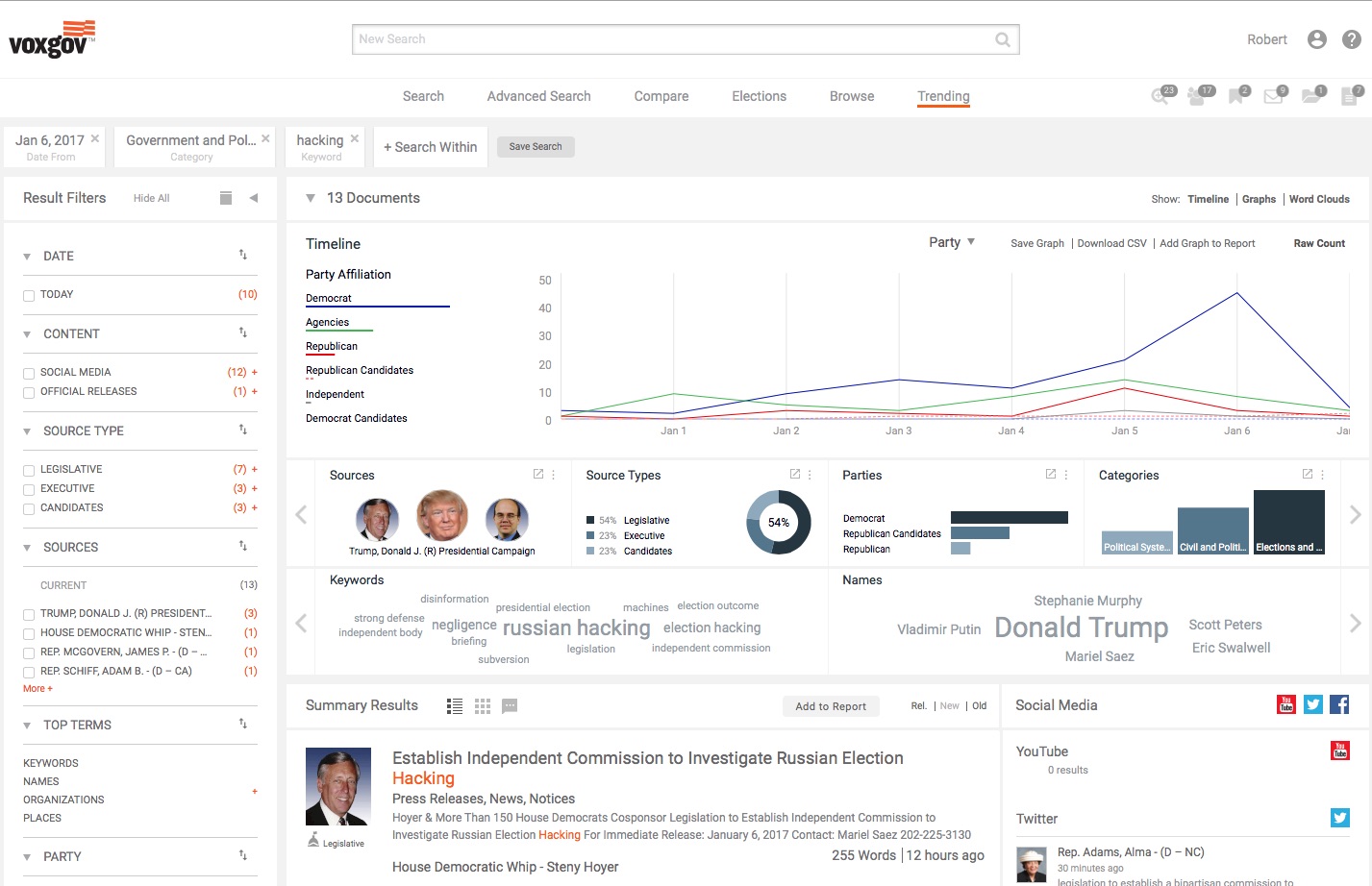
to  a relatively new product called  VoxGov.  The VoxGov website
offers a treasure-trove of hidden government data and an alerting system for anyone trying to understand
track  the statements and positions of government agencies and officials
related to  any issue. At last count Voxgov contained over 26 million government documents.

VoxGov “Hacking” trends
The
government information that lawyers normally rely upon such as statutes and
regulations only represents about 10% of the VoxGov database. The vast majority
of  government materials in VoxGov are collected from over 14,000 government
websites. The document types include: Press Releases, News, Notices, Columns,
Articles, Op-Eds, Decisions, Opinions, Orders, Events, Media Advisories, Fact
Sheets, Newsletters, Bulletins, Recalls, Alerts, Reports, Publications,
Speeches, Statements, Remarks, Testimony, and Transcripts, along with Social
Media from official government sources, Twitter, Facebook, You Tube and more.
VoxGov only collects information authored or adopted by the U.S. Federal Government and published  on official government websites .All of the data is enriched with extensive metadata which supports sophisticated filtering and trending.
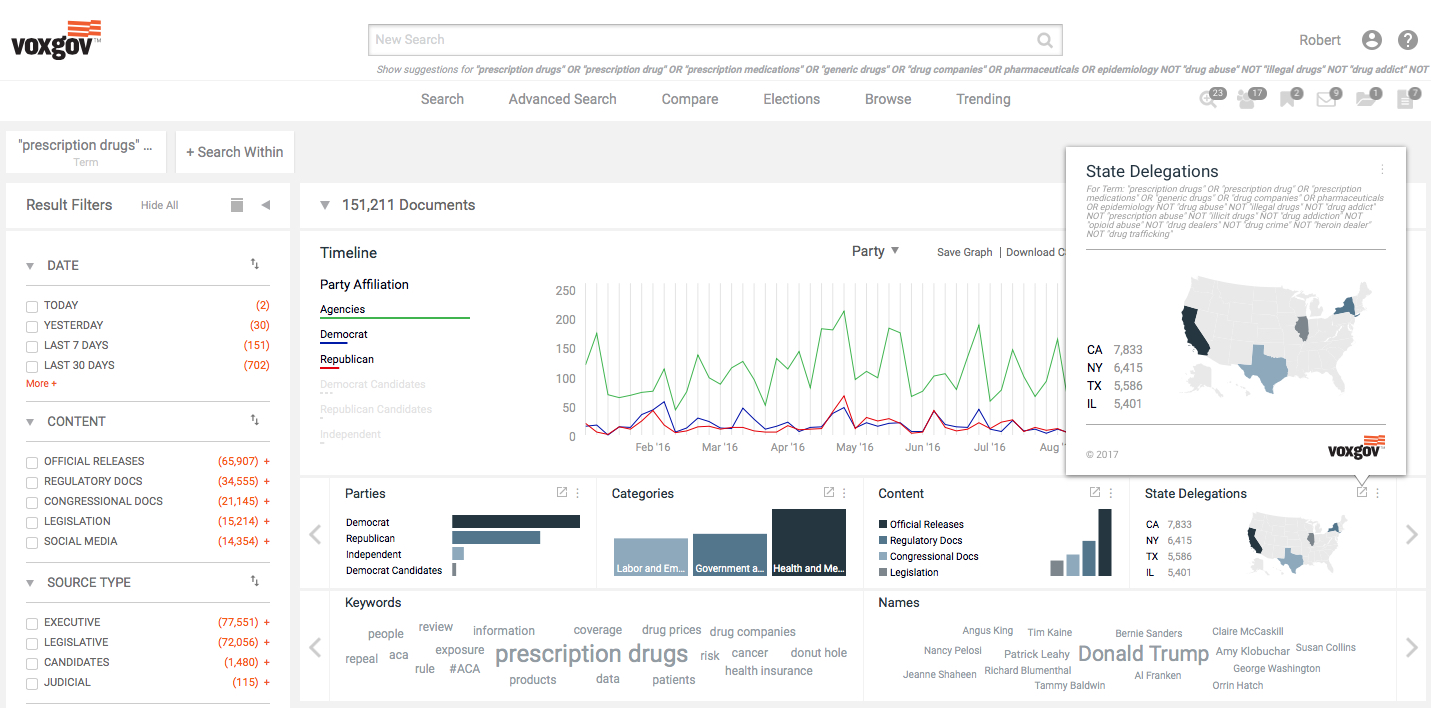
Prescription Drug – Tracking
VoxGov is the brainchild of an Australian
attorney Robert Dessau. After passing the New York State bar, Dessau  built a
successful consulting business working with Australian technology companies
seeking U.S. market entry. During this time he recognized the difficulty of
accessing valuable information  generated by agencies of the U.S.
Government. Based on this overwhelming need, Dessau has been dedicated to
building and developing the back-end systems and know-how for the VoxGov
platform that exists today.

Dessau
moved from collecting documents to analyzing trends and parsing the people,
agencies, parties and issues stirring the pot of government advocacy and
regulation. He built  a system for indexing and analyzing the reports and
data produced by over 9,000 US  government sources. Today VoxGov also
includes over 24 million social media posts. . Even though the US government has migrated
much of their standard legislative and regulatory materials online the vast
majority of government information remains hidden even though it is in digital
format.

No You
Can’t Google This Stuff.
Years ago I heard Ralph Nader remark that US
Government reports were a goldmine of data that no one wanted to read…. Their
plain brown covers and austere typeface screamed “boring.”  Those were the
bad old days before the digital revolution and for those of you who that
thought all government data was just a google search away from your
eyeballs….  Voxgov will show you just how wrong you are.  According
to Dessau less than 1% of all government documents are available on the web.
VoxGov’s proprietary technology visits over US government  14,600 web
destinations on algorithmically generated intervals, in search of new documents
published to any of these source sites.


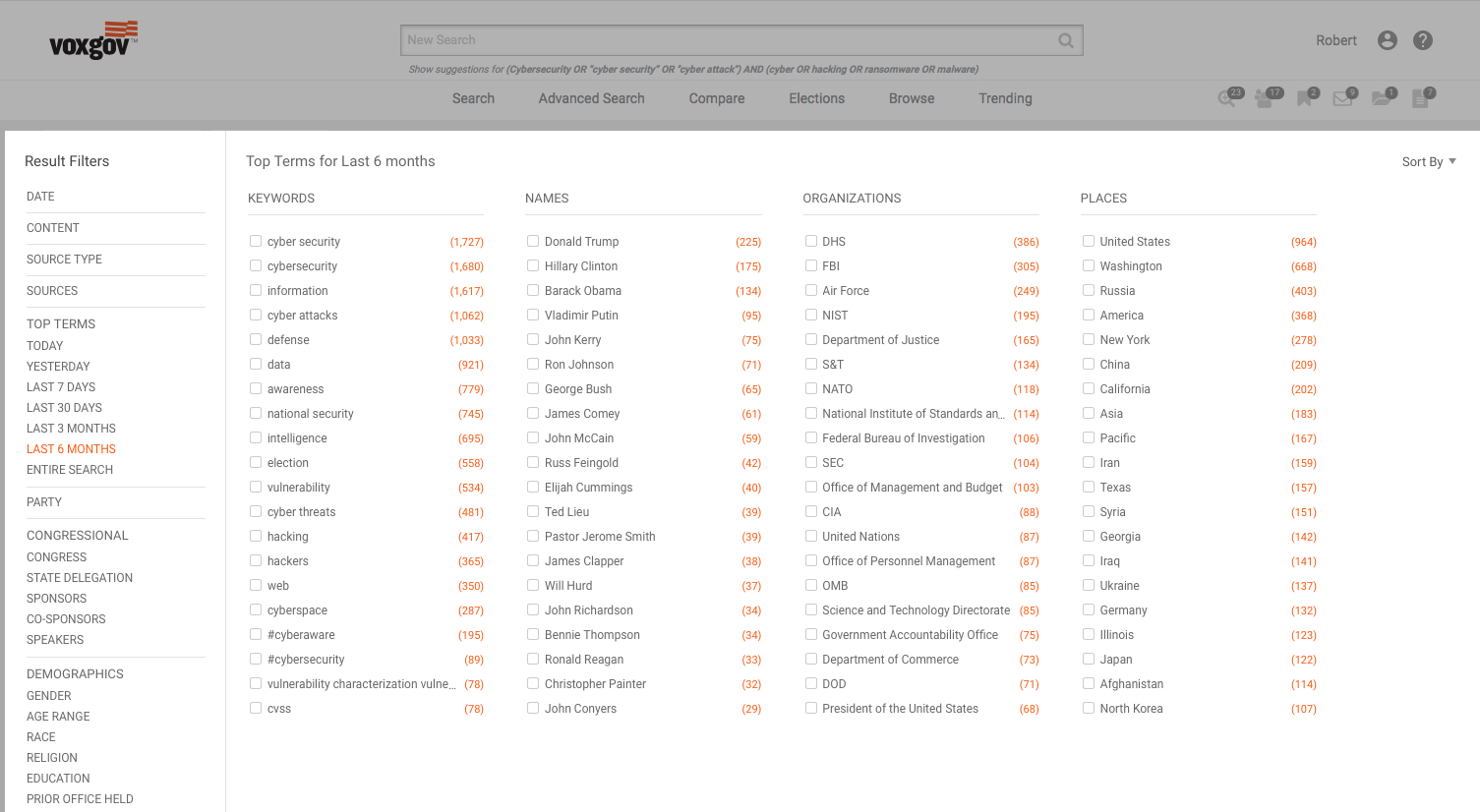
Cybersecurity- related terms, people agencies

The Trump Effect  In recent weeks Voxgov’s
phones have been ringing “off the hook.” The Voxgov  team has fielded
requests from  a wide variety of stakeholders needing to glean some
insights into the new administration. Inquiries include: A  city facing a
budget crisis if federal funding to Sanctuary Cities is withdrawn;  A bank
reading contradictory indicators on economic policy under the next administration; 
A pharmaceutical group preparing to navigate a new legislative and regulatory
environment.   According to Dessau, people are turning to Voxgov to
address  a common need  “for the ability to telescope into who in is
saying what on relevant and pressing issues in government.” 

What Do
You Need to Know
? VoxGov allows  users to analyze material generated by
government reports on any topic and to visualize the information using
timelines graphs and word clouds. 

·        
All of the data updates every 15 to 30 minutes.

·        
There is live trending of the most active issues in the past 24
hours.

·        
Measurement of tone of social commentary

·        
Everything in the system can be shared legally because it is all
public domain


Key Functions: 

Monitor

  • All branches of government
  • 9,000+ Sources
  • ~20K News Docs Daily
  • Updated 24×7
  • 50+ Document Types

Analyze        
Extensive use of data tagging and patented filtering technologies
provides unique views and insights including analysis trends over time

  •        
    Data visualizations
  •         
    52 Timeline Graphs
  •         
    Multi-year comparisons
  •        
    Extensive Document Tagging

Track      
Keep up to date with   custom-built tools that
enable easy sharing of valuable information across teams and third parties.

  • ·        
    Custom Feeds
  • ·        
    Save Searches
  • ·        
    Receive Alerts
  • ·        
    Compile Folders
  • ·        
    Generate Reports

Trend        
VoxGov highlights significant changes in issue activity levels
coming from within the government conversation throughout the day.

  • ·        
    Multi-Point Trending
  • ·        
    75 Trending Options
  • ·        
    15 Minute Updates
  • ·        
    Rapid Drill-Down
  • ·        
    Frequency Monitor

Responsiveness
to customer needs

Until
now, VoxGov was primarily marketed to academic libraries. When Dessau asked me
to evaluate the product for a law firm environment, I suggested that the alert
features needed to be  “fine-tuned” in order to appeal to practicing
lawyers who bill by the minute. Lawyers don’t want to be overwhelmed with
results they want to see the most relevant materials first and they want to
understand why a document is relevant to their interests. Within a few weeks,
Dessau returned and had implemented  almost all the new features I had
suggested including, sorting alert results  by relevance, highlighting
relevant keywords in alerts, automatically deduping results ( now handled by
grouping reissued documents under a single heading) , social media results are
grouped separately from government releases. 

VoxGov
is clearly a resource addressing the specialized need of lobbying and government affairs professional.  The product also offers unique materials for researchers and lawyers in any regulatory practice
as well as a wide variety of litigation needs. Litigators can use government materials
to locate experts, government studies and data to support or disputed facts as well as to pinpoint the timing of government actions. While the standard legal research systems, Lexis, Westlaw, Bloomberg BNA and Wolters Kluwer offer the  traditional primary sources for statutes and regulations, such as the US Code, the CFR, the Federal Register and the Congressional Records and Congressional Reports, none of them have taken on the development of an archive comparable to that amassed by VoxGov.
Correction: The original post which was distributed via RSS contained a mislabeled screenshot which has been corrected below. The “redliner” is a Wolters Kluwer feature, not a BNA feature. Jean

Wolters Kluwer and BloombergBNA’s editorial teams have built their editorial credibility on comprehensive and exacting tracking of US regulatory changes. The incoming Trump administration appears to be poised to shake up the established regulatory framework through both deregulation and statutory repeal. I reached out to executives at Wolters Kluwer and BloombergBNA to find out how they are preparing for the Trump Dereguation Agenda. Although both publishers suggest that preparation for this  transition  of government is “business as usual,” both publishers have issued special reports. In addition, Wolters Kluwer is planning some major editorial enhancements to existing products that will make tracking regulatory changes easier.

Dean Sonderegger, Wolters Kluwer’s  VP& GM, Legal Markets & Innovation provided a  statement from the WK editorial team:

Wolters Kluwer is poised to cover the legislative and regulatory impact of the incoming Trump Administration with the same level of timely, comprehensive, and objective analysis that has been our mainstay for decades. Ted Trautmann, Editor-in-Chief, states: “Nothing will change in our approach. What is different, however, is the magnitude of the new agenda — from repeal of Obamacare and Dodd-Frank, to massive reform of current tax, immigration, energy, and trade policy, to the rollback of signature rulemaking initiatives of the Labor Department, EPA, and other agencies, as well as many Obama Administration executive orders.” These potential changes, explained in a recent Wolters Kluwer white paper, are so sweeping as to warrant heightened vigilance to help our customers plan and prepare. Whatever awaits, the Wolters Kluwer team of experts is ready to help organizations navigate the changing regulatory landscape.


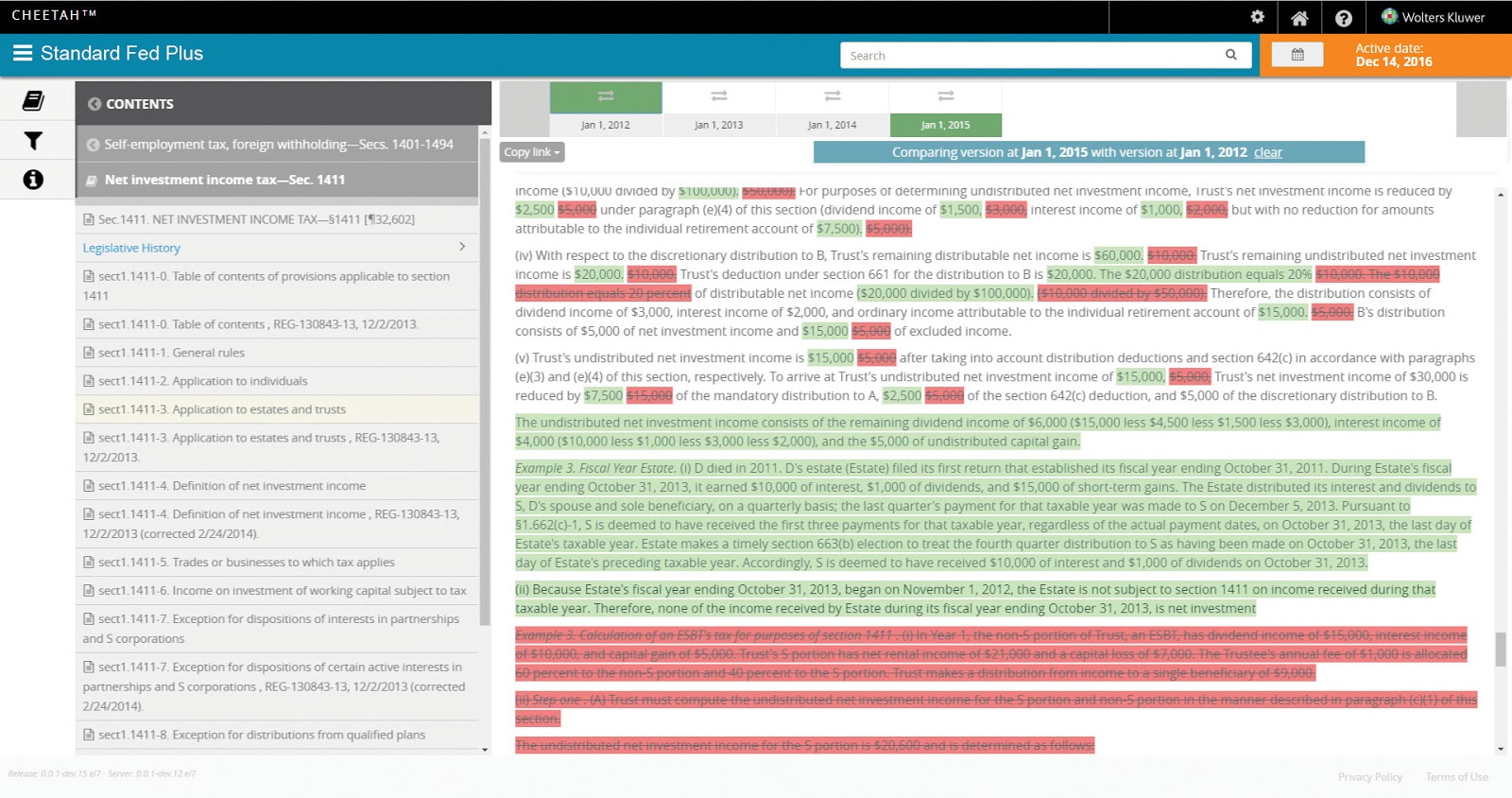
Wolters Kluwer Regulation Redliner

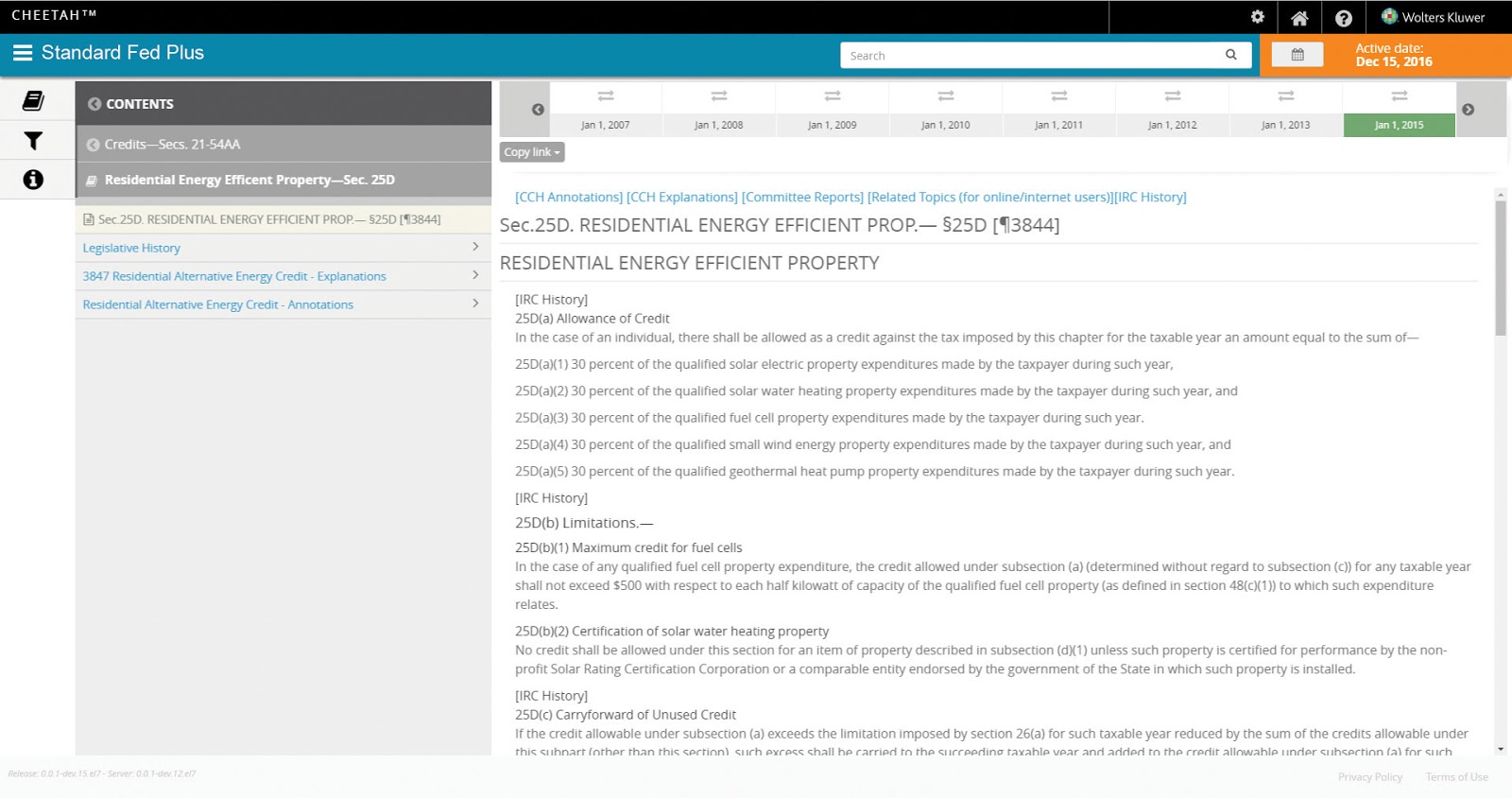
Right now Wolters Kluwer is not planning any new products to address the change in administration. Their statement underscored “our ongoing commitment to diligently track changes and update our customers as quickly as is possible…we do believe that it’s important to address the workflow that  attorneys and researchers utilize when dealing with legislative changes. To that end, we are enhancing our products that track regulatory events to enable researchers to quickly determine changes to laws, regulations and guidance and comparing those changes to particular points-in-time in the past.” In January, Wolters Kluwer will release  an enhancement to the Standard Federal Tax Reporter which they are calling “Standard Fed Plus.”

WK Standard Fed Plus -” Point in Time”  Changes

Here is a description of the product from the upcoming press release:
“Standard Fed Plus is a first-to-market, centralized, online product that helps tax professionals understand U.S. federal tax law changes. Standard Fed Plus provides point-in-time analysis that enables legal professionals to see legal tax changes in context, with redlining capability to visually show where changes have occurred at a point-in-time or to compare differences in the laws, regulations, guidance or commentary between points-in-time. It also includes a calendar feature to help attorneys more accurately and quickly research changes in the tax law back to 1986 and on a weekly basis going forward. The exclusive redlining feature of the Standard Fed Plus provides tax attorneys with a solution that increases the accuracy, efficiency and speed of legal tax research to enable them to more quickly understand legal tax changes and provide more accurate tax advice to clients. 

The BloombergBNA Approach: Outlook Reports

I  also asked BloombergBNA’s  new President Scott Mozarsky if Bloomberg BNA was making any special preparations for the Trump Administration. According to Mozarsky “Bloomberg BNA’s D.C.-based bureau of reporters and editors
will closely track Trump administration regulatory and enforcement changes in
all the key federal agencies.   In fact, before the election we were
reporting on what a Trump administration might do moving forward. “

Bloomberg Law subscribers will be able to get an early
preview of Trump’s agenda in a series of Outlook 2017 special reports,
including agencies regulating financial services, labor and employment,
international trade, privacy, health care, environment, the tech sector, and
telecommunications. Additionally, live events have been planned around several
topics that will feature Bloomberg BNA experts and thought leaders (see
Bloomberg BNA’s Outlook 2017 website for more information).

Here is the list of Outlook reports currently posted on Bloomberg’s Website.

For other topics, in addition to news coverage, Bloomberg
Law offers specialized regulatory alerts to monitor agency activities. Mozarsky noted that  the anticipated to the Affordable Care Act  will be tracked in
Bloomberg Law’s Federal Health Care Regulatory Alert  and environmental agencies can be closely tracked with the EHS Federal Regulatory Alert.

Bloomberg BNA is also releasing several regulatory trackers following federal
and state regulatory activity related to emerging technologies. Bloomberg Law
subscribers have access to these unique resources that cross jurisdictions and
agencies for technologies that will reshape industries. Examples include
autonomous vehicles and fintech.

A few ideas on what we might or might not see develop in 2017…. Thomson Reuters Predictive. 2017 has to be the year when Thomson Reuters launches a  predictive product for lawyers. Early in 2016 Thomson Reuters rebranded  itself as “The Answer Company.” They entered into  a relationship with IBM to gain access to IBM’s Watson artificial intelligence technology. Several months ago TR announced a predictive legal product for financial analysts.   TR has remained silent as their competitors large (Lexis/Lex Machina, BloombergBNA)  and small  (Ravel, Ross, CARA,LitIQ) launched a variety of headline  grabbing predictive and AI research products. TR has been quietly investing in their Innovation Labs.  TR owns all the same data which is driving their competitors predictive and AI products… so what are they waiting for? It has to be a predictive product that goes a step beyond their competitors – or they would have already launched it. Perhaps a product that combines transactional and litigation data? Perhaps a product that integrates predictive data into  a workflow/drafting tool? I can’t wait to see what it is.  I expect TR to be hosting an especially interesting launch party at the AALL conference in July. I hope I am not disappointed.

LexisNexis Will Not Purchase Any New Products in 2017. They will spend the year integrating all the  premium resources they have bought over the past 5 years (Lex Machina, Newsdesk,  MLex, Law360, Knowledge Mosaic,  Intelligize …)  into a single game-changing integrated platform. OK I don’t think this is actually going to happen – just putting it out there in case Lexis Nexis CEO, Mike Walsh is reading my blog today. I seriously think it is time to stop collecting the crown jewels of the legal market and start building some synergies between these resources.


BloombergBNA will Purchase WoltersKluwer or WoltersKluwer will Purchase BloombergBNA
It has been rumored that Mike Bloomberg planned to give BloombergLaw 100 years to  beat out Thomson Reuters and Lexis Nexis and become the dominant legal information product in the US. Bloomberg Law has been on the market for less than a decade and has faced some serious headwinds. By now, Mr.  Bloomberg  has certainly begun to notice that it is a lot  easier to get an investment bank to sign on to  a multi-million dollar subscription than it is to  slide a million dollar product into a law firm budget.  The zero based budget still reigns  in most law firms, so these two legal publishing giants WoltersKluwer and BloombergBNA  could benefit from combining their product lines. Both publishers have  been dominant players offering regulatory expertise and could gain  additional market share in a legal market competing to anticipate and track the regulatory uncertainties arising from the incoming Presidential administration.

Reinvent Government 1993 Style

The Trump Deregulation Watch  Shortly after  I  moved to Washington DC at the start of the Clinton administration in 1993,  President Bill Clinton launched the  Reinvent Government Initiative which was supposed to dramatically streamline regulation and shrink the Federal Register and the CFR– the official sources of all US regulations.  I recalled front page photos of  President  Clinton and  Vice President Al Gore posing with pallets  of the regulatory materials they planned to eliminate. Will the CFR actually shrink over the next 4 years?  Let’s look at history… in 1993 the Code of Federal Regulations was a 200 volume set. In 2016 there are 248 volumes. So the long term outcome of the earlier “Reinvent government initiative” has resulted in a 25% increase in the CFR volume count in the past 23 years.

Law Librarians will Put an End to Fake News By Creating a “Uniform System of Web Citation.” Just as judges toss briefs  which fail to cite authorities for all legal propositions, it is time to require  “news” websites to include cite-able authorities. Law librarians should collaborate on a new publication which  I propose to be called The Uniform System of Web Citation. This publication will include 400 pages of rules following the example of the “Blue Book” Editors. The “Blue Book” rule 18.2.1 on citing Internet sources  provides an  excellent inspiration point:
18.2.1 General Internet Citation Principles
(p. 180)

(a) Sources that can be cited as if to the original print source.


When
an authenticated, official, or exact copy of a source is available
online, citation can be made as if to the original print source (without
any URL information
appended). Many states have begun to discontinue printed official legal
resources, instead relying on online versions as the official resources
for administrative or legislative documents. The federal government is
also moving toward increasing access to online
versions of legal documents, though it continues to publish official
print versions.


(i)
Authenticated documents.


When citing to such materials,
The Bluebook encourages citation to “authenticated” sources:
those that use an encryption-based authentication method, such as a
digital signature or public key infrastructure, to ensure the accuracy
of the online source. Generally, an authenticated
document will have a certificate or logo indicating that a government
entity verified that the document is complete and unaltered.
If all fake news authors were required to read “blue book” style rules before posting  any “news” – sheer boredom and mental fatigue alone would dramatically reduce the volume of nonsense posted to the web.
 (Lest anyone mistake this blog post for real news – let me be clear – this is a suggestion — not a fact.)


Pop Up Law Firms Emerge in DC –  It will be HUGE!

Pop Up Law Firms in DC  Remember the Occupy Wall Street Camps which sprung up in parks around DC in  2011? I wouldn’t be surprised 2017 brings  “pop up” law firms to DC.  Law firms without DC satellite  offices know that something “huge” is about to happen in DC and they want to be part of the action.  In a nod to ongoing client demands for efficiency, smart  law firms will gain a DC presence without having to  spring for an $80 per square foot lease by establishing a “pop up” presence on the National Mall.
.

Every Law firm will Have Robot Lawyer – but they will not be practicing law. This new breed of robot will drive lawyer efficiency by having one function — they will be  password robots. They will  troubleshoot all password problems and be the repository for all 1,000+ passwords which the average

lawyer  manages in order to access everything from the law firm network, to their  daily news subscriptions, CLE training,  health care accounts, voicemail, meal accounts, travel reimbursement accounts, the spam blocker account, the time and billing account, client extranets and the 500 specialized research platforms each lawyer needs to practice law. Password robots will reduce time wasted on lost passwords, password resetting, trying to remember the password you made up 2 minutes ago because it conformed to the 16 arbitrary criteria required for reset and has no mnemonic qualities,  mandatory password strengthening exercises, clearing cache of old passwords, synching mobile and network device passwords and replacing laptops which have been flung across the office in frustration at the appearance of a random  “your password has expired message.”  Password robots are expected to boost lawyer productivity by recovering 10 to 20 hours of wasted time per month which translates into an estimated $100,000  increase in annual billable time per lawyer.

And it none of this happens… there is always next year.

I needed a “DC detox” so I have spent my holidays in the mountains of Jackson Hole, Wyoming. Not turning on the cable news. Not watching tweet streams. I ended 2016 with a “living Christmas Card” experience… taking a two hour dog-sled ride… in sub zero temps..in a snow storm… through the wilderness of the Grand Teton Mountains.

I definitely recommend adding this to your “Must Do List.”

Enjoy  26 seconds of that ride:

Legal Notice Caveat – I want to warn you that the legal notice  you are asked to sign is scarier than the ride itself. As I scanned the document I noticed the warning of “run away dog teams.” I assume that the rest of the list included things like:  avalanches; unexpected encounters with large stationary objects (boulders, trees); unexpected encounters with large  moving objects (snow mobiles, plows); unexpected encounters with wildlife (bears, cougars, wolves), sudden ejection, sled rollover…getting separated from your guide and lost in a blizzard…..helicopter rescue experiences…

Thanks to the Continental Divide  Dogsled  Adventures musher and guide Billy for a fantastic close to 2016!

Happy New Year! Wishing you a wonderful 2017.

I am sure I am forgetting some major issues and trends but it has been a bruising year for me personally and for the country in general. I am intentionally avoiding politics… too much which is simply inflammatory has been said already.

goodbyeIt does seem as if there was an unusual number of “iconic achievers” passing on — whether you liked them or not — Justice Scalia, Fidel Castro, Nancy Regan, Mohammed Ali… all left their mark.  I was particularly saddened by the deaths of … a favorite author- Pat Conroy; a favorite singer/composer – Leonard Cohen;  a favorite actor – Alan Rickman; and  shocked by the sudden passing of the mother-daughter “odd couple” Debbie Reynolds and Carrie Fisher. I digress…

Here are the  issues that have bubbled to the top as I have reflected on the legal publishing industry and the issues impacting legal information professionals in 2016.

In My Humble Opinion…..

The Most Over-hyped  Legal News Headline: “Robot Lawyers.”  oh pul-ese! I routinely talk to legal start-ups and it has become abundantly clear that they could generate months  of hyperbolic news copy if they were marketing nail clippers for lawyers…all they have to do is add the word  “robot”   to their marketing materials.

The Most under-hyped  Feature Award – “Westlaw Answers” is really quite cool and yet not only did TR fail  produce a “robot lawyer” press release, they have barely told their customers that it exits. It is buried on a  Recent Enhancements page.

The Oops Award –   In April Thomson Reuters  alerted  Westlaw subscribers to “non material” caselaw errors in over 500 cases, caused by a software glitch.

The It’s About Time Award – Goes to the US Congress for finally appointing a  female to be  the Librarian of Congress:  Carla Hayden. Extra points because the is an actual MLS credentialed librarian,  who had worked in public libraries before being appointed to  lead the world’s greatest library.

The  One More Jewel in the Crown Award – Goes to Lexis  for continuing its acquisition strategy by adding yet another high quality product — Intelligize to it’s portfolio of premium content.

The “I Saw Brexit Coming Award”  is shared by Wolters Kluwer  for publishing the first Brexit treatise and MLex for the first Brexit Newsletter.

The “Whoopee Cushion” Award – Is shared by law firms which outsourced knowledge strategy and the consultants who sold them this lame “library solution.”  Process can be outsourced, but effective strategic planning for knowledge services requires a seat at the management table. Shame on the consultant-purveyors of this short-sighted,  self-serving strategy and shame on those law firms who bought it.

Don’t Mess with Librarians Award – I can’t help but think that he was just having a bad day. But David Perla’s “Gatekeeper” post on the Above the Law website launched  a  tweet storm of outrage. The post appeared to be an attack on the key decision makers in law firm knowledge strategy and procurement. Maybe there is no connection but….shortly after the post blew up  the blogosphere, Scott Mozarsky replaced Perla as President of Bloomberg Legal Division.

Show Them the Money Award – AALL releases a Digital White Paper “Defining ROI: Law Library Best Practices” offering practical  tools for measuring and defining the ROI  of law libraries written by leading information professionals. (Disclosure – I was an editor of this publication)

The Internet Legal Research Reality Check Award– Sarah Glassmeyer for her thorough  examination of the  risks, quality and content limitations of state legal materials on the open web in her 50 State “census.”

Knowing When to Move On Award – goes to American Lawyer Media which I hope will take my advice to have published it’s last Annual Law Library Survey in 2016 and replace it in 2017 with a forward looking survey focused on Law Firm Knowledge Services and Strategy.

We are Still Not For Sale Award – Goes to Hein Online for remaining an independent company which produces high value, reasonably priced resources for the legal community.

The Half a Loaf is Better Than No Loaf Award goes to AALL President Keith Ann Stiverson and the AALL Board for salvaging the “rebranding initiative” when the members rejected the “Association for Legal Information” name change. The Board quickly moved to adopt  an updated logo: AALL/Your Legal Knowledge Network.

If any of you want to submit your own awards the  for outstanding/outrageous highlights and lowlights of 2016 I will add them to the list – with or without attribution.

Reader Contributed Awards:


How
about the OMG, Sock-It-To-You Award to Bloomberg Law for penalizing
firms with modest Bloomberg Law seat license numbers, doubling costs for
librarian access, and pumping up the cost of their legacy-to-practice
center -Brenna Louzin