I had the honor of being awarded a “Presidential Certificate of Appreciation” by outgoing AALL President, Keith Ann Stiverson,  at the Annual Meeting of the American Association of Law Libraries Meeting in Chicago on July 18th.


The award recognized “dedication to serving the profession since 2011 through her blog, Dewey B Strategic and for the hard work that distinguisher her, resulting in singular contributions to AALL and to the profession.”
It certainly was my intention to highlight the value of information professionals when I launched the Dewey B Strategic in 2011. I could not have foreseen the speed with which the economics of law and emerging technologies would transform the competitive landscape.  We face unprecedented threats as well as unprecedented opportunities for those who seize the challenge.
My thanks to Keith Ann Stiverson and AALL for the honor of this recognition to Dewey B Strategic.


Today Lex Machina launched the first
analytics product for securities litigators at event in New York City, which was held at the Park
Avenue Gansevoort Hotel. I had the opportunity to attend today’s event featuring two of  Lex Machina’s top executives. Josh Becker, CEO introduced the company and Owen Byrd, Chief
Evangelist and General Counsel, provided an overview of the unique features
offered by the new Lex Machina product. I  was asked to provide a “wrap up” commentary on the
evolution of legal research. My comments include a prediction of the
convergence of several technologies around analytics over the next 5 years. 

Practice Area Expansion.This launch marks the first new practice area since the initial launch of the IP product in 2011. The development of analytics for new practice areas was driven by access to the massive resources of their parent company LexisNexis.  The securities module will be followed by several new modules including: antitrust, commercial, product liability, employment and commercial bankruptcy.

The Lex Machina press release can be seen here. They also released an analysis of securities litigation in 2015.

At this morning’s event, Josh Becker traced the company’s
history from not-profit at Stanford Law School into a small company powered by
venture capital, through it’s acquisition. In 2015, LexisNexis purchased Lex Machina for an undisclosed
sum. Lex Machina originally  focused  exclusively on federal intellectual property
litigation. over the past five years more than have of the Amlaw 100 firms and dozens of corporations have become Lex Machina subscribers. Private firm attorneys and in house counsel have leveraged Lex Machina to analyze data regarding judges, lawyers, parties and litigation history in order to predict behaviors and outcomes.

Owen Byrd highlighted the new features
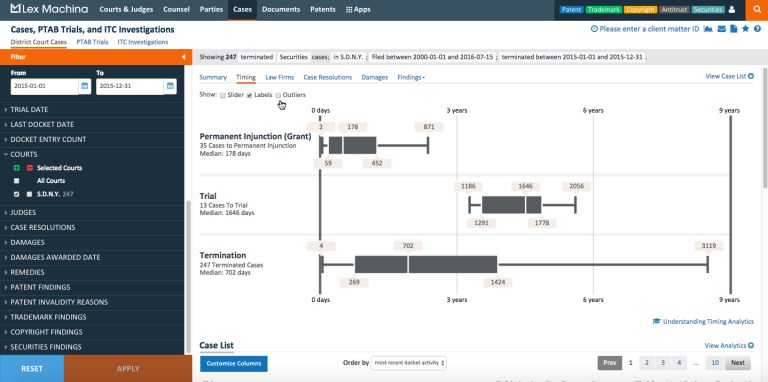
and fields which are unique to securities litigation. The current data set includes 15,000 securities cases and over 1 million docket entries. 
Cases Covered: The product analyzes
all cases brought under all of the major securities laws (the 33 Act, the 34
Act, Trust Indenture, Investment Company, Investment Advisors, Sarbanes Oxley,
Dodd Frank and several other laws. The product does not include cases brought
under the Commodity Exchange Act.
Case Types include: Class Actions, Class
Action Opt-Out, Government Plaintiff, SEC Enforcement: Settled Complaint, SEC
Enforcement: Contested, Securities Fraud (§ 10(b) / 10b-5) and Shareholder
Derivative Suit.

Damages Include: SEC Penalties, Disgorgement,
compensatory damages, Approved Class Action Settlement (Securities).

Securities Damages
Findings include: Securities Act
Violation,  Exchange Act Violation, Other
Securities Act Violations, Statute of Limitations Defense, Plaintiff Knowledge
Defense, Cautionary Language / Safe Harbor Defense.
Securities Findings 
All of these filters can be combined
with courts, circuits, judges, companies, lawyers, motion types in order to produce
interactive custom charts and lists which can be used for developing a
litigation strategy or to position a lawyer for a client pitch.

Typical reports include: judge’s behavior,
average time to trial, case outcomes, evaluate opposing counsel, understand
settlement rates and win/loss rates for parties and counsel.

Lex Machina’s analytics can serve “double-duty” in both business strategy and litigation strategy.  As lawyers compete for a limited pool of corporate clients, analytics can provide powerful insights into  law firms as both beauty contest competitors and courtroom adversaries.

Ten years ago, federal litigation data was limited to workload statistics and average time to trial by jurisdiction and judge. And that data was at least a year old! Today Lex Machina provides desktop access to near “real time”  data which can be combined  with dozens of criteria in infinite permutations. In the new world of litigation analytics lawyers  are given the power to ask completely new questions and discover completely new insights. I predict that in 5 years, analytics insights like those offered by Lex Machina, will be  viewed as a standard practice tool for lawyers. Lex Machina  has the advantage of being the first company to bring analytics to the desktop of litigators. The closest legal analytics competitor is Ravel Law which  has a somewhat different focus on the offers analytics focused on “precedential analysis” of judges opinions. As the demand for analytics grows new competitors are sure to follow.  But for today, Lex Machina has placed its flag in two practice areas: IP and securities litigation and owns the lead.

The ABA Journal is seeking
nominations for the 2016 “Blawg 100” which recognizes the best legal
blogs. If you would like to nominate
Dewey B Strategic or any other favorite law related blogs,
fill out the form at this
link


 “Friend-of-the-blawg” briefs are due no later than 11:59  pm CST on August 7, 2016..

About Blawg 100 Amici:

The ABA has outlined these parameters:

We’re primarily interested in blogs in which the author is recognizable
as someone working in a legal field or studying law in the vast
majority of his or her posts.
• The blog should offer insights into the practice of law and be of interest to legal professionals or law students.

The majority of the blog’s content should be unique to the blog and not
cross-posted or cut and pasted from other publications.
• We are not interested in blogs that more or less exist to promote the author’s products and services.

The ABA Journal  accepting “friend of the Blawg Briefs” for the 10 annual ABA Magazine Blawg 100 list.

Fastcase has just released their sixth annual Fastcase 50
list “which honors the law’s smartest most courageous innovators techies
visionaries and leaders.” I must be doing something right I know or have met
many of the innovators on this list. I am always excited to see colleagues and friends get this recognition, but it is also fascinating to discover who is behind companies, organizations and ideas which are changing the legal landscape. Congratulations to all of members of the “Class of 2016.”  Thanks to Ed Walters and Phil Rosenthal, Fastcase co-founders, for inventing this vehicle for keeping us all inspired!
 The list is definitely worth a read – – learn about innovators
and wonder –maybe your idea is worth pursuing. Who was the project manager behind the implementation of
Congress.gov legislative database? Did you know that an attorney wrote  the “Solicitor General’s
Style Guide”  which is better than “the blue
book.” There is an  octogenarian Scotusblog reporter  who literally “wrote the book” on reporting and
the law. If you are wondering “what is Codex” and “who is this Ross guy ?” Read on…
The information professionals
Janet Accardo, retired Library director at Skadden Arps
Slate Meagher and Flom LLP…  A long time
friend and colleague.

Robert Oaks retired chief library and records officer,
Latham and Watkins. A legend in DC.

Catherine Bowie, state law librarian and, or gone judicial
department- in partnership with fast case and Hein online launch the first
statewide access to case law and law reviews for all citizens of Oregon.

The Geeks
Andrew Arruda the CEO and co-founder of Ross intelligence.–
I will be introducing Andrew at an AALL  conference panel next week entitled quote “can
robots be lawyers? “

Jamison Dempsey cofounder of DC’s legal hackers and
associate at Kelly, Drye and Warren LLP. I am pleased to say that I am a member
of the DC hackers– well actually I’ve been on their mailing list and I have
been to some really interesting programs they opposed. Amazing to see young
kids right at a law school inventing self-help technology solutions.

Zev Eigen, global director of data analytics, Littler Mendelson.
I have heard Zev speak– smart and
incredibly funny.

Michael Genesereth and Roland Vogl  Stanford Professor and  Executive Director at Stanford Codex –Ground Zero for so much legal innovation.

Tammy Nelson, senior project manager Library of Congress.
Led the 40 person team which created the new Congress.gov website which replaces
THOMAS.

Kevin O’Keefe CEO and founder, Lexblog. Kevin has made a career of c.halllanging lawyers everywhere to sit down and blog… Uh-oh  I owe Kevin an email, better get on it.

Michael Sander, CEO Docket Alarm. I met Michael when he had
a booth in the Codex  Aisle at the 2015 Legal
Tech meeting in New York. Pretty nifty product was included in my post about
the Codex Aisle.

The Writers

Lyle Denniston, supreme court reporter and blogger who
literally wrote the book on reporting and the law.

Jack Metzler attorney, Federal Trade Commission. Anyone who
can write a style guide which overshadows the blue book is okay with me. Metzler
authored the solicitor General’s Style Guide and the Supreme Court Style Guide.

Michelle Olsen, Creator @AppellateDaily…play by play court side commentary at the Supreme Court.
 Law360 just announced that they will be breaking out the
champagne to celebrate their “Golden Tour” at the AALL Annual Meeting and
Conference in Chicago July 15-19, 2016. The festivities will mark the release
of Law 360’s 50th specialty newsletter as well as the release of
their In Depth news publication.
Law 360’s Newsletters 2004-2016
When  I interviewed Law
360’s founder Marius Meland  for an
earlier post “The Improbable Rise of Law 360…”  Meland described Law 360 as ”selling
awareness.”  The simple design featuring
headlines and brief summaries on a field of white – was intended to allow
lawyers make a qick scan of the daily update and  feel confident that they were aware of all the  major
developments and players of the day in their practice area.
Expanding Breadth
When I wrote my original post in 2013,  Law
360 had just been purchased by Lexis-Nexis. Meland expected  Law360 to remain on a growth  trajectory… adding additional newsletters and
enriching stories with material from other LexisNexis resources. Since August
2013 Law360 has released 16 new newsletters covering both practice areas and
industry sectors. With the release of the “Trials” newsletter, Law360 reached  50 newsletters focused on 27 practice areas, 17
sectors and 6 jurisdictions. They have
also developed 11 specialty rankings including topics such as rising stars, diversity and practice groups of the year. Such surveys have become “must-read” staples of the large law firm
competitive landscape.
Articles Published. According to the chart below, Law360 increases the number of stories published by 20 % each year. Since their birth in 2004, Law360 has published over 56,000 stories.
Readership has also grown. Law 360 now has over 300,000 individual subscribers in
about 5,000 organizations including all of the AmLaw 100 firms. Their web
traffic has reached 2 million visitors and 5 million page views a month. Their
staff has grown from 152 to 217 reporters and editors working in news bureaus
across US. This fall they will be launching a global news bureau which will
initially be based out of London.
Articles published
Expanding Depth While
law 360 remains committed to their original format of presenting brief summaries
of important news in their newsletters, they are now pivoting toward adding
depth of coverage.  On June 11 they
quietly launched In Depth, a weekly  news magazine that will provide deep analysis
of hot topics and legal developments.  The
press release stated that the new publication would offer hard hitting
journalism, long form investigative pieces and op eds from legal influencers. The
first issue covered  the “hot topic” of legal billing and focused on the “widening rate chasm in the
legal industry where stagnant hourly billing rates stand in stark contrast to
the staggering new rate high of $2,000 an hour.”
 Last week I had the chance to
talk to the Editor in Chief – Cat Fredenburgh about  Law 360’s pivot to “In Depth.”  Fredenburgh  explained that the idea for In-Depth arose from
conversations with their editorial advisory board members who are practicing
attorneys. Interviews suggested that lawyers were clamoring for deeper coverage
of important legal issues. Fredenburgh sees the publication as being analogous
to the New York Times Sunday Supplement. It doesn’t replace the daily news, it
provides something different. Right now the In Depth publication is free to existing
Law360 subscribers but at some point, In Depth will become a “fee based” subscription. Before setting the price, they might want to consider that  BloombergBNA offers similar content in Big Law Business  and Thomson Reuters offers Legal Current which are not only “free” publications but available to anyone–even non-subscribers.
 The In Depth Team. The managing editor
Christine Hall field and Assistant managing editor Jocelyn Allison are managing
a growing team of feature writers which includes Natalie Rodriguez, Max
Stendhal, Erin Coe, Ed Beeson and Sindhu Sundar and the senior feature editor
Jeremy Barker. There are two photo graphics editors Chris Yates and Jonathan
Hayter. The managing editor for third-party content is Christian Lewis,who also works on the magazines op ed features. The Law 360 In Depth reporters include some of
the most experienced Law 360 writers and each has a unique specialty covering
specific legal issues.Law360 has a track record of writing their own rules and bucking the trends. It will be interesting to see if they can move their “high stress” audience of headline scanners to consume longer and and deeper articles… and pay more for the privilege.

Several publisher’s responded to Tuesday’s
“Brexit” post  by providing me with information and links to their specialized Brexit resources which I share below.  Let me first say that I never meant to imply
that the major legal publishers were ignoring Brexit. Of course they are not –
in Tuesday’s post I  was simply speculating  on the expected emergence
of  hyper-specitalized publications completely devoted to Brexit issues.

I am not
disappointed – not only did I learn about a publication which may be the first Brexit legal
newsletter- but I have received valuable insights into how various publishers
are supporting lawyers need for insights and expertise regarding the vast range
of issues potentially impacted by Britain’s departure from the EU.


 MLex:
Brexit Market Insight Service
 

It appears that MLex
which was recently purchased by LexisNexis is  the first legal publisher to offer a newsletter devoted to all things Brexit.  The “Brexit Market Insight Service.”  which focuses on regulatory riskis part of the fee based MLex service. However “Brexit Market Insight” is currently available for free and will remain free through the end of July.

Thomson Reuters


Thomson
Reuters Practical Law team has published a special report on Brexit : UKVotes out Après Nous L Deluge.  The Thomson Reuters News Team has published EverythingYou Need To Know About Brexit.
 BloombergBNA


I
have seen a number of Brexit stories on BloombergBNA’s free daily “Big LawBusiness.”  No surprise, the editors and
writers of their many specialized regulatory publications are examining Brexit issues
impacting tax, labor, manufacturing, trade and environment. Brexit related materials
can easily be located entering the word “ Brexit” into the search box at
BNA.com.Even though BNA’s publications require a subscription some Brexit stories can read outside the paywall. Click here to see some of BNA’s Brexit stories


Manzama:
Curated Brexit News


Last
but not least, today Manzama which bills itself as a listening platform  announced  the availability of preformatted “suite of Brexit queries” for subscribers to want to easily “listen
for” Brexit news. While Manzama is not technically a legal publisher, they are an increasingly important player in the legal market by allowing information specialists to develop targeted alerts focused on legal and business issues which are delivered to lawyers as a custom newsletter.
 Wolters Kluwer  has won the “Brexit  Legal Publishing Sweeps” with their  title “Britain Alone! Implications and Consequences of United Kingdom Exit from the EU”
When the citizens of the UK voted in favor of leaving the
European Union last week, they unleashed a firestorm of “news” and commentary consisting
to two major elements- a litany of negative speculations and a conclusion which
can be summed up as “no one really knows.”  One legal publisher who I spoke to today
confessed to having “Brexit fatigue.”   The need for solid legal commentary and analysis will not abate any time soon. The market is ready for some deep legal analysis from experts, how will the major legal publishers respond? Have they already responded? I took a brief tour of their websites to see what may be in their publishing pipelines.
Yesterday, I was pleasantly surprised when a colleague
pointed out to me that Wolters Kluwer International had already published a book in January 2016:  Britain Alone! Implications and Consequences of United Kingdom Exit from the EU.
Wolters Kluwer which is based in the Netherlands also has a  Brexit Web page…in Dutch… so I can’t tell you what it offers.
Thomson Reuters Legal’s
website provides a link to a page containing Reuters news on Brexit:
UK votes for Brexit – which is part of the Reuters News site. The TR publications “catalog”
lists a few general EU titles and the digital version of the “Official Journal
of the EU” which contains the laws and regulations of the EU.
RELX which owns LexisNexis is also a European based company,
had nothing on their website mentioning Brexit.
BloombergBNA a search of the publications catalog on the
BloombergBNA website failed to identify any Brexit related publications.
Just to be clear, all of the major legal publishers are publishing stories and commentaries
about Brexit in their existing newsletters and news sources,
but there is no indication
on their public websites  that they are planning to offer any specialized Brexit publications.
Other Sources
The Peace Palace Library Not a source I am familiar with, offered  the most extensive “bibliography
of Brexit titles” on the web. I have no idea if these are unbiased treatments or political
diatribes.
Amazon  seems to offer more Brexit t-shirts than Brexit
books. It was almost impossible to determine the quality of the books listed on
Amazon.Are these “vanity publications?  I couldn’t find the name of a publisher
or a publication date for most  the books listed on Amazon .I find it surprising that Amazon which started out as a book
seller, no longer provides easy intuitive access to the most fundamental
bibliographic data.
Google Books – Google also lists a few Brexit titles. To
Google’s credit – it was easy to identify the name of the publisher and
publication dates for the books they list.
Which Legal Publisher Will Launch the First Brexit
Newsletter?
Your guess is as good as mine.


Whenever a “hot” legal topic emerges –specialized legal
newsletters soon follow. I could spout a litany of transient topics which have spawned dedicated newsletters. “The
Alaska Oil Spill Law Reporter” emerged as the gash in the Exxon
Valdez was fouling the Alaskan coastline. My favorite specialty newsletter was the “ BNA Y2K Law Reporter” which anticipated a flood of
litigation from the worldwide crises triggered when computers running electrical grids, transportation systems, elevators,
hydroelectric dams cascaded through serial malfunctions at midnight on December 31, 1999. BNA
quietly rebranded  the newsletter as “the
Computer Law Reporter”  in early 2000.


 Legal publishers, please feel free to email me with any additional information if you have already published a resources which I missed or if you are working on a Brexit  treatise or newsletter to be published in the future.
 The ABA, LPM, Knowledge Strategy Subgroup is hosting the 6th in a series of free knowledge strategy webinars this week.  “Find Your Stuff When You Need It –
The Key Technique for Organizing Your Work Product”
 
June 30, 2016 – 12:00 Noon, Eastern (30 minutes) – Free webinar
 
The program will cover:
·
How to organize your
work product and reference material in a group setting for maximum findability,
whether your firm is large or small
·
Why this effort should
be designed at the practice group level, not firmwide
·
How your system can
evolve with your practice, and is complementary to a document management system
·
How this approach lays
a solid base for future knowledge management software initiatives
Register Here


Improve Practice Group Performance
 
Document management systems haven’t solved the problem of locating relevant practice group precedent.  Practice groups at
most firms have a hard time quickly finding relevant precedents.
The upcoming free ABA 30-minute
webinar

focuses on process rather than software and will outline how a practice  group can
readily create a system to make it much easier for colleagues to find relevant documents.
The expert panel will explain how document and folder naming conventions can be
created by each practice group and
implemented consistently. The panel will also explain why this kind of system
is so fundamental and important.
The Panel includes Karen Buzard of
Paul Hastings LLP, addressing the large firm perspective, and Ariadne Montare,
Knowledge Attorney and Consultant, who will address the small firm perspective.
Registration and additional information
is available here.

Most of the exciting new products I have seen in the past year have offered visualization or analytics features. I shouldn’t be surprised that Gurinder “Gary”  Sangha has resurfaced with a product that focuses on text rather than data. He has a decidedly contrarian history.  In an earlier post I explored  his launch of the highly successful Intelligize product at the height of the financial crisis where it was a late entry into an overcrowded market of products built around SEC filings and regulation. I nearly groaned at the prospect of seeing yet another SEC product trying to take share from 10K Wizard, Securities Mosaic and  Westlaw Business…. what could possibly crack that market? Sangha had managed to develop a product driven by algorithms which untangled and sorted and paired streams of SEC correspondence, No Action Letters and comments which were painfully unintelligible using standard Boolean keyword search or normal filters. Intelligize exposed  a web of relationships between documents and offered lawyers a “time rebate”- less time searching and sorting meant  more time for  high level analysis.

Sangha is a former AmLaw 100  associate (Shearman & Sterling and White & Case) who left the practice of law in 2007. As CEO of Intelligize he developed a product which has been adopted by most of the Amlaw 100 firms. After stepping down as Intelligize CEO in 2013 , Sangha pursued a more traditional legal dream of returning to his alma mater Penn Law to teach business law. He was recently appointed a Fellow at CodeX, The Stanford Center for Legal Informatics and was profiled in Crain’s New York Business 40 Under 40.
Although Sangha had been a corporate lawyer his new venture is a product called LexCheck  which was inspired by litigation. Sangha was appalled that the fate of the Affordable Care Act was being derailed by textual ambiguity. The case of King v Burwell  had  reached the US Supreme Court because of the phrase “exchanges established by the state.” Did  that phrase refer only to insurance exchanges established by individual states or  did it include the exchange established by  the federal government?  This was of course not the first instance of a legislative drafting error resulting in litigation, but it was the case that launched Sangha into his next tech venture with a company called LitIQ. Sangha went around the country talking to leading computational linguists about developing a technology to remedy legal drafting errors. He assembled a team of technologists and computational linguists who came together to build a new product called LexCheck.
Diagnosing  Lawyer Errors.  Sangha wanted to solve a “big issue” in the legal sector. The “issue” he has taken on is “human error.”  Sangha learned that according to the ABA 45% of malpractice claims arise from substantive errors, drafting errors. ambiguous language, language omissions or conflicting language. When a lawyer makes an error, he will face adversarial interpretations.
The Diagnostics of LexCheck

Lexcheck is a diagnostic software that detects unnecessary ambiguities, errors and inconsistencies in contracts, patents, regulations and other legal documents. LexCheck will quickly enable lawyers to diagnose errors in their own documents before they are sent to a client or counterparty. 

LexChek offers 3 main features:
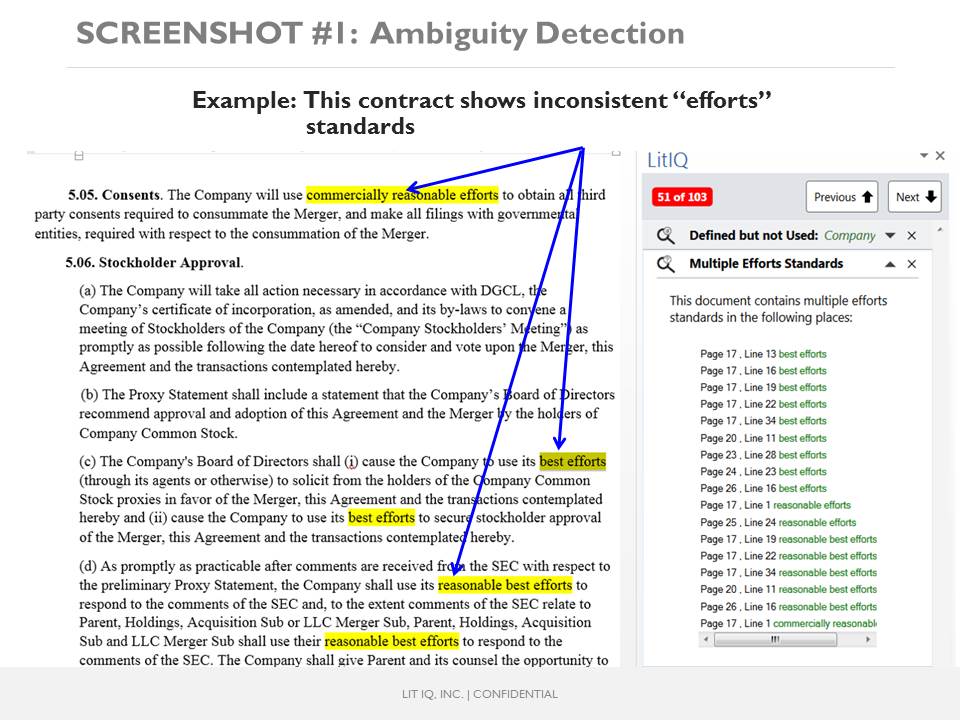
1) Ambiguity detection. The English language is full of ambiguities.The “ambiguity detection” tool can identify both semantic and syntactic ambiguities.  For example: “I saw her duck” has two completely different meanings. Does “she’ have a pet duck? Or did “she” take evasive action?
2. Style Manual. LexCheck incorporates the Ken Adams Manual, of Style for Contract Drafting.
Certain words always cause trouble. Instead of using  “biennial,” or ” biannual” the style guide recommends “every two years.” The style guide can be customized with “firm specific” rules.
3. Proofreader.  Sangha knows first hand from his Intelligize experience that the average  length of a merger agreement has doubled over the past 15 years. This increases both the risk of a mistake and the “mind-numbing”pain of reviewing such documents for internal inconsistencies. Cost conscious clients don’t want to pay for proofreading. Associates are terrified of “career ending” oversights.
The Value Proposition


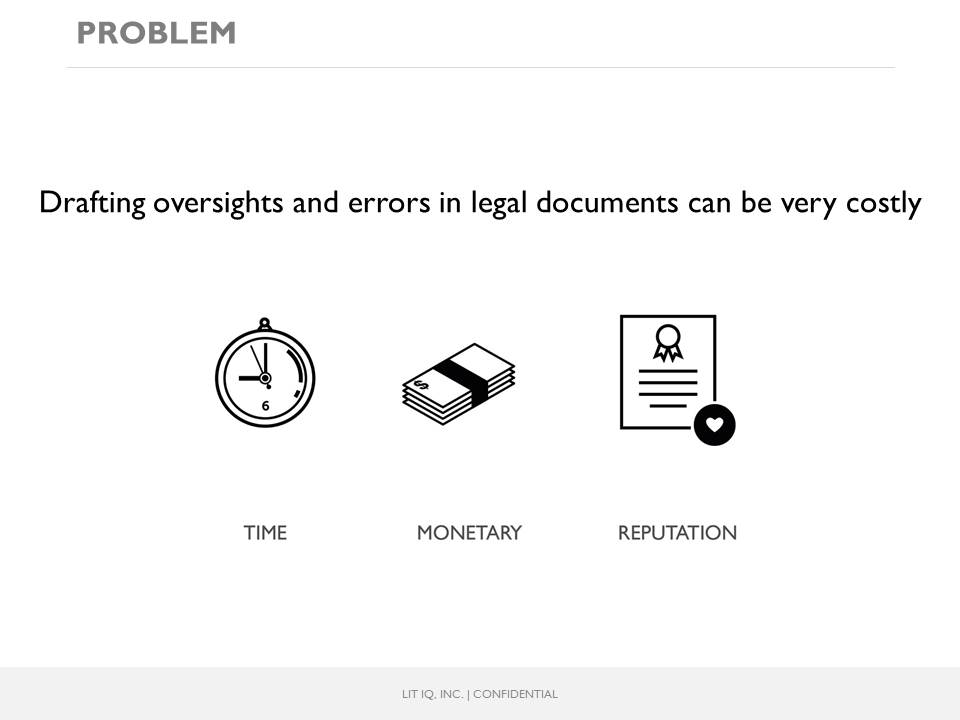
 Sangha sums up LexChek’s value proposition in a single illustration. LexChek, Saves time and money while mitigating the risk of damage to the reputation of a lawyer or the firm or damaging client relationships.

What’s Next
According to Sangha LexChek is available on the market and has already been adopted by several ALM 100 firms. The cost of licenses will be scaled to the practice group size. Right now the product is ready for the transactional market. A version for litigators is under development. I can’t think of any product that combines all of the features offered by LexCheck. Thomson Reuters Transactional Drafting assistant has similar proofreading capabilities but not the ambiguity detection.

Competitive Analysis in Your Future? While the primary focus is  on helping lawyers improve the quality of their own work, it is clear that this product could also have a “competitive analysis” function by identifying weaknesses in an adversaries documents or contested legislation or regulations.

Could LexCheck Have an A2J Impact?
I am a big fan of legal entrepreneurs. I  certainly wish Sangha success in his venture…  I also can’t help but hope that the product is so successful, it can be adopted by every legislature in the US.  Access to justice is impaired by the sheer volume of litigation. If LexCheck were run on all legislation in the US, could this not have cumulative benefit on access to justice by reducing some volume of litigation? More importantly it could assure that  all legislation is more comprehensible to the general public — those who can’t afford lawyers to fight over common legislative drafting errors such as ambiguities,  omissions and grammatical errors which impact the interpretation of a law.

American Association of Law LibrariesIn response to the recent American Lawyer article on the outsourcing of law libraries, AALL President Keith Ann Stiverson released a statement today which underscored the important role which information professionals play in 21st century law firms. Stiverson recognized the value of limited, targeted outsourcing but warned of risks and hidden costs arising from the wholesale outsourcing of all information services to a third party. Information management is more important now than at any time in history.
 Stiverson’s statement included some interesting data on “content clutter.”
“Every two days society creates as much information as it did from the
beginning of time until 2003.On an annual basis, content clutter costs businesses about 500 hours of time per employee. Information professionals cut this cost by effectively managing content for the firm, keeping them competitive in this information driven economy.”
The statement concluded by urging firms to calculate the total cost of outsourcing including an assessment of risk to the business before considering the wholesale outsourcing of all information support and intelligence functions.
Read the full statement here here.