Last Wednesday, Thomson Reuters hosted an Innovation Summit
in New York City for legal journalists and bloggers in advance of the Legal Tech
Conference.
Before the presentation began I noticed  that TR has adopted a new corporate slogan: “Thomson
Reuters the answer company.”  A bit of a
pivot from their 2013 Innovation Summit where they seemed to be rebranding as a
“solutions” company – de-emphasizing their legacy as a content provider and
focusing on their development of cloud based practice management products.
Perhaps they have found an elegant balance in “the answer company.” I assume
this is driven by  emergence of  big data and augmented intelligence as
important factors which will impact how lawyers find answers in the future.
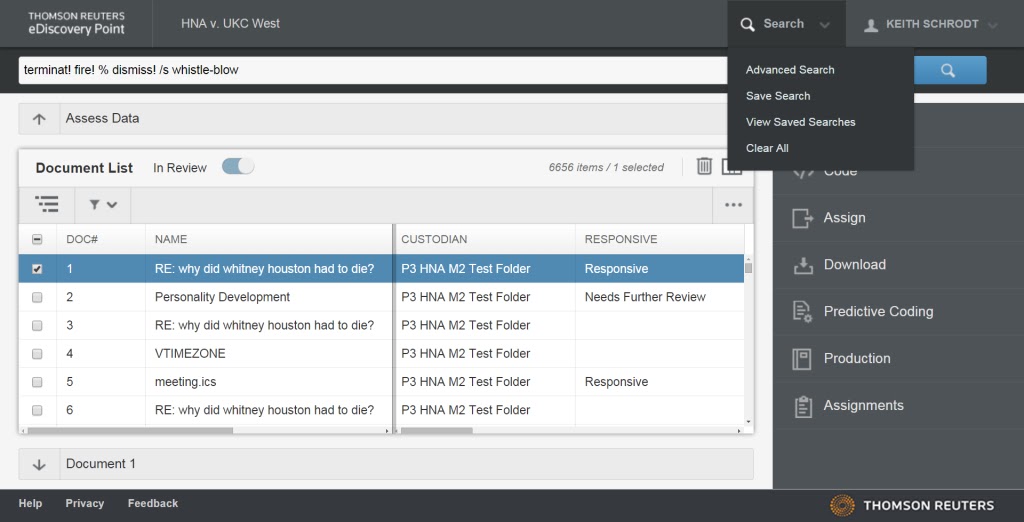
Attendees were given an overview of two products, eDiscoveryPoint and Practice Point which will be debuting at Legal Tech in New York this
week. They also provided some intriguing insights into the company’s recent
alliance with IBM Watson and their PermID project.
Susan Taylor Martin, President, Legal opened the morning by
framing TR’s technology initiatives in the context of the today’s legal market
challenges (the buyers market, maximizing efficiency, the rise of alternative
service providers.) Thomson Reuters was positioned as an ally having “the
intelligence, the technology and the human expertise that customers need to
find trusted answers.”
Drawing a parallel to the challenges facing law firms,
Taylor Martin described how TR has shifted to a more client focused development
strategy. They continue to drive innovation internally but are also open to
collaboration with other external organizations (IBM and Stanford Codex), as well
as customers to shape what they will deliver in the future. 

TR Watson Will Debut
in Global Financial Regulation
Ever since TR announced their collaboration with IBM Watson
last October, the legal community has been impatient to learn how this alliance
will manifest in a legal product. We still don’t know but TR did promise that
they will be the first company for built a legal product using Watson technology.
The alliance will combine IBM’s cognitive computing with TR’s deep domain
expertise. A panel of executives from TR and Watson revealed that there will be
a beta product available by the end of 2016. Their first collaboration will
focus on taming the complexities of global financial regulation.
Practice Point for
Transactional Lawyers
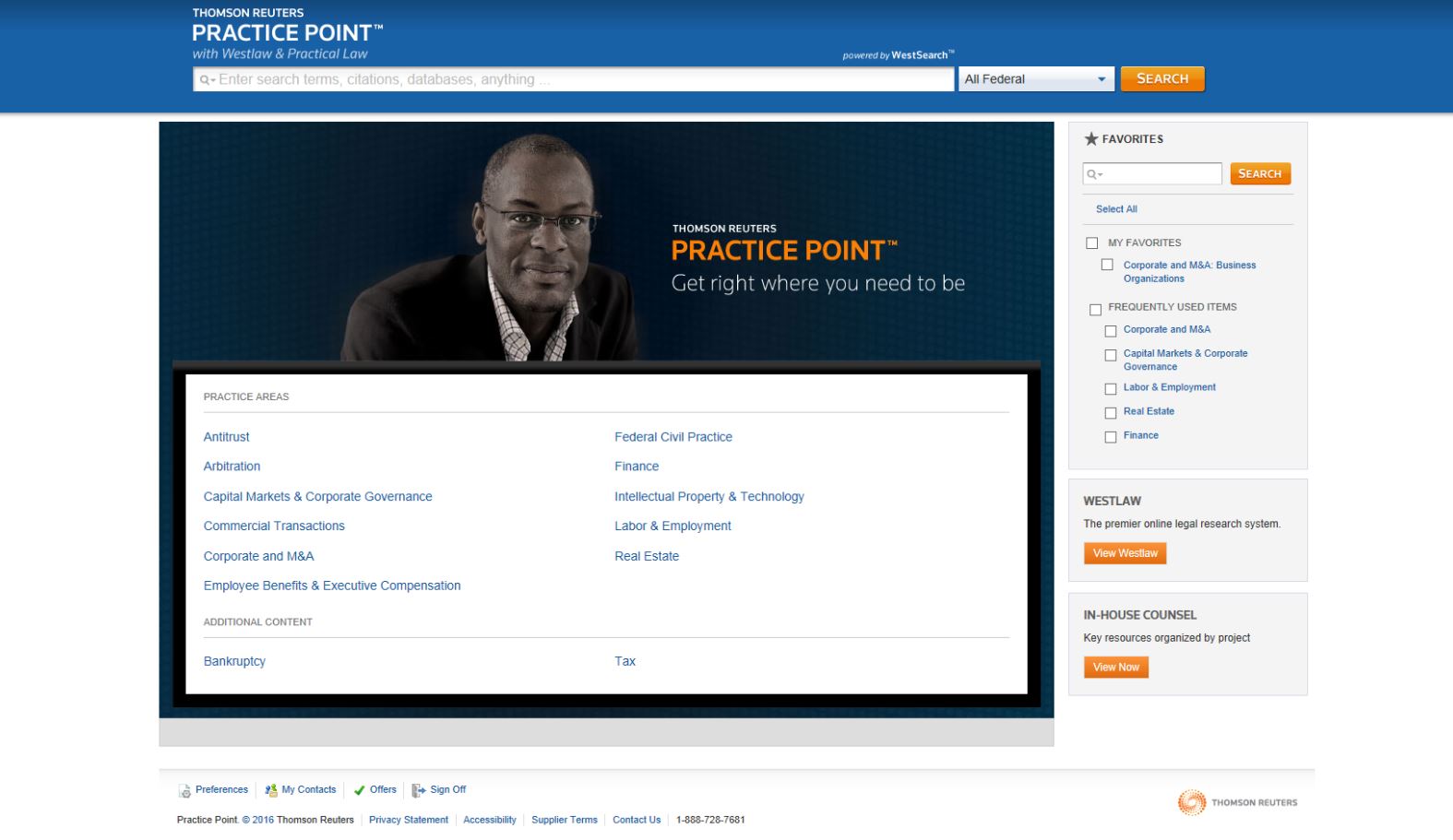
Practice Point appears to be a variation on the Practical
Law workflow tool. It appears to have much of the same content but it is
organized around tasks rather than practice groups. For example an M&A lawyer
could browse a list of  M&A activities
while moving through various phases of a merger. It includes one on Practical
Law’s “wow” features – the creation of “what’s market” tables which can compare
deals by a variety of criteria such as company, industry, and deal type.  My jaw dropped when I saw that Practice Point
contains a “ rulebook” feature which I have been pleading for TR  to build. Practice Point includes a “bookshelf”
of all the key rule compilations needed by a transactional lawyer.  Each book can be read in a browse-able book-like
experience. Not clear at all why this would be included in Practice Point but
not in Practical Law. Practice Point is also offered in an “in house” version
which includes “in house” transactions such as planning a new product.
EDiscovery Point
Eric Laughlin introduced eDiscovery point which will be
launched at Legal Tech. Laughlin promoted the product as  offering ease-of-use,
increased speed of accuracy and pricing that makes sense. Since TR is a latecomer to the ediscovery market, TR executives knew that the product couldn’t simply be different, it had to be better.  Currently most  ediscovery product involve complex  pricing where charges are triggered by a wide variety of factors. TRs new product will offer one price based on a single factor — the volume of data in review.

Key features which were highlighted include

  • Flat $40 per gigabyte price
  • Eliminate slow loading times
  •  Lawyers can use WestlawNext search syntax  which they learned in law school
  • Eliminates complex training
    manual to learn search techniques
  •  Eliminate loading bottlenecks by breaking data
    loads down into smaller files which can be loaded simultaneously.
  • Searches execute 10 times faster than the competition.
  • Browser based searching 
eDiscovery Point

Perm ID is a unique identifier to 3.5 million organization and
240 thousand equity instrument and 1.17 equity quotes from the TR core entity
data set. This will eliminate the confusion which arises from name changes, corporate
family tree relationships, and different companies with similar names. In the
future PermID will be expanded to support people, fixed income instruments and quotes
and other business data. A PermID entity search API is available in the
Creative Commons.  Companies can use the
PermID data to match entities in unstructured data sets. I immediately think of
the challenges law firms face in conflicts checking. Perhaps the permID can be
used to clean up  conflicts data. But I can’t help
but wonder why TR isn’t taking this data to build a commercial “conflicts
checking” product for law firms. Try a company search here.
 “The Difficulty lays
not so much in developing new ideas as escaping old ideas.”- JM Keynes
TR Legal President Taylor Martin opened the meeting with this quote from economist John Maynard Keynes. The fact that  Taylor Martin and Charlotte Rushton, SVP, Global Legal Markets  were presiding  over the meeting was itself a testament to how far Thomson Reuters had come in escaping some old ideas. This meeting stood in the stark contrast to my first meeting with West Publishing Company executives circa 1983 in St. Paul Minnesota. The leadership of West Publishing Company
was a middle-aged gaggle of men who enjoyed recreational
hunting and ice fishing. By the mid 1990’s West’s President, Dwight Opperman knew that the
company could not evolve and compete in the 21st century without a
dramatic overhaul and infusion of new blood and new investments. 
This year will mark the 20th Anniversary of  Thomson
Reuters  acquisition of West Publishing Company.  During the Summit TR executives laid out a vision of change through collaboration and innovation. It is hard to imagine what law firms will look like in 20 years but I assume that those which survive will have mastered the escape from old ideas. Will Thomson Reuters actually evolve into a full fledged legal service provider in the future? After all they are “the answer company” and what lawyers (and librarians do) if not provide answers?
Earlier this month Sara Glassmeyer, Librarian, Lawyer and
Information Provocateur published an important new study outlining the
substantial shortcomings of “free” digital,  legal information in the United States. Glassmeyer has spent the past year as a Fellow at the Harvard Library Innovation Lab and has produced what I believe is the first comprehensive census on the quality of primary legal resources published by states on the web.  “The State Legal Information Census: an analysis of primary state legal information” is a “must
read” for every information professional,whether they are engaged in research,
training, curation, cataloging, procurement or knowledge strategy.
The next time you are asked why you are paying for
commercial research products “since everything a lawyer needs is on the web” —
just whip out the Glassmeyer report.  I
have long suspected the difficulties and unevenness of free digital resources
on the web but I had never seen a systematic analysis of the problem.  Glassmeyer’s report fills the gap and moves
the ball from impression to proof.  State
legal publishing is a vast and uneven landscape offering the public content which is impaired by yawning
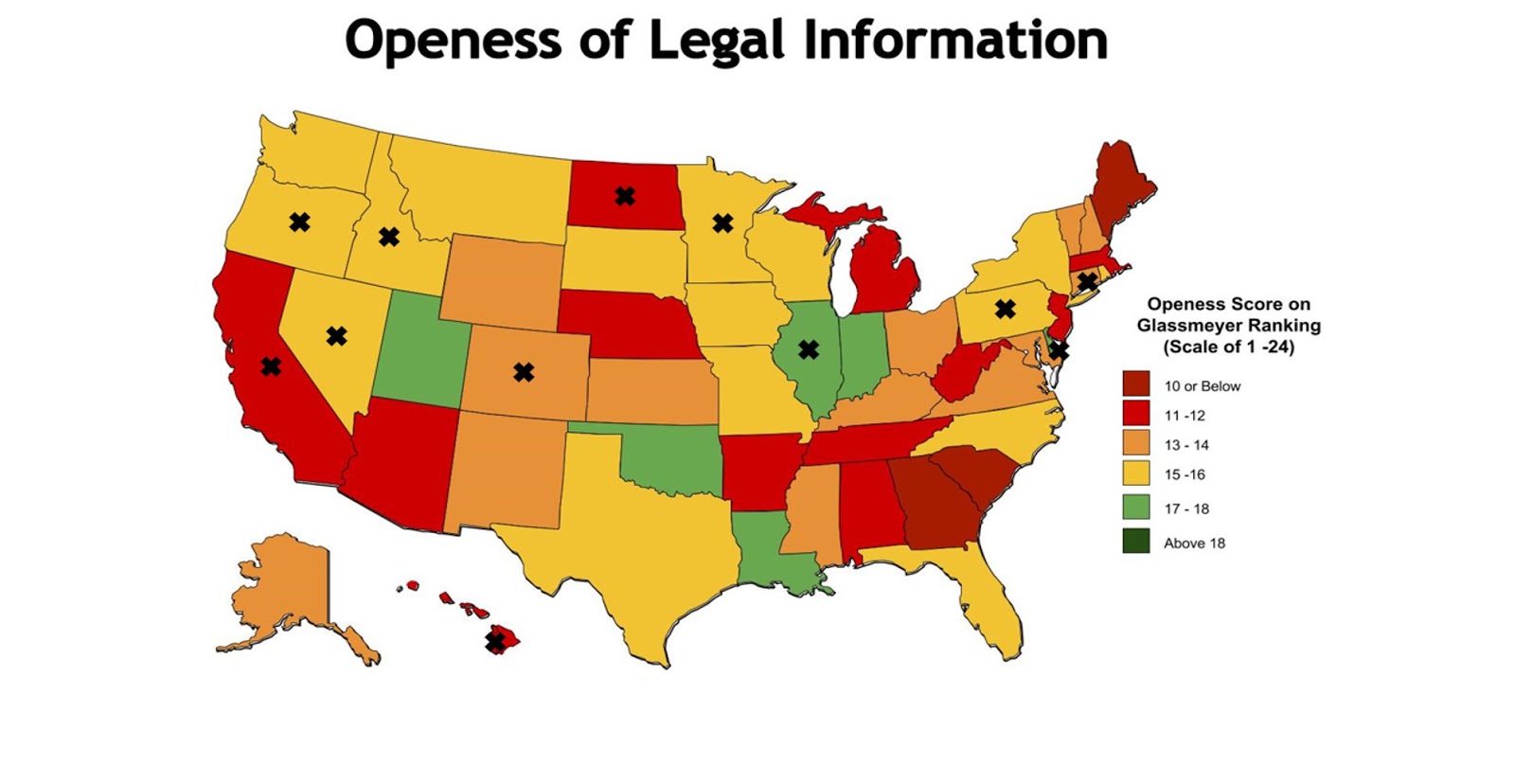
gaps in reliability, currency and completeness. Glassmeyer scored each state based on 14 access criteria. No state got a perfect score. Most states have serious deficiencies.
S. Glassmeyer State Census Ratings

Glassmeyer describes an ” information desert” which
exacerbates the access to justice crisis in the United States. More and more
people are seeking to address their legal issues without the assistance of a  lawyer and relying on these public
resources.  While the goal of the report
may have been to highlight the variety of obstacles  which the general public faces in accessing
the materials promulgated by their governments —it also  underscores the significant risks which
lawyers  assume when they rely on free
government websites for primary source materials.
The report focuses on state primary legal resources including codified statutes, administrative, regulations and
case law which are made available by each state. Glassmeyer has outlined a chilling
litany of obstacles, irregularities, oversights and shortcomings which hamper
the usability of state legal information.
The Report’s Recommendations
Include:

  •  States should create law portals to provide
    one-stop access to all state legal information.
  •  
    States should publish information openly and
    reduce barriers to reuse such as copyright claims in state created content.
  •  Official publications should move from print to
    digital to promote greater access.
  • All copyright claims as well as restrictive use
    terms should be removed from webpages containing state primary source material. Disclaimers should warn about the limitations and usefulness of legal
    information provided.
  • States should consider outsourcing web-based
    content to commercial publishers in order to improve comprehensiveness and
    usability.
  • States should provide basic disclaimers about
    the use and usefulness of all legal information collections advising of the
    need to validate that the material is current (i.e. hasn’t been repealed
    superseded overruled or withdrawn etc.)

What Does “Access”
Mean?
  Glassmeyer’s report
deconstructs the notion of “access” and investigates the variety of issues
which create impediments to quote “meaningful access.”  All of these concepts described are familiar
to information professionals –these are the warp and woof of collection
analysis.
Barriers to access
include:
·        
Cataloging
since the law is full of  “terms of art,” full text searching of a free database
does not necessarily create access for a nonprofessional. No state provides an
index to its case law.
·        
Citation
citation systems help practitioner determine the validity of case law and courts
require that pleadings and filings include official citations. There are no
free public citators and the public is required to purchase official
versions of cases in order to comply with court filing rules.·        
Ironically
most online versions of cases statutes and regulations are not
considered official for purposes of citation. In some states it is not even
possible to determine what is the official version.
·        
Citators
No state provides a citator for validating its law.
·        
Container
The format in which the digital content is published has an impact on its
usability. States publish materials in PDF, HTML as well as mixed formats. The
entire repository of caselaw, statutes or regulations may not be in the same
format.
·        
Content
archives
. The majority of states post incomplete collections of codes,
regulations and case law. Most collections start in the mid-1990s. The validity
of these codes and regulations cannot be determined without the assistance of a
professional librarian.
·        
Control.
States attempt to control the use of law by posting copyright claims and usage
restrictions. Eight states actually post restrictions on the use of case law –
– indefensible in a common law system where precedents matter.
·        
Conveyance
how the state makes the information available. In most states, the print
version of a case, statute or regulation remains the “official “version.  Most states do not allow bulk access to their
legal information and most prohibit web scraping.
·        
Copyright
although it is a general rule that states cannot copyright their official
publications, several states do post
copyright notices claiming copyright in their cases, statutes and regulations. 
·        
Corporate
control
since many states rely on commercial publishers to publish their
state law, this increases the cost of access to state materials. In addition,
commercial publishers wrap the public domain law with editorial enhancements
making it difficult for the public to understand what they can use and what is
restricted.
·        
Correctness.
For a resource to have value it must be trustworthy and yet some states place
disclaimers on their websites suggesting that the information cannot
be trusted. The problem of revised court opinions is particularly troublesome.
Courts post slip opinions which they don’t remove or flag when there is a subsequent change.
·        
Cost.
Most state law is free on the Internet but there are some significant
exceptions where states charge for access.
·        
Currency.
The law changes constantly but some states fail to update their materials
quickly and fail to post a clear indication of  when the material was last updated.
·        
Search.
Legal materials are not searchable on some state websites. Most states only
provide a basic search function. Advanced search features would enhance both precision
and retrieval.
A
Public-Private  Solution?
Although
many states have adopted the Uniform Electronic Legal Information Act (UEELMA)
this did not result in “barrier free” access to information. The report suggests
that  commercial publishers are simultaneously
 part of the problem and part of the
solution. At this point in the 21st Century the major commercial publishers with editorial teams (Lexis, Westlaw, BloombergBNA and WoltersKluwer) offer the best hope for producing legal resources with editorial quality, cite checking  tools, complete  archives and  current content. This may change as new technologies and legal startups evolve. Ravel and Fastcase are creating lower cost alternative approaches to legal research but neither is in a position to “clean up” the wide variety of state statutes, regulations and caselaw issues outlined in the Glassmeyer report.

 It seems unlikely that states have the will
and the wherewithal to fix the problems outlined in the Glassmayer report any
time soon. Commercial publishers have the technology and expertise but not the
incentive to make all of the primary content  (which they acquire from the states)  available to the public in a user friendly
platform. As primary law gets commoditized and legal publishers shift their
focus from content to process,  will they
consider  public-private partnerships
designed to create reliable open access to primary law across the United
States?

In the meantime – let the lawyers and public
beware: Free legal content is not risk free.
Last week Ravel and Handshake Software announced a partnership.
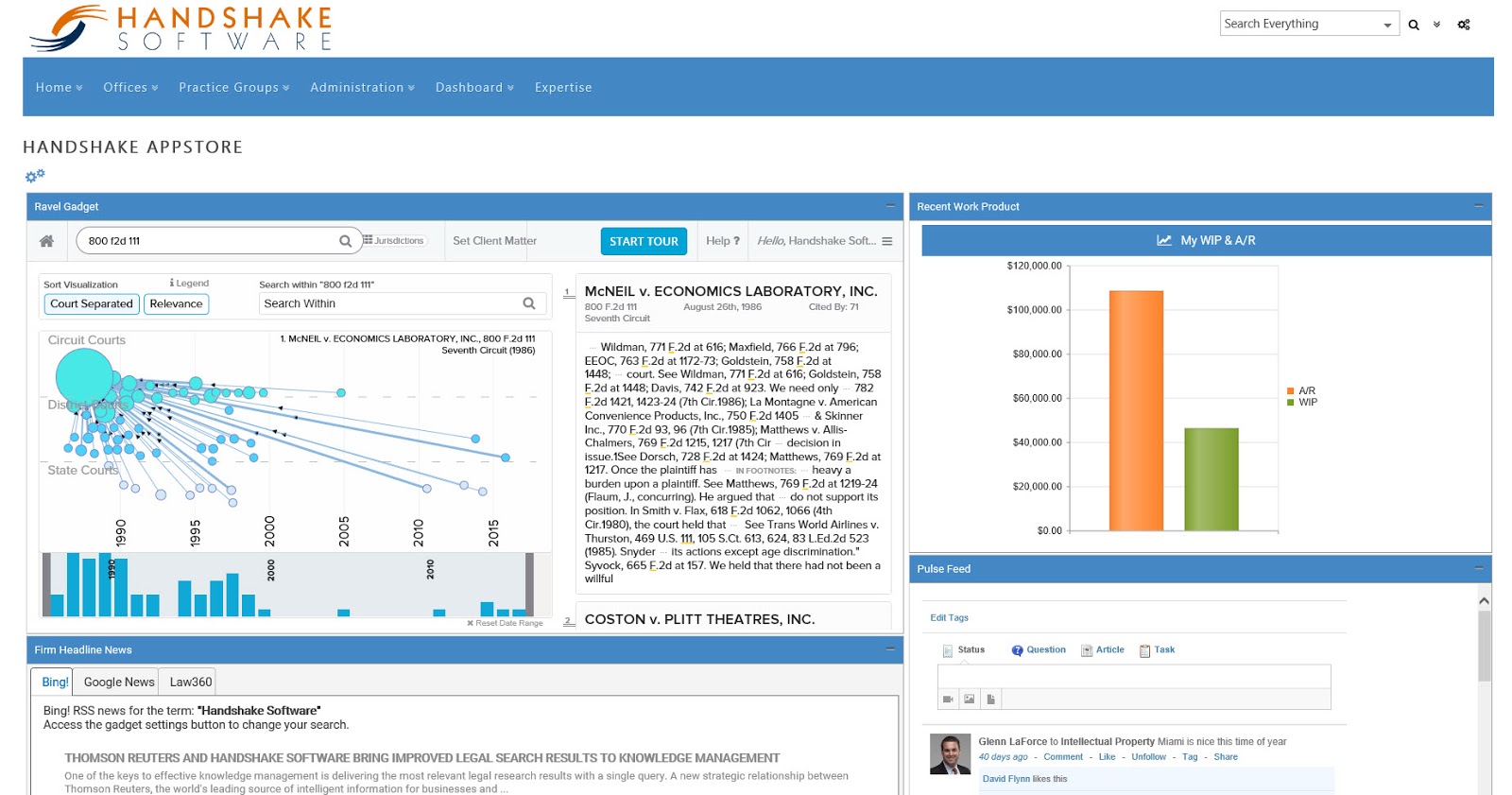
Law firms with Handshake software will be able to integrate Ravel caselaw and
analytics into desktop applications and create personal homepages. On Monday Ravel
co-founders Daniel Lewis and Nik Reed were featured in a Forbes article about
the emergence of Big Data in the practice of law. Yesterday they announced that
as the result of their Harvard Law School alliance they had loaded the complete
California case law archive.

The Ravel/Handshake Alliance

The alliance with Handshake which was announced last week
enables firms to integrate ravel search and analytics into their interwoven
platform. 
Ravel/Handshake

The Ravel/ Handshake alliance
allows law firms to create a platform in which Ravel’s legal materials and  a firm’s internal expertise and data can be integrated
and accessed using enterprise search or on personalized pages. According to the
press release” This not only alleviates the need to conduct legal research as
part of a siloed search but brings together all other critical aspects of the
modern practitioner’s hub including relevant information from the firm’s
financials, document management, customer relationship and practice management
systems.”

 Nik Reed, co-founder and chief operating
officer at Ravel Law explains the benefits to law firms. “Legal research is an
essential part of business intelligence in developing legal strategy, and our
integration with Handshake makes data-driven insights available with just a few
clicks.”

Free California Caselaw

In October 2015, Ravel Law  and Harvard Law School announced an ambitious
Big Data  project. Ravel and Harvard are
collaborating on scanning the complete archive of all US cases in the Harvard
Law Library and make that archive available to the public for free on the Ravel
platform.
Yesterday, Daniel Lewis co-founder
of Ravel announced the release of California caselaw, which was loaded into
Ravel as part of the Harvard-Ravel digitization project, This is exciting
news for the public because for the first time the entire archive of California
state caselaw is freely accessible to anyone with access to the web. Each case
is accompanied by an authoritative scan of case from  the original book from the Harvard library.(GoogleScholar
provides free case law searching but it has a limited archive  of state appellate cases dating back to 1950
and Ravel’s archive is a complete archive including cases back to the 19th
century. The Ravel/Harvard archive  includes both trial and appellate opinions.)

Subscribers to Ravel law’s
Judge’s Analytics will soon be able to analyze the opinions of California state
judge. Judge’s Analytics provides insights into how judges make decisions by analyzing
their cited precedents.

Forbes: How Big Data is Disrupting Law Firms and the Legal
Profession.
This week Forbes posted and article which examines the emergence of big data in
legal practice.  I profiled Ravel in an earlier post. Since the entire legal profession is rooted in precedent it
should not be surprising that change comes slowly. Anyone who looks at the results of a Ravel search can see immediately that Ravel is a radical re-imagining of the legal research process.

Ravel’s Research Results

The article includes a
particularly interesting insight from  from Ravel co-founder Nik Reed  on the changing profile of young lawyers. “One
of the most exciting moments for me starting at law school and having come from
working on Wall Street was realizing I wasn’t alone – the days when lawyers
were all English Literature or philosophy majors are behind us now, my
classmates included a lot of people from finance and one who had a PhD in bio
chemistry from MIT. These are people who are familiar with quantitative
analysis and datasets, and they are yearning for richer information sources and
better analytics technologies. It probably wouldn’t have gone down very well 30
years ago with the kind of people who were lawyers back then.”

It will be interesting to see what happens when the first generation of “quant” lawyers “make partner” and  start migrating into leadership roles in law firms.

The Poll: Please take the brief (11 question)  2015-2016 Start Stop Poll here.

  
For the last two years  one  of the most popular Dewey B Strategic blogposts has been the summary of results contributed by you, the readers of this blog.

Here are links to the  2013 and 2014 results.
 
We are living in a whirlwind of change. We routinely assess new products, new processes, new roles,  new organizational options, new expectations.  Let’s help each other decide what’s worth doing. Let’s leap boldly into the future together. Share your insights. What were your victories, false starts or  plain old bad choices. Share your hot tips,  short cuts,  projects and best practices.


Are you launching an AI project? Did you outsource? Centralize? Switch to a single online provider? Stop distributing deskbooks? Start offering eBooks? Participate in a Lean Six Sigma team? Launch a content curation project? Develop an app?

Make Room For Value. The speed with which old processes and assumptions become obsolete is accelerating. We can only deliver more value by eliminating or streamlining the routine, the redundant and the unexamined. 

Invest in the Future. Since law firm budgets remain flat, the best  way find the budget for innovative new products, is to reduce or eliminate redundant  products  and products which offer a low ROI.

The Wisdom of Colleagues. In the spirit of collecting the wisdom of colleagues I am once again asking readers to share  insights on the processes and products they  started or stopped in 2015 and  what they plan to start or stop in 2016. What products did you  stop using? What new ones will you adopt in 2016?

Anonymity Results will be aggregated and there will be no attribution to any individual person or organization without the written consent of the respondent.

The Poll: Please take the brief (11 question) survey here.
The Survey will remain open until January 18th and I will report on the results. 

Thanks in advance to all participants.

Knowledge strategy is not about technology; it’s about
efficiency. In the current  buyers market, value conscious clients shop around for law firms that can demonstrate that they have a knowledge strategy. For law firms, alternative fee arrangements can not be profitable unless they have optimized efficiency by leveraging internal knowledge and time saving tools and resources.. Savvy clients  will go elsewhere rather than pay for inefficiencies. 

On January 28, 2016 the ABA Section of Law Practice Management, Knowledge Strategy subgroup will be offering a free webinar to assist lawyers in developing  or improving their firms knowledge strategy to improve client satisfaction and retention. 

The  “How to Compete with IBM Watson JD: Future-proof your practice by improving efficiency now ” webinar  will outline  the business case for knowledge strategy. Topics include:
  • Why clients won’t ask for efficiency, but will instead move to other lawyers who do provide the desired value
  • Why efficiency is about people and process, not technology
  • What we mean by efficiency
  • How efficiency can improve not only the value you deliver to clients but also your financial results
  • How you as an individual lawyer can respond now, whether you practice in a large firm or solo/small firm setting
  • Why knowledge strategy is more powerful than knowledge management

Register here!

Information on upcoming webinars is available at this link.

London based Incisive Media  announced in a press release this morning that they had sold their  legal market news publication Legal Week to  American legal news pioneer American Lawyer Media. Ironically ALM was briefly owned by Incisive Media from 2007 to 2009.

As the legal market globalizes it makes complete sense for law firm leaders to understand the international market.Bigger Data?

ALM CEO Bill Carter is quoted in the press release:  “This acquisition is an important next step as we expand our offerings into key international markets,” Since ALM has been expanding it’s analytics offerings on the ALM Legal Intelligence Platform I assume this acquisition will provide not only an opportunity for ALM to expand the international news purveyed through Law.com and their many regionally branded news products ( New York Law Journal, Texas Lawyer etc.) but it will enable ALM to expand their analytics to include “big data” insights into the international market. Legal Week also publishes periodic reports on the state of the legal market. The press release focuses on the synergies between both companies conference and events businesses. ALM’s events include Legal Tech which will be held in New York February 2nd  through 4th. The press release was silent on what I would call “the elephant in the room.”

What is the LexisNexis Angle?

What is intriguing to me is how this will fit into LexisNexis recent alliance with ALM. Last November  LexisNexis announced that it  had become the exclusive provider of ALM. ALM bills will appear on Lexis invoices. ALM accounts will be serviced by LexisNexis account executives… Will this support model apply to Legal Week as well – I think we need to assume yes. Although this may be a bit dicier outside the US where large segments of the LexisNexis customer base are supported by third party vendors.

I asked ALM to provide clarification on the Legal Week/ALM/LexisNexis trifecta. According to Lenny Izzo, President of ALM’s  Legal Media division:  Legal Legal
Week content is available today on LexisNexis via a pre-existing licensing
agreement. It will not be immediately included in the recent ALM/LexisNexis
AmLaw 200 exclusive distribution arrangement, but can be subscribed
to through direct channels by contacting Legal Week directly  at +44
(0)207 316 9404.  Nothing was said suggesting or precluding future changes.

Dominance of the Legal News Market

LexisNexis has been so persistent in routinely acquiring legal news assets that it is getting a bit tiresome to repeat the litany once again – but it is impossible to understand the market impact without repeating the list. Lexis will now own or control the following legal news assets:

  • Legal Week
  • MLex
  • American Lawyer Media
  • Law 360
  • Wall Street Journal Online – distribution to legal market
  • New York Times online exclusive
  • Newedge news platform

It’s only mid January. It will be interesting to see how LexisNexis plays the ALM/Legal Week alliance  and what other news gems they may add to their crown in 2016.

Lex Machina will be releasing it’s 2015 Year End IP Trends Report tomorrow and it will be posted on their website  on January 7th. Lex Machina is one of the pioneers,  if not “the pioneer” in bringing
custom intellectual property litigation analytics into legal practice workflow.  Periodically Lex Machina does all the heavy lifting and generates special reports examining intellectual property litigation trends. Their most recent report summarizes patent copyright and trademark litigation in 2015.

I received a preview of the year end report from Brian Howard, Lex Machina’s Legal Data Scientist and Director of Analytics.

Here are some key trends:

Patent

  • Patent litigation in US District Courts rose 15% in 2015.
  • Filings rose 43% from the 3rd to 4th quarter of 2015.
  • 43% of all patent cases are filed in Eastern District of Texas


Copyright

  • In the copyright area file sharing cases declined and more traditional copying cases were relatively flat and within a recent trend of 500-600 cases per quarter.

Trademark

  •  2015 saw the lowest rate of trademark litigation cases filed in 10 years.( Which I find surprising — Mark Zuckerberg wants to own “face”  and Taylor Swift just tried to trademark “1989”  — and trademark litigation is slowing?)

2015 was a year of innovation and acquisition in legal publishing. Watson continues to intrigue law firms and legal publishers. New platforms, new alignments, new identities, , new environments and new tools for powerful insights dominated the legal market.

Thanks to all my readers for your valuable insights and feedback. 

The Top Dewey B Strategic Posts of 2015: 

Has the Librarian-ship Sailed? The American Association of Law Libraries Board Votes to Rebrand As the Association for Legal Information

 LexMachina Launches Custom Insights: Data Mining for the Impatient Lawyer

IBMWatson – Not the Robot Apocalypse! 

Fastcase and Loislaw: Reading the Tealeaves– Realignments in Legal Research Market Ahead?

 Welcome to the Loungebrary: 2015 ALM Library Survey. Transformations Abound.

WoltersKluwer Launches “Cheetah” Research Platform: Usability,Workflow and Context Drive New Design

 Private Law Librarians and Information Professionals Group Publishes Resource Guides For Strategic Planning, Intranets and Legal Research on the Internet

 Dear Watson:: I have a question for You. Watson and Legal Research… But Can it Ask Questions?

10KWizard Bites the Dust. Morningstar Directs Customers to Intelligize. Will Intelligize Enter the Workflow Race?

Proview Professional: Thomson Reuters Releases eBooks And Promises to Break the Book Paradigm

BloombergBNA Levels the Corporate Deal Landscape with Launch of Corporate Drafting Platform Leveraging Analytics and Enhancing Workflow.

Ravel Law Launches Judges Analytics: Precedential Behaviour Analysis Made Easy.

New ALM Law Firm Staffing Report: Outsourcing Out, Library Staff In, Partners Answering Own Phones?
  
“3 Geeks” Founder Greg Lambert Enters the C Suite At Amlaw 200 Firm Jackson Walker: An Interview With a Geek 

The 2014-15 Start Stop Survey Results: The Products. Out with the Old. In With theInnovative: Lex Machina Best New Product. Fastcase/HeinOnline Best Innovation

ThomsonReuters Intelligence Center: Map Out Your Opportunity and Business Development Strategy

BloombergBNA Releases Open Access “Big Law Business” Platform Targeting Law Firm Partners and In-House Counsel 

LexisNexis to Launch NewsDesk Aggregation Platform: Cool Tools, Deep Content, Rich Analytics

New York Law Institute Goes National: Offers “Just In Time” Research, Desktop Access to 75,000 eBooks to Member Law Firms Across the US and a Free Trial!!

AALL Releases “The Economic Value of Law Libraries” Report– Long on Rubrics– Short on ROI

Wishing everyone a wonderful 2016. Happy New Year!

The Poll: Please take the brief (11 question)  2015-2016 Start Stop Poll here.

  
For the last two years the Start/Stop survey has generated some terrific insights into trends and triumphs shared by readers of this blog. Here are links to the  2013 and 2014 results. The 2015-16 Start Stop Survey is now open.
 
We are living in a whirlwind of change. We routinely assess new products, new processes, new roles,  new
organizational options, new expectations.  Let’s help each other decide what’s worth doing. Let’s leap boldly into
the future together. Share your insights. What were your victories, false starts or  plain old bad choices. Share your hot tips,  short cuts,  projects and best practices.


Are you launching an AI project? Did you outsource? Centralize? Switch to a single online provider? Stop distributing deskbooks? Start offering eBooks? Participate in a Lean Six Sigma team? Launch a content curation project? Develop an app?

Make Room For Value. The speed with which old processes and assumptions become obsolete is accelerating. We can only deliver more value by eliminating or streamlining the routine, the redundant and the unexamined. 

Invest in the Future. Since law firm budgets remain flat, the best  way find the budget for innovative new products, is to reduce or eliminate redundant  products  and products which offer a low ROI.
 

The Wisdom of Colleagues. In the spirit of collecting the wisdom of colleagues I am once again asking readers to share  insights on the processes and products they  started or stopped in 2015 and  what they plan to start or stop in 2016. What products did you  stop using? What new ones will you adopt in 2016?

Anonymity Results will be aggregated and there will be no attribution to any individual person or organization without the written consent of the respondent.
 

The Poll: Please take the brief (11 question) survey here.
The Survey will remain open until January 15th and I will report on the results. Thanks in advance to all participants.

“Knowledge management and knowledge strategy are not well
understood at the senior management level in law firms. Yet economic
pressures today make this practice management technique an even
more important activity, which should be managed and accountable at
the senior partner level. A handful of law firms are doing this now and
the trend will likely continue. Our Group hopes to facilitate
that trend.” –
Jack Bostelman, ABA Knowledge
Strategy Interest Group Chair.
 
KMWebinars Logo
 
Editor’s Note: I was recently appointed as Vice Chair of the ABA Law Practice Management Knowledge Strategy Interest Group. I asked the founder and Chair of the Knowledge Strategy Interest Group, Jack Bostleman to provide his thoughts on knowledge strategy in law firms and describe the upcoming initiatives of the ABA, LPM Knowledge Strategy Interest group.
 

What in your prior experience inspired you to take a
leadership role in promoting Knowledge Strategy?


Jack Bostelman
My “day job” for 30 years was
practicing transactional securities law at Sullivan & Cromwell in New York.
From my days as a young partner, I found myself acting as the de facto
knowledge sharing coordinator within the firm. Back in the late 1980s, I had
the idea of hooking up our fledgling desktop PC network and document management
system database to the search engine running on the firm’s mainframe computer,
used at the time only for e-discovery. This created a powerful way for users to
search for documents in our system. It’s hard to believe, but at the time the
DMS had no search function, and even later for a long time couldn’t search
across office libraries. My band-aid and bailing wire system was a success and
I suppose cemented my de facto status.

Over the ensuing years I wore a number
of internal hats that allowed me to push further on a variety of
knowledge-sharing initiatives, including overseeing the IT department and
acting as firmwide coordinator of our securities practice. We also were an
early beta site for what ultimately became West KM’s automated document
categorization feature. We combined those categories with data collected within
practice groups about matters to create search filters to augment enterprise
search.

When I took an early retirement at
age 55,  becoming a knowledge strategy consultant focused on AmLaw 200 firms seemed to be a natural next step. (Jack
is president of, San Francisco based KMJD Consulting) .

What inspired 
the  creation of the Knowledge
Strategy Group?

When I was starting my consulting
business a few years ago I looked around for professional organizations
focusing on knowledge strategy or knowledge management. To my surprise, I
couldn’t find any that focused on the subject from the perspective of law firm
leaders and client-facing lawyers, as opposed to in-house KM professionals or technologists.
I’ve been active in the American Bar Association for 20 years. When I switched
from the Business Law Section to the Law Practice Division when I changed
careers, I decided to try to organize a knowledge strategy group under the ABA’s
auspices. Happily, my proposal was accepted by the Division’s leadership.  We now have a terrific advisory board that is helping us pursue a number of new
initiatives, including publications and webinars. Our goal is to get the
knowledge strategy message out to as many law firm leaders and practitioners as
we can reach, and to stimulate dialogue about the subject. 

What is the biggest challenge to implementing knowledge
strategy in law firms?
 

An issue I have observed for a long
time, which I now understand is rooted in the lawyer personality – skeptical,
autonomous, low resilience (resistant to change), high urgency (work only on
client work) and low sociability (bad at teamwork) – is that most lawyers have
not been willing to invest the time and effort to create the efficiencies and
other benefits of knowledge strategy. Recognizing the effect of these
personality issues is the first step in coming up with strategies to overcome
them. And there ARE successful strategies for overcoming them. Our Group seeks
to raise consciousness in this area. 

Knowledge management and knowledge
strategy are not well understood at the senior management level in
law firms. Yet economic pressures today make this practice management
technique an even more important activity, which should be managed and accountable
at the senior partner level. A handful of law firms are doing this now and
the trend will likely continue. Our Group hopes to facilitate
that trend. 

How it is  Knowledge Strategy different from Knowledge Management?

As we say in our Group’s charter,
“Knowledge Management is about how lawyers share what they know
about client work, about clients, about markets for their firms’
services and about their firms as businesses. It’s a broad topic…
. Knowledge Management becomes Knowledge Strategy when all these
elements are considered together as a core function managed by the firm’s
senior-most leaders to support the firm’s strategic goals.” In other
words, the active involvement and support of senior management in selecting KS
initiatives that align with the firm’s strategic goals, giving the most bang
for the buck, and then pushing these initiatives on the firm’s lawyers is the
difference between KM and KS. Involvement by firm leadership is also one of the
ways to overcome the lawyer personality issues I referred to. 

Why  do lawyers and firm leaders need to think
seriously about Knowledge Strategy?

There are huge pressures today on
law firms to do more with less, and to manage their services more predictably
and transparently. KS can be a game-changer. It takes time and effort by both
management and practicing lawyers but the pay-off in efficiency, quality and
service levels can be huge and a real differentiator. And it can improve the
firm’s bottom line at the same time. I normally advise that a firm start with a
single practice group – one that is already somewhat successful and visible
within the firm and has some interest in these kinds of improvements. When that
practice group takes it to the next level through successful KS initiatives,
the other practice groups want the same thing and become more motivated to try. 

What programs are being offered by the Knowledge Strategy
group in 2015-16?
 

During our inaugural year we are
launching a monthly free webinar series, starting in January. These are aimed
at practicing lawyers who have no prior knowledge about KS but are interested
in figuring out how to do more with less, both at the individual level and at
the practice group or firm level. These will be 30 minutes and recorded.
They’ll be free and open to ABA members and non-members alike. Our first few
webinars will have content for firms of all sizes. Later some webinars will
have a solo/smaller firm focus and others will have a larger firm focus. We are
hoping to build a community through our registrant list, and will be setting up
moderated discussion groups so lawyers will have a place to go to ask questions
and share ideas.
 
We will also be publishing some articles, which will also be
available on our website. We have already written two 50-page white papers,
each outlining 10 specific KS initiatives that a firm could pursue which are also posted on the website. One paper
is for larger firms; the other for solo/smaller firms.

 
Free Webinars: Information  and registration for our first webinar on Jan. 28 at 12:00 Noon, Eastern,
can be found on our new website. The title of that webinar is:
 “How to Compete with IBM Watson JD:  Future-proof your practice by
improving efficiency now – Part 1”.
This Part 1 will focus on the
business case for KS. Part 2 in February will offer practical KS tips and tools
lawyers can use in the practices. 

Program December 9th :
Our Group is also sponsoring a 90-minute ABA CLE program on Dec. 9 at 1:00pm,
Eastern, entitled “Improving Law Firm
and Practice Group Efficiency Through Knowledge Strategy:  The Top Ten
Ways to Improve Client Service and Profitability”.
I will moderate. Our
panelists will be two of our advisory board members, Jean O’Grady (Director of
Research and Knowledge Services, DLA Piper) and Delilah Flaum (Partner at
Winston & Strawn). Pricing and registration can be found here.