Image result for lex machina logoLately
I feel like a kid in an analytics candy store. The recent wave of products offering analytic insights is escalating  the power of legal research and creating new opportunities for information professionals to offer “game changing” insights to the attorneys they support. Lex Machina is having a good year. AALL recently awarded Lex Machina the prestigious “New Product of the Year Award for 2015.” Lex Machina also  launched
two important new modules for Trademark and Copyright  which include data on 57,000 trademark cases
and 49,000 copyright cases. The 
Trademark  and Copyright modules offer
similar features to those available in their flagship Patent Product. It also
offers data sets and  analytics which are
unique to Trademark and Copyright litigation. Lex Machina includes case data
back to January 1, 2001. The Lex Machina analytics  can provide insights in a variety of contexts.
Pitch Preparation business development “pitch”
preparation. Demonstrate your firm’s experience on an issue, before a judge,
against your adversary. A firm can plan a litigation budget by seeing both high
level trends for a particular type of 
litigation, as well as  granular
trends for specific issues in a certain circuit, before a certain judge or when
opposing a specific firm.
Manage Client Expectations. Lawyers can now produce data to
manage client expectations by showing a client time data for similar types of litigation issues, motions, remedies and findings before a specific judge or in a specific court to trial analytics, remedy
analytics and  potential damages.

Competitive
Advantage.  
 The Lex Machina reports can provide insights
into the  behavior of district court judges, opposing parties, and opposing
counsel, engaged in similar litigation, enabling the lawyer  to gain competitive advantage in trademark and copyright
litigation.

Unique
Copyright-Specific Data

Case
Tags
– file sharing
cases (enabling users to exclude from analysis these 6,400+ repetitive
“copyright troll” cases suing ISP addresses of anonymous John Doe defendants),
trial (bench and jury), appeal, declaratory judgment

Case
Timing
– median days
to grant of permanent injunction, trial, termination

Case
Resolutions
–judgment
resolutions for claimants and claim defendants (default, consent, judgment on
the pleadings, summary judgment, trial, JMOL), procedural resolutions
(dismissal, consolidation, severance, transfer, stay), likely settlements
(plaintiff voluntary dismissal, stipulated dismissal)

Findings
– infringement, fair
use, ownership/validity, license or equitable defense

Damages – statutory damages (including for willful
infringement), actual damages and

infringer’s
profits, public performance license, attorneys’ fees, costs, prejudgment
interest

Remedies – seizure/destruction of goods, preliminary
injunction, permanent injunction, temporary restraining order. 

Unique
Trademark-Specific Data

Case
Tags
– Lanham Act,
unfair competition, dilution, false advertising, trade dress, cybersquatting, trial
(bench and jury), appeal, declaratory
judgment

Case
Timing
– median days
to grant of permanent injunction, trial, termination

Case
Resolutions

judgment resolutions for claimants and claim defendants (default, consent, judgment
on the pleadings, summary judgment, trial, JMOL), procedural resolutions
(dismissal, consolidation, severance, transfer, stay), likely settlements
(plaintiff voluntary dismissal, stipulated dismissal)

Findings
– Lanham Act
violation, fair use, ownership/validity, equitable defense

Damages – statutory damages (including for willful
infringement), trademark owner’s actual damages, infringer’s profits,
corrective advertising, attorneys’ fees, costs, prejudgment interest

Remedies
– seizure/destruction
of goods, termination of mark, relinquish domain name,
preliminary
injunction, permanent injunction, temporary restraining order

Stay Tuned..Lex Machina has indicated that they have plans to expand beyond intellectual property cases and will soon be offering analtyics on other kinds of commercial litigation in federal courts.

Here are some sample custom  Trademark and Copyright reports from Lex Machina:

Copyright Filings by Judgement C.D. Ca.

Trademark Remedies and Finding C. D. Ca.

Patent Trademark and Copyright Case Filings C.D. Ca.


Trademark Filings By Judgment in C.D Ca.

I am a shameless audiophile. Not the “woofer and tweeter” variety…but  the  working mother, multitasker, “infomaniac” variety. I try to have at least one source of news material handy at all times so that I can harvest precious reading time in a doctor’s waiting room or on a train ride.  I am the person in the grocery line reading a  newsletter which i pulled from my bag instead of “The Enquirer”. Several years ago I discovered the joy and convenience of audio books. I have easily “read” 50 audio books in the past two years without having to sit still in a chair – I “read” audio books while “on the go” in a car or at the gym.

I would love to be able to consume other professional reading materials through my headphones, but I can’t think of one legal publisher* that offers an audio option for their newsletters or journals. Isn’t the  legal newsletter audio playlist overdue?. Every morning I  receive a variety of custom alerts. I scan several hundred headlines on key law firm, legal  and business issues. I occasionally open up a few links – but how many more would I like to save and “read” later using an audio-playlist when I am at the gym or driving?


Lawyers are the ultimate time sensitive, multi-tasking over-achievers who would gladly read a newsletter on a bike ride if it didn’t endanger their lives. Why are virtually all of the major legal publishers ignoring the opportunity to transform their print newsletters to audio format and allow them to be consumed in whole or in part from an audio playlist? They don’t even need to invent the technology — someone has done that.


Modio Legal to the Rescue

Modio Legal’s Website Describes the Product this way:


“Using its patent-pending system, ModioLegal partners with legal publishers to convert news and current awareness content to a same-day, word-for-word, article-specific, human-narrated audio format that subscribers can access through their smart phones. By placing content in a smart phone enabled audio format, attorneys no longer need to forgo desk time that they could otherwise bill in order to stay informed; rather they can access this information away from their desk during multi-tasking activities such as commuting, exercising or riding a bike. The end result is that attorneys using ModioLegal stabilize and enhance their access to the critical information they need for conducting their practice, while also increasing their billing capacity at their desk.”
The founder and CEO of Modio Legal is Kevin Mitchell, a New York lawyer who was seeking audio news options for his own personal use. He recognized that news consumers have to choose between convenience and depth of coverage. Newspapers and magazines offer depth of coverage while TV and radio offer superficial coverage but permit multi-tasking. Mitchell believed that lawyers are the ideal market for a new technology which could offer both multi-tasking and in-depth coverage. Modio Legal launched in May 2014.
Convenience vs Depth The explosion of smartphones suggested to Mitchell that the market was ready for an  audio delivery platform for legal news.  However Mitchell also recognized that the legal news system he was developing had some significant differences with two common audio delivery models: music playlists and podcasts. Music playlists assume that the list owner will want to listen to the same songs repeatedly. Legal news consumption for the most part involves single use consumption. Podcasts are delivered as an indivisible unit. Lawyers don’t have the ability to select and focus on the parts of special interest. Legal newsletters are born with an index which Modio Legal uses to enable a lawyer to create a playlist of content based on the time he or she will be at the gym or driving.

Is the Legal Publishing Industry Listening to the Market?


The American Bankruptcy Institute (ABI) is the first publisher to take the Modio plunge. Their subscribers can access an audio version of  ABI Journal. I have also narrated  a popular post from Dewey B Strategic on Modio so you can try it out. ModioLegal’s proprietary interface is accessible through your web browser rather than an app or software.

Key features of Modio Legal

  • An entire publication or selected content can be added to your playlist.

  • Modio defaults to display the most recent content at the top of the list and displays earlier issues in reverse chronological order.
  • A “Star” feature allows you to select all the content you want to listen to for the desired length of time.
  • Modio provides visual cues showing which articles are new and which articles you have already listened to.
  • All the articles are available for both reading or audio on the Modio website.
  • You retain access to prior issues.
  • The audio readings are performed by law students.

Legal Publishers Listen Up: Does anyone know a lawyer without a smartphone?
The Market is Ready for Audio!
Lawyer and Legal Tech guru Bob Ambrogi recently wrote a post  “The Rise and Fall and Rise Again of Legal Podcasts”  in which he describes the recent resurgence of legal podcasts. He cites a Columbia Journalism Review article which recognizes the need for “on-demand in-car” technology. According to the article audio content creates deeper personal connections between the audio producer and the subscribers who spend more time with audio content. Contrast the deeper audio experience with the quick scanning of legal newsletter headlines— lawyers barely interact with legal newsletters. Why not deliver you content in a format which your subscribers can more easily consume at the time of their choosing?

The major legal publishers Thomson Reuters and LexisNexis  have invested a lot in ebook platforms which have failed to capture a large share of the legal market I elaborated on the shortcomings of eBooks in an earlier post. I understand why publishers might be skittish about investing in yet another alternative delivery system. My personal observation is that eBooks have failed because they are inferior to online databases. In addition ebooks work better on ipads but are not optimal on a smartphone. Ipads are not nearly as ubiquitous as smartphones … in fact smartphones are now practically an extension of the human body… so why not put your content into a smartphone compatible format and  make it available at those times when a lawyer is away from the office but ready to stream a playlist of legal content?  I can identify newsletter and journal titles from all the key publishers: Thomson Reuters, Lexis Nexis, American Lawyer Media, The American Bar Association and BloombergBNA as being suitable for delivery in a playlist format. In January Wolters Kluwer  launched an audio option in the app for their Daily Reporting Suite , but these audios can’t be consolidated into a playlist of stories from combined WK titles for convenient listenting at a different time.

The Modio Legal platform offers legal publishers an opportunity to take their daily newsletter content and enhance the user experience while extending the value and reach of their intellectual assets. Why not leverage the wild popularity and ubiquitous presence of  the  smartphones? This audiophile is ready and waiting!

Go to the Modio Legal website http://modiolegal.com/user so you can experience some audio newsletters and blog posts.

You can access content using Username: DeweyB and Password: modiolegal

Modio Legal is also offering a one month free trial.

* I was notified this morning that Wolters Kluwer actually had released an app which includes audio back in January.


Today Bloomberg BNA is  announcing the launch of Bloomberg Law:Corporate Transactions, “a revolutionary new web-based product that includes a patented technology-driven drafting workflow tool, analytics powered by Bloomberg’s proprietary financial databases.”  Bloomberg provided me with an exclusive preview.  The resource leverages and integrates the Bloomberg BNA  deal repository, news publications, primary resources, secondary materials, and practical guidance.
Since productivity and workflow process improvement are prominent themes in client discussions and law firm strategy this is a smart and timely development. It is also no doubt a response to Thomson Reuters’ Practical Law Product and LexisNexis Practice Advisor. Bloomberg BNA’s tight integration of resources into a single workflow has enabled them to leapfrog over the competition. Many
competitors large and small have pieces of the workflow offered by Bloomberg BNA but I have not seen a product which has offers this level of integration. Competition among vendors sharpens everyone’s game and law firms are the beneficiaries.
I love the bold enthusiasm in Bloomberg BNA’s press release “Just as searchable databases of case law revolutionized the way litigators approached their work 30 years ago, Bloomberg Law: Corporate Transactions is set to dramatically change the workflow for transactional lawyers. Leveraging data from the Bloomberg terminal they provide insights into over 500K deals and 7 million SEC exhibits.’
“For decades, corporate lawyers have been drafting and negotiating deal terms in relative darkness,” said David Perla, President of Bloomberg Law and Bloomberg BNA’s Legal Division. “Without clear knowledge of ‘market standards,’ protracted negotiations have become the norm; inefficient client service and less-than-optimal agreements, the result.  With Bloomberg Law: Corporate Transactions, lawyers can instantly access the language that is most current, quickly putting an end to any sort of boardroom blustering. This addition to Bloomberg Law levels the playing field for all law firms, while allowing lawyers and their clients to close deals more efficiently.”
 The “Landing page” offers 3 big buttons representing different phases of transactional workflow: drafting, research on deals, current practice information. “Dealmaker” is used for finding precedents and comparing clauses. “Draft Analyzer” compares your deal terms with
the market standards. “In Practice” provides practical guidance on  capital markets, M& Banking & Finance and Corporate Governance.
Draft analyzer  This is a “what’s market”  solution. The “draft analyzer” is the “big data” engine which enables a lawyer to analyze a firm template or a counter-party document by “cut and pasting” the deal terms into the analyzer page.  The analyzer compares the text
with a repository of deal documents and produces a result showing market standards. You can produce a redline version showing how your language compares to the most common market terms. An attorney can further refine and focus these by limiting the analysis to deals from specific law firms or in a specific industry and other common factors.
Templates  This function can produce up to 10 market standard templates. It shows sources of standard, deal type, year and law firms that contributed to that standard. A lawyer can review the individual agreements; view the context of the language, filter results by a variety of criteria such as date, industry, underwriter or law firm.
Redline and market standard
Deal Analytics is a dramatically enhanced version of the “Dealmaker” function which has been available on Bloomberg BNA. The function searches a repository of all SEC filings and exhibits filed since the beginning of EDGAR in 198. It is updated in “real time.”  Lawyers can locate specific precedent language. Since they are leveraging Bloomberg terminal data they are able to include private equity deals.  Precedent deals can be identified by industry, governing law, equity offering criteria, offering type, exchange parties, underwriter, and law firm. A summary report can be produced comparing deal terms which can be downloaded into a spreadsheet.
Document Drafting

Practical Guidance This is an aggregation of legacy BNA products including their 90 practice portfolios and new “in practice” training guides authored by attorneys. They provide lawyers with timelines, checklists and practical guidance. These resources also link to precedent documents and templates.

Bloomberg’s Long Game

Unlike its competitors, Bloomberg is not trying to sell this product as an “add on.”   Bloomberg BNA’s approach to the legal market has
been to sell a “desktop” and the pricing for that desktop does not increase even when they add significant new features. By taking this approach Bloomberg BNA immediately placed themselves at the front of the pack. The new functionality is now part of the Bloomberg Law product and integrated with their wide range of  primary and secondary materials,  as well as financial and deal content from the Bloomberg Business terminal.
This integrated strategy by contrast exposes how Thomson Reuters lost ground by focusing on taking a product line approach to the legal market. They had the foresight to acquire high quality “add on” products such as GSI which became Westlaw Business and Practical Law but then failed to identify the powerful workflow synergies which these products could offer in a single workflow platform. Law librarians have been begging TR to integrate content from the TR Financial product lines into their legal products for over a decade.There is a perhaps apocryphal story that Michael Bloomberg has given Bloomberg Law 100 years to gain market dominance. As a private company Bloomberg has the advantage of being able to invest in products without the quarterly bottom-line scrutiny faced by their publicly held competitors. It will be interesting to see if Bloomberg Law: Corporate Transactions becomes a tipping point for firms which have held out on purchasing Bloomberg Law, Thomson Reuters Practical Law or LexisNexis Practice Advisor. Firms may see the benefit of opting for a single-solution workflow which Bloomberg BNA now offers in lieu of either the Thomson Reuters or LexisNexis practice and drafting solutions. It will also be interesting to see how LexisNexis and Thomson Reuters respond to Bloomberg Law: Corporate Transactions. Law firms are the beneficiaries as the market players compete to help them become ever smarter, faster and more efficient.

Here is a link to  the Bloomberg BNA Press release
Yesterday AALL announced the hot topic programming selected for the 2015 annual meeting in Philadelphia July 18-21st. I am moderating the IBM Watson program on Monday the 20th.Other topics include an exploration of how technology continues to impact the transformation of legal practice and an examination of the  issues surrounding “Net Neutrality” and how regulations will impact access to legal information.

Here’s AALL’s announcement:

Change is a constant in the field of legal information, and this year’s programming offers tools and strategies for harnessing the opportunities that change presents. Three new hot topic programs have been recently added to complement the daily lineup – be sure to check them out:

Hot Topic: Technological Innovation in the Practice of Law
Sunday, July 19 • 1:00 p.m.

Advances in computing, networking, and data analysis have revolutionized many aspects of American life, from politics to professional sports. These same advances have the potential to profoundly impact and greatly increase the efficiency of the practice of law. Yet lawyers, often a risk-adverse group, have at times been slow to adopt technological innovation. This session will describe the potential benefits of technological innovation, the process of innovation, and ways to mitigate the security concerns that arise with new technologies.

Hot Topic: Contestant, Doctor, Lawyer, Chef: IBM Watson Moving from Jeopardy to the Legal Landscape
Monday, July 20 • 11:30 a.m.

In 2011, the nation was riveted when IBM’s Watson computer system beat all-time Jeopardy winner, Ken Jennings. Since then, the IBM Watson team has been exploring how cognitive computing can be used in medicine, law, and other professions. Artificial intelligence has a place in the legal world, and information professionals need to understand how its development could benefit the practice of law, access to justice, and legal education. Kyla Moran, a senior consultant with IBM’s Industry Leadership team, will explain how linking smart people with smart machines can add new value to the legal industry. This session will explore Watson’s potential impact on law practice management, knowledge management, e-discovery, deep client understanding and process improvement.

Hot Topic: Net Neutrality and Law Librarians: It’s a Good Thing
Tuesday, July 21 • 11:00 a.m.

Network (net) neutrality is the fundamental principle that ensures that all internet traffic is treated equally. In February, the Federal Communications Commission (FCC) adopted new rules that reclassified fixed and mobile broadband as a telecommunication service, and thus established regulatory authority over these services. These rules protect and maintain open, uninhibited access to legal online content, and prohibit broadband internet access providers from blocking, impairing, or establishing fast/slow lanes to lawful content. This presentation gives an overview of the rules relating to net neutrality, and why maintaining these rules is critical to all law libraries, their missions, and their patrons.

Register for the 2015 AALL Conference at this link.

My
colleague Ron Friedmann  @ronfriedmann  posted an interesting question on his blog Prism Legal today. He is collecting “crowd sourced” questions
 which he can ask at this week’s IBM’s World of Watson conference. I am fully booked, so I can’t attend, but I have a question for Ron to ask on my
behalf:   “Can Watson ask questions?” 

Answers are Easy— Questions are The Sign of a Pro!

The test of Watson as a
legal researcher will not be whether it  can provide a generic legal answer but whether it can ask the necessary series of narrowing
questions to help a lawyer define the answer that  she/he really needs.


Watson Beats Humans on Jeopardy – copyright IBM

I am puzzled by the rather giddy certainty among the “legal techno pundits” suggesting
 that since Watson has made such great strides in responding to medical
questions from doctors,  that it will soon be the ultimate  24/7 associate—-Spewing answers at midnight and never uttering a word about  work-life
balance. Will it really be that easy to teach Watson to conduct legal research in in the next decade?
Medical
Research vs Legal Research
Although
I claim no expertise in medical research, I know enough about the evolution of
online medical research systems to suspect that there is at least one
significant difference between medical and legal research. Medical information
has the benefit of having a comparatively standard and nearly universal taxonomy. Symptoms,
diseases, diagnoses, adverse reactions are the same in each state and in each
country. Measles are the same in New York and California.

 But the law???? There or is no
standard naming convention across the federal government and the 50 plus
jurisdictions of the United States. Terminology and even the definitions  of ordinary words such as
“person” or “homicide”  could differ wildly when you cross state lines. Then
there are such unruly concepts as elements, defenses, statutes of limitations,
jurisdictional and procedural issues. And yet we are not done.  The
federal government and each of the fifty states have not only enacted laws but they each
have courts which interpret the application of laws.Then there are the administrative agencies
which generate regulations for the federal government and each state – which explain how to comply with those laws. These agencies may have quasi- judicial enforcement arms which
generate even more interpretive materials. I am not even going to mention, municipal laws, county zoning, equity, conflict of laws,international treaties, SRO’s (self regulatory organizations), the ABA or state bar ethics rules…. and I trust my readers will come up with a dozen more sources of laws and compliance which lawyers need to take into consideration.
 

Comparing 50 state Laws 
 
Let’s look at the existing state of legal taxonomny and the standardization of legal concepts across the US.  West/Thomson Reuters
developed the most  sophisticated taxonomy and normalizing framework for US legal research in its topic and key number system which is compiled in the “Analysis of American Law.”  Even its
detractors have to admit that it is the closest thing we have to a
 taxonomy of US law – and it took over 100 years to develop!
Yet lawyers still struggle to find new tools which modulate and standardize the analysis of laws across the 50 states. 

Compiling a “50 state survey” on a single issue used to be a surefire summer project which might take an associate a whole summer to complete! Thankfully the major legal publishers have spent the past decade trying to tame this particular beast. And today… if an associate gets such an assignment and has access to a savvy  research professional – they may find that a comparison chart, survey or “smartchart” on their issue can be generated in a matter of seconds using one of the premium legal research services (LexisNexis, Blaw, Westlaw, Wolters Kluwer.) But the development of these charts involved a lot of “heavy lifting” by each publisher. There are still  thousands of legal issues  which have not yet been tackled by any of the majors.
 

It is in fact, a day for celebration when one of
major legal publishers releases a new topical survey or a new tool  for comparing 50 state laws which normalizes and
highlights the differences and commonalities of laws on a single issue across the country.  
Can
Watson conduct a research interview?

 
Watson
may get there, but I remain convinced that the biggest challenge for Watson may
be learning to ask the series of contextualizing and narrowing  questions
that must follow a simple and common question such as “What is the statute of
limitations for breach of contract?”  Can a lawyer accept a google-ized
/wikipeidi-ized generic answer which is not curated  to address the specific facts of his
client’s situation?  We all know the frustration of hearing this standard Siri refrain “I don’t know ‘mens reä.’ ” 
Legal advice requires a higher level of precision than a Jeopardy-style fact based query. This is not a slam dunk.
A Humble Suggestion  I just suggest that Watson’s developers
 find some research librarians who have served serious “hard time” at a large
law firm reference desk to run Watson through the paces. If Watson is to master legal research it needs to learn how to ask questions from the pros!
Ravel Law is  relatively new entrant to the legal research market. Just looking at Ravel you can see that it was designed without regard to the hierarchical and organizational conventions of  traditional legal research. They use a unique algorithm and an analytical approach to displaying and ranking the relevance of cases which I outlined in an earlier post: Ravel Law: Legal Research Radically Reimagined.

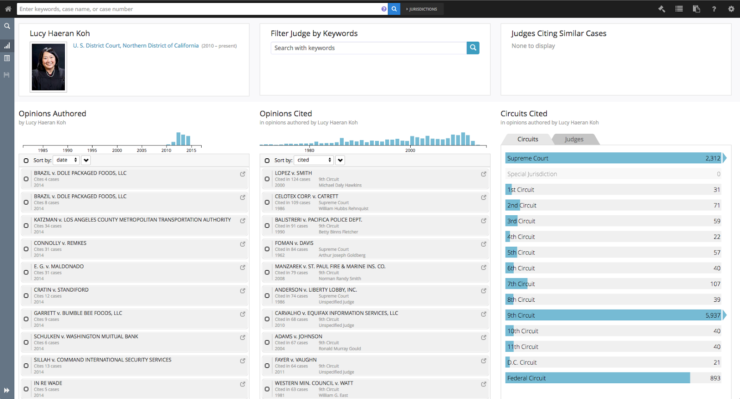
Ravel: Judge’s Citation Analysis and Comparison to Peers

Judges Analytics Earlier this month they launched a new judges analytics platform which may be especially interesting to partners and senior attorneys responsible for developing litigation strategy.  I am inclined to say we need a new vocabulary to describe these innovative legal research techniques. I am inclined to describe Ravel as providing “Precedential Behavior Analysis.” The bottom line is that Ravel has invented new ways for lawyers to seek a competitive advantage by discovering patterns and outliers in judges opinions  as well as  insights into who and what influences them. And yet the desire to gain competitive insights is not new… Daniel Lewis one of the co-founders of Ravel likes to  tell a story about how President Lyndon Johnson used precedential insights in 1948 to overcome an election challenge. The full story is printed below.*

From Anecdote to Precedential Insights
Lawyers have always employed a variety of techniques to glean insights into a judges temperament and judicial behavior including firm wide emails, checking court websites or  directories like the Almanac of the Federal Judiciary which provides lawyers comments about judges. Ravel has created a completely new way of gaining competitive insights.

Wouldn’t You Like To Know:…

  • How many opinions your judge has written addressing an issue
  • How often has the judge  ruled in your favor on that issue?
  • What precedents do they cite?
  • What Circuits do they cite?
  • Does this judge rely on different caselaw than other judges?
  • What language does this judge find to be persuasive on an issue?

Ravel provides powerful comparative analytics illustrating citation patterns and patterns of rulings which can be accessed with a simple keyword search.

In addition to the analytics, Ravel provides up to the minute feeds from news sources and blogs on individual judges.

Ravel Judge News and Blog Coverage

*Lyndon Johnson & Abe Fortas  Strategy

In 1948, years before he became president, Lyndon B. Johnson fought a
desperate senate election campaign. A loss would ruin his political career.
With election day approaching, a district court judge issued an injunction
keeping Johnson’s name off the ballot until accusations of voter fraud in the
democratic primary were resolved. Johnson called in attorney Abe Fortas to seek
the one outcome that mattered: get the injunction overturned, fast.
Fortas
devised an unconventional, but brilliant strategy – the only one that could
work in the time available. He recommended identifying and appealing to the 5th
Circuit judge most likely to rule against Johnson. A loss would
allow Johnson to quickly appeal to the Supreme Court, where Fortas expected
they could win a final, favorable decision from the Fifth Circuit’s overseer,
Justice Hugo Black.
 
Executing
on the plan, a team of lawyers flew to New Orleans to dig through previous
decisions by the Fifth Circuit’s judges. After analyzing the rulings and
language in case after case they found their judge, the one most likely to
rule against them. Properly targeted, the court fight
unfolded exactly as envisioned by Fortas. Johnson went on to win the election.
And Fortas? He was appointed to the Supreme Court in 1965.

American Lawyer Legal Intelligence has released a new report “Law
Firm Support Staff How Many are Enough?””In response to the changing legal landscape, law firms have restructured
their staffing of both attorneys and non-attorneys alike.  Law firm
management has begun to realize that they can use support staff more
strategically within the organization. This survey examines staffing changes
and the impact on law firm for the following categories: legal support staff, library
services, marketing and business development, office services and litigation
support”

The authors of this year’s report acknowledge up front the
challenge of establishing consistent staff and function definitions that have
equivalencies across all law firms. They wonder at what point does  secretarial work morph into paralegal work?   When a report indicates that partners are answering their own phones and doing their own proofreading, one has to wonder if the cost control and staff reductions of the Great Recession haven’t “overshot the mark.”At what point is the cost of efficiency too high? At the point where client support is suffering and lawyers are no longer focused on using their “highest and best talents?”

Here are some key findings from the report:


  • Spending on non-attorney staff continued to increase. 47% of firms increased their spending on staff.
  • 62% decreased legal support staff levels.
  • Firms are reducing lower level staff while recruiting staff with more sophisticated skills who are being paid higher salaries.
  • Legal support staff (secretaries and other administrative clerks) continue to be the biggest staffing category.
  • Library Staffing has been impacted by technology more than any other staff function.
  • Outsourcing remains unpopular. Library is the department least likely to be outsourced and litigation support the most likely to be outsourced.
  • Lawyers and paralegals are doing more online research. The report suggests that this research is “being taken away from the library.” I completely disagree. Lawyers have been doing their online research for 30 years. Librarians have been freed from routine research and are now able to focus on conducting more sophisticated research and generating analytics on a wide range of non-legal issues to support both the business and practice of law.
  • 34% of firms who had outsourced, brought the work back in-house.
  • IT and office services where the functions that were most often brought back in house after unsuccessful outsourcing.
  • 97% of lawyers screen their own calls. (I wonder if this is because they are relying more on their mobile phones which are not available for secretarial screening.) But it does raise the troubling possibility that downsizing from the recession has pushed clerical work up to partners and impacting both billable time and client support.
  • Litigation support is the function most likely to have increased staffing in the next year.
  • Marketing functions which are most often performed by outside vendors are website design, Public relations and graphic design.


The bottom line is that each firm must find its own balance of efficiency, cost control, staffing and client support. The responses to this year’s survey in some ways seem both inconsistent and contradictory, but perhaps this is just a reflection of the varying methods firms are using to reconfigure support (automation vs insourcing vs outsourcing vs downsizing vs upgrading). One size solution does not fit all.


 .
Note: This post was originally published on Tuesday but it was mysteriously deleted from the blog so I am reposting.
 
Members of the The Private Law Libraries Special Interest Section of AALL have voted to change the name of the SIS to “Private Law Librarians & Information Professionals.” The results were released Tuesday in a special edition of the PLL eNewsletter. Almost 79 % of those voting, cast ballots in favor of the name change.

The name change accomplishes two things. It changes the focus from “libraries” to the “librarians” themselves. It enlarges the membership tent to include the growing number of librarians who are now pursuing non-traditional careers as information professionals within law firms.

In late 2013 the PLL Board surveyed members on the name change. At that time 70% of the members indicated that the word “librarian” no longer described the scope of their responsibilities. Nonetheless. there was a strong resistance to rebranding the SIS without including either the word “library” or “librarian.” The Board finally proposed a compromise name which satisfied both the traditionalists and those professionals who are focused on redefining the profession for the 21st century.

Creating a more inclusive name recognizes the many “non-library” activities performed by PLL members. An increasing number of librarians are focused on Competitive Intelligence, Business Intelligence, Knowledge Management, records, docket, web development, and other emerging digital roles. Members are intentionally embedding information professionals in practice groups outside of the library. I saw it as increasingly risky to maintain a tight professional identity with a room that is shrinking.

“Private Law Firm Librarians & Information Professionals” acknowledges the professional roots and a signals to law firms and the larger world that SIS members engage in a broader range of activities beyond traditional librarianship, it also combats the stereotypes that generate unconscious biases. Most importantly the new name recognizes that information professionals have a role that will endure long after the last book has been tossed in the dumpster.

The final step in the name change is a vote to amend thy Bylaws to reflect the new name. Those ballots will be sent to members on May 13th.

Jackson Walker an Amlaw
200 firm based in Texas has promoted Greg Lambert to their roster of
C-level leaders.  Lambert  joined the firm as the Director of
Library and Research Services in 2012 and became Chief Knowledge Services Officer
in February of this year. Lambert made a name for himself as one of the
founders and writers of the award winning 3 Geeks and a Law
Blog
.

My first encounter with Greg
occurred at the inaugural PLL Summit in 2010 when he rather
Greg Lambert

prophetically spoke
on the topic: “Expanding Your Role: How to Reach the C Level.”
In the course of his presentation he  raised some uncomfortable issues about the low
numbers of librarians at the  C Level in law firms. (Data
indicates that fewer than 1% of  the C-level leaders in law
firms began their career as librarians.) He pointed out that in the past
20 years librarians were repeatedly at the forefront of introducing new
initiatives and technologies above and beyond their core responsibilities as
librarians.

These innovations include providing firms with the first link to
the Internet, introducing knowledge management (which by the way librarians
invented in about 2000 BC), competitive intelligence and formal professional
development programming. But instead of having their roles elevated, a strange
thing happened… someone else was hired to lead each new initiative. Worst of
all the people hired into these new roles were then elevated to the C-Level!
The persistence of the pattern is too dramatic to be ignored. But for today,
lets celebrate the addition of one more librarian to the C-Suite and
congratulate both Greg and Jackson Walker.

I invited Greg to answer some questions
about his new role and share his wisdom on law firms and the role of legal
information professionals.
What unique perspective and
expertise do librarians bring to C-level discussions and strategy?
GL: I think a lot of librarians
underestimate what they bring to their organization. I know I’ve mentioned this
before to you, but librarians (whatever you call them) are one of the best
evaluators of risk that the organization has. Librarians understand the
information and knowledge needs of the organization, usually they have
significant relationships within the organization, and they know the industry
and industry players very well. They are leaders, and need to see themselves as
such. No one in the organization has the skill sets that a librarian has. The
unfortunate thing is that many times their voices are pushed into the
background at times when it should be heard very loudly. Whether that is
self-imposed, or something of a traditional stance taken by the organization,
it needs to change. Many of us deal with 7 or 8-figure budgets, many of us have
multiple departments to manage, coordinate between different Admin and
Professional groups within our organization, but when it comes to the strategic
goals of our organizations, we are pushed to the sidelines. That just can’t be
the norm. I understand that each organization has its own personality on who
sets strategy, but we have just got to make more of an effort to get in that
discussion. We have so much to add. It’s a disservice to our organization, our
profession, and ourselves to not get in on that discussion.
Has this resulted in your being
engaged in new projects that people were unaware you could contribute to or
advise on?
GL: We’ve been doing some really great
things here, especially with Practice Group alignments. I don’t think that this
alone has created any additional projects at the moment, but aligns better with
what we have been doing since I arrived here. I will say that I have some ideas
of projects that I’m going to pitch, but I would have pitched them regardless
of what my title was.
What non academic life
experiences  have helped you in your career?
GL: A few years ago, some law librarian
friends and I started an informal peer group. We call the group “The Bradys”
because it started out with a Greg, a Jan, a Cindy, and a Marsha (no kidding).
Over the past six or so years, the group has become a core set of 11 folks
ranging from Librarians, CI Leaders, Marketing, Pricing, IT, and KM
professionals. We also talk a lot on trends we see out there, complain a lot
about things we think should be corrected in the industry, but aren’t, and
bounce a lot of ideas off of each other. The Bradys have become one of the most
successful things I’ve ever been a part of… and it’s really just an unofficial
think tank of really smart, really nice people.
What do you think the next
generation of info professionals should focus on learning?
GL: One of the thoughts that’s been
bouncing around in my head lately is the concept of “Library and _____” or
“Information and ____”. When I was in law school in the 90s, there was this
movement of classes of “Law and ____” Law and Economics… Law and Religion… etc.
I think we’re at a point in time where law firms will always need help in
organizing and managing the information needed to keep the firm competitive.
However, that just isn’t enough to justify creating an entire department. So we
have to make sure that Information Professionals continue to be top notch
managers of information, and negotiators with information providers, but that can’t
be our only purpose. In fact, it may end up not even being the most important
purpose we have within our organization or profession. It’s the other things we
do that become the most visible, and most valued (whether actual or perceived)
that our organization looks at and understands about what we do. There’s no
“Easy Button” when it comes to determining what that service or process is.
Each organization has its own set of needs, and it is the smart person that
looks to fill that need. The next generation (actually even this generation)
needs to find what their organization is failing to accomplish, and find a way
to fill that gap. Listen, understand, learn, succeed/fail/regroup and then
start over. It’s not about what we solved yesterday, it is about what we are
helping to solve tomorrow that counts.
What do you look for in a new hire?
GL: I’ve hired a number of new people
since moving jobs a couple years ago. I think I’ve been pretty successful in
finding people that are motivated to help, and are willing to interact with
others here at the firm. When I have an open position, I usually get a number
of well qualified people that apply. In fact, there have been many nights where
I stay up fretting over a couple of applicants that are just really close in
skill sets and I don’t have a clear winner. I did that a couple years ago, and
luckily it turned out that six months later I had a new position open, and I
was able to go back to the previous applicant and get her to come work with us.
So that’s a long way of saying that I look for people that I think will fit in
with the group. I give my people a lot of freedom to conduct their work in the
best way that they can, and so far, that has worked very well. I want people
that are smart, hard-working, creative, and energetic. At the same time, I want
people that have personality, and can interact and have fun with the others
here at work. We do not lack for personalities. I’m sure they would tell you
that extends all the way up to me.
How should librarians measure their value?
GL: That’s a big question that probably
has a thousand different ways to answer. Value is really in the eye of the
beholder, and not necessarily in the Librarian’s eye. We need to be viewed as
leaders. We need to be viewed as problem solvers. We need to be seen as go-to
people to get things accomplished. We need to be in the discussion when it
comes to setting the strategies for the organization, and not just worker-bees
in accomplishing those goals. There should be an expectation that we will be
involved, and noticed when we are missing.
What is your proudest professional
achievement?
GL: One of my proudest achievements was
one of my very first when I started this career. That was helping in the
completion and maintaining of the Oklahoma Supreme Court Network (OSCN.NET).
Creating a vendor-neutral resource of legal information for the State of
Oklahoma, and making that freely available to everyone was such a fun project,
and completely rewarding experience. The pay was terrible, but the reward was
fantastic.
A close second is what all we have
achieved with the blog, 3 Geeks and a Law Blog. I have to say, we
never imagined that it would have been as successful as it has turned out to
be.
How many years ago did you start 3
Geeks?
GL: We started back in July of 2008. Since
then we’ve posted over 1500 blog posts. Some good… some bad… but all were fun
and interesting to those of us that wrote them.
Why did you start the blog?
GL: The blog started really on a whim.
Lisa Salazar, Toby Brown, and I met for lunch one day and Lisa came up with the
idea and the name. From there it has been a whirlwind of activity and
additional people that have joined and helped along the way.
How did it help or hurt you career?
GL: It definitely helped, but in ways
that may not be obvious. As with many things, what’s important isn’t
necessarily how much you know, as opposed to who you know. The blog has opened
up many doors to leaders in the industry. There have been many times where I am
in on a strategy meeting and a name comes up in the conversation, and I get to
say “hey, I know him/her… do you want me to connect you to them?” It may sound
a bit shallow, but in this industry, being connected is very powerful.
Did your blogging ever get you into
trouble?
GL: I’ve never gotten into trouble for
what I’ve written. But, I have gotten into trouble for things others have
written. With this blog, we give everyone a pretty long rope to do with as they
please. We really only have a few rules, but the big rule is that we don’t give
away any internal information from our own places of business or air any dirty
laundry. When we poke at vendors, it is usually because they say one thing, and
then do another. We hardly ever say that a product is bad (we may say it looks
bad, or doesn’t do what it is advertised to do. We get asked to do a lot of
product reviews, but very few of those do we actually agree to do.
We try to be very honest, but very
fair in what we write. Occasionally, especially with those that don’t post all
the time, there is a line that is crossed. We’ve only every pulled one post
over the past 8 years, but we did so after talking with everyone involved, and
then making that decision. Most of the Geeks have had big transitions in their
careers the past few years. Two of us are now C-Levels at different firms, and
that takes a bit more of a time commitment than we had at our previous firms.
So you may have noticed that the writing had dwindled off a bit over the past
couple of years. It’s still a lot of fun to do, and as long as we are having
fun, we’ll keep writing.
What is your advice for the next
generation of information professionals?
GL: Listen, Learn, Act. Do something
interesting. Do something a little risky, but understand, and let those that
are affected by your actions, understand what the goals are. Get involved in
your organization. Understand what’s important, and help achieve those goals.
Accept recognition. You can still be humble in your acceptance, but make sure
everyone knows that you’re a leader that has taken action and succeeded. The
key is understanding you have the ability to contribute to your organization.
Once you understand that, take the lead and own it. When you’re truly valued by
the organization, you don’t have to tell everyone that you are valuable… they
already know it.

Related Posts: No Room in the C Suite for Strategic Information Leaders aka Librarians: The Long Shadow of “Help Wanted Female?”

I don’t hide the fact that I am a “big data” and analytics enthusiast. Having started my career in an analog world of print and key word searching, I have a deep appreciation for the fact that we are witnessing an unprecedented transformation of legal  research products. Products have evolved from providing answers to providing custom insights. When I first wrote about Ravel Law in August 2014, co-founder Daniel Lewis promised me that they were developing a unique product for analysing judicial opinions. I described it at the time as a “killer app.” It goes beyond research and is an app which I could imagine a partner using to plan litigation strategy. Yes there are other litigation analytics products out there, but Ravel is delivering insights which I haven’t seen in any other product. I am excited to see that  Judge’s Analytics  is about to launch.
Ravellogosimp8
The founders of Ravel Law have asked me to host the webinar where they will launch Judge Analytics. There is a link to register below.

Join The Free Webinar on Ravel’s Judge Analytics Tool

In this half hour session, you can get the inside scoop on Ravel’s Judge Analytics product, which arms litigators with data and analytics about how individual federal court judges make decisions.

  • Quickly identify opinions authored by your judge about issues like yours and the cases that influenced those rulings
  • Develop a data-driven understanding of your judge’s decision making process
  • Deliver high quality & financially efficient results to your clients

Register here  to join the webinar on Thursday April 16th, from 11:00 – 11:30am PST , 1 -1:30 pm CST, 2-2:30 pm  EST.