Just as I was contemplating topics for Library
Week,  I had a chance to review a 2014
study which provided at least of one perspective on “Why Libraries Still
Matter.”

The global architectural and design firm Gensler
recently published a compilation of their Research Reports and one the reports asks “Why do students really go to the library?”

The results are based on an observational analysis conducted at seven US and UK university libraries using a web-based
observational tool.

What tools do students use in the library? Surprise!
c.Gensler

What
Tools Are They Using
 When They Are In the Library?

The results are fascinating and somewhat
surprising. Who knew that paper and pen still dominate private study?

  •             Books are used less often than computers (10% vs 23%)
  •             Computers are used less often than pen and paper ( 23% vs 65%)

Collaboration
vs Solitude

 When Students are in the library…

             71% are working alone

            15%
work in groups of 3 +

            10%
work with one other person

Libraries Remain Important Gensler’s research suggests that some aspects
of the traditional library must be retained for both symbolic and functional
reasons.

Here are some of the findings:
  • Students still seek quiet places to study. 
  • Libraries remain students first choice for private study.
  • Library and university leaders have over estimated the need for collaboration space.
  • The solution is to increase the capacity of libraries without increasing space. 
  • Private study stations are occupied twice as much as open work areas.
  • Design classrooms for collaboration.
  • Design libraries for solitude.
I recognize that  the library’s role as a book repository shrinking as digital resources expand exponentially. Yet, students still long for a quite place
to think and study. I thought that perhaps earplugs created a sufficient zone of privacy for the current college generation.  Gensler says I am wrong.  When I was in college at Fordham University in the Bronx,
the university library was a former church and I loved  studying in a space that was once a choir loft. I would climb up to the third tier and feel smarter from simply breathing the scent of  ancient scholars … old leather and dust.

I
have worried about a world in which there is no refuge from noise. I am in fact writing this at the Sherwood Hall  Regional Public Library in Alexandria, Virginia. It is quieter than a Walmart but noiser than a church. I hear the murmur of students receiving tutoring and people talking on their phones.  Every one of the 20 or so  public computer terminals is occupied. I am alone in the communal table area. It lacks the hush of scholarly reverence, yet I am delighted to see the robust traffic and hum of activity in a DC area library on the Sunday of a beautiful Cherry Blossom Weekend.

The Gensler study suggests that
even when the last book has been digitized, the library will have a purpose as a
 cathedral of solitude. When I considered what these future library carrels might look like, I recalled the scene in the movie “The Internship” where Vince Vaugh and  Owen Wilson as Google Interns  stumble noisily into their colleagues “sleep pods.” 

c. Dunnco.com

Implications for Law Firms

Although firms remain committed to private offices for lawyers, the increased mobility and financial pressures to reduce real estate costs may lead some firms to consider hoteling and hot-desking to increase daily space utilization. The paradox may be that while law firm libraries are tossing their books and shrinking, the concept of libraries as bookless but quiet spaces for solitary study could get a second life in the law firm of the future. 

Lou Andreozzi, former Chairman of Bloomberg Law and CEO
of LexisNexis North American Legal Markets, has been named CEO of .law by Minds + Machines, Minds + Machine was granted an exclusive license to market the new generic  top level domain .law  by  ICANN  (The Internet Association for Assigned Names and Numbers) which governs internet domain assignments. Andreozzi not only has
experience in the legal market but his experience includes leading the
Martindale Hubbell, which in pre-internet days was the premier marketing
vehicle for law firms. In a recent interview, Andreozzi took credit for
acquiring the domain “lawyers.com” domain for Lexis. He believes that since law firms have a much more sophisticated understanding of marketing than they did when Martindale Hubbell ruled the legal market, firms are likely to welcome and recognize the importance of claiming a .law presence on the web.

Organizing the legal market on the web

.law will officially launch in August. Unlike .com and
.net which can be used by virtually any organization, .law registration will
require the registrant to be a lawyer. Each registrants legal credentials will go
through a two step verification process. Law firms will have a chance to
re-brand their web presence.

Andreozzi believes that 
.law enable .law domain owners to get better rankings in Google. It will
also give some law firms a second chance to claim a domain name which they were unable to secure in the .com domain. In addition, law firms are very
likely to want to acquire .law domains for both offensive and defensive
strategies. Even if a law firm plans to continue using their .com URL, they
will not want another law firm claiming a confusingly similar .law domain name.

 Minds + Machines is also going to market .law to  other kinds of legal entities. They are
currently in discussions with bar associations around the country and they plan
to give 5 free domain names to each US law school. Other law related entices such as legal publishers will also be eligible for .law registrations if they qualify for registration.
 
Below is the press release:

___________________________________________

SANTA MONICA, April 1, 2015, California, 
– Minds + Machines (LSE: MMX), the owner of the new .law top-level
domain today announced the appointment of Lou Andreozzi, former Chairman of
Bloomberg Law and CEO of LexisNexis North American Legal Markets, Martindale
Hubbell and lawyers.com<http://lawyers.com/>,
as CEO of .law. Carl Jaeckel, founder of Lawyer Central and CMO of Morgan &
Morgan will also join as COO and John Morgan, Founder of Morgan & Morgan,
renowned businessman, philanthropist and political power broker will serve as
Chairman.

Minds + Machines has been granted an exclusive license to
operate the .law top-level domain by the Internet Corporation for Assigned
Names and Numbers (ICANN), which regulates the Internet namespace and will
provide registry and registrar services for .law.  Andreozzi, Jaeckel and Morgan will play key
leadership roles in the launch of .law. 
The leadership is in discussions with many prominent bar associations,
legal journals and key legal market players worldwide to distribute .law domain
names.

 Lou Andreozzi said, “Minds + Machines has been truly
visionary in recognizing the importance of the new top level domains.  I am very proud to be working alongside them
in bringing .law to the legal industry.”

The new .law web address, which will function just like
other familiar top-level domains such as .com or .org, will go on sale to
accredited lawyers and law firms during the summer of 2015.  Applicants will have their credentials
checked upon registration and renewal.

Antony Van Couvering, Chief Executive Officer of Minds +
Machines, commented, “Lou Andreozzi and his team are the right people to run
.law.  Their experience and network will
assure that qualified lawyers worldwide become aware of .law and its tremendous
benefits to their practice.”

“We are giving lawyers and law firms the once in a
lifetime opportunity to rebrand their identities online, clear up any confusion
with other extensions and differentiate themselves from non-lawyers,” said
Morgan.

About Minds + Machines

Minds + Machines (LSE:MMX) is a leading owner and
operator of new generic top-level domains (“gTLDs”), and provides registry
services to a range of high-profile clients. The Group also provides domain
name services to consumers through its wholly owned registrar operations in the
US and Europe. For more information on Minds + Machines and its services and
companies within the Group, please go to investors.mindsandmachines.com.

For further information

 Tina Lord – Minds + Machines

+1 424 299-2079

 Toby Hall – gth Communications

North America 802 768 8018

Europe +44 7713 341072


Image result for ilta peer to peer professional evolutionThe Spring issue of  ILTA’s Peer to Peer magazine is devoted to the  topic of “The Professional Evolution.” Articles address the changes impacting, IT, Professional Development, Diversity, Marketing, Pricing and other management professionals in law firms. I contributed the article covering the transformation of law librarians and information professionals. The editors of Peer to Peer shortened the title of my article to “Info Professionals Connect Knowledge” 

Lawyers have traditionally been in the business of selling hours, but today’s client want to buy results, not attorney time. The new buyers market is forcing firms to identify ways of driving efficiency and process improvement. Information professionals  who live at the intersection of content and technology are uniquely  positioned to help. Law librarians who have redefined their roles beyond the “boundaries of the book stacks;” are driving intelligent resources and analytics into each practice are and administrative function. Read the rest of the article here.

 In December I offered readers the opportunity to respond to a survey on products and processes that they started/stopped in 2014 or planned to stop or start in 2015. This year readers were also given the chance to describe products or features they are waiting for vendors to provide.

What
s the best NEW PRODUCT you became aware of in 2014?

 Responses to the question “What was
the best “new product that you became aware of in 2014?”  is remarkable because
of the variety of responses.The one feature that is common to many new products
is that they are leveraging big data to provide analytic insights.


It appears to me that the legal
information market is experiencing a great reawakening. Innovators in both
start up and in well established companies are recognizing the power of data to
offer new insights. The competitive pressures in the legal market seeking practice
efficiencies and actionable insights for business intelligence and client related
matters make it ripe and receptive to these new offerings.


 Lex Machina which provides IP
litigation analytics got the most votes for best new product. It was followed
by PacerPro which is streamlining and eliminating some of the inefficiencies of
using the official government Pacer website.


  • Lex
    Machina
  • PacerPro
Other new products mentioned in the
survey are:


  • Westlaw
    Intelligence Center
  • Basecamp
  • Quatrove
  • Mlex,
  • Benchmark
    Judges
  • Deal
    Data Point
  • CaseText.
  • RavelLaw
  • West’s
    Business Law Center
  • WestlawNext
  • FiscalNote
  • Neudesic
    Firm Directory
  • Investor-State
    Law Guide
  • PatBase
    Analytics
  • Bloomberg
    Law.
What
was the BEST FEATURE/FUNCTION added to an information resource in 2014?


The most cited “best new feature or
function” added to an information resource in 2014 was the collaboration between
Fastcase and Heinonline
. Fastcase although not quite a start up is still a relatively young, still edgy newcomer to the legal information market. They offer low cost access
to  primary law using an innovative search algorithm and offering visual displays of
search results. The William S  Hein Company is a very old,
family owned business with roots in serving the traditional library needs for
more scholarly and esoteric research materials including law reviews, treaties,.
Government documents and historical treatise. But since cases and academic
materials have a perfectly symbiotic relationship, one feeds off  and informs the other, Hein and Fastcase deliver a low cost suite of core research
materials.


The second most cited product feature was Westlaw Next’s simplified pricing. This
is an issue near and dear to my heart. This was the topic of the blogpost/diatribe
against the complexities of online research pricing which I raised in “ The Myth and the Madness of Cost Effective Lexis and Westlaw Research Training” which put  “ Dewey B Strategic” on the map.The best innovations or new features are:

  • Fastcase/HeinOnline
    collaboration
  • Predictable
    pricing in Westlaw Next

Additional product enhancements
cited:

  • Intelligence
    Center Upgrade to Westlaw Monitor Suite.
  • Favorites
    in Lexis Advance
  • The
    enhancements made to Lexis Advance.   It is now easier to find the databases
    and content you need.
  • New
    Lexis Advance platform – cleaner and with requested enhancements
  • Docket
    Navigator’s analytics
  • Wolters
    Kluwer Intelliconnect’s browser search feature.
  • Ability
    to create custom pages in WestlawNEXT
  • Collaboration/personal
    saved documents space in WestlawNext Canada

Features cited without mentioning a
specific product:

  • Seemless
    collaboration and email tracking with tagging feature
  • Data
    analysis tools becoming more widely available on more litigation support
    review platforms and review tools
  • Increasingly
    prevalence of dashboards.
Name the New
Products which you plan to rollout 2015


  • Lex
    Machina
  • Room
    reservation system
  • Quatrove
  • Automated
    Reviews, Learning Management System
  • Lexis
    ebooks via Overdrive
  • Darts-IP
  • Lexis Practice Adviser
  • Considering
    moving to a cloud storage product for our DMS
  • Password
    management software
  • Firm
    directory/experience database.
  • Electronic
    resource management software (e.g., OneLog, Research Monitor, etc.)
  • Aggregator
    (Convergence) to automate CI/current awareness efforts
  • Research
    Monitor and Research Hub (for mobile)
  • Custom
    workflows within our Relativity environment.
  • West
    KM as a federated/enterprise KM tool.


 What
PRODUCT did your department/organization STOP using in 2014?


There was no real trend here. There
is no one product that a lot of firms are dropping; The only thread I see
connecting the various responses is that they are for the most part products
which have been around a long time and which support  core research activities. Two
are directories (Lawyers Manual and Marindale) which are clearly marginalized
by web based resources.  But generally it
looks like a list of products that were probably cancelled to cut the budget or
in favor of a competitor. There is nothing on the list which suggests a new and
innovative product was tested and found to be not worth the cost or not up to
the hype.


  • Lexis
  • BNA
    stand alone databases
  • File&ServeXpress
  • Lawyers
    Diary and Manual
  • Westlaw
  • RBSource
  • Intelliconnect
    Tax Library
  • Martindale
  • Equilar
  • West
    LegalEd Center
  • Infomart
    News
  • Windows
    XP
  • Deal
    Proof
  • Westlaw
    Business
  • 10K
    Wizard
  • Concordance
  • Loislaw
  • Ozmosys


Name
any PRODUCTS you PERSONALLY STARTED using in 2014


These responses also covered a wide range of products. The majority of these products focus on process improvement rather than research. There was also an interesting mix of products that were more likely for personal use. These are listed separately below.


  • Lex
    Machina
  • Practical
    Law
  • Lync for video  meetings
  • Bloomberg
    law
  • Benchmark
    Litigation
  • Camtasia web
    recording software for short tutorials on library resources
  • WLN –
    benchmark reports
  • SimpleMind
    (process mapping tool)
  • Windows
    8.1
  • Eagle
    Eye
  • Intelligize
  • Litigation
    Monitor
  • Manzama
  • PTAB Trials


Products For Personal Use
  • Fitbit
  •  Fage yogourt.  I’m not joking
  • Giving up hotels in favor of Airbnb
  • Giving up taxis in favor of Uber and Lyft
  • Giving up GPS device in favor of Wayze apps
  • I got my first iphone and I really like watching HBOGO on it
  • I started reading print books instead of reading books on my Kindle
  • Pay by Phone traffic meter app
  • iPad Air
  • Carbonite – online backup


Listen Up Vendors. Product ideas. Describe a PRODUCT/SERVICE you would like to see developed, which doesn’t currently exist. Here are the recommendations:

  • I want a universal thumbprint or iris reader to get me into all of my work and personal applications. I use the available technology but it is just not good enough. I still spend way too much time recovering and resetting passwords.
  • Cataloging records for individual products in Bloomberg
  • Auto-Meta tagging system to mark items for practice groups or legal issues.
  • A product that will give you a comprehensive Reverse Whois report. We use Domain Tools but it doesn’t compile the data in a report. Mark Monitor isn’t as complete.
  • Is like a one-stop-shop for our group to organize requests and be able to see who is doing what. Being able to EASILY bill time would be great.
  • A search service that is publisher agnostic, allowing searches of materials from many publishers using a single search technique.
  • CaseText should adds second half to cover EDGAR.
  • Reincarnation of defunct ITC Research database
  • Vendor neutral all-inclusive news database
  • A competitor to Platt’s newsletters
  • A service that would give a comprehensive comparison of periodical/news content/coverage from Lexis, Westlaw and EBSCO.
  • Graphics embedded in periodical literature from Lexis and Westlaw
  • Legal ebooks on a single universal platform for multiple users
  • Attorney-oriented reviews of KM technology that compare features of certain products systematically. For example, point-by-point on Recommind vs. FAST vs. HP Autonomy
  • An OverDrive-like service for private libraries with the option to manage and serve the library’s own digital content.
  • Real time-searching of docket documents; not docket entries.
  • An ediscovery project management tool. More true practice support applications.
  • More IP authenticated searches available on WestlawNext-Links from WestKM documents without login.
  • A database that allows a search by party name across all federal and administrative patent proceedings, that can then be loaded into Excel.
Thanks to everyone who responded. As much as I try to stay aware of new products, my colleagues have once again shared insights, experience and recommendations about products which  which had  flown under my radar or not registered as products warranting a serious look or critical reassessment.Part 1 of the survey results were published on March 20th: The Start Stop Poll Results 2014-2015 Processes and Initiatives: Workflow Improvement In, Print Continues Its Freefall.

The original survey was posted on December 15, 2014.

Thanks to everyone who responded to this year’s poll. I will be reporting the results in two parts. Today I am reporting on processes and on Monday I will be reporting on which new products are making the grade and which products may be starting a slide into oblivion.We are once again being offered a chance to learn from the “Wisdom of Colleagues.”
START. The initiatives that were most often cited as priorities in  2014 and 2015 are: Client monitoring initiatives, workflow process improvements and personalized “high touch”outreach to
lawyers.
STOP
Print is still under fire. All manner of print is being tossed, books, subject
files and periodicals. The challenge of completely eliminating the routing of
print newsletters was noted repeatedly— even when a digital version is available – lawyers fight to keep newsletters coming in print. “But I prefer reading from
a velum scroll!”

Another
recurring theme was  improving workload tracking. In many cases this involves eliminating generic workload tracking  software (access, excel) or IT
help desk software which doesn’t quite fit the workflow needs as well as  ditching manual tracking processes in favor of custom research tracking software.

 Here
is the  list of  additional services which were  stopped in 2014 or will be stopped in 2015:

  • Manning
    the reference desk.
  • Giving
    up IT help software in favor of research software.
  • RFID
    tagging of books.
  • Webinars
    replaced with SharePoint training gadgets.
  • LibGuides
  • Recording
    user passwords (“Forgot your password?” is now ubiquitous).
  • We
    stopped using a filing service
  • We
    cut way back on links in our Virtual Library.
  • We

    centralized techical services functions in our main office, eliminating redundant processes in 11 offices.

 Which
organizational initiatives were started in  2014?

  •  Software is being deployed to streamline workflow and analysis of workflow and resources:( Ref Tracker Illumen, Onelog and Quattrove).
  • Software which is being implemented to track use of digital resources include Research Monitor, Onelog and Quattrove.
  • Competitive intelligence initiatives are using Manzama and Linex.

Here  are additional responses:

  • Research
    Services started producing the highly formatted and structured CI reports
    and reports on all proposed lateral partners.
  • Research
    Monitor Administrative center provides real time digital resource usage
    data.
  • Started
    using ResearchHUB, the Research Moniotr module for mobile apps and
    websites.
  • Started
    a Twitter  and Linked-in accounts
    for the  Info Center.
  • New
    SharePoint portal
  • Added
    contract management data  to InMagic
    Genie module
  • Set
    up a digital library of Bender IP titles
  • Rebranded
    department from Library and Information Services to Knowledge &
    Research Services
  • Changed library staff titles to Director
    of Knowledge & Research Services and Knowledge and Research Services
    Assistant respectively.
  • West
    KM
  • Created
    Library App of the Week cards to promote library apps.
  • Process
    mapping litigation and counseling tasks.
  • Use
    of Summation Pro
  • We
    created CUI’s for Westlaw (Find and Print, e-books)
  • After
    being approached by a partner and his clients, I became an embedded
    librarian

Describe
any ORGANIZATIONAL (task/process/initiative) you plan to START in 2015:

Top Initiatives Cited:

  • Client monitoring initiatives
  • Workflow process improvements
  • Outreach to lawyers

Additional
initiatives cited:

  • Screening
    potential clients for litigation against law firms or bankruptcies, etc
  • Lawyer
    Process improvement. Working with a practice group to analyze a complex
    process in order to map out which products can streamline the process.
  • Using
    Instant Messaging to answer reference questions
  • Lexis
    ebooks on Overdrive
  • Optimize
    the Department’s billings, increasing Department revenue opportunities and
    decreasing expenses. 
  • Launch
    OneLog. 
  • Launch
    new SharePoint.
  • Personal
    follow up visits to attorneys requesting complex research
    assignments.  
  • Use
    Chrome River for library invoices.
  • Weed
    collection heavily prior to West LMA renewal.   Compare online resources for
    redundancy  3. Increase online
    delivery of routed periodicals.
  • Create
    Practice Group specific training videos.
  • Transition
    to WestlawNext from Lexis Advance in 2015.
  • Cross
    train research and technical services teams
  • Implement
    a library mobile app using Boopsie
  • Document
    requirements and business justification for KM project requests.
  • Reference
    Services & collection management processes reviews.
  • We
    plan to start a floor support program which will increase librarians’
    visibility.
  • Plan
    a “reference academy” where our librarians will share their
    special expertise with the rest of the group;
  • Moving
    our intranet pages to SharePoint 2013
  • Programmed
    standardized reporting (SQL).
  • Re-educate
    everyone on the value of WestKM and our internal work product

Coming Up Monday: The Start Stop Poll on Products, Best New Products, Best New Features and Ideas for completely new products! Stay tuned.

Thomson Reuters Intelligence Center Dashboard

Anyone who reads my blog must know by now that I am a “soft touch” when it comes to products which offer  intuitive access to analytics. I was anxious to get a close look at the Thomson Reuters Intelligence Center which was launched last year.

The Thomson Reuters Legal Intelligence Center is the latest offering in a suite of business development products such have offered increasingly sophisticated tracking and reporting on litigation activities in the US. Thomson Reuters Client & Market
Intelligence products include Monitor Suite, Dockets, Court Wire, and
WestlawNext Practitioner Insights.

Monitor Suite  was launched in 2005 and was originally named Firm360. At the time it offered ground breaking reports and analysis of a company’s litigation history by extracting docket data. The Intelligence Center extends the range, depth and flexibility of the reports which can be generated using the intuitive Intelligence Center dashboard. The Monitor Suite leverages the design and technology used to build recent Thomson Reuters solutions such as Firm Central and Concourse.
Like these products, the widgets within Intelligence Center are highly interactive, enabling users to view and manipulate seemingly endless combinations of data points (lawyers, law firms, judges, companies, industries…).  Jefff Arvison, Director of Product Management described the benefit of using these platforms in a press release. By leveraging the these new “we were able to combine the collaboration tools of our client- and matter-centric platforms, along with the analytical power of Monitor Suite, to provide the business development focus that law firms want and need.”

Map Your Opportunity. My favorite part of the product is the national litigation map. This
feature allows a firm to see where a client or company of interest is
currently engaged in litigation,  where a firm is engaged in
representing client and states where the firm has the opportunity to generate business with the client.The  the deeply faceted data supports easy custom analysis of litigation activity and opportunity. 

Firm Profile Views – Innovative approach to displaying opportunity

Purple – you firm has work
Green – Firm has work but client not represented
Orange = client is there an firm is there but no representation

Examples of reports include reports
 by company, law firm, judge, causes of action.

Industry Litigation Reports
Select companies in a single industry and track litigation over time, analyse the attorney
  • Litigation Representation by Share of Industry
  • Compare your firm’s share of litigation across an industry
  • Compare you firm’s share of litigation in an industry to other law firms history representing the company or industy
  • Litigation by Industry
Attorney Representation Report 
Attorney Representation Report
Wheel charts parse an individual lawyers litigation history and shows which companies they represent, what courts they practice in and what area of law they litigate.

Center provides views into a company’s litigation activity by
jurisdiction over multiple time periods, along with the ability to see
the firm’s share of litigation representation for that company. The tool
also offers a company comparison chart that can help identify industry
trends and provides company-related news through WestlawNext.

Access and Collaboration. Reports can be delivered to interested lawyers by sending them a link to a report which  can transparently authenticated and will continue to  update. An RSS feed can be posted on a practice or client page.

The Intelligence Center not only streamlines  processes, it performs analyses that were for all practical purposes impossible to perform in an analog world. Yet these reports don’t run themselves. TR Intelligence Center is a reminder that information professional are faced with an abundance of opportunity to introduce and explore and promote the benefits of analytics in the business and practice of law. 

Just when it appeared that
Lexis was about to corner the legal news market (ALM, Law360, WSJ Law Blog),
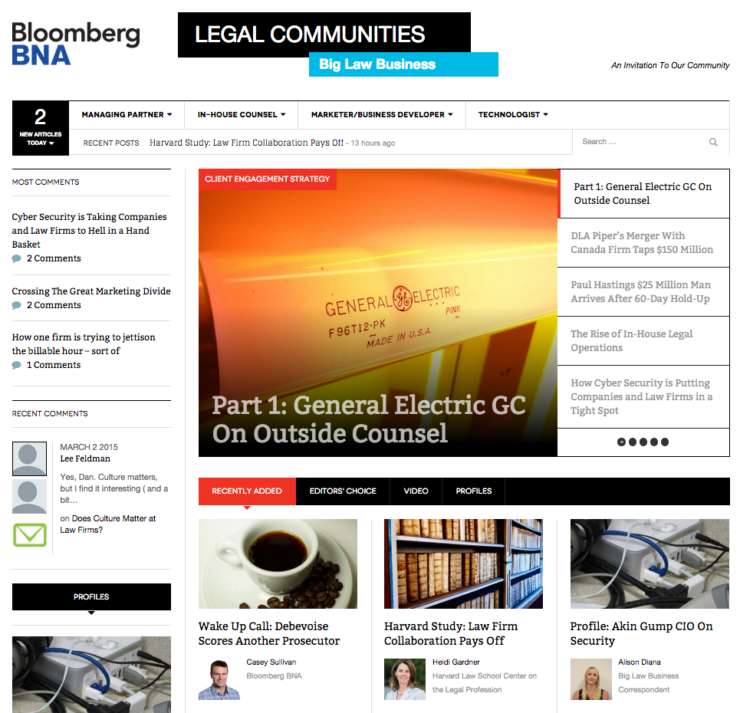
Bloomberg BNA is announcing today the release of a new open access community
platform called “Big Law Business.”   Big Law Business  
delivers  articles, podcasts, videos, twitter feeds,  polls and white
papers focused on the unique concerns of partners, GCs and  Law firm
executives at AmLaw 200 firms. One unique feature is moderated online discussion. 
Law firm leaders and GCs can join moderated online communities and exchange
ideas on best practices, innovations as well as legal issues.

Scott
Mozarsky, President, Cross Platform Businesses, Bloomberg BNA is quoted in the
press release: “Big Law Business will provide visitors ample opportunities to
engage with those in similar roles at law firms and corporations and benefit
from shared insights and wisdom.”   When Greg McCaffery was appointed CEO of Bloomberg BNA in 2012 he signaled Bloomberg’s
intention to supplement the traditional practice of law platform with new
content which focuses on “the business of law.” Today they are taking one
more step in implementing that strategic focus. 

Bloomberg’s Big Law Business Platform

I predicted in 2011
that Bloomberg would ultimately leverage their multimedia talent pool  for
their legal product. Bloomberg has recruited editorial talent from their news
and  tv production  divisions. Big Law Business has a clean
professionally produced  look and feel. About
50% of the content will be contributed by independent “thought leaders” recruited
from the Amlaw 200 community,  academia
and the commercial ventures and support the practice of “Big Law.”

Above the Fold

I was given a prelaunch
tour of the product. The Big Law Business Platform currently offers 4 major
”communities of interest” which are aligned with potential members roles: Managing Partners, In House Counsel,
Marketing/Business Developers and Technologists. I am surprised that they have
not yet added  a section for professionals involved in
Knowledge Management/Process Improvement which are key initiatives driving  both the competitive position and the
profitability of Amlaw 200 firms.

Bloomberg is not known
for embracing open platforms. The login procedure for early versions of BLaw
actually required lawyers to provide a biometric thumb scan. Until recently
they would not allow BLaw content to be accessed using IP authentication– which
is  routinely allowed my most legal information
providers. Bloomberg does have a history of making contrarian moves, so as
Lexis locks down the news, Bloomberg  is
throwing open the gates.

      Casey Sullivan, Senior Director of the Big Law
Business Community  will oversee the
moderation of comments.   The site is built on the assumption that there
is an appetite for more community engagement. Any comments placed on the Site
need to be relevant to the Big Law Community. This community includes current
and former members of AmLaw 200 Law Firms, in-house counsel, vendors who
support big law practice, academics and industry observers. According to
Sullivan “We won’t allow community members to throw up an advertisement in a
comment to promote their own business. The comments should be thoughtful. The best
comments will offer original ideas, opinions, best practices and analyses of
industry wide issues.”

Touching the Hot Buttons

The Bloomberg Law
product has always marketed itself as being both a business and legal
research platform which offered a unique value proposition to partners. Breaking
with the traditional legal research cost recovery model, Bloomberg had no meter running
because a firm paid an annual subscription for unlimited access. Like the Bloomberg terminal in
the financial sector – the product was positioned as a desktop utility that a
lawyer should simply keep open on their desktop for use as needed through the
day. The use case  is that BLaw allows a  partner to launch their BLaw account in the
morning and easily locate information on clients using the “go bar command ” to
retrieve company profiles, executive profiles, financials all delivered in a click.
The Big Law Business platform appears to be a tool for building both brand awareness and goodwill at
the partner level. I have to presume that this is a gambit to increase the
adoption of Bloomberg Law in Amlaw 200 law firms.

It is a given that law
firms are competing for the attention of In-House Counsel. So the creation of
an online community plays to the most fundamental business development and
competitive instincts of lawyers. Every lawyer needs to be a rainmaker.
Opportunities to gain insights and access to corporate GCs from the comfort of
your own desktop are coveted. To this end, Big Law Business will prominently
feature video interviews with  In House
Counsel. They will also provide GC profiles and the chance to engage GC in the
Chat discussions or build the law firms brand by adding publications and
commentary to the site.

The Competition

Blaw is  not actually the first company  to offer an online chat community to lawyers. David
Johnson, a former partner from Wilmer Cutler and Pickering created a platform with
American Lawyer Media called Counsel Connect in the mid 1990s.  It may have been an idea that was two decades ahead of
its time. The world and even Big Law partners have a much higher awareness and
openness to online social engagement in the 21st century. Big Law Business
also plays to lawyers consciousness of being part of a very exclusive club
a factor which may drive more traffic and engagement One issue that argues against
participation is the strong branding control exerted by law firm marketing
department. It is a lot harder to be spontaneous in the more self conscious and
controlled marketing regime which exists in most big law firms today.

Big Law Business is competing with the Memisis Law
site which was created by former Bloomberg video host, Lee Pacchia which offers
similar video interviews of thought leaders on hot topics. The site has some
resemblance to ALMs re-launched  Law.com
platform which also offers communities and  a mix of crowd-sourced and editorial content. I
anticipate that  Bloomberg  will develop their own brand of law firm rankings before too
long. 

I was baffled when Bloomberg did not purchase American Lawyer Media last
year when it was up for sale, and now I know why. They planned to complete directly and build their own
business of law brand… and they are doing it as “free ware” rather than entering
the market only after convincing firms to pay a fee for admission. It
is also a dramatic change from the positioning of BLaw which entered the legal market
at the high end of the pricing spectrum. Big law partners now have a new source
of business intelligence and a platform for client engagement at the best
possible price – free!

Access:
Big Law Business is located at http://bol.bna.com/

Subscribe  to Updates:      
Anyone can subscribe to receive our Big Law
Business newsletter by clicking on a “Sign Up for Our Email Newsletter” icon on
the website. There are no restrictions regarding who can view the Site since it
will be public.BOL will also provide RSS feeds.


Lexis was the first legal research product to offer a news database to lawyers when they created Nexis in 1980. They were the first to offer newsfeeds when they introduced “eclipse” in 1984. They took an early stab at creating a news aggregation platform when they introduced LexisNexis Publisher in 2000. They have strengthened their position in the legal market with a series of strategic news alliances ( Wall Street Journal, New York Times and American Lawyer Media publications) and the acquisition of the Law360 newsletters.

Moreover. Last October they announced the acquisition of a news aggregation platform called Moreover. Next month the Moreover platform will be re-launched after the addition of LexisNexis content and rebranded as LexisNexis Newsdesk. Lexis Nexis news is in the process of being added to the Moreover news database before the launch. Factiva, Law360, Court Link and other Lexis content will be added in the third quarter of this year. They will be also offering NewsDesk on a Mobile App.

The LexisNexis NewsDesk Dashboard


From Abstracts to Analytics. I
have watched the delivery of digital news morph from  primitive beginnings.  In 1983 the New York Times Infobank  was at the cutting edge by offering dial up access to news “abstracts.”  (That’s right, no full text –  you got a citation and a summary  –then you
had to locate a copy of the actual newspaper to read the full story.) We have
come a long way…. The Lexis Nexis NewsDesk is a 
gob-smacking, marvel of interactive features and functions.  News aggregation is on the cusp of evolving
from  offering very sophisticated news curation  and personalized delivery to a new tier of offering
“news as a living and interactive source of insights and analytics.”

Although
NewsDesk  will be a “stand alone” product
like Lexis Nexis Publisher, it will only be available to Lexis subscribers, for an additional subscription fee.
Lexis will continue to offer news libraries to 
legal product subscribers. but these will lack the functionality and
analytics available in the Newsdesk platform. They are clearly 
positioning the product to compete with independent aggregators such as Ozmosys,
Manzama, InfoNgen. Attensa and Linex.

Content Includes

•     
LexisNexis
licensed news sources, including exclusives like Factiva, The Wall Street
Journal
, The New York Times, ALM and more.

•     
Coverage
across 55,000 editorially-maintained Web-based news sources from 150 countries
in 75 languages.

•     
Key
social media sites including blogs, forums, Twitter, Facebook, Google+, YouTube
and more.

•     
National,
cable and local TV broadcast video clips and associated transcripts.

•     
Third
party premium content based on subscribers licenses.

Tools

•     
Near-real-time
media monitoring with over 2,500 new links added per minute – categorized and
searchable.

•     
Powerful
search filters  to quickly refine results.

•     
User-friendly
interface with a personalized dashboard, on-demand updates and searching
–  available for admins and end-users.

•     
Curated
and automated email delivery options, including alerts and fully branded
newsletters.

•     
Flexible
export formats (RSS, Atom, etc.) to integrate news on an internal webpage or
portal, like SharePoint.

•     
Advanced
media analytics for deeper insights with many charting options and full data
download to Excel.

•     
Platform
can manage both personal curated content and aggregated content for groups. 

Really Cool Tools and Unique Features

I
have only seen a demo and I haven’t used the product myself but I am a sucker
for products which offer intuitive interactivity  and rich analytics. Here are the features
which really caught my attention.

  • Newsfeeds
    include video clips from news broadcasts
  • Video clips
    include transcripts
  • Foreign language
    stories are automatically translated into English
  • Semantic tools
    provide sentiment analysis allowing you to focus on negative or positive
    stories on a subject
  • Sentiment can be
    graphed!
  • Word clouds,
    time trends
  • The relevancy
    slider. Each story is scored by relevance and you can adjust relevance to
    increase or reduce the search results using a sliding bar.

Location Location Location

One
of my big gripes about the loss of access to  “native Factiva” was the granularity of
Factiva indexing. The deal Lexis Nexis struck with Dow Jones in 2005 which ended law firms’
ability to subscribe directly to either Factiva or to get corporate accounts for the
Wall Street Journal. Factiva was loaded into Nexis and despite assurances, much
of the power of the Factiva indexing was lost on the Lexis platform. Factiva coding
of stories allowed you to  select stories
based on both the geographic location of a publication and the geographic
location of the subject. Without this coding it is extremely difficult to
locate stories in Japanese news sources about Toyota plants in the US. Lexis
assures me that the Moreover platform will support this kind of granular
distinction in creating alerts.

Third Party Aggregation

The
Moreover Platform can accept and redistribute feeds from third party
publishers. According to Lexis it will be up to each publisher to determine if
they will allow Lexis to redistribute the feeds. So in theory  — the
Lexis News Desk platform may be able to deliver feeds from Lexis major
competitors, Thomson Reuters, BloombergBNA and Wolters Kluwer.

Getting Social: Share of Voice

The
Moreover analytics are impressive. Administrators and end users can interact
with and analyze news using a variety of visual tools.
  • Charts can show “share
    of voice”
  • Maps will show
    geographic concentration of coverage of a topic by state
  • Timetrends will
    show spikes in news coverage
  • Word clouds
    allow you to select a subset of stories on a particular issue
  • RSS feeds can be
    posted with charts to show trends

It
is simply not possible to describe all the analytics or functions I observed in
an hour long demonstration. I will summarize by saying that  anyone in the
market for an aggregation platform should take a close look at the LexisNexis News
Desk.

There
is only one feature which I identified, that is available in competitors  and which
NewsDesk doesn’t currently offer. NewsDesk does not currently allow end users
to “unsubscribe” to selected content in their personal newsletters. And it does
offer some unique features which I haven’t seen in competitor products.

Competition
is the mother of better products.
  As of 10pm on March 3, 2015, Lexis
appears to be positioned to leapfrog over many of today’s dominant aggregation players.
But
it’s a horse race and law firms can only benefit from the fierce competition in
this space. We can expect the products to keep getting easier, smarter and
offer ever deeper analytic and even predictive capabilities.
In November  when I wrote Lex Machina Provides Bigger Data “Custom Insights Raises the Analytics Bar for IP Litigators it was clear that the product would continue to evolve. Last week Lex Machina added a new “high value”  tranche of litigation data from the Patent and Trademark Appeals Board and the  International Trade Court. The PTAB data include every trial since the creation of PTAB in September 2012. It currently includes the Lead Petitioner and the Patent owner,  not all parties are listed at this time- but there is  a plan to add all party names. A complete list of parties can be viewed in the related PTAB documents. The module include all the PTAB documents in PDF format for fee.
“PTAB Trials “currently includes two tabs: a Summary which describes the case and Timing. They will be adding information on law firms, attorneys, outcomes and findings. The PTAB document are assigned granular codes for documents types. They currently identify about 20 different types of documents related to PTAB trials. They plan to add judges data in the near future.

New PTAB Data Reports in Lex Machina

The Lex Machina “motion metrics” report will include all district court and PTAB cases/ They are tightening the integration of  District, PTABa nd ITC investigations data.

In House Counsel and Legal Analytics ( or Escape from Anec-data)

I have focused on Lex Machina as a powerful data engine for law firm business development and a kind of crystal ball providing predictive insights which can be applied to case assessment and litigation strategy. The March issue of the  Association of Corporate Counsel Docket is featuring an article which provides in the “In-house” perspective on legal analytics from Lex Machina and other sources. The  article co-authored by Kevin Kramer, Yahoo’s VP and Deputy General Counsel for intellectual property and Owen Byrd. Lex Machina’s Chief Evangelist and General Counsel. The Article ” Legal Analytics Transform Law Department Patent Activity” describes the variety of ways that in house counsel are using data to select and manage outside counsel, make internal business decisions when faced with a lawsuit and determine their own tactical and strategic approaches to case assessment for patent litigation. The article provides  interesting insights into how Yahoo is using data to assess their response to patent troll litigation, select outside counsel and conduct case assessment and litigation strategy. There were also some applications I couldn’t have imagined. Yahoo  reports using workforce data and geographic location of their engineers to anticipate the volume of “invention discolsures” which will be submitted to the GC. My favorite insight in the article is the power of legal analytics to empower lawyers by  moving them away from making decisions using subjective “anec-data” to leveraging resources which deliver actionable, objective data.

The authors are optimistic that access to legal analytics will continue to improve but they  also highlight two important “confidential” data sets which remain unavailable for analysis. These two areas are settlement data  and licensing data.

Don’t Look Now: Outside Counsel Are Digging Your Data

The article also describes some collaborative projects in which Yahoo
worked with Lex Machina to identify lower cost and highly experienced IP
litigators with relevant experience in appropriate jurisdictions as an alternative to Big Law firms.  Yahoo is using Lex Machina
for early case assessment, choice of venue, evaluating judges,opposing
party and counsel. 

The implicit warning in this article, is that lawyers need to seize legal and business analytics in order to even be “in the game.” Top tier firms may  find themselves losing clients based on  comparative legal analytics. Imagine the unspeakable embarrassment of going to a client pitch without your own custom analytics report and being confronted with  “time to trial” data and  early case  assessment strategies developed by the client’s GC who used commercial services such as Lex Machina.


I haven’t been to Legal Tech in years. Over the years they seem to have evolved into a trade show which focused on the hot technology of the moment. In recent years eDiscovery was the dominant theme. But this year ALM entered a partnership with  Codex,the Stanford
Center for Legal Informatics.

According to the press release:  “CodeX’s mission
is to solve systemic problems in the law through the exchange of ideas around
legal technology, which will empower individuals and impact our legal system
for the better. A primary focus of its researchers is the development and
implementation of computational law, the use of computers to translate legal
rules and regulations at a moment’s notice.”


 ALM
worked with the CodeX team to introduce new companies to a market of nearly
13,000 LegalTech attendees by providing packages to eligible companies that
offer a free exhibit space in a new pavilion on the trade show floor, as well
as the opportunity to host thought leadership presentations on the pavilion
stage.


Innovation in
Aisle 117


Aisle 117 was not only a great place to see innovative products but it was a social hub for other innovation pioneers. When I arrived at Aisle 117 ran into  Ed Walters of Fastcase and D. Casey Flaherty of  “technology audit” fame. Flaherty had recently left Kia Motors and was pursuing innovation as an independent cost control consultant.  Aisle 117 did feature an interesting mix of new products. Not one of
them involved ediscovery. There was a heavy bias toward IP related products.


Patent Vector
is a new take on using big data for IP. It provides ranking and mapping of
patent influence using a database of US patents from 1976.


IP Nexus is a
kind of IP marketplace for inventors looking to protect their inventions. It
links inventors to a legal advisers, experts, , Investors and purchasers.


Plain Legal
is a cloud based collaboration application for IP filings. It automatically
generating  USPTO filings and tracks deadlines.


Docket Alarm
Yes another docket product. They are also focused on IP filings. They claim to
be the only service that includes all of the Patent Trial and Appeal Board
data. The do offer a cool looking dashboard of analytics with lots of filtering
options. They promise  near real time alerts.

MeWe  is
what we now call an “alternative service provider.” They are selling automated
compliance services to corporations. They appear to currently be focused
primarily on environmental and health compliance issues. They have a mobile app
that enables field inspection –powered by a comprehensive library of rules and
regulations.

Wizdocs.net  Is
focused on streamlining complex team based  M&A document drafting.
DealManager allows lawyers to manage
diligence reviews. “With DealManager, lawyers can (in real time) assign tasks,
track review progress, collect diligence analysis, manage deal issues, and
instantly generate diligence reports and disclosure schedules.”


One400 Is a
marketing firm for law firms which  focuses on everything from website design to social media
optimization.
If the Innovation Aisle is any indication of the products which will be dominating Legal Tech in the future,  many past attendees who had dismissed Legal Tech as a gigantic eDiscovery show will have add Legal Tech back into their calendars.