Shortly after launching their Commercial Law Analytics product in June of this year , Lex Machina released their first Commercial Litigation Report which traces the trends in commercial litigation in federal courts since 2009.

Since Lex Machina introduced their initial product which analyzed patent litigation, all of Lex Machina’s modules have relied on the “nature of suit” NOS codes in Pacer to identify relevant cases. As Pacer researchers know – there is no NOS code for commercial law cases and they are mixed in a catch all code 190 for “other contract” cases.

Commercial Law analytics posed special challenges. Lex Machina had to develop their own parameters for defining commercial law. That definition identifies litigation between 2 business entities involving breach of contract or business tort. They used a combination of human and machine screening to identify over 63,000 cases filed in federal courts since 2009 which meet their criteria. Lex Machina has a team of attorney analytics who review documents such as damage awards which require interpretation.


Key Trends

  • Since 2009 there has been a steady decline in commercial cases files each year which Lex Machina interprets as tracking with recovery from the recession.
  • Most of cases involve breach of contract (44%) or cases which combine breach of contract and business tort.
  • 20% of commercial cases also involve an IP claim.
  • The Northern District of California with (4,257) cases beats our other commercial centers Southern District of New York (3,855) , Northern District of Illinois (2,546), and the District of New Jersey (2,438).
  • The decline in litigation has occurred across all of the top districts.
  • The FDIC is the leading plaintiff or defendant.
  • Retailers (Amazon, Ross, Home Depot) are the among the leading defendants
  • Greenberg Traurig is the top law firm representing both plaintiffs (333) and defendants (401).
  • DLA Piper is the top firm representing defendants with 299 cases.
  • $6.5 billion in contract damages was awareded during the period covered.
  • Half of commercial damages were awarded on default judgment.


The full report is available for free from Lex Machina at this link.


Lex Machina is launching the third new module in the past twelve months, following the release of Securities and Commercial Law products.The new employment litigation module includes over 70,000 discrimination, retaliation, and harassment cases pending in federal court since 2009.  According to Lex Machina Chief Evangelist, Owen Byrd they plan to add Americans with Disabilities Act and labor union cases in the fall.

Employment Law analytics includes the standard Lex Machina data and trend analysis for case timing, resolutions, damages, remedies, and findings, as well as insights into opposing counsel, law firms, parties, judges, venues which can be used for pitches and litigation strategy.
Continue Reading Lex Machina Launches Employment Analytics

lexMachina_logoOwen Byrd , the Chief Evangelist at Lex Machina  is really excited about the latest module of legal analytics. Byrd provided me with a preview of the new commercial litigation product. While Byrd is proud of all of the Lex Machina modules, he sees the commercial product as providing lawyers with a truly unique set of insights . According to Byrd until today there was no easy way to isolate analytics for the most common types of commercial litigation cases:”breach of contract” and “business tort.”  Sophisticated docket researchers  have been frustrated by the gaps in the federal NOS codes which frustrate the tracking and analysis of many important types of litigation.

Continue Reading Lex Machina “DeCodes” Commercial Litigation: Launches Latest Analytics Insights into Business Torts and Contract Litigation

Only seven months after launching the Securities analytics module, Lex Machina has published their first  Securities Litigation Year in Review Report. The report examines key trends in securities litigation using data from 2009 through 2016. It also identifies the top plaintiffs, defendants their law firms and outcomes including damages.All cases are coded into one of the five categories of litigation: Securities Fraud
(§ 10(b) / 10b-5), CFTC Enforcement, SEC Enforcement Contested, SEC
Enforcement Settled Complaint and Shareholder
Derivative Suits.
SEC Enforcements With a Settled Complaint
 

Key findings on 2006- 2016 Trends:
  • There was a 23% increase in securities litigation in 2016 over 2015.
  • Citigroup, Merrill Lynch and Goldman Sacks are the top defendants
  • Goldman Sachs, Morgan Stanley and Credit Suisse  were subject to the highest damages (($5Billion each)
  • Approved Transaction settlement resulted int more than $32,5 billion in damages.
  • 25% of all securities cases were filed in the Southern District of New York.
  • Exchange Act violations are the most common cause of action.
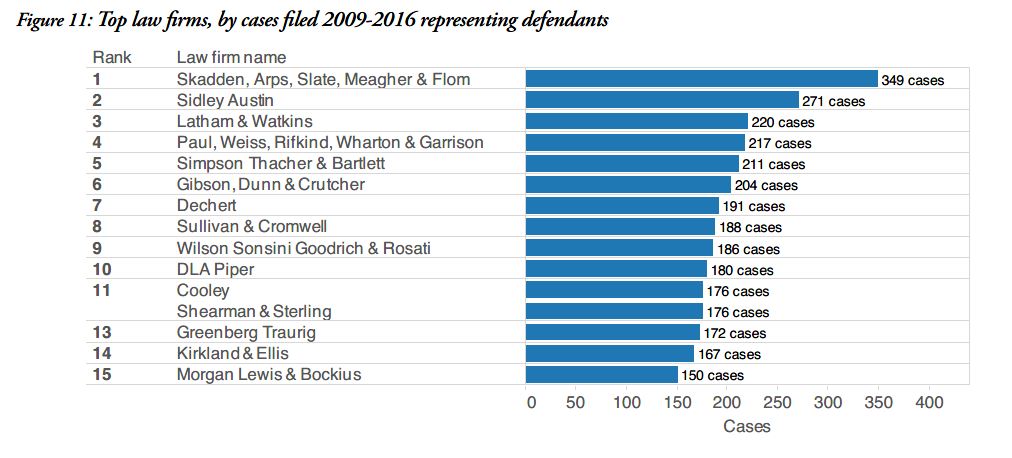
Top Law Firms Representing Defendants
 A full copy of the report can requested and downloaded  here.

LexMachina is a system  exploding with data.
But Data doesn’t equal insights until you combine elements into a query. Data
analysis is pretty new to legal research and Lex Machina is on a mission to
keep making it easier for lawyers to extract powerful insights with minimum –
as in “no” training. It also enables lawyers to ask completely new questions.
The Lex
Machina system includes hundreds of data elements which can be combined in
thousands of permutations. Their modules currently cover, Patent, Trademark, Copyright, Antitrust,ITC and Securities Litigation.  
Today Lex
Machina is releasing two important new apps: The Damages Explorer and the
Parties Comparator which provide instant insights to litigators. Attorneys
can use both apps to quickly model different strategic approaches – using
information from the Lex Machina database  that previously would have taken weeks to compile using a team of researchers.
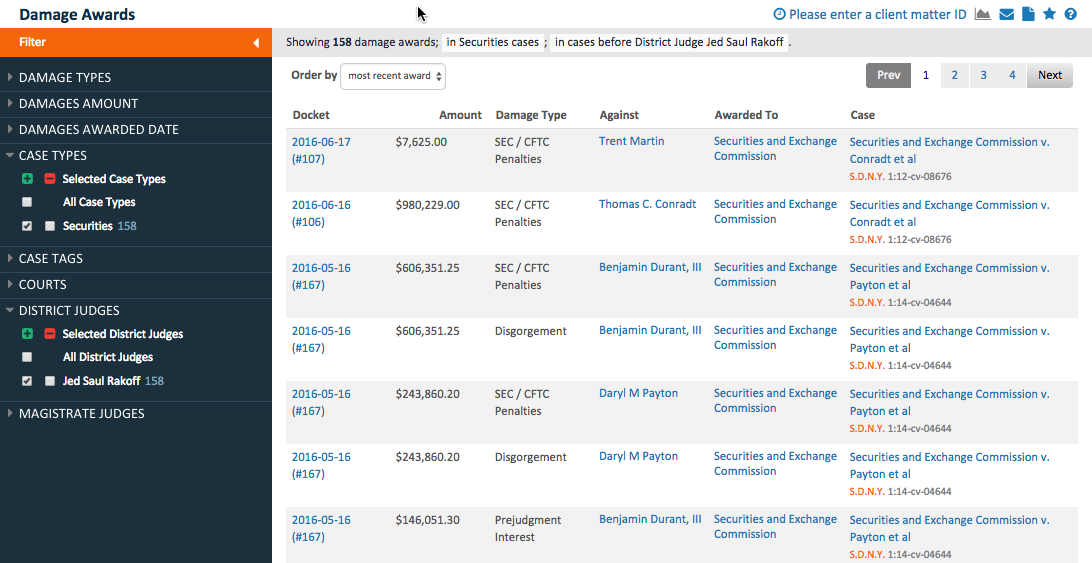
Damages Explorer delivers the first-of-its-kind ability to
expose,  compare and analyze individual
damages awarded. The app  can analyze
damages awarded by judge,  court, and  type of
damages. Sample reports include:
·
attorneys’ fees
in a specific district
·
infringement
damages awarded by a particular judge
According to the
press release Lex Machina has the only complete record of damages awards in
patent, copyright, trademark, securities, and antitrust cases since 2009. 

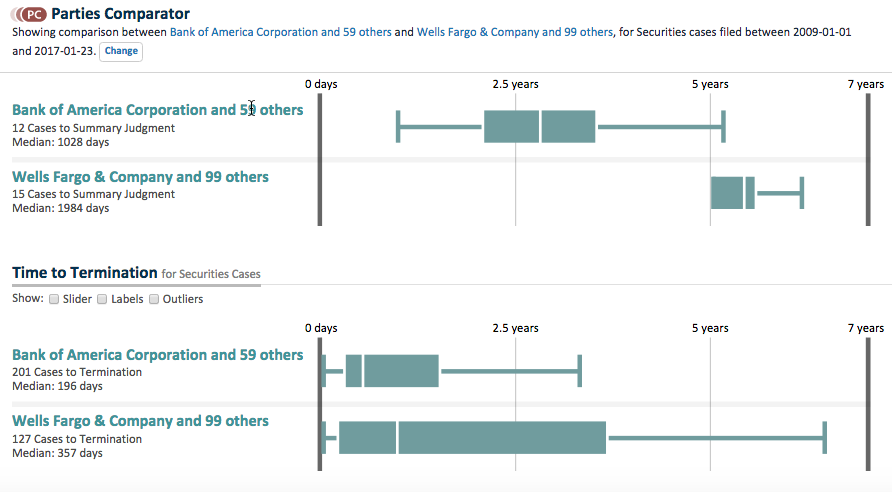
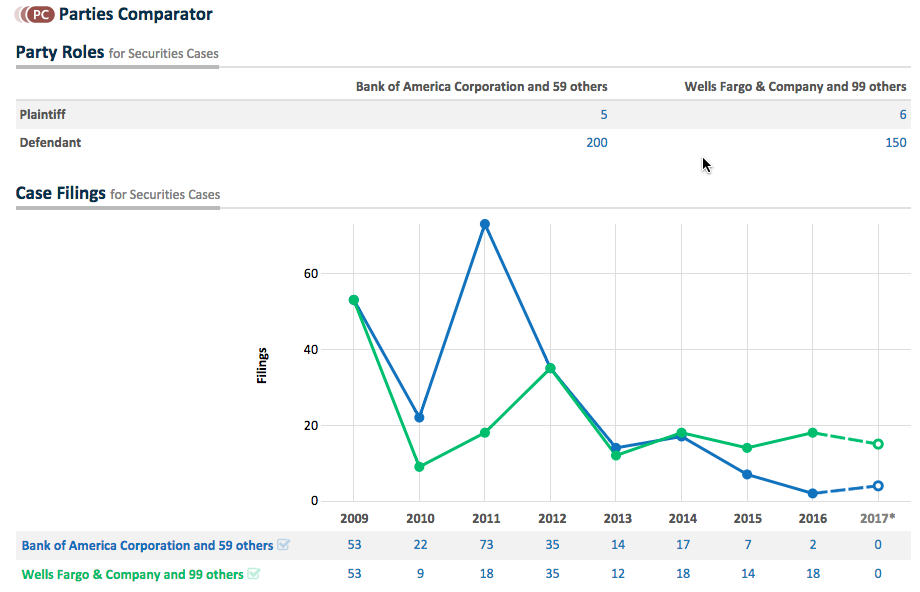
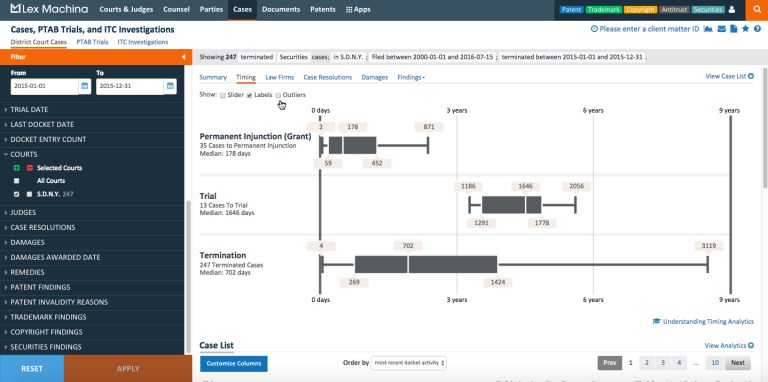
Parties Comparator enables  lawyers to compare parties  across multiple criteria, such as litigation
volume, performance, and outcomes. For each party being compared, the
application shows damages, remedies, findings won or lost and case timing
milestones.
Compare Litigation Timing By Party
Compare Case Filings by Party
The press release
highlights the value of this  app as
enabling GCs  to perform peer
benchmarking and for law firms to gain deeper insights into  clients and  to improve legal strategies.
From the PressRelease:
“Today, attorneys
need data-driven insights to make sound legal and business decisions. Our new Damages Explorer and Parties Comparator, deliver unprecedented
information within seconds instead of days or weeks,” said Josh Becker, Lex
Machina’s CEO. “Being able to easily explore the damages awarded in similar
cases, enables attorneys to gauge whether to pursue or settle a case before
setting foot in a courtroom. Similarly, the ability to analyze how opposing
parties or similar companies have fared in court can give attorneys valuable
strategic insights, instant decisioning capabilities, and a distinct
competitive advantage.”
The Lex Machina Suite of Apps. Lex
Machina’s previously released  Legal
Analytics Apps
(Early Case Assessor,
Motion Kickstarter, and Patent Portfolio Evaluator) and Comparator
Apps
(Courts and Judges Comparator and Law Firms Comparator).
When Lex Machina was acquired by LexisNexis last year, the company promised that the huge Lexis data archive would be leveraged to expand Lex Machina beyond its original intellectual property
offerings. Last summer they announced the launch of a securities analytics product. Today they are announcing the launch of an antitrust analytics product.The new module will enable litigators to ask new questions and gain new insights based on a data generated by more than 7,800 antitrust cases which have been active since 2009— those cases have already resulted in $20 billion in damages awarded. Like its predecessors. the platform allows a lawyer to generate custom insights into trends in antitrust case timing, resolutions, finding, damages, remedies, opposing counsel, law firms, parties, judges and venues including multidistrict litigation cases.

“In antitrust litigation, where potentially billions of dollars and companies’ entire futures could be at stake, Legal Analytics for Antitrust helps law firms, in-house counsel and government attorneys develop winning case strategies and data-driven arguments based on the outcomes of thousands of prior cases,” said Josh Becker, CEO of Lex Machina. “The power of Legal Analytics truly becomes apparent in multidistrict litigation where unraveling some of the more complex cases could encumber attorneys for months, instead of finding the desired insights in minutes.”

New Features:

·
Expanded case
coverage
: Attorneys can now analyze federal cases brought under the Sherman
Act, Clayton Act, Robinson-Patman Act, or Federal Trade Commission Act.


·
New data source
and case linking:
Existing Lex Machina case data is integrated with data
from the Judicial Panel on Multidistrict Litigation to provide accurate MDL case
counts. The platform also links procedurally connected cases to let attorneys
analyze them in the right context.


·
Antitrust
findings analytics
: New tags for Class Actions, DOJ/FTC Enforcement cases,
Robinson-Patman Act price discrimination cases, and cases where counterclaims
were asserted.


·
Enhanced case
timing analytics
: Added
median days to Dismissal, Class Certification and Summary Judgment Orders —
useful for budgeting, resource allocation and legal strategy.

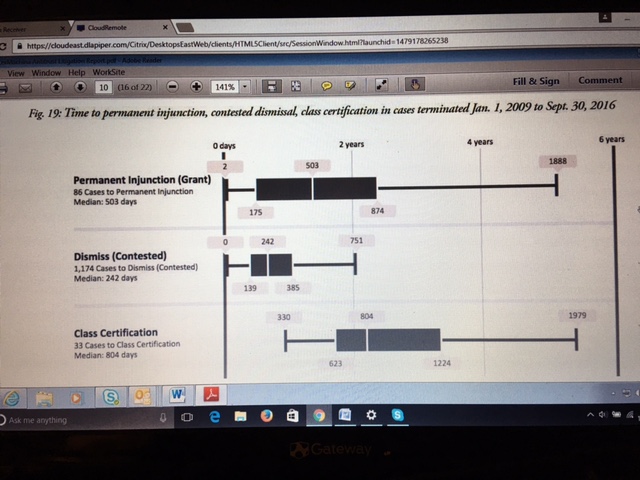
The Report Lex Machina has also underscored the importance of the launch by releasing a report chocked full of high level data and insights based on all antitrust cases filed since 2009:

Time to Injunction, Dismissal, Class certification

·
Judge
Marianne Battani of the Eastern District of Michigan has handled the most
antitrust cases (393 cases) since 2009 – more than twice as much as the next
leading judge.

·
The top
defendants since 2009 include financial institutions like JPMorgan Chase &
Co (270 cases), Goldman Sachs & Co (192 cases), UBS (188 cases), and
Deutsche Bank (185 cases); electronics companies like Panasonic (265 cases) and
Hitachi (253 cases), and several airlines such as Delta (231 cases), American
Airlines (212 cases), Southwest (211 cases), and United Airlines (206 cases).
·
Cotchett
Pitre & McCarthy is the top law firm representing plaintiffs (255 cases),
followed by Miller Canfield (248 cases), and Spector Roseman Kodroff &
Willis (236 cases).
·
Latham
& Watkins (340 cases), Gibson Dunn & Crutcher (334 cases), and
Freshfields Bruckhaus Deringer (294 cases) are the top law firms representing
defendants.
·
The
median time to the grant of a permanent injunction is just under a year and a
half (507 days).Judgments
favoring the defense side (especially findings of “no antitrust injury,” “no
sherman act violation § 1 (restraint of trade), and “no sherman act violation §
2 (monopolization) tend come from judges – either as a judgment on the
pleadings, or as a summary judgment.


·
Judgments
favoring the defense side (especially findings of “no antitrust injury,” “no
sherman act violation § 1 (restraint of trade), and “no sherman act violation §
2 (monopolization) tend come from judges – either as a judgment on the
pleadings, or as a summary judgment.
Today Bloomberg announced the launch of a new analytics
product that transforms data on more than 3 .5 million companies, 7,000 law
firms and all active federal judges into actionable insights. The product is positioned as strategic planning tool for litigators by analyzing   past patterns of judges behavior such as motion grants/denials and time to trial.

Coverage:*

  • Motion Outcomes and Appeals Outcomes include the full time period that a judge has been on the bench.
  • Length of Time and Appearance/Case Types are docket based analytics covering back to 2007.
  • Company search and Law Firm search are docket based analytics covering cases back to 2007. 

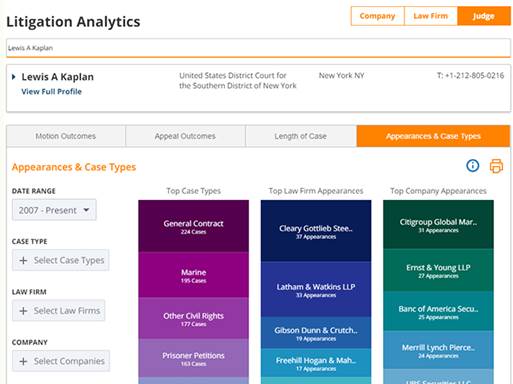
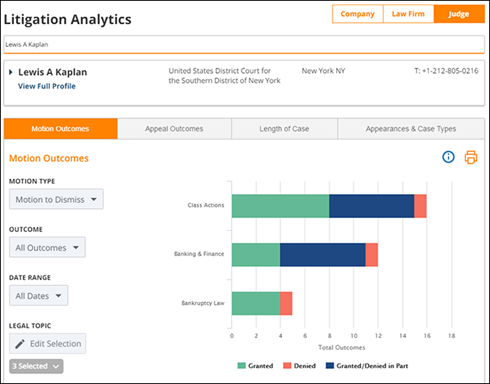
Here are some sample reports:

Law Firm  Appearances by Case Type


Average Time to Trial


Motion Outcomes

 The Competition. From it’s earliest days in the legal market Bloomberg Law has offered a topnotch docket tool and that docket tool provides the raw data which Bloomberg feeds into their analytics engine.There are  several products which offer judicial analytics including Ravel Law and PacerPro and Lex Machina . Lex Machina is the product which can be most closely compared to Bloomberg Law’s new offering. Lex Machina came into the market with a product focused on IP litigation. The rationale for Lex Machina’s acquisition by Lexis Nexis was the opportunity to expand the Lex Machina offerings by loading the Lexis archive of docket data. In July, they launched a securities litigation product.  I have not yet had a demo of the Bloomberg Law Litigation Analytics product so I can’t compare how their interactive features and reports compare with Lex Machina’s.


Bloomberg Advantages. The one obvious advantage that Bloomberg will have out of the gate – is that they appear to be offering analytics on all types of federal litigation. Lex Machina intends to expand their coverage beyond IP and securities over the coming year – but for now Bloomberg Law appears to be the only product  offering the insights into practice areas such as labor law, contract disputes and civil rights which are not yet covered by Lex Machina.

A second advantage is that in keeping with Bloomberg Law “all in” contract approach, every Bloomberg Law subscriber automatically gets access to all new content and features. Lex Machina is not integrated into Lexis and must be purchased under a separate license. Thomson Reuters also offers litigation analytics on a separate platform the Intelligence Center, which cannot be accessed from Westlaw and which requires a separate subscription.

In this hyper-competitive legal market, building products such as Litigation Analytics which feed law firms insatiable  appetite for competitive insights is smart marketing strategy.

* Correction of original post regarding coverage dates.
________________________

Here is the press release:
New Bloomberg Law Litigation Analytics Solution
Provides Insights into Judicial Behavior
hdfcInnovative Resource Helps to Shape Litigation Strategy,
Drive Business Development Efforts
 Arlington,
VA.
(October
18, 2016)
— Imagine if attorneys could counsel their clients on how long
judges typically take to resolve cases, how they rule on dispositive motions,
and how often they are overturned on appeal. Insight to those important
questions, along with a host of other predictive analytics invaluable to trial
lawyers, litigation managers and business-generating rainmakers, are now
available on Bloomberg Law.
 Today,
Bloomberg Law announced the launch of Litigation Analytics, which draws
on both comprehensive court opinions (both published and unpublished) and
docket information in Bloomberg Law’s vast databases to help inform litigation
strategies and understand potential impacts of judges and courts, revealing
insights like:
 Judge
Jack Weinstein in the Eastern District of New York has been almost four times
more likely to deny a motion to dismiss in full than Judge Jesse Furman in the
Southern District of New York.  The disparity is particularly noticeable
when it comes to corporate law cases, where Judge Weinstein has been five times
more likely to deny a motion to dismiss in full.  
Judge
Leonard Stark in the District of Delaware had – to an extraordinary degree –
the busiest bench of the judges we sampled over the past five years: the top
three firms appearing before him appeared a total of 1050 times.
 “Bloomberg
Law Litigation Analytics
allows attorneys to devise informed litigation
strategies and anticipate outcomes to a degree we could simply not approach
before,” said Cassandra Collins, partner in the Business Litigation practice at
Hunton & Williams LLP. “The depth of intelligence that can be gleaned from
this product is going to make it a go-to resource not only for litigators, but
also law firm business developers, marketers, and law librarians.”
                                                                                                                                          
With the
introduction of Litigation Analytics, Bloomberg Law becomes the first
and only full-service legal research and business intelligence platform to
include this type of solution, together with access to a comprehensive case law
and dockets collection. In addition to providing insights about federal judges,
Litigation Analytics includes extensive information on the litigation
activities of companies (more than 70,000 public and 3.5 million private
companies), as well as the law firms that represent them.
 This
universe of data allows law firms and corporations to make more informed
decisions on critical strategic issues such as where to file or remove a case,
whether or not to settle, whether or not to pursue an action in the first
place, and even which law firm to retain or consider—all of which are likely to
be influenced by the success rate of cases before particular judges and the
length of time that judges take to make decisions.
Corporate
legal departments and law firms will also find Litigation Analytics
instrumental in gaining intelligence on their competitors and industry peers,
as well as each other. Thus, a general counsel can instantly discover how many
product liability cases a specific law firm has litigated in California to
determine which law firm might best represent a company, while a partner can
find out which firms a client prospect is using for environmental cases in New
York.
“Our
mission at Bloomberg Law is to create technology that enhances our clients’
legal practices, and there’s no better example of that mission in action than
this new solution,” said David Perla, President of Bloomberg Law and Bloomberg
BNA Legal, who called Litigation Analytics the most comprehensive
product of its kind. “Unlike other analytical tools on the market, Litigation
Analytics
covers all federal district courts and case types, all practice
areas, leverages both case law and dockets, and is available without additional
cost to existing Bloomberg Law subscribers.”
For more
information on the valuable insights Bloomberg Law Litigation Analytics
can provide, please view a Technology Snapshot at http://www.bna.com/litigationsnapshot.
To learn
more about Bloomberg Law Litigation Analytics, register at http://about.bna.com/litigation-analytics for a
product overview webinar on Tuesday, November 1.
About
Bloomberg BNA
Bloomberg
BNA provides legal, tax and compliance professionals with critical information,
practical guidance and workflow solutions. We leverage leading technology and
a global network of experts to deliver a unique combination of news and
authoritative analysis, comprehensive research solutions, innovative practice
tools, and proprietary business data and analytics. Bloomberg BNA is
wholly-owned by Bloomberg L.P., the global business, financial information and
news leader. For more information, visit www.bna.com.
About
Bloomberg Law
Bloomberg
Law helps legal professionals provide world-class counsel with access to actionable
legal intelligence in a business context. Bloomberg Law delivers a unique
combination of practical guidance, comprehensive primary and secondary source
material, trusted content from Bloomberg BNA, news, time-saving practice tools,
market data and business intelligence. For more information, visit www.bna.com/bloomberglaw.
Yesterday LexisNexis announced their intent to acquire Intelligize — one of those start up gems that came late to the SEC research party and became the “belle of the ball.”  Well really, it was  completely different kind of SEC research product that  not only provided deep faceted searching of documents, but introduced powerful algorithms which produce unique insights into SEC comment letters, no action letters and standard  corporate filings.  Today I had the opportunity to discuss the Lexis- Intelligize deal with Jeff Pfeifer, Lexis VP of Product Management and Todd Hicks, CEO of Intelligize.

Intelligize and Securities Mosaic? Do Customers Need Both? In 2013 Lexis bought another “boutique” securities product  with a loyal following called Securities Mosaic. It is hard to see why Lexis would retain both Securities Mosaic and Intelligize, especially when one of them, Intelligize is driven by  more sophisticated technology. Here is a clue. Securities Mosciac will move into the Intelligize organization where both products will be managed by Todd Hicks the current CEO of Intelligize. In today’s call, Hicks indicated that they plan to take time and conduct  “a thoughtful assessment of the  product roadmaps for each product” before determining if the products should be merged or remain separate.  For the remainder of 2016, both products will operate separately within LexisNexis North American Research Solutions organization. In January the two product teams will come together within LexisNexis under the leadership of Todd Hicks.

Intelligize and Lex Machina for Securitiesthe Bigger Data Play?  Less than a year ago LexisNexis purchased Lex Machina  a litigation analytics product.  It seems unlikely that it is a mere coincidence that the first non-IP module for Lex Machina  was focused on securities law and it launched only six weeks ago.  The more interesting alignment of Lexis products may be the convergence of these two securities data sets powered by algorithms and data: Lex Machina for securities litigation  and Intelligize for securities transactions.  Could  a marriage of Intelligize and Lex Machina for Securities Litigation create a whole new breed of legal intelligence platform? Imagine a product that identifies the documents and clauses that are most vulnerable to litigation. Imagine a product that analyses SEC filings and predicts events such as shareholder activism, takeover targets and lawsuits!

Lexis Content Acquisition Strategy. For the past few years LexisNexis  has been collecting legal content gems – Law360, Lex Machina, MLex. Instead of integrating them into the massive LexisNexis organization, each company has remained a stand alone operation retaining their entrepreneurial culture, their key talent and their client relationships. Core Lexis content is being leveraged to enhance the offering of the smaller companies. At some point it would make sense for  – Lexis to start aligning some of the content synergies between the acquired gems. Are they ready to to that?


Why Lexis and Intelligize Agreed to the Deal?
According to Jeff Pfeifer, Lexis VP of Product Management, Lexis has been focused on developing solutions that provide deeper insights using machine learning and analytics. That is…. insights which can’t be achieved with traditional text searching. Pfeifer anticipates that Intelligize content will be used to enhance existing Lexis products such as Lexis Practice Advisor and Lexis for Microsoft Office. Pfeifer also described how Lexis Search Advantage  and Intelligize could be combined to enhance internal firm document  research using “clause level analysis.” This feature  would enable firms to analyze their own deal documents and compare documents and clauses with peer data sets. This functionality would have an application both in drafting and deal strategy.

According to  Todd Hicks, Intelligize had other suitors, but chose Lexis because of the company’s commitment to letting Intelligize remain a stand alone company while making Lexis content and technology available for product enhancements. Hicks anticipates that as a Lexis subsidiary they  can accelerate  the product enhancement pipeline. Hicks indicated that product enhancements are likely to focus on improving drafting tools, expanding regulatory products. Since Intelligize recently  launched an exempt offerings module, Hicks indicated that they would explore creating an international exempt offerings module which would include offerings from non-US stock exchanges.

Like many of my colleagues, I feel a twinge of sadness as I watch the arc of another small startup move from  scrappy innovator to hot property for acquisition. At least we can look back at how Lexis has handled, Securities Mosaic,  MLex, Law360 and Lex Machina — to see that those companies and products have retained their identities while expanding content and functionality under the Lexis umbrella.

Lex Machina is not a hard product to use. It is loaded with data and offers lawyers an infinite landscape of  data permutations. As I have often said “lawyers don’t want research products that make them feel like they are wiring a powerplant. They want to flip a light switch.” In 2014 Lex Machina launched three desktop ‘” apps”: the early case assessor, the motion kick starter and the patent portfolio evaluator.  These are the “lightswitchs” of litigation data discovery. Today they are announcing the release of two more “apps” the court and judges comparator and the law firm comparator.

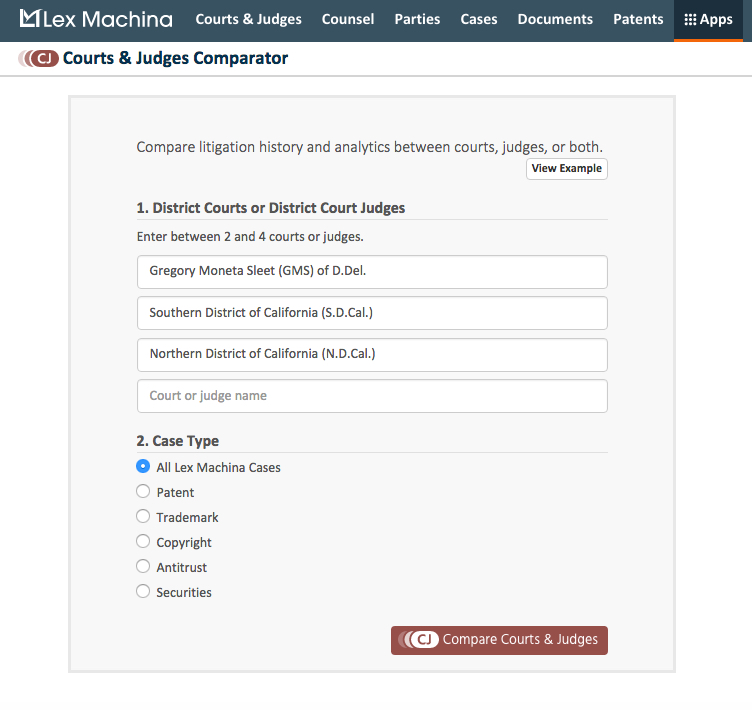
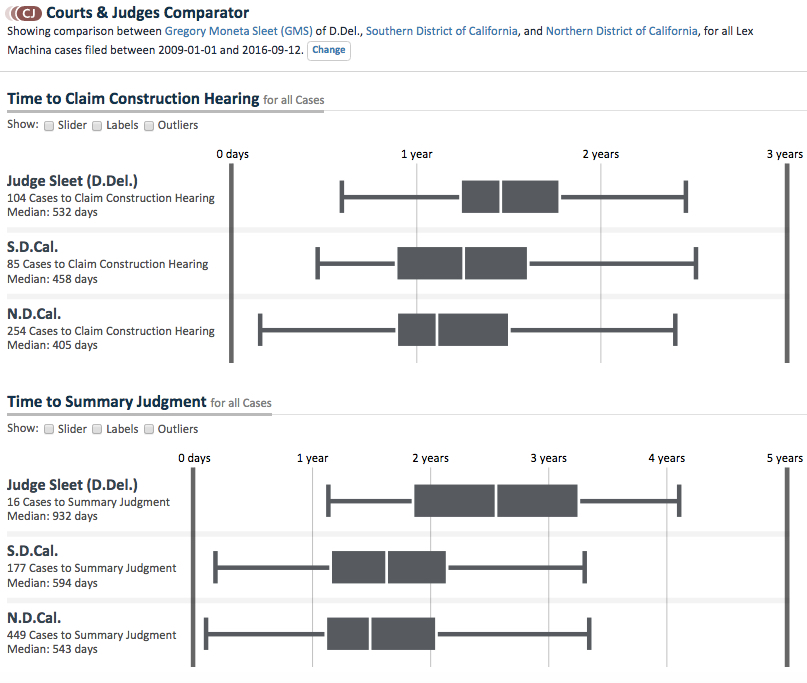
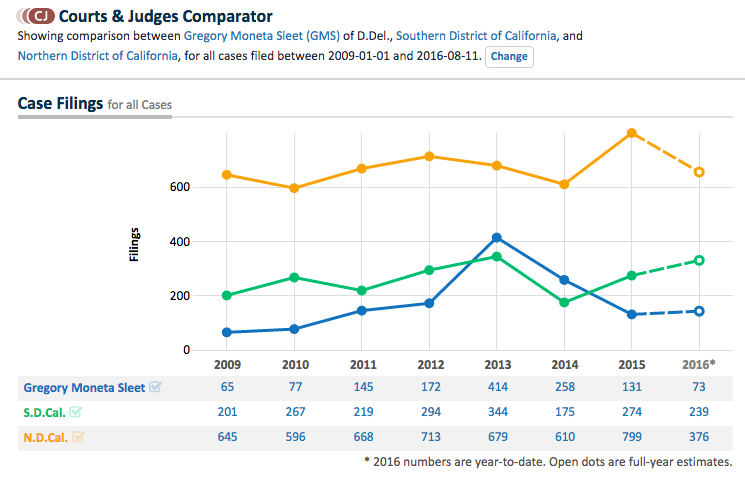
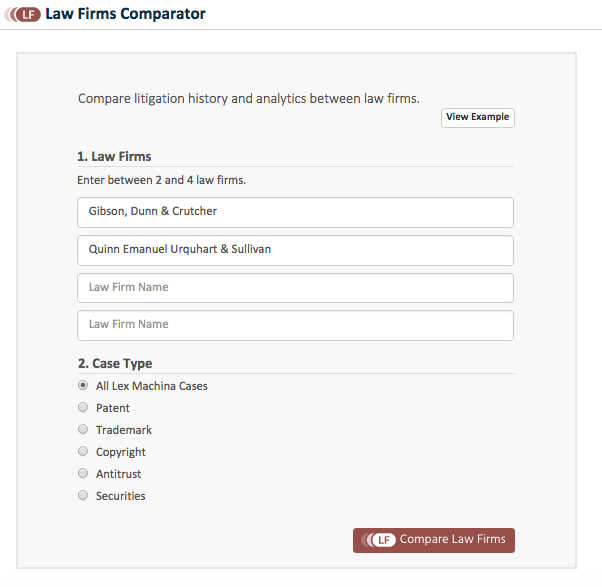
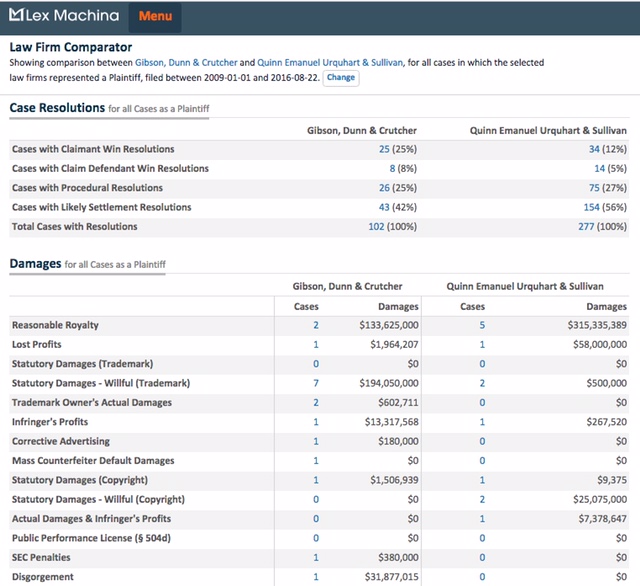
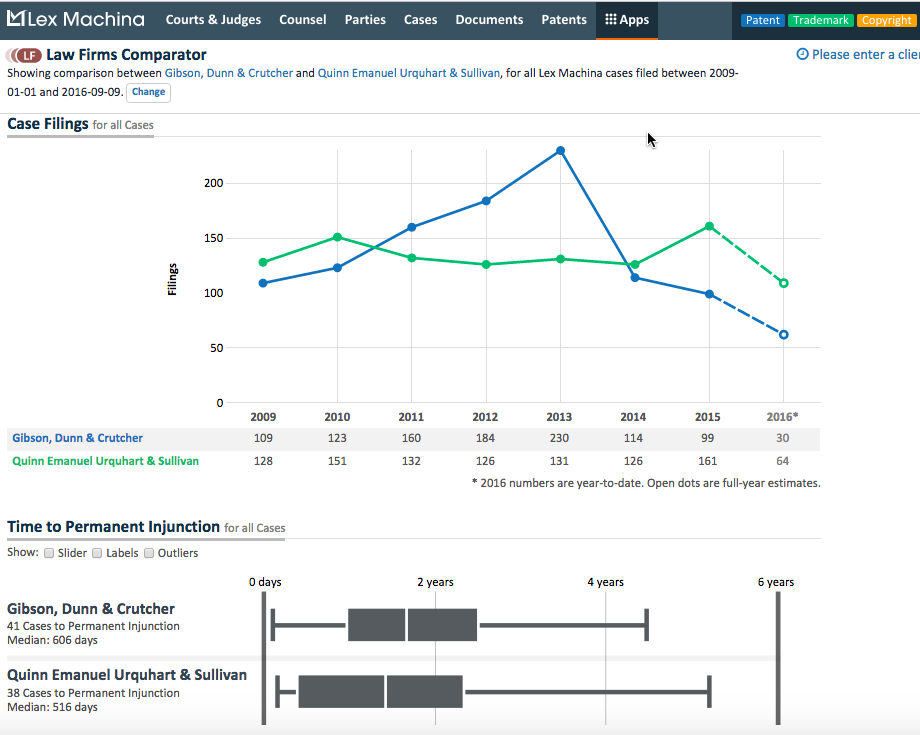
Each of these new functions takes what was formally a multistep process and provides a ” fill in the blanks” template which in one click produces a set of charts comparing  up to 4 courts judges or law firms using custom selected criteria.

The Court and Judges Comparator

This function allows a lawyer to compare up to four districts or judges. There are two basic “use cases” for this app. One is forum selection:  comparing  trends in districts in order to determine the most  favorable jurisdiction in which to file. The other is to compare an assigned judge to alternate jurisdictions for when  considering a motion to transfer. In each scenario up to four judges and courts can be compared along multiple criteria: trends in case filings, assessing the expertise of the judge, average time for a  preliminary injunction grant, average time to  dismissal,  average time to claim construction, average time to summary judgment,  average time to trial.

The Law Firm Comparator

This new app can be used by outside counsel in selecting law firms as well as by law firms seeking new business. A law firm can compare themselves to three other law firms across multiple criteria  including: volume of cases, number of open cases, number of terminated cases, party roles, success rates and remedies. GCs can compare existing outside counsel with competitor firms using these same types of metrics.

Even though the apps makes the production of comparative charts easy,  the expertise of a lawyer is still required to assess the meaning of the data and trends produced by the comparators.

The Lex Machina apps are “an add”  on to the Lex Machina subscription.

When I interviewed Owen Byrd, Lex Machina’s Chief Evangelist and General Counsel for this post he indicated that the engineers  at Lex Machina
would continue developing what he refers to as “easy buttons” for lawyers. New apps could include comparators for parties and individual attorneys– which I agree would be welcome additions to the comparator family.

Keep the “easy buttons” coming!

Today Lex Machina launched the first
analytics product for securities litigators at event in New York City, which was held at the Park
Avenue Gansevoort Hotel. I had the opportunity to attend today’s event featuring two of  Lex Machina’s top executives. Josh Becker, CEO introduced the company and Owen Byrd, Chief
Evangelist and General Counsel, provided an overview of the unique features
offered by the new Lex Machina product. I  was asked to provide a “wrap up” commentary on the
evolution of legal research. My comments include a prediction of the
convergence of several technologies around analytics over the next 5 years. 

Practice Area Expansion.This launch marks the first new practice area since the initial launch of the IP product in 2011. The development of analytics for new practice areas was driven by access to the massive resources of their parent company LexisNexis.  The securities module will be followed by several new modules including: antitrust, commercial, product liability, employment and commercial bankruptcy.

The Lex Machina press release can be seen here. They also released an analysis of securities litigation in 2015.

At this morning’s event, Josh Becker traced the company’s
history from not-profit at Stanford Law School into a small company powered by
venture capital, through it’s acquisition. In 2015, LexisNexis purchased Lex Machina for an undisclosed
sum. Lex Machina originally  focused  exclusively on federal intellectual property
litigation. over the past five years more than have of the Amlaw 100 firms and dozens of corporations have become Lex Machina subscribers. Private firm attorneys and in house counsel have leveraged Lex Machina to analyze data regarding judges, lawyers, parties and litigation history in order to predict behaviors and outcomes.

Owen Byrd highlighted the new features
and fields which are unique to securities litigation. The current data set includes 15,000 securities cases and over 1 million docket entries. 
Cases Covered: The product analyzes
all cases brought under all of the major securities laws (the 33 Act, the 34
Act, Trust Indenture, Investment Company, Investment Advisors, Sarbanes Oxley,
Dodd Frank and several other laws. The product does not include cases brought
under the Commodity Exchange Act.
Case Types include: Class Actions, Class
Action Opt-Out, Government Plaintiff, SEC Enforcement: Settled Complaint, SEC
Enforcement: Contested, Securities Fraud (§ 10(b) / 10b-5) and Shareholder
Derivative Suit.

Damages Include: SEC Penalties, Disgorgement,
compensatory damages, Approved Class Action Settlement (Securities).

Securities Damages
Findings include: Securities Act
Violation,  Exchange Act Violation, Other
Securities Act Violations, Statute of Limitations Defense, Plaintiff Knowledge
Defense, Cautionary Language / Safe Harbor Defense.
Securities Findings 
All of these filters can be combined
with courts, circuits, judges, companies, lawyers, motion types in order to produce
interactive custom charts and lists which can be used for developing a
litigation strategy or to position a lawyer for a client pitch.

Typical reports include: judge’s behavior,
average time to trial, case outcomes, evaluate opposing counsel, understand
settlement rates and win/loss rates for parties and counsel.

Lex Machina’s analytics can serve “double-duty” in both business strategy and litigation strategy.  As lawyers compete for a limited pool of corporate clients, analytics can provide powerful insights into  law firms as both beauty contest competitors and courtroom adversaries.

Ten years ago, federal litigation data was limited to workload statistics and average time to trial by jurisdiction and judge. And that data was at least a year old! Today Lex Machina provides desktop access to near “real time”  data which can be combined  with dozens of criteria in infinite permutations. In the new world of litigation analytics lawyers  are given the power to ask completely new questions and discover completely new insights. I predict that in 5 years, analytics insights like those offered by Lex Machina, will be  viewed as a standard practice tool for lawyers. Lex Machina  has the advantage of being the first company to bring analytics to the desktop of litigators. The closest legal analytics competitor is Ravel Law which  has a somewhat different focus on the offers analytics focused on “precedential analysis” of judges opinions. As the demand for analytics grows new competitors are sure to follow.  But for today, Lex Machina has placed its flag in two practice areas: IP and securities litigation and owns the lead.