Today Lex Machina a LexisNexis product, is launching an Environmental Analytics module which provides insights on nearly 14,700  environmental cases pending in federal court since 2009. This is the fourteenth module in the Lex Machina suite of products. The product provides previously unreported data, e.g. more than $22 billion in damages have been awarded in environmental litigation cases over the last decade. High profile cases Continue Reading Lex Machina Launches Environmental Analytics Product: Hosting Webcast June 11th
Lex Machina Adds Contract Litigation Analytics Rebrands Commercial Module
Yesterday Lex Machina announced the launch of a newly expanded Contracts Litigation module which includes 45,000 new cases  which resulted in the awarding of $4 billion in damages. Lex Machina now offers insights into more than 130,000 commercial and non-commercial cases pending in federal district courts since 2009. New cases include individual, class action, and government lawsuits.This release upgrades and replaces the Commercial Litigation module which was released in June of 2017.
The module offers the standard Lex Machina insights into case timing, resolutions, findings, damages, and remedies, as well as insights into on opposing counsel, law firms, parties, judges, venues and other data that can inform litigation strategy or a pitch meeting.
The press release highlights the following insights:
- Findings go beyond breach of contract and include unjust enrichment, conversion, fraud, tortious interference, defamation, and breach of fiduciary duty.
- The practice area includes nearly 2,000 cases that resolved at trial and over 6,500 cases that resolved at summary judgment, over 8,000 cases at default judgment, and over 1,400 on consent judgment.
- A breach of contract claim was evaluated by the court in over 18,500 cases.
- Using a Franchise Agreement case tag, users can see about 6,500 cases relating to franchise agreement litigation, including both business and individual franchisees.
- Overall damages for the Contracts litigation module are over $2.2 billion, with over $1 billion in Class Action Settlement Damages.
Lex Machina in the market– Lex Machina is facing increasing competition in the analytics area. Lex Machina has taken a slower topical approach in which they leverage AI, machine learning and human expertise to curate a subset of cases in a specific area of litigation. They currently covers 13 areas of law (Antitrust, bankruptcy, contacts, copyright, Delaware Chancery Court, Employment, ERISA, Insurance, Patent, Products Liability, Securities, Trademark and Trade Secret litigation. They provide the most sophisticated product on the market for the areas they cover. Competitors such as Westlaw Edge, Bloomberg Law and Fastcase DocketAlarm offer data across all federal cases, but they rely on the Pacer’s Nature of Suit (NOS) code which does not adequately describe a large number of federal suits. Although Lex Machina analytics on fewer topics than their competitors, Lex Machina has the advantage of offering the most sophisticated filters and visual displays. However, since the market is changing quickly – they will face increasing pressure to add new modules at a faster clip.
Lex Machina and Law360 Announce Data Driven Lawyer Awards
Law360 and Lex Machina (both owned by LexisNexis) have created a new award recognizing lawyers “who are using data and analytics to dream up new ways to meet the challenges of their practice” The 2018 Data Driven Lawyer award recipients are Eric Falkenberry DLA Piper; Scott Forman, Littler Mendelson PC ; Kate Gaudry,  Kilpatrick Townsend & Stockton LLP; Evan Moses, Ogletree Deakins Nash Smoak & Stewart PC and. Kyle Poe, Morgan Lewis & Bockius LLP.
Josh Becker, the head of Lexis legal analytics and chairman of Lex Machina, describes the data drive lawyer as “ the lawyer of the future. “This is still very early days and these pioneers are critical. They’re evangelists within their firms and they bring data with them each step of the way.”
I became a librarian because I was interested in books not bytes and big data. But I saw the power of data emerge from the most primitive dial-technology — a Texas instruments dumb terminal with an acoustic coupler attached to a telephone handset. Early systems called Dialog and Orbit could deliver fascinating data which exposed patterns of human activity or industrial insights.
I have been a vocal evangelist of the place data in legal practice for almost 30 years but it is only the past few years that a clear business case and the right tools emerged to help lawyers gain actionable data insights for both the business and practice of law. Lawyers continued to shun online research in favor of the slower and less current information in digests and reporters. At some point the use of analytics will move from offering a competitive advantage to being an ethical imperative.
Learn more about Data Driven Lawyer Initiatives:
Law 360 will be running a series of articles in which the award winners are interviewed. In addition, Lex Machina and Law360 will host a live webcast with all of the data driven lawyer recipients on Dec. 12.
Lex Machina Launches “Trade Secrets” Litigation Analytics – Outsmarting the Pacer NOS Codes for the Second Time –Webinar May 31st
Today Lex Machina is announcing the release of a unique litigation analytics module on trade secrets. This is the second time in a year that Lex Machina has used machine learning to identify a unique and valuable subset of cases for with there is no “Nature of Suite” code in the Pacer system. Owen Byrd the company’s General Counsel and Chief Evangelist, provided me with a demo of the product. Byrd stated that ” trade secrets” analytics was the most requested addition to the platform. After taking an informal poll of some big law information professionals, I would describe their reaction as a collective “sign of relief.” The new module will include over 9,600 trade secrets cases pending in federal court since 2009, including cases filed under the 2016 Defense of Trade Secrets Act (DTSA). According to Byrd trade secrets has become as important as any other area of intellectual property in protecting a companies intellectual assets. Companies need to protect heir processes, formula’s and client lists as much as they need to protect their trademarks and patents. Byrd also pointed out that there is often an overlap between employment and trade secrets since issues often arise from the behavior of employees.
Controversies such as trade secrets for which there is no nature of suit code in the Pacer system have been virtually invisible to researchers. It was virtually impossible to aggregate a specific data set of this type. Last year Lex Machina pioneered the use of natural language processing to cull a reliable subset of commercial cases – another high value controversy type which lacks an NOS code. They used NLP again to crawl all post 2009 pleadings in Pacer to identify the trade secret data. “This is a big deal,” according to Jeremy Sullivan, Manager of Competitive Intelligence & Analytics at DLA Piper… To my knowledge there is no other bulletproof resource for zeroing in on trade secrets litigation data.”
With the launch of its trade secret module, Lex Machina has uncovered some interesting insights within the data including:
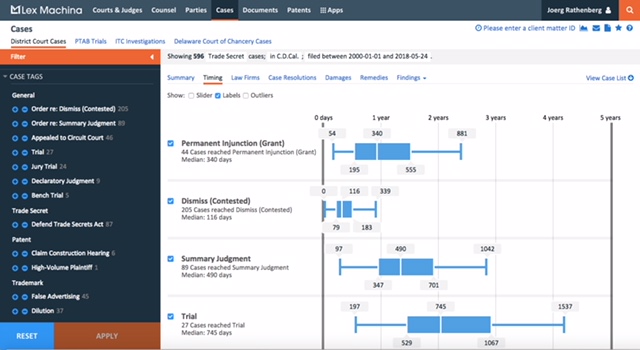
- The Central District of California sees the most trade secret cases (7%), followed by the Southern District of New York (5%) and the District of Illinois (5%).
- Top law firms retained in trade secret cases include firms that specialize in labor and employment law, as many trade secret cases involve former employees.
- More than 1,350 cases with DTSA claims have been filed during the two years since it was enacted on May 11, 2016; only 11 of the 550+ currently active Article III district judges have evaluated DTSA claims on contested motions or presided over the issue at trial
- 71% of trade secret cases that resolve at trial are won by claimants whereas 29% are won by claim defendants
The Insights and Analytics
The trade secrets module will provide all the standard insights on judges, parties, law firm and courts which can be used for client pitches and litigation strategy. Case timing, motion metrics damages will include new tags which are specific to “trade secrets” issues.
Some of the new tags are:
- Case tag- Defend Trade Secrets Act
- Damages actual/lost profits, reasonable royalty, punitive/willfulness damages
- Finding- State Law Trade Secret Misappropriation (DTSA Trade Secret Misappropriation
- Other Findings: Ownership validity, Failure to identify trade secret, failure to maintain secrecy, readily ascertainable
- Defenses: Independent development
- Remedies: Granted and denied permanent injunction preliminary injunction and TRO

The Competition Given the increasing importance of trade secrets, it is surprising that there have been so few new products addressing this issue. Last year, following the enactment of the Defense of Trade, Wolters Kluwer released Trade Secrets Advisor which provides practical guidance as well as statutory and regulatory updates. Westlaw, Lexis and Bloomberg Law also provide general practice materials and treatises on trade secrets. Since Bloomberg recently announced the ability to allow customers to search complaints – their docket product could be tested for identifying “trade secret” complaints… as in.. You can find out something.. about trade secret litigation but not deep analytics.. So at this point , Bloomberg Law they may be the competitor most likely to develop analytics for trade secrets litigation based on today’s product landscape.
Trade Secret Webcast
For more information about Lex Machina’s newest practice area, please register here for the Legal Analytics for Trade Secret Litigation webcast (May 31, 11:00 PDT/2:00pm EDT). Lex Machina’s Owen Byrd and Rachel Bailey will discuss trends and insights for Trade Secret litigation in federal court, and give viewers a peek into Lex Machina’s new practice area capabilities.
Lex Machina Expands Analytics Insights into Remedies Grant/Deny Rates and Trends
This week Lex Machina added Remedies Analytics to their platform. Lawyers can now investigate the trends on grant and deny rates for permanent injunctions. Preliminary injunctions and temporary restraining orders. Grant/deny rates can be analyzed for specific judges and districts for the types of litigation currently covered by Lex Machina. These include antitrust. Commercial, copyright, employment. Patent, securities and trademark. In addition, the new data will provide insights into the timing for grant or denial of these remedies for specific judges and districts. According to Lex Machina’s General Counsel and Chief Evangelist, Owen Byrd, Lex Machina is continually enhancing the product based on customer demands and remedies was the most recent response to customer needs.


The Data About the Data Lex Machina shows the power of the data by inserting macro trends extracted from their product into the press release. According to the press release 27,500 of 1 million+ federal district court cases involves orders for permanent or temporary injunctions or TROs. Overall 88% of injections on the merits are granted and 125 are denied. However, the regard deny rates overall vary for specific types of cases such as trademark and labor.
Special remedies. The Lex Machina analytics platform also includes remedies data for specific types of litigation. Employment cases include remedies for reinstatement and promotion; antitrust remedies cover divestiture; commercial remedies include replevin and specific performance and trademark remedies include “termination of a mark.”
All of the Lex Machina data includes a wide range of filters for case types, tags and timing options which can be applied to develop custom insights. Read the full press release here.
Lex Machina 2018 Products Liability Litigation Report Includes Trends and an Analytics “Primer”- Expert Witness App Launched
Today Lex Machina announced the release its first annual Products Liability Litigation report which analyses more than 400,000 product liability cases filed in U.S. District Courts from January 1, 2009 to Dec 31, 2017.
The report highlights claims related to pharmaceuticals and medical devices and provides detailed insights on case findings, resolutions timing, damages awarded in verdicts, and approved class action settlements.
Owen Byrd, General Counsel and Chief Evangelist is quoted in the press release announcing the report. “Every year, the number of product liability cases filed in District Court consistently outpaces the combined case filings for patent, commercial, employment, trademark, copyright, antitrust, securities, and bankruptcy appeals. Of those product liability cases, medical device and pharmaceutical litigation accounts for the lion’s share of all filings, which is why we’ve chosen to feature this sector in our first annual report.”
Key Findings Include:
Lex Machina Launches First State Court Analytics Module: Delaware Court of Chancery
Several weeks ago Lex Machina subscribers started seeing analytics from the Delaware Chancery court appear in the platform. It is significant that Lex Machina has entered the state analytics market where there are so few players. It is especially exciting that they have started with one the most important if not the most important jurisdiction for corporate and contractual disputes. The module covers over 6,000 cases which have been filed since October 26, 2012.Delaware Chancery is the 10th Lex Machina module following patent, trademark,copyright, antitrust, securities, commercial, bankruptcy appellate, products liability and labor.
As with all Lex Machina products this new module offers insights and trends in case resolutions and findings across a wide range of controversies arising from constitutional and state law issues. The module provides insiilluminates the track records of opposing counsel and parties, and accurately chronicles the behaviors and decisions of the court’s judicial officers
The press release quotes Karl Harris, president and COO of Lex Machina on the importance of this product: “Senior litigators at major corporations and top national law firms need to understand the nuances of practicing law in this court to offer the best possible legal counsel and support to clients incorporated there. Lex Machina’s Legal Analytics for the Delaware Court of Chancery provides attorneys with data-driven insights to help them create successful litigation strategies in this highly influential jurisdiction.”
The Challenge of State Court Data. The market is full of products leveraging federal docket data. That has been an easy market to enter because of the centralized federal filing system called Pacer. Not only do most state lack centralized court systems, there are still many states and courts which have no electronic filing system. Add to that the myriad inconsistencies and data mapping problems which could arise from the locally developed systems 50 states and the District of Columbia.
Adding Delaware to the Lex Machina Platform. Fortunately the Delaware Court of Chancery uses a proprietary electronic filing system that includes “taggable” information, such as case title, civil action number, judicial officer, parties, counsel and documents which are the building blocks of analytics systems. Lex Machina’s Attorney Data Engine and expert legal editors were able to take the Delaware data and run it through the enhancement and clean up process which is used for all the Lex Machina modules. This editorial work includes correcting “errors ranging from simple spelling mistakes to complex data problems; normalizing data on judicial officers, parties, law firms and attorneys; extracting records of law firms and attorneys not found in the basic data; tagging and categorizing cases; annotating case resolutions, damages and rulings; and more.”
Lex Machina also added new features and unique tags such as Field of Law, and Nature of Claim, as well as tags such as case resolutions, damages, and rulings, which are similar to federal modules. Since New York has a unified court system and a robust electronic filing system and rivals Delaware in commercial importance, I wouldn’t be surprised to see on of the vendors in this space offer a New York product in the t
The Market for State Court Analytics Last year respondents to my reader survey, named state court analtyics as the feature/product that readers most wanted someone to develop. In the past few months I have reviewed 2 other products which are entering teh challenging market for state level analytics data. Gavelytics – which is tackling several California state courts and Docket Alarm which was recently acquired by Fastcase is offering federal and selected state analytics. I am happy to see so much activity in an area where there is so much market demand and so few products to fill the need.
Click here for a Delaware Court of Chancery Video Demo.
Lex Machina Releases 2017 Litigation Trends: E.D. Texas Docket Dive–Trump’s SEC Appears to be Increasing Enforcement Activity
Lex Machina has released their annual Litigation trends report. Although there are an increasing number of competitors in the legal analytics market, Lex Machina still offers the most sophisticated platform offering users the ability to create an almost limitless array of custom insights. Although Lex Machina launched as a product offering patent litigation analytics, Lex Machina has followed an aggressive scheduled for adding new modules since its acquisition by LexisNexis. During the past year Lex Machina released analytics for Bankruptcy Appeals, Securities, Labor and Products Liability in additional the commercial and antitrust modules that were previously added.
Overall federal litigation continues to trend down, but I was surprised to see that the one area where litigation is increasing is securities litigation. Securities Litigation is trending up and is at its highest level since 2009
Below are the trends highlighted in the Lex Machina press release:
Patent Litigation:
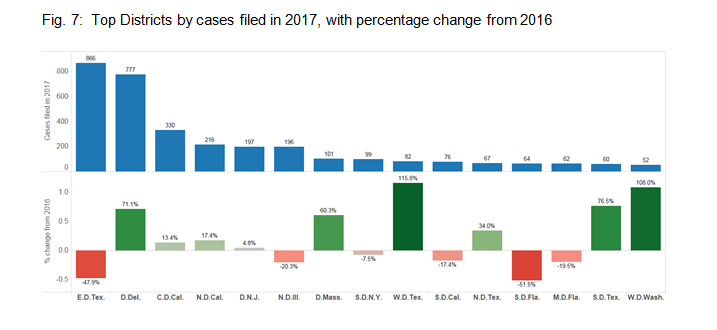
- The most notable event of 2017 was the Supreme Court issuing its opinion in T.C. Heartland on May 22, holding unanimously that, under 28 U.S.C. § 1400(b) (the statute governing venue in patent suits), a domestic corporation “resides” only in its state of incorporation.
- Since that landmark decision, the number of cases filed in the E.D. Tex has significantly declined and been overtaken by the number of cases filed in the District of Delaware.
- Other districts including the D. Mass, the W. and S.D. Tex, and the W.D. Wash all saw significant increases in terms of percentage over 2016.
PTAB:
- While the first quarter of 2017 saw a record high number Inter Partes Review (IPR) petitions filed at PTAB (548 petitions), each successive quarter has seen a drop in filings
- This crest/trough may be related to the Supreme Court’s granting of certiorari in Oil States Energy Servs., v. Greene’s Energy Grp. in June 2017 – a case in which petitioners argue that IPR is unconstitutional, as a non-Article III forum extinguishing a property right without a trial by jury.
Trademark:
- The filing of new trademark cases has declined at a slight rate over the last few years. The fourth quarter of 2017 (953 cases) represents a continuation of this trend.
Copyright:
- From its apogee in Q1 of 2015 at over 900 cases, the number of file sharing cases filed each quarter declined steadily and rapidly until Q2 of 2016, which saw only 262 cases. Since then, the number of cases has been less predictable – Q4 2017 (367 cases) returns to the levels seen in late 2016, after two low quarters of around 150 cases.
Securities Litigation:
- Fewer cases were filed in Q4 2017 than in any of the first three quarters, but the 406 cases filed still represents nearly twice the volume of quarters from 2010-2016.
- The top five districts accounted for just under half (44.2%) of the cases filed in the first half of 2017. Those districts are the S.D.N.Y. (16.2%), the N.D. Cal (8.8%), the C.D. Cal (7.0%), the D. Del (6.1%) and the D.N.J.(6.0%).
Antitrust Litigation:
- 121 cases were filed in the fourth quarter of 2017, consistent with the recent trend of 100-150 cases per quarter, but is still down from the peak, occurring from the third quarter of 2015 and into the first quarter of 2016, which saw nearly three times as many cases.
Commercial Litigation:
- The number of Commercial cases filed each quarter has generally declined over the last several years. The 1,500 cases filed in the fourth quarter of 2017 is the lowest quarter total on record (back to 2009). Lex Machina’s Commercial cases involve claims for breach of contract or business torts between or among businesses. The decline in these cases has correlated with recovering economy in the years since 2009.
Employment Litigation:
- Since the last quarterly update, Lex Machina has broadened our coverage of employment litigation. In addition to cases brought under federal employment civil rights statutes alleging discrimination, harassment, and/or retaliation, we now also include wage and hour claims under the FLSA, as well as interference and retaliatory claims under the FMLA.
- Figures in the update show 1) Employment cases filed 2011-2017 Q4 by quarter and 2) FLSA, FMLA cases filed, 2011-2017 Q4, by quarter.
Bankruptcy Appeals in U.S. District Court
• Lex Machina has analytics for Bankruptcy appeals in the district courts, including the ability to filter cases by the various chapters, by business or individual debtor, and by whether the case is an adversary proceeding.
• Figures in the update show 1) : Bankruptcy appeals filed in U.S. District Courts, 2011-2017 Q4, by quarter and 2) Bankruptcy appeals filed in U.S. District Courts, 2011-2017 Q4, by tag
Product Liability
• Since the last quarterly update, Lex Machina has also introduced Legal Analytics for Product Liability cases – practice area that approximately doubled the number of cases in our system.
• This update includes a figure showing product liability cases filed from 2011-2017 Q4, broken down by quarter and product classification, and using a logarithmic scale. (Otherwise the large number of medical device / pharmaceutical cases would dominate the scale.)
Lex Machina Releases Products Liability Litigation Analytics Module— Offers Launch Webinar
Today Lex Machina is announcing the release of a new module which covers federal product liability litigation. The Products liability addition of 500,000 cases pending since 2009 represents the largest expansion of the Lex Machina platform since its launch in 2006.
This data set more than doubles the number of cases which can be analyzed by subscribers.
Products liability module will provide the same trends in case timing, resolutions, findings, and damages for injuries caused by product defects, including medical devices/pharmaceuticals, vehicles, aircraft, asbestos, and more. It also includes third party subrogation cases where entities such as insurance companies take over the case on behalf of the plaintiff.
Challenges of Multi- District Litigation. The majority (91%, or 454,166 cases) of federal product liability cases pending since 2009 are part of a multi-district litigation (MDL) – a procedure where cases around the country involving the same incident (or complex set of facts) are transferred and combined into the MDL proceeding for discovery and pretrial. Lex Machina has tagged all of these cases so they can be filtered out of the results in one click. This technique allows researchers to easily compare the data involving only the master case, with the data including all the MDL cases included. Researchers can easily determine whether a presiding judge has expertise with MDL cases, and provides actual judicial rulings about expert witness admissibility.
Products Liability Damages and Findings Tags. According to the press release, Lex Machina interviewed top product liability attorneys to better understand their needs and incorporated their feedback directly into the new offering. As a result, Lex Machina has added 11 new damages tags, including wrongful death/disfigurement, property damange, lost profits and medical expenses; and 24 new findings, including breach of warranty, defective product, negligence and consumer protection law violations. Lex Machina’s Legal Analytics is the only platform that incorporates these unique filters into its offering.

Among some of the key product liability insights found within the data, include:
- More than 10,300 vehicle-related product liability cases have been pending since 2009. Last year saw the largest number of vehicle-related product liability cases filed (2,226 cases).
- The top three district courts for product liability cases pending since 2009, representing 58% of all filings, are: Eastern District of Pennsylvania (29%), Southern District of West Virginia (21%), and Eastern District of Louisiana (8%).
- Asbestos-related filings made up over 140,000 cases pending since 2009 – 97% of which were filed in the Eastern District of Pennsylvania.
Legal Analytics for Product Liability Litigation Webcast
On November 14 and 9:30 PST, 12 EST, Lex Machina is hosting a Products Liability Litigation webcast will feature Bob Ambrogi, renown legal tech blogger and Above The Law columnist will introduce the new module, along with with Eric Falkenberry, partner at DLA Piper, and Lex Machina’s chief evangelist and general counsel, Owen Byrd. Register for for the webinar http://bit.ly/2ysY5y8
Lex Machina Launches Bankruptcy Appeals Analytics Module
Today Lex Machina is releasing a new module which covers district court bankruptcy appeals. Until now all prior Lex Machina modules have focused on federal trials. The Bankruptcy product covers 18,000 bankruptcy appeals filed since 2009. This is Lex Machina’s first foray into appellate analytics.
The Lex Machina CTO, Karl Harris is quoted in the press release: “Although there are relatively few bankruptcy appeals cases at the district court level compared to commercial or employment litigation cases, the stakes are incredibly high for all those involved, so it is imperative that attorneys know the lay of the land before entering the courtroom. With Lex Machina, attorneys will now be able to get critical insights into the behaviors of district court judges, allowing them to provide the most informed counsel and formulate the best case strategy.”
Bankruptcy practice is highly specialized and Lex Machina developed the new module based on feedback received from top bankruptcy litigators. The new product incorporates 10 practice-specific tags and 15 unique “dispute appeals” categories, which will enable attorneys derive insights a competitive advantage throughout the appeals process. Since bankruptcy appeals are much less common than traditional appeals it is more challenging for attorneys to gain insights into judges and outcomes.
As part of the product development process, Lex Machina interviewed top bankruptcy appeals lawyers to better understand their needs and incorporated their feedback directly into the new offering. As a result Lex Machina developed 10 new filers and 15 appellate categories.
- The new case tags include: Bankruptcy Appeal; Individual Debtor; Business Debtor; Adversary Proceeding; Chapter 7; Chapter 9; Chapter 11; Chapter 12; Chapter 13; and Chapter 15.
- The new dispute appeals categories include: Procedure and Jurisdiction; Malfeasance and Remedies; Officers; Administration; Lift of Automatic Stay; Debtor’s Rights and Duties; Plan and Disclosure Statements; Objection to Confirmation; Property of the Estate; Dismissal and Conversion; Discharge and Dischargeability; Claims and Liens; Objection to Proof of Claim; Avoidance; and State or Other Federal Law.

Unique Insights
Owen Byrd, the chief evangelist and general counsel at Lex Machina provided me with a preview of the product. One of my favorite things about seeing a new Lex Machina module is hearing, is hearing Byrd exclaim “ no one has ever seen this data before!” Byrd highlights some of the unique insights of the bankruptcy product in the press release: “If you’re a creditor trying to decide whether or not to file an appeal, knowing whether a particular judge has a tendency to affirm or reverse the lower court’s ruling will have a significant impact on your appeal strategy. “Similarly, having concrete data at your fingertips about the expertise of opposing counsel or how often larger creditors, such as banks, win their appeals could weigh heavily into your decision-making. “
Bankruptcy Appeals Report
Lex Machina will be releasing a comprehensive report on district court bankruptcy appeals in October, containing insights and analyses of bankruptcy appeals cases filed between January 1, 2009 and September 30, 2017. The company also released a blog post today that provides a sample of data points to be featured in the upcoming report, including:
- More than 17,000 cases have been pending since 2009.
- Nationally, U.S. District Court judges are more likely to affirm the Bankruptcy Court’s decision (30% of cases pending since 2009) than to reverse, remand and/or vacate (7%)
- The most common issues in bankruptcy appeals include Administration, Objection to Proof of Claim, and Dismissal and Conversion.
Legal Analytics for District Court Bankruptcy Appeals Webcast
Lex Machina will be offering a webcast Lex Machina’s Legal Analytics for District Court Bankruptcy Appeals webcast, scheduled for September 28, at 10:30 am PDT/1:30 EST. Register for the Webcast here .